75 cm of Fury: What Triggers a Titan Triggerfish to Charge
23 เมษายน 2569
Teeth built to crack urchins, an inverted-cone territory that reaches the surface, and a charge with zero warning — why Thailand's biggest triggerfish earns its fearsome reputation.
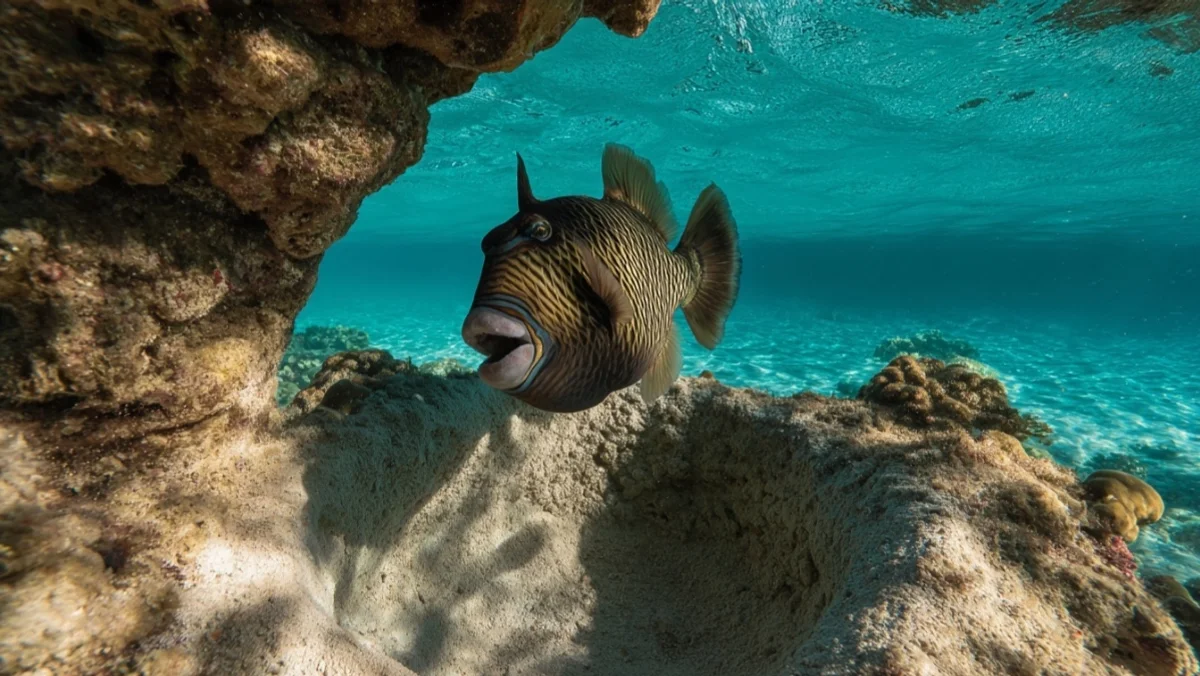
The charge starts from below — a flash of green-brown muscle, teeth bared, dorsal spine locked upright like a switchblade. Most divers freeze. Some kick upward. Both responses are wrong, and the fish knows it.
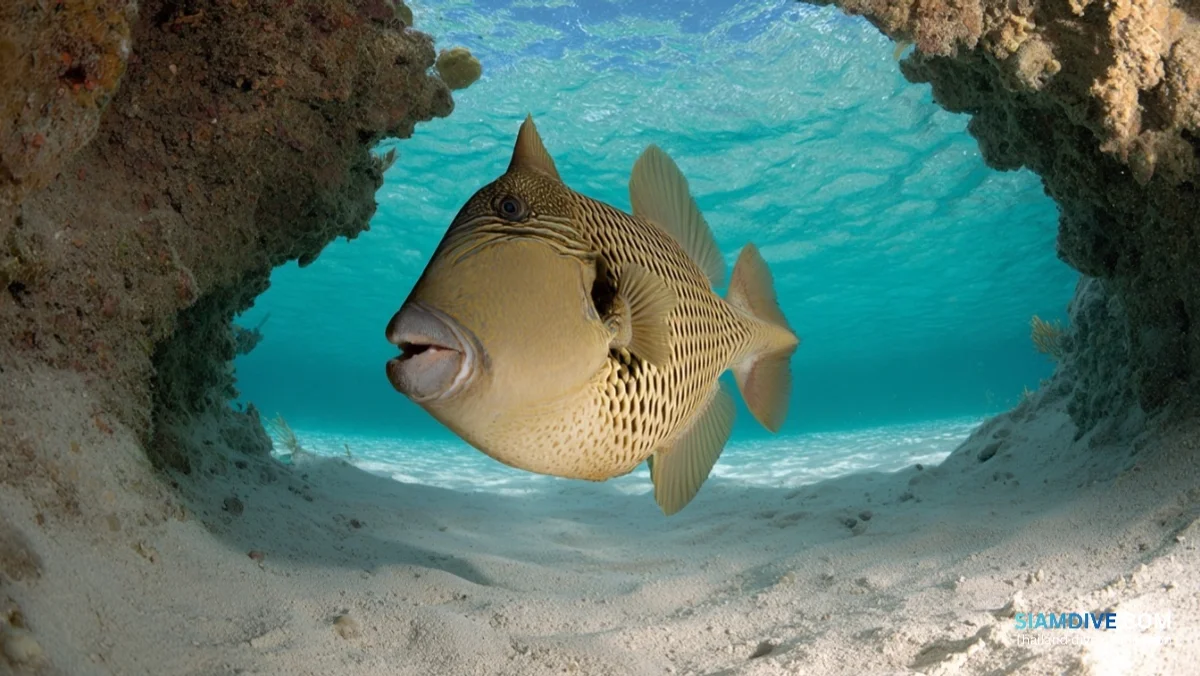
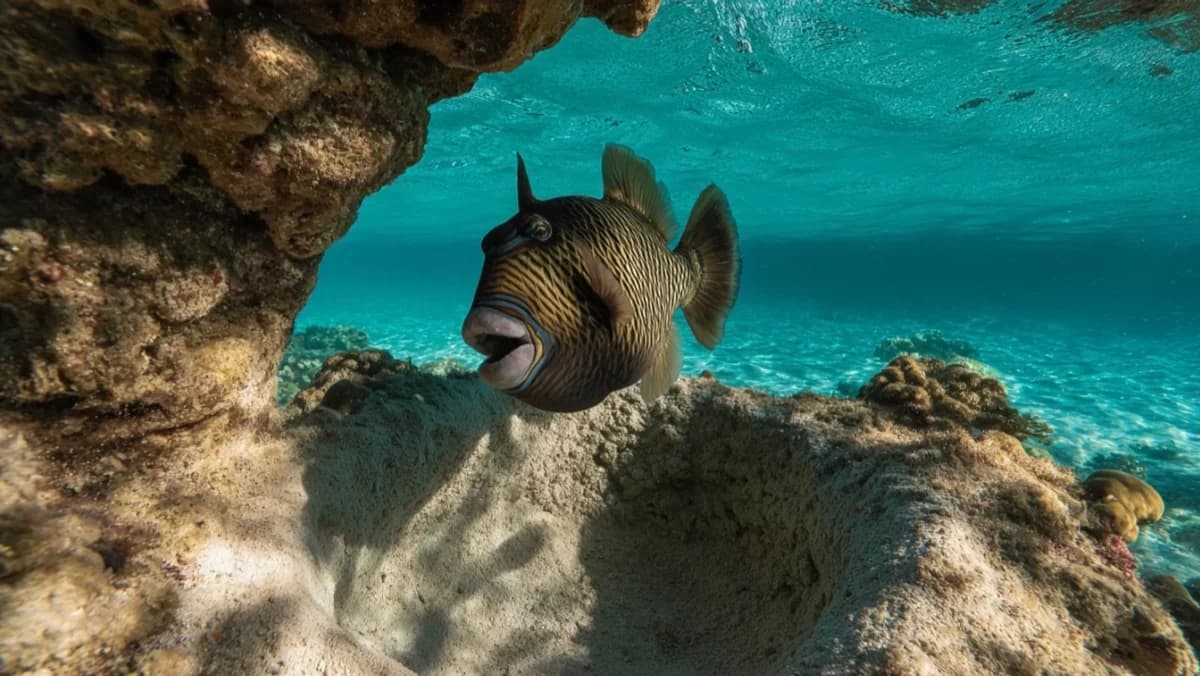
The titan triggerfish (Balistoides viridescens) is not Thailand's most venomous resident, nor its largest predator. But during nesting season, it may be the reef creature most likely to make physical contact with a diver. At up to 75 centimetres long and over 5 kilograms, this is not a fish that bluffs.
Teeth That Crack Sea Urchins Open Like Walnuts
Those jaws evolved for a specific job: crushing hard-shelled invertebrates. Sea urchins, crabs, tube worms, thick-shelled molluscs — the titan triggerfish handles them all with conical teeth backed by jaw muscles powerful enough to bite through coral rubble. On any given reef, you can hear them working before you see them. The crunch carries through water.
That same hardware makes a bite on human skin a serious wound. The teeth are not venomous, but they leave deep, ragged lacerations that bleed freely in saltwater. DAN classifies triggerfish bites alongside barracuda and moray eel injuries in their marine bite protocols — clean the wound aggressively with soap and water, flush with dilute hydrogen peroxide, and start antibiotics if medical care is more than twelve hours away.
But here is the part that reef ecologists want you to remember: those teeth also make titan triggerfish reef engineers. By controlling sea urchin populations, they prevent overgrazing of coral. Their constant digging aerates sand substrates and recycles nutrients. The fish that terrifies new divers is, quite literally, maintaining the reef they came to see.
February to April: When the Sand Gets Cleared
Nesting runs roughly from February through April across Thailand's reefs, though the timing is not fixed to a calendar. Titan triggerfish sync their reproductive cycles to the moon — spawning activity peaks in the days following either a full moon or a new moon, depending on the local population. Each cycle produces about a week of intense nesting behavior, then a lull, then another spike.
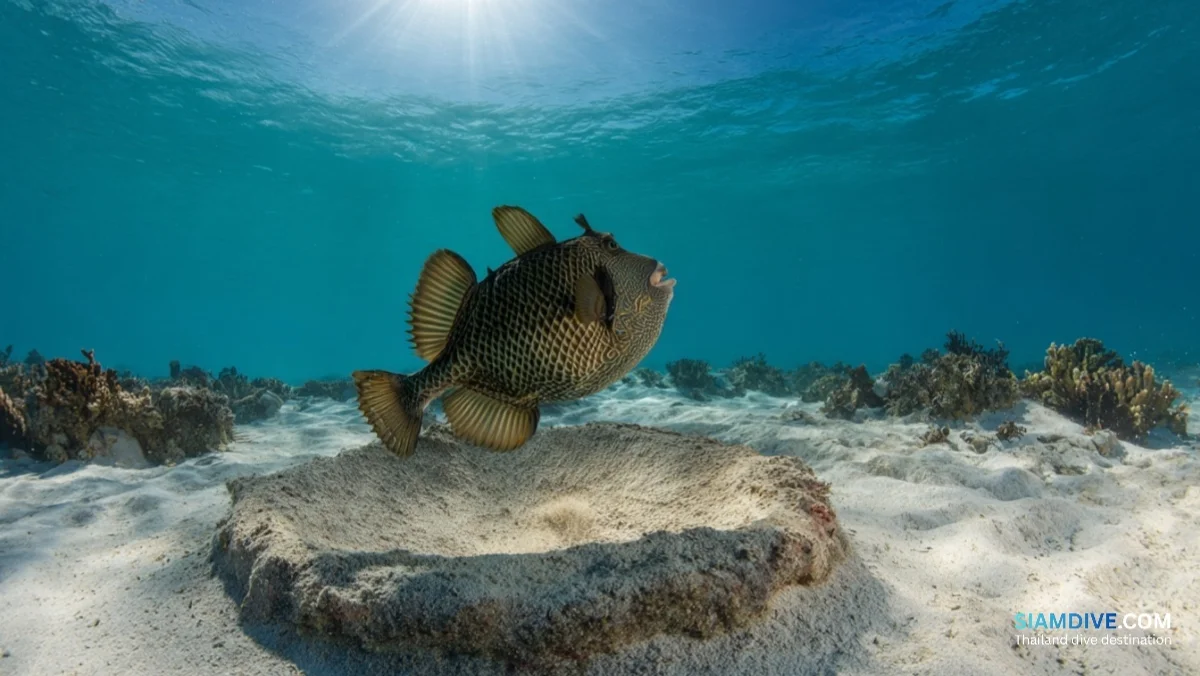
The nest itself is deceptively simple: a circular depression in sandy substrate, often at the base of a coral bommie or between rock formations. The female excavates it by blowing jets of water from her mouth, clearing debris until the sand is smooth. Eggs are laid in a thin layer across the bottom of this disc.
What happens next is a division of labour. The female stays directly over the nest, fanning the eggs with her pectoral fins to keep them oxygenated and free of sediment. The male patrols a wider perimeter — a secondary line of defence that serves as the first warning for approaching divers. When both adults are present, the male typically displays first; the female charges harder.
For divers, the problem is visibility. These nests sit in the kind of flat, unremarkable sand patches that nobody thinks twice about finning over. There is no sign, no colour change, no obvious marker — until the occupant decides you are too close.
An Inverted Cone With No Ceiling
The territory is not a circle. It is a cone — broad at the top, narrowing to a point at the nest on the seabed. Picture an ice-cream cone balanced upside-down, with the nest at the tip and the widest perimeter somewhere near the surface.
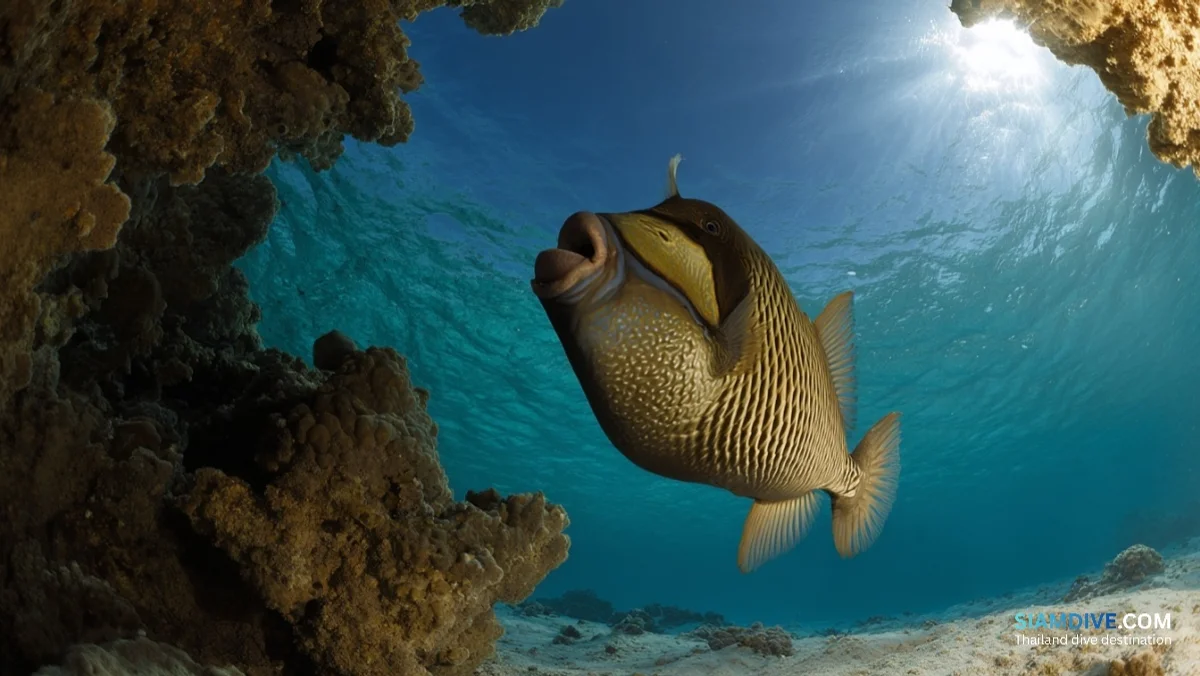
This geometry is why the most common instinct — swimming upward — is the worst possible escape. Every metre of ascent takes the diver deeper into the territory, not out of it. The fish does not lose interest. It escalates. Titan triggerfish have chased divers from reef level all the way to their safety stop at five metres, and sometimes beyond.
The correct response is horizontal. Swim sideways, parallel to the bottom, keeping an eye on the fish. Once outside the cone's radius — typically three to four metres from the nest's vertical axis — the aggression stops almost immediately. The fish turns, drops back to its station, and resumes guard duty as though nothing happened.
The cone dimensions vary by individual and nest stage. Freshly laid eggs produce the most aggressive defence — a territory that can extend well beyond four metres horizontally and ten metres vertically. Older clutches, closer to hatching, provoke slightly less intensity. But "slightly less" on a titan triggerfish scale remains more than enough to draw blood.
- Territory shape
- Inverted cone — widest at the surface, narrowing to the nest
- Effective radius
- 3–4 metres from the nest's vertical axis
- Escape direction
- Horizontal and away — never upward
- Guard behaviour duration
- ~1 week per lunar cycle during nesting months
The Warning You Get — and the One You Don't
A titan triggerfish broadcasts two clear threat signals before it charges. The first is the dorsal spine: a thick, rigid fin spine that locks upright when the fish feels threatened, like a dog raising its hackles. Divers who spot this have a few seconds to change course.
The second signal is stranger. The fish rolls onto its side, angling one eye upward to get a better look at the intruder overhead. This side-roll is often the last warning before a direct charge. If you see a titan triggerfish lying flat and staring at you with one eye, you are already inside the cone.
Not every encounter follows the script. Some individuals — particularly females guarding fresh eggs — skip the display entirely and charge on sight. Dive guides at Koh Tao's Green Rock, one of the Gulf's busiest nesting grounds, brief every group on triggerfish behaviour before descending during peak months. The site's shallow reef flats between 6 and 14 metres host multiple nesting pairs simultaneously.
Other triggerfish species share Thai reefs — the orange-lined and the yellowmargin are common — but none matches the titan's size or aggression during nesting. The clown triggerfish, popular with photographers for its bold patterning, tends to flee rather than fight. Only the titan consistently holds its ground against animals many times its size.
What to Do When the Fish Picks You
Step one: do not panic, and do not ascend. Controlled horizontal movement away from the nest is the only reliable strategy.
Step two: put your fins between you and the fish. Fins are large, hard, and expendable. A titan triggerfish biting a fin blade is a triggerfish not biting an ankle. Keep your legs oriented toward the animal as you kick sideways.
Step three: watch the fish, not the reef. Maintaining visual contact lets you track the exact moment aggression drops — typically a sharp turn and descent back toward the nest. That turn signals you have exited the cone.
- Do not touch the fish. Physical contact escalates aggression and provides no defensive advantage.
- Do not attempt to photograph the charge. Camera housings positioned in front of the face remove the fin barrier and expose hands and arms.
- Signal your buddy. A quick tank-tap alerts your dive partner to change course before they enter the same territory.
- Check behind you. Multiple nesting pairs can occupy adjacent patches — escaping one cone into another is a real possibility at high-density sites.
After the Bite: Clean Hard, Watch for Infection
Most triggerfish encounters end with nothing more than a racing heart. But when a bite does land, the wound demands immediate and thorough attention.
DAN's marine bite protocol is straightforward: scrub the wound vigorously with soap and water as soon as possible after exiting the water. Flush with a half-strength hydrogen peroxide solution, then rinse again with clean water. Apply antiseptic and a sterile dressing. The risk is not venom — it is marine bacteria, particularly Vibrio species, which thrive in warm tropical seawater and can cause severe infection within hours.
If a clinic or hospital is more than twelve hours away — a real scenario on remote liveaboard routes — DAN recommends starting a course of antibiotics such as ciprofloxacin or doxycycline while en route. Any bite that penetrates deeper than the skin surface, or any wound that shows redness, swelling, or pus within 24 hours, needs professional medical evaluation.
Where in Thailand You Are Most Likely to Be Charged
Every coral reef in Thai waters has titan triggerfish, but not every reef turns into a minefield during nesting. Density clusters at specific site types — shallow, sheltered flats with ample sand between coral formations:
- Green Rock, Koh Tao — shallow reef flats between 6 and 14 metres with multiple nesting pairs. One of the Gulf of Thailand's most reliable nesting aggregation sites. Dive briefings during March–April routinely include triggerfish warnings.
- White Rock, Koh Tao — broad sandy patches among coral heads at 8–16 metres. Encounters tend to happen in the shallower southern sections.
- Twin Pinnacles, Koh Tao — sandy flats between the two rock formations at 12–18 metres. Moderate nesting activity but less crowded than Green Rock.
- Similan Islands, Andaman Sea — coral gardens at sites like East of Eden and Breakfast Bend. The Similan season runs October to mid-May, overlapping fully with nesting months.
- Koh Phi Phi and Hin Daeng — Andaman reef flats host nesting pairs, though current-swept sites see less nesting than sheltered bays.
Instructors at popular training sites keep a mental map of active nests during peak months, adjusting routes mid-dive when a triggerfish's body language shifts. The fish move nest locations between lunar cycles, so yesterday's clear path may be today's cone.
April 2026 conditions in the Gulf remain warm — water temperatures around 29–30 °C with 10–15 metre visibility at Koh Tao. The Andaman season narrows through April as the southwest monsoon approaches, but the Similan Islands typically remain diveable through mid-May. For divers on Thai reefs right now, this is peak triggerfish alertness season: eggs are in the sand, lunar cycles are running, and the cones are active.
The Fish That Keeps the Reef Alive
It is easy to cast the titan triggerfish as a villain — the reef's bad-tempered bouncer, the fish that bites. But strip away the nesting-season drama and what remains is an animal essential to coral reef health. Without triggerfish controlling sea urchin numbers, reefs can tip into urchin barrens — overgrazed rubble fields where coral cannot recover. The sand-turning, shell-cracking, territory-clearing habits that make them a hazard to inattentive divers are the same behaviours that maintain the underwater landscapes divers cross oceans to see.
The practical takeaway is simple: give nesting triggerfish space, swim sideways when challenged, protect your extremities, and treat any bite wound seriously. The fish is not malicious. It is a parent defending a nest on a reef it helped build — and it has the jaw hardware to back up the threat.
For more on the extraordinary creatures sharing Thai reefs, read about the mantis shrimp's 1,500-newton strike, Koh Tao's weapon-stealing nudibranchs, or how to time a whale shark encounter at Richelieu Rock.