Nitrox Diving Guide: Benefits, Risks & MOD Explained
6 เมษายน 2569
Master Enriched Air Nitrox diving — understand MOD calculations, oxygen toxicity risks, EAN32 vs EAN36, and how Nitrox extends your bottom time safely.
Why Every Certified Diver Should Know About Nitrox
If you have been diving on regular air and doing multiple dives a day, you have probably noticed the fatigue that builds up after your third or fourth dive. You may have also watched your no-decompression limit (NDL) shrink on repetitive dives, forcing shorter bottom times just when the reef gets interesting. Enriched Air Nitrox (EANx) solves both problems by replacing some of the nitrogen in your breathing gas with extra oxygen — typically boosting the O2 content from air's 21% to 32% or 36%. The result is longer NDLs, shorter surface intervals, and less post-dive exhaustion. But Nitrox is not a magic gas. It introduces a new risk — oxygen toxicity — that every diver must understand before switching from air.
How Nitrox Works: The Science in Plain Language
Standard air is roughly 21% oxygen and 79% nitrogen. When you dive deeper, the partial pressure of both gases increases. Nitrogen is the culprit behind decompression sickness (DCS) and narcosis because your tissues absorb more of it under pressure. Nitrox reduces the nitrogen fraction — EAN32 contains 32% oxygen and only 68% nitrogen, while EAN36 has 36% oxygen and 64% nitrogen. Less nitrogen means your tissues absorb less on each dive, which directly translates to longer no-decompression limits. For example, at 30 meters on air your NDL might be around 20 minutes, but on EAN32 it extends to roughly 30 minutes — a 50% increase in usable bottom time. On repetitive dives the advantage compounds further because you start each subsequent dive with less residual nitrogen in your tissues.
EAN32 vs EAN36: Which Mix Should You Choose?
The two most common Nitrox blends are EAN32 (Nitrox 32) and EAN36 (Nitrox 36). The choice depends entirely on your planned dive depth:
- EAN32 (32% O2): Maximum Operating Depth (MOD) of approximately 33.7 meters at a PPO2 limit of 1.4 ATA. This is the most versatile mix — it covers the vast majority of recreational dive profiles and is the default Nitrox fill at most dive shops worldwide. Choose EAN32 for dives between 18-33 meters.
- EAN36 (36% O2): MOD of approximately 28.8 meters at 1.4 ATA PPO2. The higher oxygen content gives you even longer NDLs and faster nitrogen off-gassing, making it ideal for shallower repetitive dives — think reef diving at 15-25 meters across multiple dives per day. However, its shallower MOD means you cannot use it for deeper profiles.
A simple rule: if your dives stay above 28 meters, EAN36 gives you maximum benefit. If you regularly touch the 30-34 meter range, stick with EAN32.
Understanding MOD and Oxygen Toxicity
The Maximum Operating Depth (MOD) is the deepest you can safely go on a given Nitrox mix without exceeding your oxygen partial pressure limit. For recreational diving, the standard PPO2 limit is 1.4 ATA, with 1.6 ATA as the absolute contingency maximum. The formula is straightforward: MOD (in meters) = ((PPO2 limit / FO2) - 1) x 10. So for EAN32 at 1.4 ATA: ((1.4 / 0.32) - 1) x 10 = 33.7 meters. Exceeding your MOD exposes you to central nervous system (CNS) oxygen toxicity, which can cause convulsions, visual disturbances, nausea, twitching, and loss of consciousness — all of which are potentially fatal underwater. There are no reliable warning signs; a seizure can strike without any buildup. This is why analyzing your tank and setting your dive computer correctly before every single dive is non-negotiable. Never assume the fill is what you ordered — always verify with an oxygen analyzer.
Nitrox in Thailand: Availability and Cost
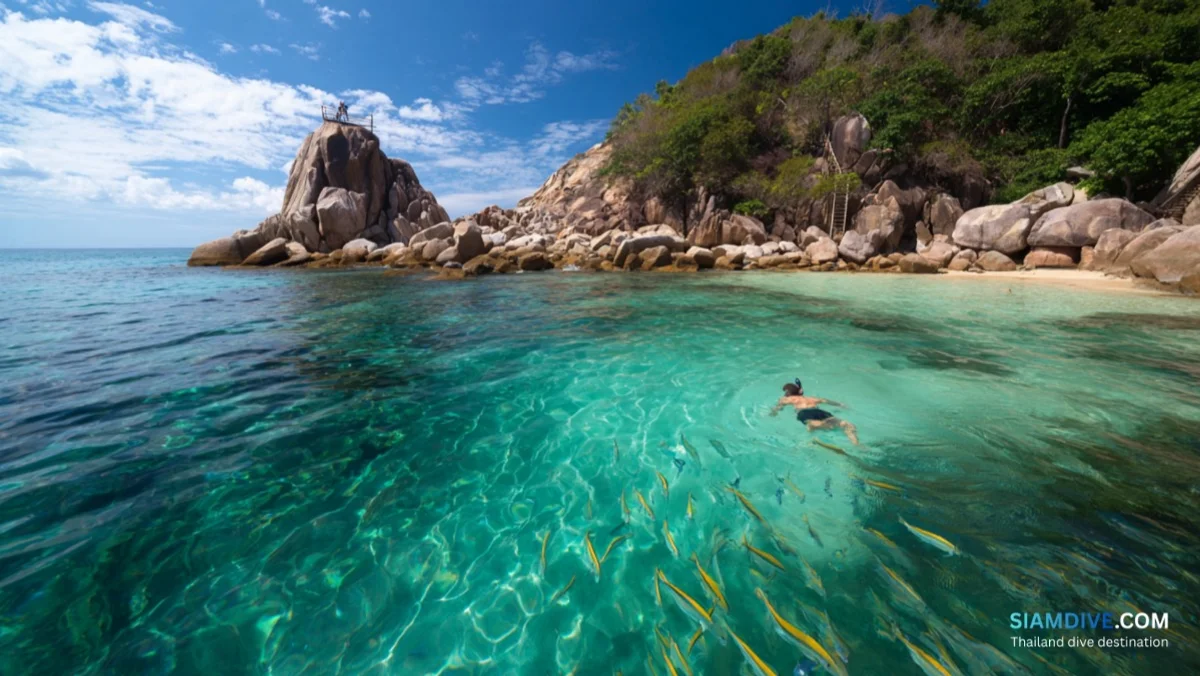
Nitrox fills are widely available across Thailand's major dive destinations. Koh Tao, Phuket, Koh Lanta, the Similan Islands liveaboards, and Koh Phi Phi all have dive operators offering EANx. Most shops charge an additional 100-200 THB per tank on top of the standard air fill price. Liveaboard operators in the Andaman Sea typically include Nitrox as a paid upgrade package for the entire trip. The two main certification agencies operating in Thailand — PADI and SSI — both offer Enriched Air Nitrox specialty courses. The SSI version tends to be slightly cheaper (around 10-20% less) and uses a digital app for theory, while PADI offers a more structured classroom approach. Both certifications are interchangeable and recognized worldwide. The course typically takes half a day to one day, covers gas analysis, MOD calculation, and dive planning with Nitrox tables or computers, and does not require any in-water training.
Practical Tips for Diving Nitrox
After years of diving Nitrox across Southeast Asia, here are the tips that matter most:
- Always analyze your tank: Use the shop's O2 analyzer before every dive. Write the mix, MOD, date, and your name on the tank tag. This takes 30 seconds and could save your life.
- Set your dive computer correctly: Switch your computer from Air mode to Nitrox mode and input the exact FO2 percentage. Forgetting this step means your computer calculates NDLs based on air, giving you shorter limits than necessary — or worse, you might accidentally exceed MOD without an alarm.
- Plan for the actual depth, not the planned depth: Currents, surge, and following a divemaster can push you deeper than intended. Build a buffer of at least 3 meters between your planned max depth and your MOD.
- Watch your CNS oxygen clock: On multi-dive days, oxygen exposure accumulates. Your dive computer tracks this as a CNS% — keep it well below 80% across all dives in a day.
- Nitrox does not let you go deeper: A common misconception. Nitrox lets you stay longer at moderate depths, but your MOD is actually shallower than on air. Never use Nitrox as a reason to push deeper.
- Hydrate and rest: Nitrox reduces nitrogen loading but does not eliminate it. Good hydration and adequate surface intervals remain essential for safe diving.
When to Dive Nitrox vs Air
Nitrox shines in specific scenarios. Multi-dive days at moderate depths (15-30 meters) are the sweet spot — you will notice significantly longer NDLs on your second and third dives when your dive buddies on air are already running short. Liveaboard trips where you do 3-4 dives per day for multiple days are where Nitrox delivers its greatest value, as the reduced nitrogen loading also means less cumulative fatigue. Photography dives where you need maximum bottom time to get the shot are another excellent use case. However, for single shallow dives under 18 meters, the benefit is minimal and the extra cost may not be justified. And for any dive below 40 meters, Nitrox is not appropriate — you need trimix or heliox, which require separate technical diving certification.
Final Thoughts
Enriched Air Nitrox is arguably the single most useful specialty certification a recreational diver can get. It extends your bottom time, reduces fatigue, adds a safety margin against DCS, and opens up the full potential of multi-dive days and liveaboard trips. The course is short, affordable, and requires no additional dives — just knowledge. But that knowledge is critical: understanding MOD, PPO2 limits, and the reality of oxygen toxicity is what separates a safe Nitrox diver from a dangerous one. If you are planning your next dive trip in Thailand, consider getting Nitrox certified before you go. Your dive computer — and your body — will thank you. Explore Nitrox-ready dive operators and liveaboards at siamdive.com.