Octopus Intelligence: The Smartest Creature Underwater
14 เมษายน 2569
Octopuses have 500 million neurons, use tools, recognize faces, and change color in milliseconds. Here is why divers never forget their first encounter.
Why Octopuses Are the Ocean's Most Fascinating Creatures
Of all the animals you might encounter on a dive, the octopus is the one most likely to look back at you and actually seem interested. An octopus has roughly 500 million neurons — about the same as a dog — and two-thirds of those neurons sit not in its brain but distributed across its eight arms. Each arm can taste, touch, and make decisions semi-independently. An octopus is a decentralized intelligence wrapped in soft tissue.
Three hearts pump blue blood colored by hemocyanin, a copper-based molecule that carries oxygen more efficiently than hemoglobin in cold water. The systemic heart actually stops when the octopus swims, which is why they prefer crawling. And the evolutionary timeline is staggering: octopuses split from our vertebrate lineage roughly 600 million years ago. Their intelligence evolved completely independently from ours. When you lock eyes with one on a night dive, you are looking at a mind that took a radically different path to awareness — and arrived somewhere strangely familiar.
Problem-Solving That Rivals Primates
In labs, octopuses unscrew jars from the inside, navigate mazes after a single attempt, and escape from secure tanks with alarming regularity. But what they do in the wild may be more impressive — nobody hands them puzzles, so they invent their own solutions.
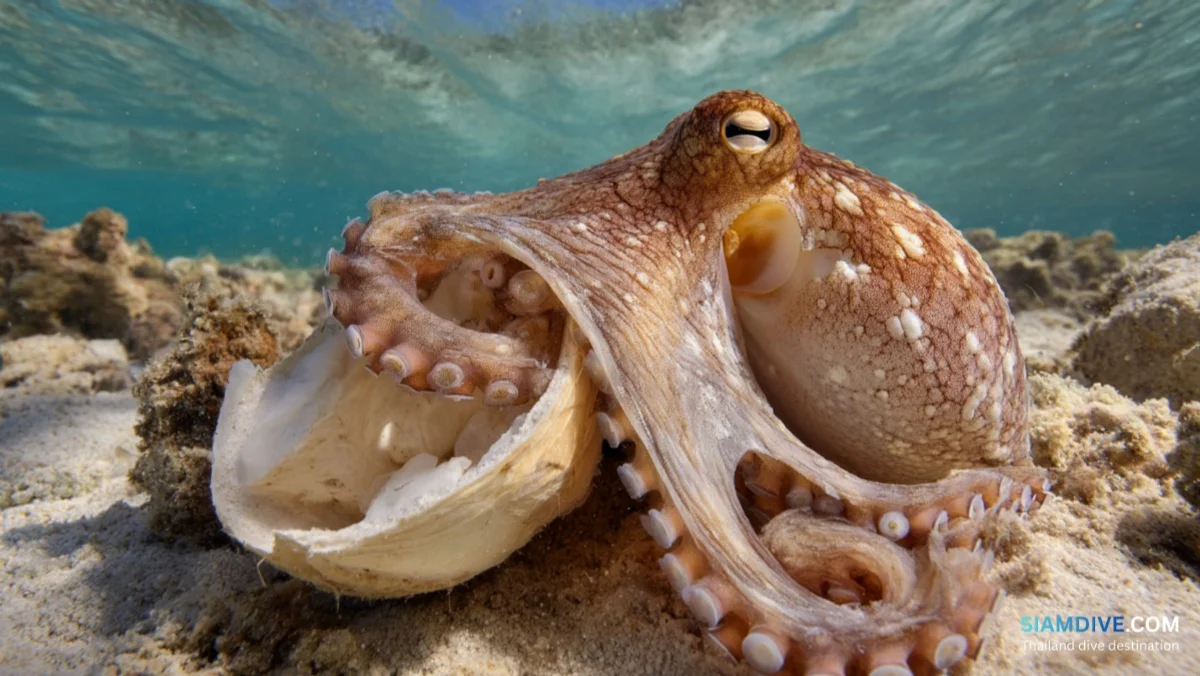
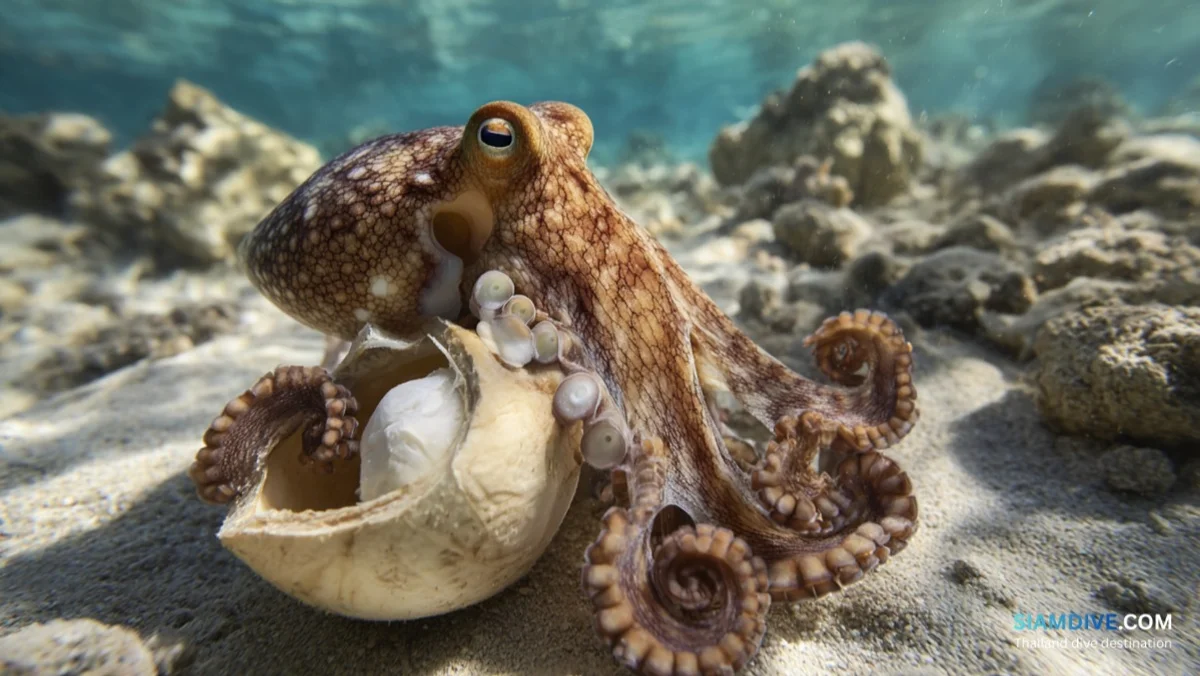
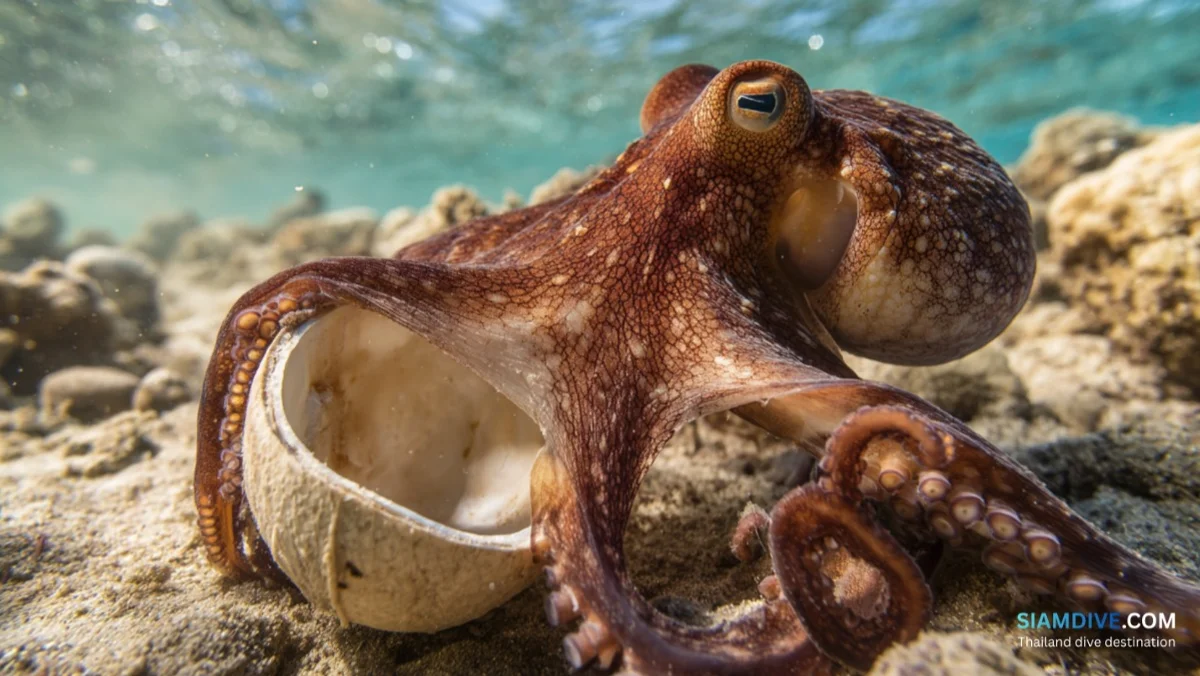
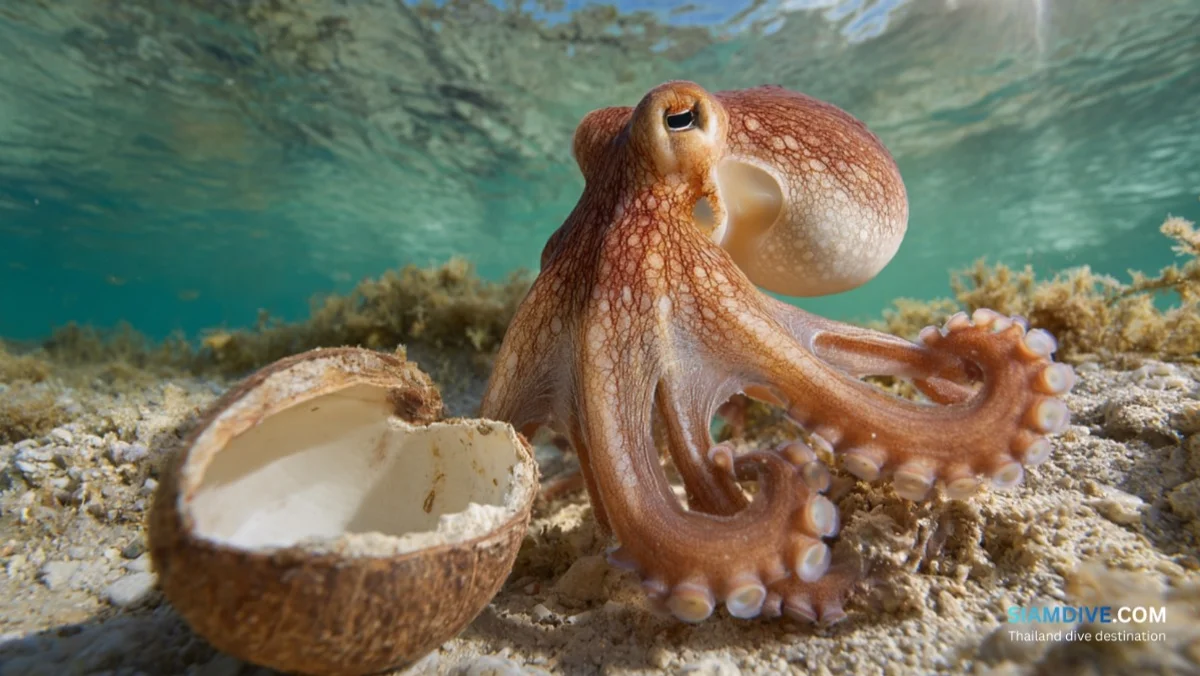
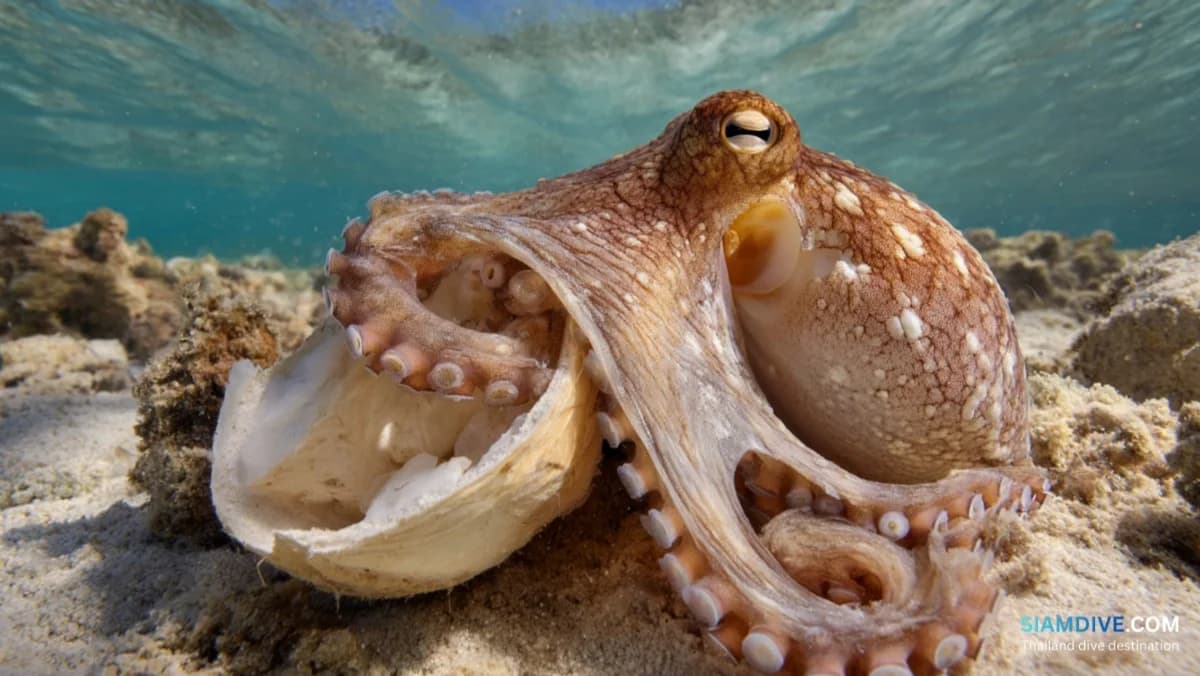
The coconut octopus (Amphioctopus marginatus) carries discarded coconut shell halves across the seafloor, then assembles them into shelter later. Published in Current Biology in 2009, this was one of the first documented cases of tool use in any invertebrate. The behavior requires planning: picking up shells at a cost to mobility, then deploying them when needed. That is forethought, not reflex.
Other species barricade den entrances with rocks, pulling the door shut behind them. Some have been observed wielding Portuguese man o' war tentacles as weapons — ripping off the stinging arms and brandishing them at predators. Different individuals in different locations invent different solutions to similar problems, which is one of the hallmarks of genuine intelligence.
Masters of Disguise: Camouflage and Color Change
Every diver has stared at a patch of reef and watched part of it move. The mechanism behind octopus camouflage relies on chromatophores — tiny pigment-filled sacs controlled by muscles and nerves. An octopus can change the color, pattern, and texture of its skin in as little as 200 milliseconds. Some species raise bumps called papillae to mimic three-dimensional texture, blending in even from the side.
The puzzling part: octopuses are technically colorblind, with only one type of photoreceptor. Yet they match colors with extraordinary precision. One hypothesis is that their skin contains opsins — the same light-sensitive proteins found in eyes — so they may literally perceive light through their whole body.
Then there is the mimic octopus (Thaumoctopus mimicus), which impersonates other animals entirely: flatfish, lionfish, sea snakes, jellyfish, and more. Researchers have documented it mimicking 8 to 14 species, choosing which impression to deploy based on the specific predator threatening it. A flatfish shape scares off damselfish; a lionfish display deters larger hunters. That is situational decision-making at speed.
Personality, Memory, and Individual Recognition
Octopuses have personalities — studied and documented at institutions including the Seattle Aquarium. Individual animals show consistent bold or shy traits stable over time, which is the scientific definition of personality.
More striking: they recognize individual humans. In lab settings, octopuses treated differently by two researchers in identical uniforms learned to distinguish between them. They would approach the friendly keeper and jet water at the one they disliked. They remember specific faces and assign specific reactions.
They also play. Octopuses in aquariums repeatedly push objects into water currents and catch them, with no food reward. Play is a marker of cognitive complexity, and octopuses are among the very few invertebrates that demonstrate it. They remember solutions to problems for months, and keepers report that octopuses who have not seen a particular person in weeks still react specifically upon reunion.
Species Divers Encounter in Thailand
The coconut octopus (Amphioctopus marginatus) is the crowd favorite. Found on sandy bottoms throughout the Gulf and Andaman Sea, this small day-active species tolerates divers remarkably well. Watch for it walking bipedally on two arms while clutching a coconut shell shelter with the other six.
The blue-ringed octopus (Hapalochlaena spp.) measures just 5 to 20 centimeters but carries tetrodotoxin — roughly 1,000 times more potent than cyanide — with no antivenom available. You will most likely spot it on night dives in rubble areas. The iridescent blue rings flash as a warning display. Do not touch. Admire from a safe distance, take your photo, move on.
The day octopus (Octopus cyanea) is the bold hunter on daytime reef dives, often 30 to 60 centimeters across, flushing prey by spreading its web over coral heads in a technique called "web over" hunting.
The mimic octopus (Thaumoctopus mimicus) has been confirmed in the Andaman Sea, with sightings around Richelieu Rock and sandy areas near the Similans. Encounters are uncommon but real — if you see a small octopus on sand doing impressions of other animals, stay still and enjoy one of the rarest behavioral displays in the ocean.
How to Spot and Observe Octopuses on a Dive
Most divers swim right past octopuses. The trick is not where to look but how. Slow down, then slow down more. Scan rubble fields, sandy patches between coral heads, and reef edges. Look for color that does not quite match the substrate, or a texture that shifts when you move. The rhythmic expansion of a breathing mantle can give them away.
Check crevices in the reef. A pile of empty crab and clam shells outside a hole is a classic sign of an octopus den — they discard meal remains like room service trays in a hallway. Look for an eye in the darkness.
Once spotted, give it 5 to 10 minutes. Approach slowly from the side, settle at 1 to 2 meters, and avoid sudden movements or fin kicks near the bottom. Signs of stress include rapid color flashing (especially going white), inking, jetting away, or pulling into a tight ball. If you see any of these, back off. The best encounters happen when the octopus decides you are boring and goes back to being itself.
Photography Tips and Ethical Interaction
A macro lens in the 60mm to 105mm range is ideal, giving enough working distance to capture sucker detail and those extraordinary eyes without crowding the subject. Shoot from the side or slightly below at eye level — position yourself and let the animal turn toward you naturally.
For blue-ringed octopuses, skip the strobe if possible. Their rings fluoresce brilliantly under UV or blue light with a yellow filter. A strobe blast stresses the animal and flattens the natural color display.
The ethics are non-negotiable. Never touch an octopus. Never move one for a photo, chase one into the open, or corner it against reef. Maintain about 1 meter minimum and let the animal set the terms. If it moves away, let it go. If it approaches — which they sometimes do — stay still and enjoy the moment.
For rare sightings like mimics or unusual blue-rings, report to Reef Check Thailand or iNaturalist with location, depth, date, and photos. Citizen science data from divers is genuinely valuable for tracking species distribution in Thai waters.
Why Divers Fall in Love With Octopuses
There is something about an octopus encounter that sticks with you in a way sharks and mantas do not always manage. Maybe it is the eye contact — the unmistakable sense that the animal is assessing you just as much as you are watching it. No two encounters play out the same way because no two octopuses behave the same way. One might ignore you entirely. The next might reach out a curious arm. The one after that might change color six times in thirty seconds just because it can.
What hooks divers is the connection across a 600-million-year evolutionary gap. Everything about the octopus's intelligence evolved on a completely separate track from mammalian cognition. When it looks at you and seems to think, that is convergent evolution producing awareness through an entirely different architecture. It is humbling in the best possible way.
Thailand offers some of the best octopus diving in Southeast Asia. Muck sites in the Gulf deliver coconut octopuses reliably. Night dives around Koh Tao and Koh Lanta turn up blue-rings for those who look carefully. Richelieu Rock offers the slim but real chance of a mimic sighting. And on virtually any reef dive, day octopuses hunt in plain sight if you know how to watch. All you need is patience, respect, and ten minutes on a reef while something with eight arms and three hearts decides what to make of you. Plan your next dive at siamdive.com — and keep your eyes on the rubble.