2 Threads Apart: Why DIN Divers Won't Switch Back
30 เมษายน 2569
Two extra threads and a captured o-ring separate yoke from DIN. A step-by-step walkthrough of the connection detail Thai dive shops rarely explain.
A brass thread catches on the second turn. The diver at the Khao Lak fill station pauses, backs off, realigns, and screws the first stage in again — five clean rotations until the o-ring seats. Next to her, another diver jams a yoke clamp over an identical tank, tightens the handwheel in three seconds flat, and walks toward the boat. Both regulators will deliver air at depth. One connection, though, is engineered to survive what the other cannot.
What’s Screwed Into Your First Stage Right Now?
Every scuba regulator connects to a cylinder through one of two systems. The yoke — also called an A-clamp or international fitting — drops a horseshoe-shaped frame over the tank valve, pushes a pin into a dimple on the valve’s back, and tightens with a handwheel. The o-ring sits exposed on the cylinder valve pillar, sandwiched between metal faces when the clamp compresses.
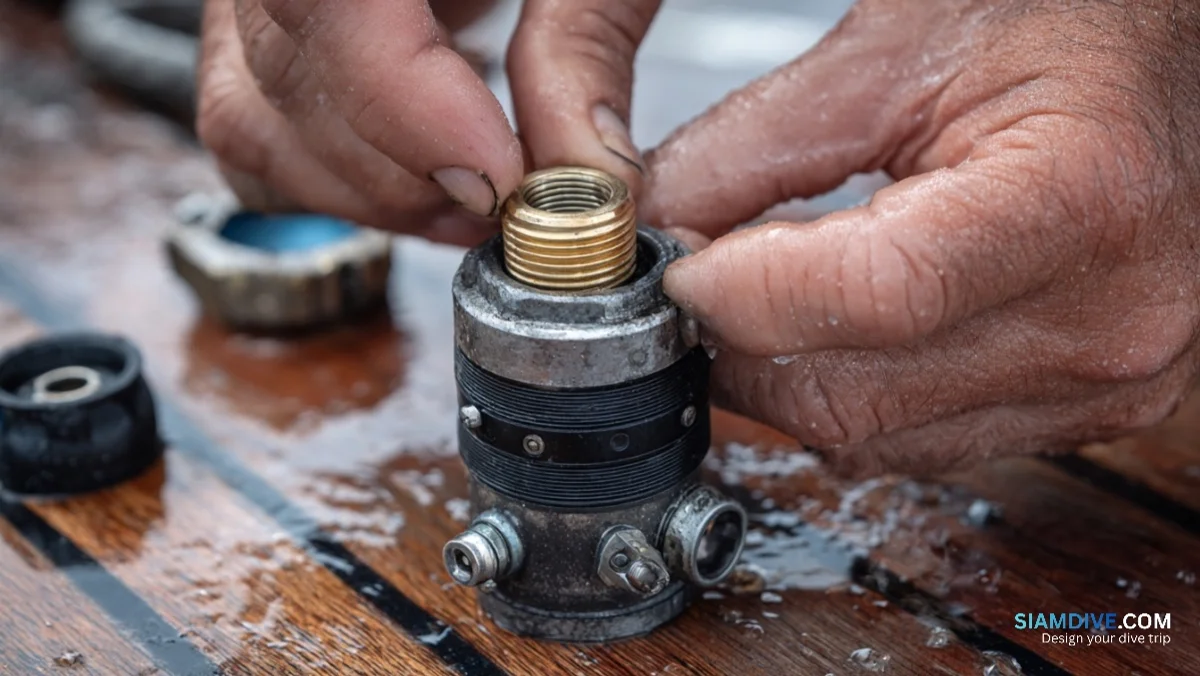
DIN — short for Deutsches Institut für Normung, the German industrial standards body — takes the opposite approach. A threaded male fitting on the first stage screws directly into the tank valve. The o-ring rides inside a groove on the regulator itself, protected on all sides by metal until the moment it seats against the valve’s internal bore.
Pick up your first stage right now. If you see a threaded post with a visible o-ring recessed in a groove, you have DIN. If you see a flat face with a round port and a yoke clamp arching over it, you have yoke. That single difference — where the seal lives and how it is held — drives every other advantage and limitation of each system.
Five Threads, Seven Threads, 68 Bar of Difference
DIN fittings come in two pressure ratings hidden inside their thread count. A 200-bar DIN connector has five threads. A 300-bar connector has seven. Both use the same M26 × 2 thread pitch — the difference is how far the fitting sinks into the valve.
Those extra two threads on a 300-bar fitting are not there for a stronger grip. They are a mechanical lockout. A five-thread first stage runs out of thread before the o-ring reaches the seal face inside a 300-bar valve. It simply will not seat. The mismatch prevents a regulator rated for 200 bar from ever connecting to a tank filled to 300 — no electronics, no warning sticker, just metal refusing metal.
- Yoke / A-clamp
- Maximum rated pressure: 232 bar (3,365 psi). No thread engagement — clamp pressure only.
- DIN 200 bar
- Maximum rated pressure: 200 bar (2,900 psi). Five-thread engagement.
- DIN 300 bar
- Maximum rated pressure: 300 bar (4,351 psi). Seven-thread engagement.
The gas math makes the point concrete. A 12-litre steel tank filled to 300 bar holds 3,600 litres of breathing gas. A standard 15-litre aluminium tank on a yoke valve, capped at 232 bar, holds 3,480 litres. The DIN tank is smaller, lighter on the boat, and carries more air. For a diver logging deeper profiles where gas planning tightens, that 120-litre margin is not academic.
Where the O-Ring Actually Lives
Pressure ratings tell half the story. The other half sits in a rubber ring smaller than a ten-baht coin.
On a yoke setup, the o-ring occupies a groove cut into the cylinder valve pillar — exposed to sand, salt spray, gear-bag friction, and every bump between the fill station and the dive deck. When the yoke clamp compresses the first stage against the valve, it squeezes the o-ring between two flat metal faces. A nick, a grain of sand, or a dry spot on the rubber, and the seal leaks. Sometimes slowly enough to notice on the surface; sometimes fast enough to end a dive at depth.
On a DIN fitting, the o-ring sits inside the threaded post of the first stage, recessed in a groove surrounded by metal. It does not touch the outside world until the post threads fully into the valve and the o-ring meets the internal bore face. Salt, sand, and clumsy handling hit brass threads — not the seal.
DAN’s technical article on DIN connections describes the captured o-ring as a design that reduces extrusion failures — events where pressurised gas pushes a damaged o-ring out of its groove and into the gap between mating surfaces. Consistent reports across diving forums log extrusion incidents almost exclusively on yoke setups, where the exposed position leaves the o-ring vulnerable to the very force it is meant to contain.
None of this means yoke is dangerous. Millions of yoke dives happen safely every season across every tropical dive destination on the planet. The system works under normal conditions. DIN works better under the conditions that test a regulator most.
Recreational, Technical, or Somewhere in Between?
The question is not which system passes a lab test. It is which one fits the diving you do right now — and the diving you plan to do next year.
- Recreational warm-water, single tank, ≤ 30 m — Yoke handles this cleanly. Every rental tank from Koh Tao to the Maldives ships with a yoke valve. No adapter, no thread-counting, no compatibility friction.
- Advanced recreational, own gear, 30–40 m, travel — A convertible DIN first stage with a yoke adapter gives the widest range. Dive DIN when the shop has DIN tanks; spin on the adapter when it does not.
- Technical diving, doubles, stages, trimix, > 40 m — DIN is non-negotiable. Manifold blocks for twin sets are machined for DIN. Stage regulators are DIN. Instructors in GUE, IANTD, and TDI programmes expect it on day one.
- Cold water below 10 °C — DIN with an environmentally sealed first stage. The captured o-ring removes a freezing point that yoke leaves exposed to ambient water temperature.
The Tank You’ll Get at a Thai Dive Shop
Ask for a tank anywhere from Khao Lak to Koh Lipe, and nine times out of ten the valve on top is yoke. Thailand’s recreational diving infrastructure runs on aluminium 80-cubic-foot cylinders with yoke K-valves — the same default as the Caribbean, most of Australia, and the bulk of Southeast Asia.
DIN tanks are not absent, just tucked behind the counter. Shops running tec programmes keep steel 12-litre and 15-litre cylinders with DIN or convertible valves. Liveaboard operators that market to European and technical divers stock a mix, and a polite email before the trip usually confirms availability. Day-trip boats serving Open Water students — where the volume is — almost never carry DIN.
That gap is why the majority of European divers — who learn on DIN because it dominates the Red Sea, the Mediterranean, and northern European cold-water sites — carry a DIN-to-yoke adapter in their save-a-dive kit when they fly to Thailand. The adapter weighs under 200 grams and fits in a BCD pocket. Brass spin-on models run between 1,800 and 2,500 baht at gear shops in Phuket, Koh Tao, and Bangkok, or USD 25–45 from international online retailers.
Adapters, Inserts, and the Conversion Walkthrough
Three paths exist for making DIN and yoke coexist. Each has a catch worth knowing before the dive.
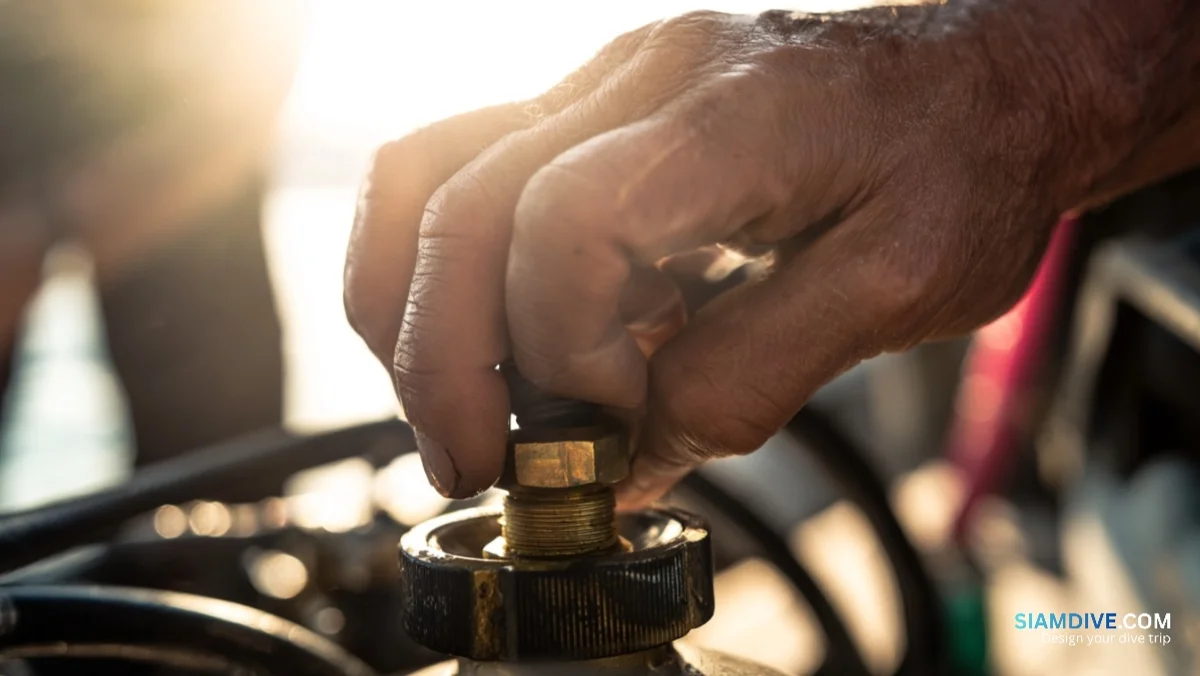
Path 1 — DIN-to-yoke spin-on adapter. The most common workaround. A brass housing screws onto the DIN first stage’s threaded post and converts it into a yoke-compatible fitting. The correct sequence — skipped more often than followed:
- Thread the adapter onto the tank’s K-valve first. Hand-tight plus a quarter turn.
- Screw the DIN first stage into the adapter until the o-ring seats.
- After the dive, remove the DIN first stage first. Cap the DIN fitting with its dust cap.
- Remove the adapter from the tank.
- Never leave the adapter permanently attached to the first stage. Brass against brass under salt exposure seizes over time. Penetrating oil and pliers become necessary — and neither is gentle on precision threads.
Path 2 — Valve insert swap (tank-side). Some cylinder valves accept a removable insert that converts the valve itself. An allen key removes the yoke insert; a DIN insert threads into the same housing. This converts the tank, not the regulator. The limitation: inserts exist for 200-bar DIN conversions. For 300-bar DIN, the valve body is rarely deep enough to accommodate seven threads. Full 300-bar DIN requires a native DIN valve.
Path 3 — Convertible first stage. Apeks, Scubapro, Aqualung, Atomic, and most mid-range and premium brands offer first stages that ship with both DIN and yoke fittings. The body is machined for DIN; a bolt-on yoke adapter kit — usually included or under USD 30 — adds the A-clamp when needed. For a diver buying a first regulator set in Thailand, this is the path with the fewest long-term compromises.
The Inspection Habit Worth Starting
Both connections share the same failure mode: a bad o-ring. The difference is how early you catch it.
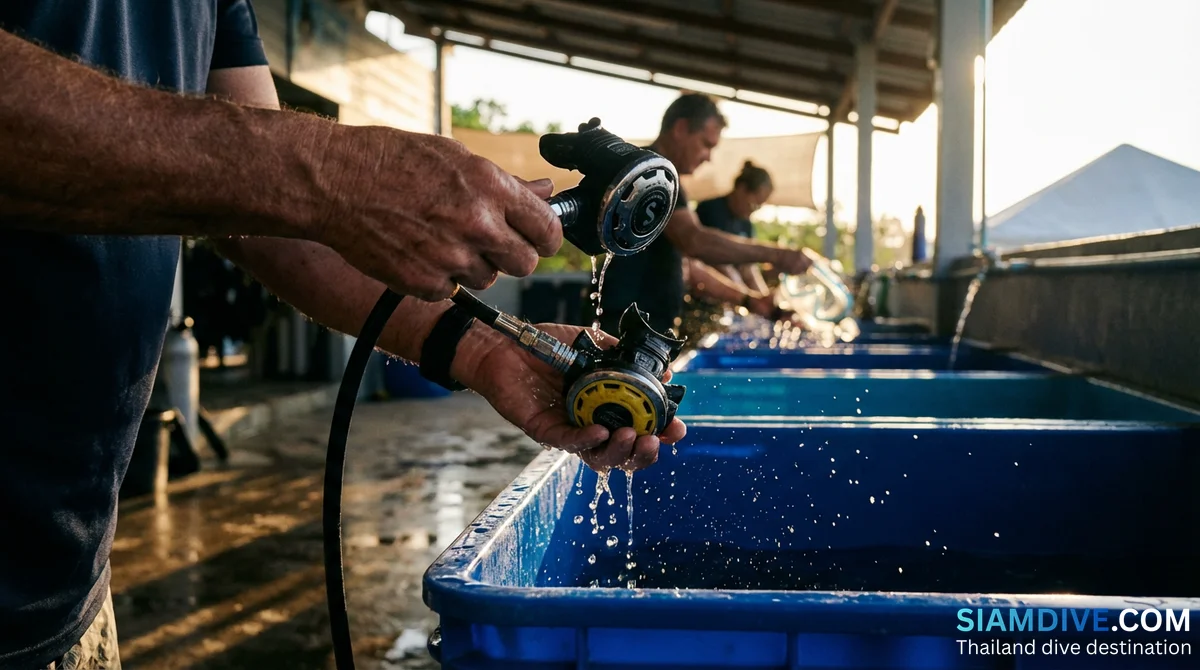
On DIN, inspect the o-ring every time you unscrew the first stage. It sits in a groove you can see, touch, and assess in seconds. Look for cracks, flat spots, swelling, and grit embedded in the rubber. Replace the o-ring annually or whenever it shows deformation — replacement rings cost under 50 baht and weigh nothing in a save-a-dive kit.
On yoke, inspect the tank valve o-ring before every dive. Most shops replace tank o-rings on a schedule, but “on a schedule” varies from daily to quarterly depending on the operation. A dry, cracked, or misshapen o-ring is a five-second fix with a spare — if you carry one.
A timely reminder: Huish Outdoors confirmed in early 2026 that its Hollis 200LX second stage — sold in both DIN and yoke configurations — has an internal component susceptible to fracture if the unit is dropped on the inhalation knob. No failures during active dives have been reported, but repairs are expected to begin in May 2026. The issue sits in the second stage, not the first-stage connection, but it underscores a wider point: regulator maintenance does not stop at the valve interface.
Two Threads, One Decision
A first stage lasts a decade with proper service intervals. The DIN-or-yoke choice made at the shop counter follows a diver through hundreds of logged dives and dozens of destinations.
For a diver doing Open Water courses and resort diving in warm water, yoke is practical, universal in the tropics, and requires zero adapters. It is the path of least friction.
For a diver heading toward deeper profiles, own-gear ownership, cold water, or any path that leads past 40 metres, DIN earns its extra setup time. Two more threads, a captured o-ring, and 68 additional bar of rated pressure add up to a connection built for the scenarios where “good enough” is not the standard you want between you and your gas supply.
The smartest first purchase: a convertible DIN first stage, a yoke adapter in the save-a-dive kit, and the habit of checking the o-ring before every single dive.