Why a Bigger Mask Bruises Your Face Below 10 Metres
28 เมษายน 2569
At 10 metres your mask air halves. A high-volume frame pulls harder on capillaries than a low-volume one — here is the physics, the injury, and the gear fix.
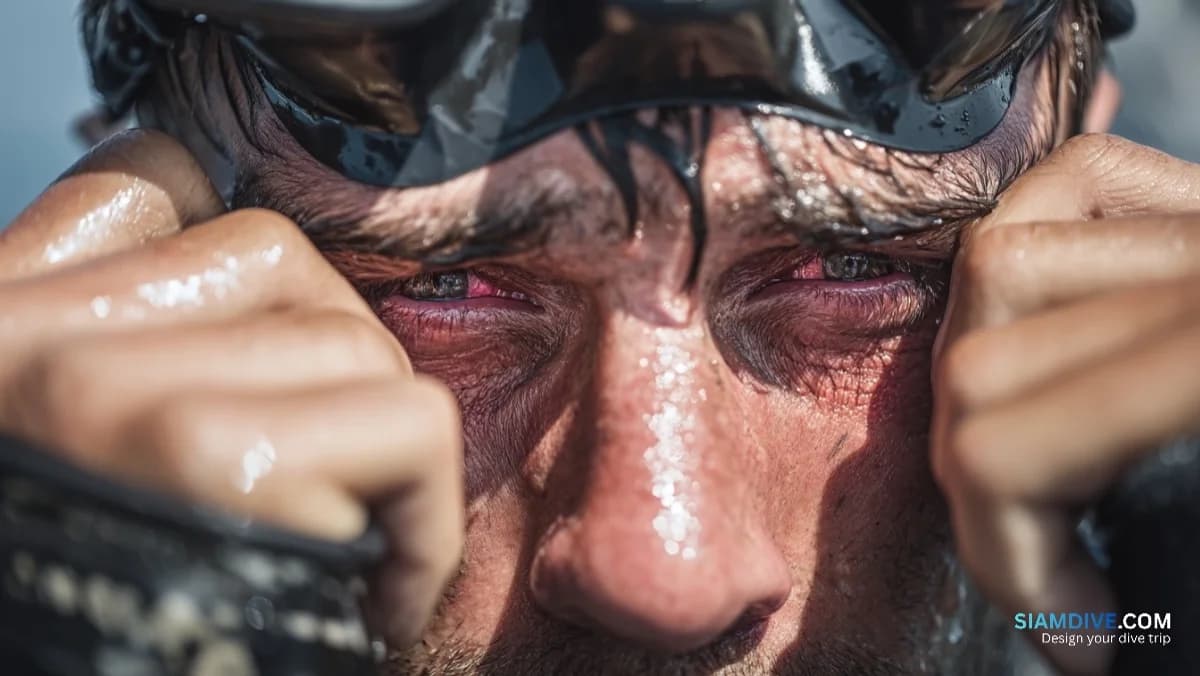
Two black eyes after a single training dive. No collision, no surge, no reef strike — just a mask that held too much air and a diver who forgot to breathe out through the nose. The condition is mask squeeze, and the physics behind it are as precise as they are unforgiving: lose track of pressure for a few seconds on descent, and Boyle's Law turns your faceplate into a suction cup pressed against orbital tissue.
This comparison breaks down how different mask designs — low-volume frameless, standard framed, and full-face — handle that pressure gap, and why the mask sitting in your gear bag may be working against you every time equalization slips.
What Happens Inside the Mask at Depth
Every 10 metres of seawater adds one atmosphere of pressure. At the surface, the air space in your mask sits at 1 ATA. At 10 metres, ambient pressure doubles to 2 ATA, and Boyle's Law (P₁V₁ = P₂V₂) compresses that pocket of trapped air to half its original volume. At 20 metres, it shrinks to a third. At 30 metres, a quarter.
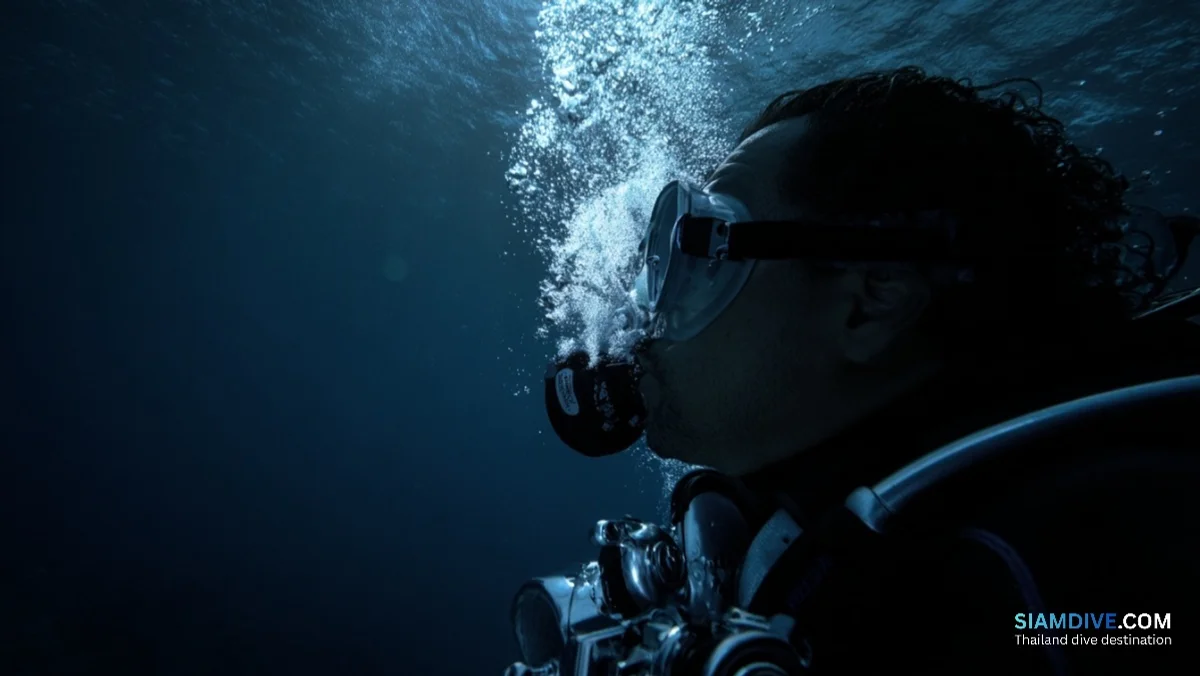
The mask skirt is flexible, but not infinitely so. As the trapped air shrinks, the skirt pulls inward against your face, and the rigid lens frame acts like a gasket — transferring the entire pressure differential onto soft tissue around your eyes, cheeks, and forehead. Exhale through your nose, adding air back into the mask, and the pressure equalizes instantly. Skip it, and the vacuum deepens with every metre of descent.
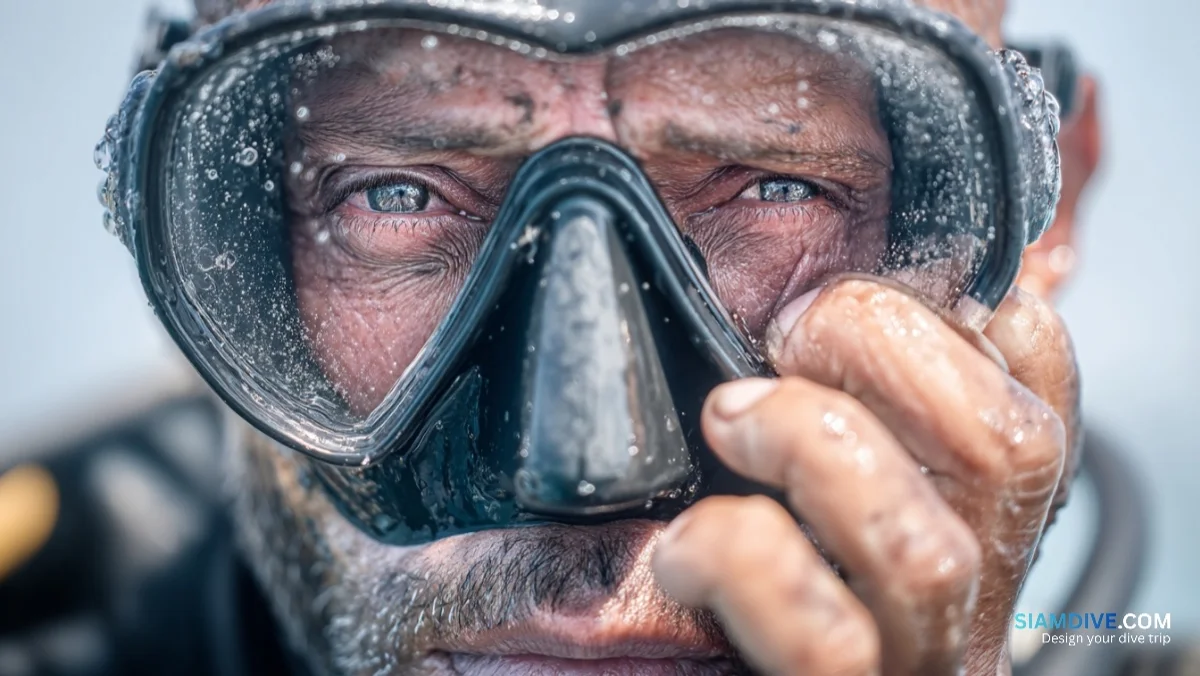
A standard twin-lens framed mask holds roughly 200–280 ml of internal air. A low-volume frameless mask holds 100–160 ml. That gap is not cosmetic. At 10 metres, the higher-volume mask needs substantially more exhaled air to equalize, and the suction force ramps up faster if equalization is delayed even briefly. The first 10 metres are the most punishing — half the total air volume disappears here, compared to only 17 percentage points between 10 and 20 metres.
- Surface (1 ATA)
- Mask air at full volume — no suction force
- 10 m (2 ATA)
- Air compressed to 50% — moderate pull on soft tissue if not equalized
- 20 m (3 ATA)
- Air at 33% — strong suction, capillary stress begins
- 30 m (4 ATA)
- Air at 25% — high risk of subconjunctival hemorrhage
The Injury Nobody Expects on a Checkout Dive
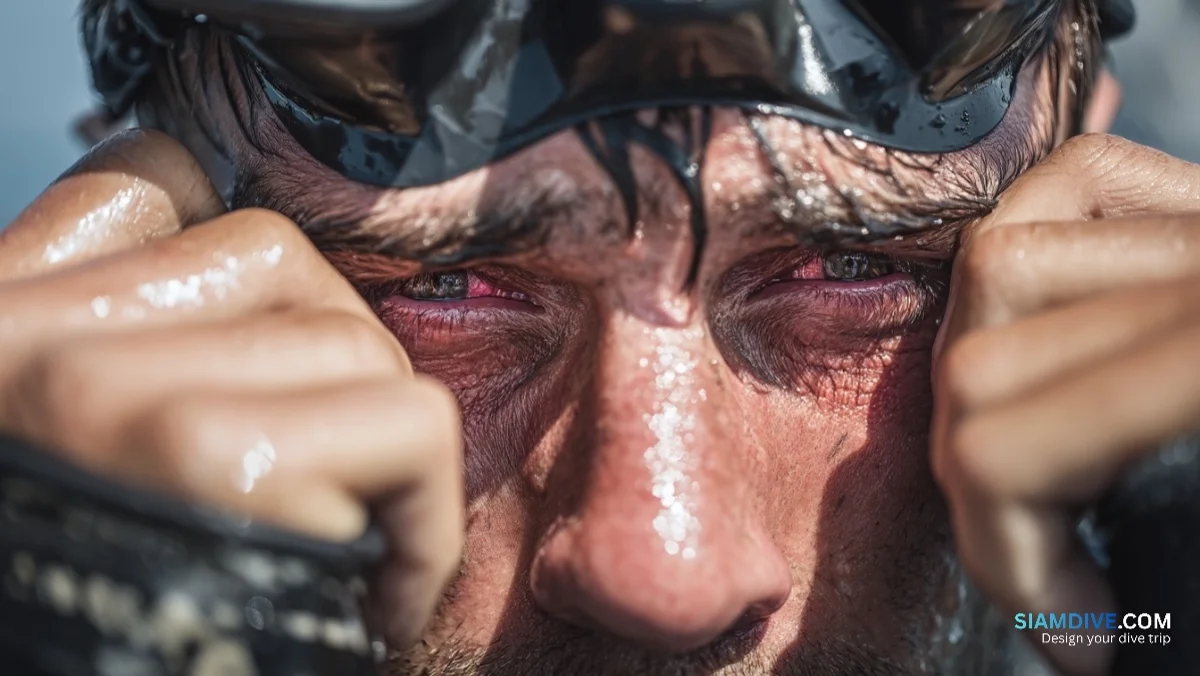
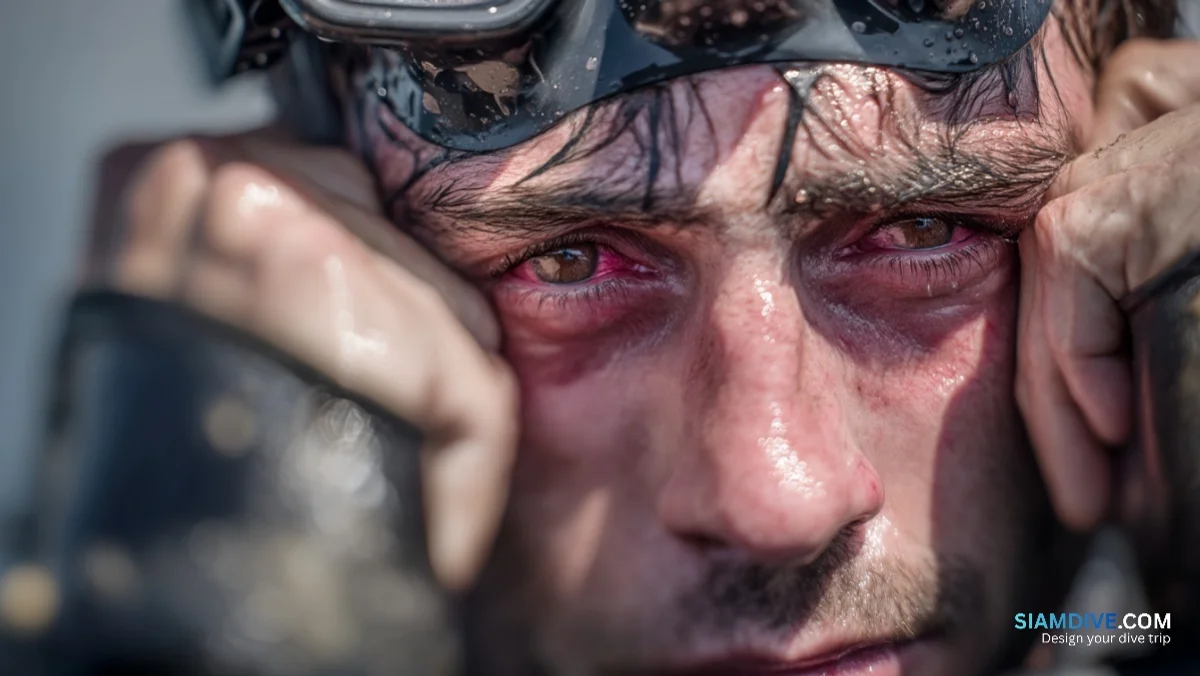
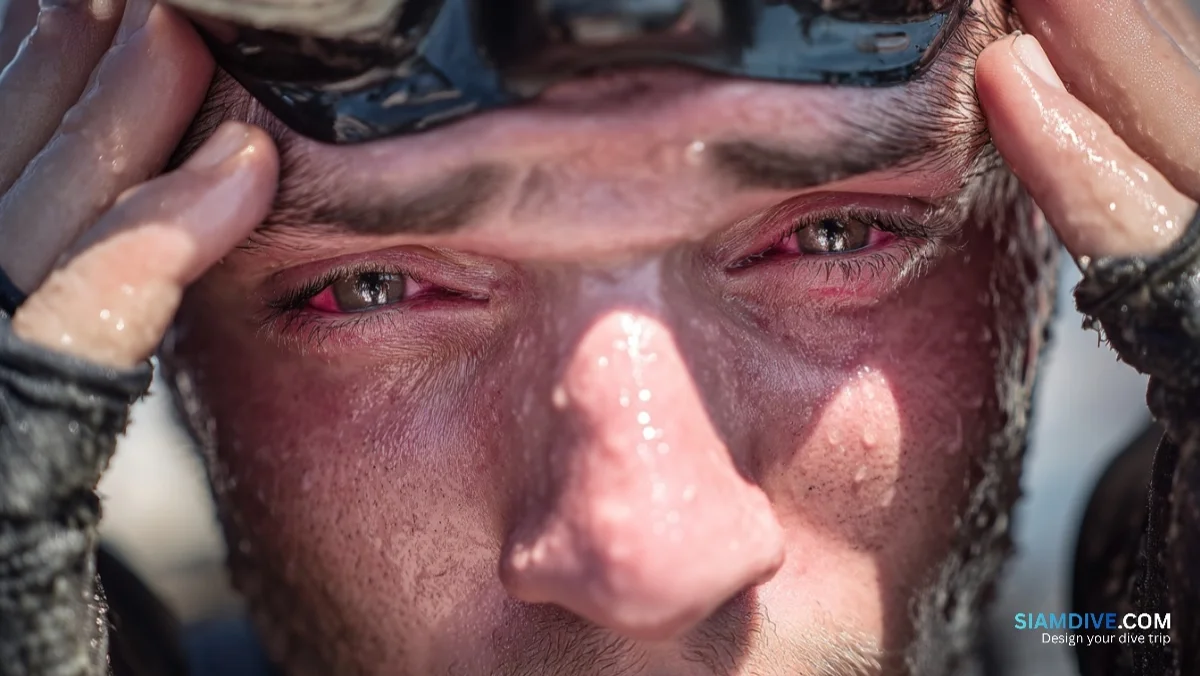
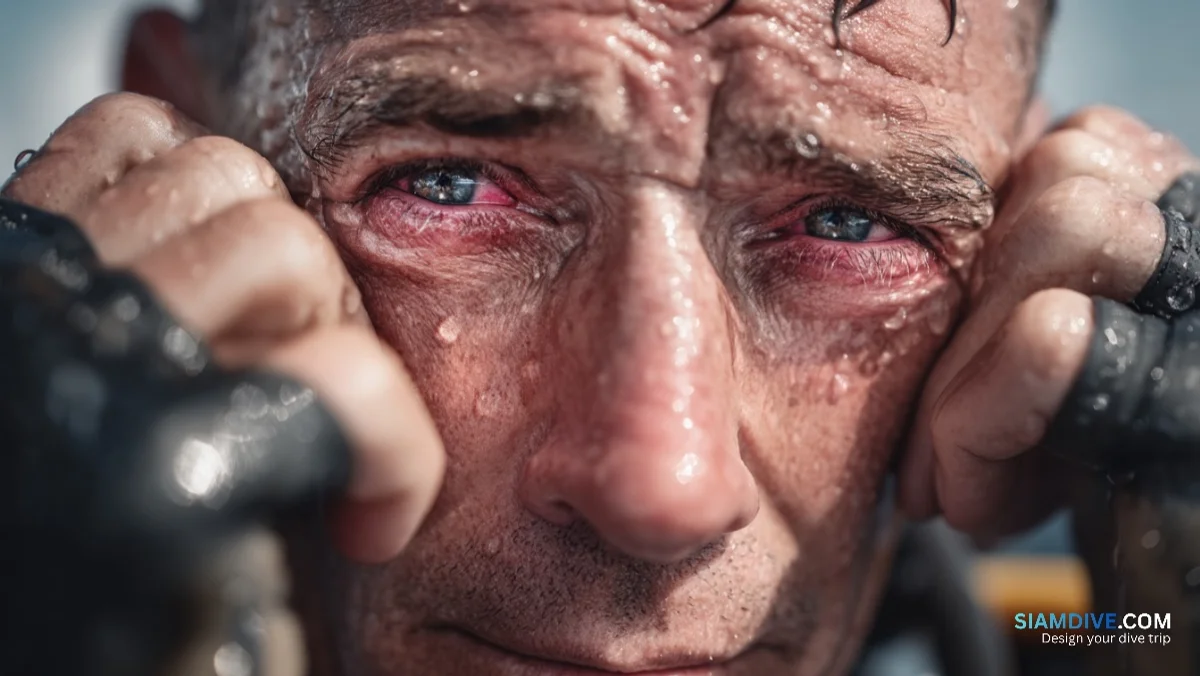
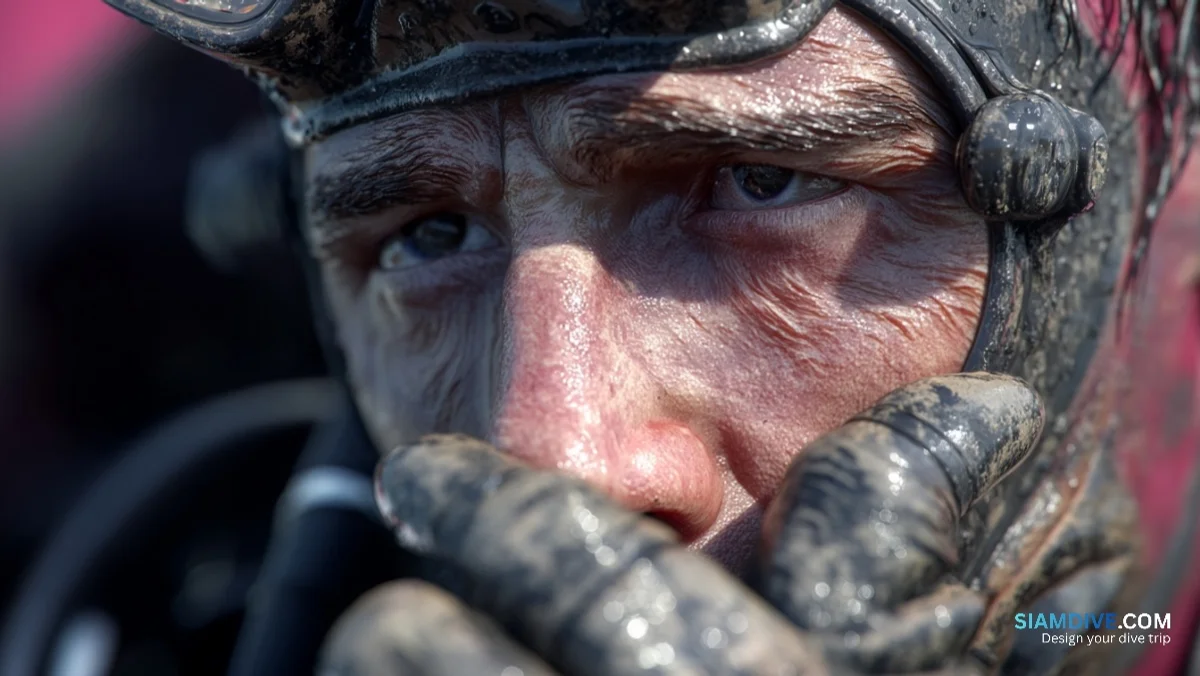
Mask squeeze shows up as periorbital petechiae — pinpoint red dots from ruptured capillaries around the eyes. In moderate cases, the whites of the eyes flood red with subconjunctival hemorrhage. Severe squeeze produces ecchymosis: deep purple bruising spreading across both eye sockets. Divers and ER doctors alike call the result raccoon eyes.
The primary risk factor is inexperience, though StatPearls (NCBI) also flags high-internal-volume masks and any mask that does not cover the nose — swim goggles and snorkel masks being the worst offenders. Recovery is straightforward but slow: cold compresses, no rubbing, patience. DAN notes that bruising typically takes up to two weeks to reabsorb completely. Divers with recent eye surgery or pre-existing glaucoma face elevated risk because the tissue is already compromised.
The clinical presentation fools emergency physicians more often than you might expect. A forensic case published in Cureus in 2025 documented a recreational diver in his twenties who lost consciousness at roughly 20 metres. His periorbital bruising triggered a blunt-force trauma investigation — until dive footage confirmed a solo descent and autopsy established that the facial injuries preceded drowning, caused entirely by mask squeeze during an uncontrolled sink. The case has since entered forensic medicine curricula as a reference for distinguishing pressure injury from impact trauma.
Low Volume vs. High Volume: Squeeze by the Numbers
Once you understand the mechanics, gear selection becomes partly a medical decision. The internal volume of a dive mask determines three things: how fast the vacuum builds, how much air you spend to equalize, and how much margin you have if you miss a beat during descent.
- Low-volume frameless (100–160 ml) — One small nose exhale every 3–5 metres keeps pace with compression. The skirt sits closer to the face, spreading suction load evenly across a wider area of silicone. If equalization lapses for a few seconds, the pressure differential stays manageable — there is simply less air to compress.
- Standard framed (200–280 ml) — Needs a longer or more forceful exhale to equalize the same depth change. The rigid frame concentrates force on the orbital rim rather than distributing it across the skirt. A missed equalization at 15 metres creates noticeably more pull than the same lapse in a low-volume mask.
- Full-face mask (400–600+ ml) — Equalization is continuous because the diver breathes through the nose naturally, which sounds ideal until the regulator free-flows or the diver switches to mouth-only breathing. The massive air space then flips from advantage to liability. Professional training and full-face certification are non-negotiable.
Freediving instructors have long preferred low-volume masks because every millilitre of exhaled air costs buoyancy and bottom time. For recreational scuba divers the benefit is different — it is not about conserving air but about softening the consequence of a lapse. Every diver forgets to equalize the mask at some point. The question is how much tissue damage that lapse causes before correction.
Three Masks, Three Risk Profiles
Pick up three masks at a dive counter in Khao Lak or Koh Tao and you are holding three different squeeze equations. Specifications rarely list internal volume in millilitres — manufacturers prefer vague terms like "low profile" or "wide field." The figures below come from independent displacement measurements and gear reviews published in early 2026.
- Cressi F1 (~120 ml, frameless, single lens) — Among the lowest internal volumes in any recreational mask. The flexible silicone skirt wraps close to the face, and the single tempered-glass lens eliminates the nose bridge that splits vision in twin-lens designs. Equalization effort: one light puff every 5 metres. The trade-off is slightly narrower peripheral vision. Approximate price in Thailand: 1,200–1,800 THB.
- Aqualung Plazma (~140 ml, frameless, twin lens) — Engineered pressure-reduction zones in the silicone skirt distribute suction load across a wider surface instead of concentrating it on the orbital ridge. Slightly higher volume than the F1, but the skirt geometry compensates. Equalization effort: moderate. Price: 3,500–4,500 THB.
- Mares X-Vision (~240 ml, framed, twin lens) — Dual teardrop tempered-glass lenses behind a rigid frame deliver wide peripheral vision — arguably the best sightlines of the three. But the frame transfers pressure loads directly to the orbital ridge, and the higher volume demands more deliberate equalization on descent. If your technique is consistent, this mask rewards you with superior reef views. Price: 2,500–3,500 THB.
None of these masks are dangerous when used correctly. The difference lies in the margin for error. The Cressi F1 gives the longest grace period when attention drifts to a current change, a buddy signal, or a camera setup. The Mares X-Vision demands more discipline but pays back in peripheral vision. Knowing your own equalization consistency is the honest way to choose between them.
The One-Second Fix That Stops the Squeeze
Every time you pinch your nose and blow to equalize your ears, exhale a small puff into the mask. One motion, two pressure problems solved. PADI folds this into ear-equalization training, though the mask part often gets lost in the noise of a busy Open Water course.
- First 10 metres on the line — Equalize ears and mask together every 1–2 metres. The greatest volume change happens in the shallowest water: 50% compression by 10 metres versus only an additional 17% between 10 and 20. Front-load your equalization effort where it matters most.
- Free descent without a line — Without a reference to control speed, equalization falls behind fast. Descend feet-first if possible — the position keeps nasal passages aligned for easier exhale and slows your drop rate naturally.
- Pressure building on the face — Stop. Exhale firmly through the nose. The skirt should lift slightly off your skin. If it does not, the seal may be blocked by hair, a hood fold, or dried silicone. Break the bottom seal, let a small amount of water in, reposition, and try again.
Overtightening the mask strap is the most common amplifier. A tight strap does not improve the seal — water pressure alone pushes silicone against your face. What overtightening does is stiffen the skirt, making it harder for a nose exhale to lift it. That means more effort per equalization and faster squeeze buildup when effort falls short. The test: place the mask on your face without the strap and inhale gently through your nose. If it holds by suction alone, the fit is correct.
When to Abort the Descent
Mask squeeze starts as tightness, not pain. The mask presses in more firmly than depth alone would explain. Experienced divers describe the sensation as the mask "locking onto" the face. By the time genuine discomfort arrives, capillaries are already under stress.
- Equalization fails to relieve the pressure — Signal your buddy, hold depth, and try again. If a second attempt does not work, ascend to a shallower point where the differential eases. Do not push deeper hoping it resolves on its own.
- Congestion or a blocked nose — If nasal airflow is restricted before the dive, stay on the boat. Decongestants wear off unpredictably at depth, and a half-blocked passage turns mask equalization into a coin flip. This scenario catches experienced divers most often: ear equalization may still work fine while the mask goes unattended.
- Untested mask on a deep dive — Every mask has different skirt geometry, volume, and strap tension characteristics. Never take new equipment below 18 metres without a shallow checkout first. Five minutes at 5 metres reveals equalization quirks before they matter.
Surface with red eyes or periorbital spotting? The dive day is over. Apply cold compresses, avoid rubbing, and watch for vision changes over 48 hours. Blurred vision or increasing pain means a dive medicine physician — DAN's emergency hotline operates around the clock.
Depth carries other risks that compound when a diver is already managing an equipment issue. Narcosis at 30 metres slows the very reflexes needed to solve a squeeze problem, and a surface current after ascent can escalate a minor injury into a stressful recovery. Small gear oversights stack — a single failed O-ring is another example of one cheap component ruining an entire dive day.
Match the Mask to Your Equalization Habit
The honest question is not "which mask is best" but "how reliable is your equalization routine." A diver who consistently equalizes every 2–3 metres can safely use any mask on the market — high volume, low volume, framed, frameless — because the vacuum never forms. The Mares X-Vision's wider field of view then becomes a genuine advantage with zero downside.
For newer divers, or anyone whose equalization is still becoming automatic, a low-volume frameless mask is insurance. The Cressi F1 and Aqualung Plazma both reduce the penalty for a lapse without requiring any extra thought. Once equalization is habit — something your body does the way it breathes — switch to whatever mask suits your face shape and dive style.
Whichever mask you choose, buoyancy control remains the enabler. A diver who drops too fast outruns their equalization rhythm, whether the mask holds 120 ml or 280. Controlled descent rate is the first line of defence; mask volume is the second.