Why Your OW Buoyancy Skills Barely Count After Card Day
26 เมษายน 2569
Your Open Water card proves you can equalise and breathe. It says nothing about hovering hands-free at 18 metres — that takes a progression most divers skip.
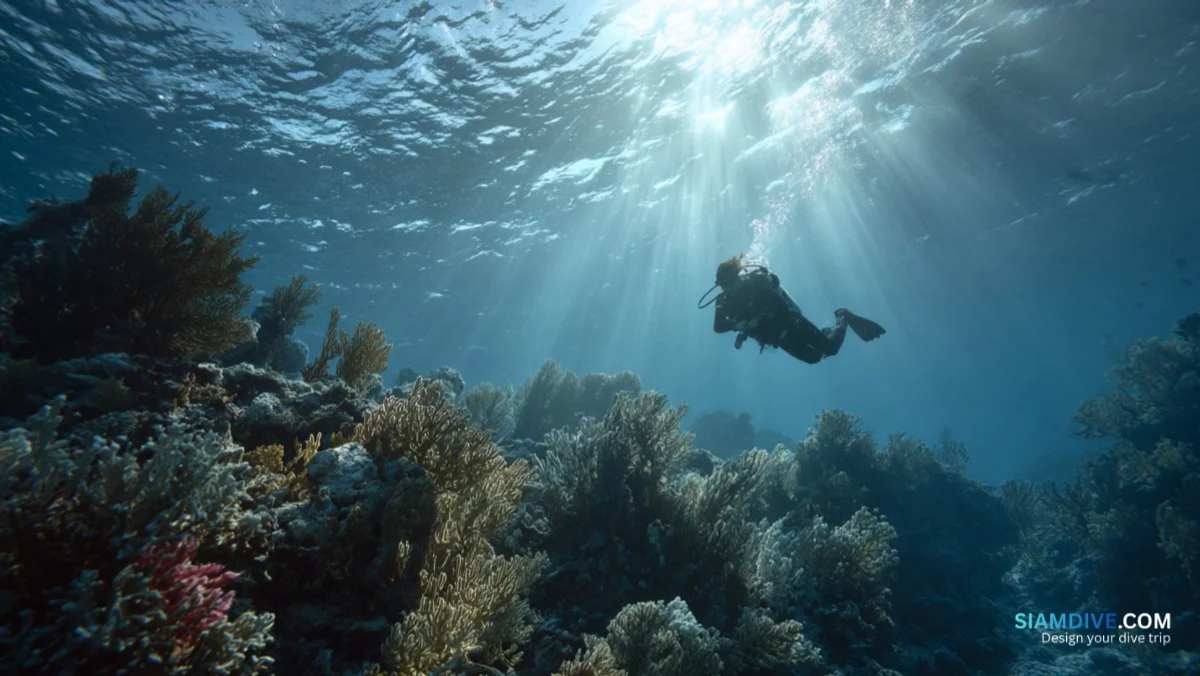
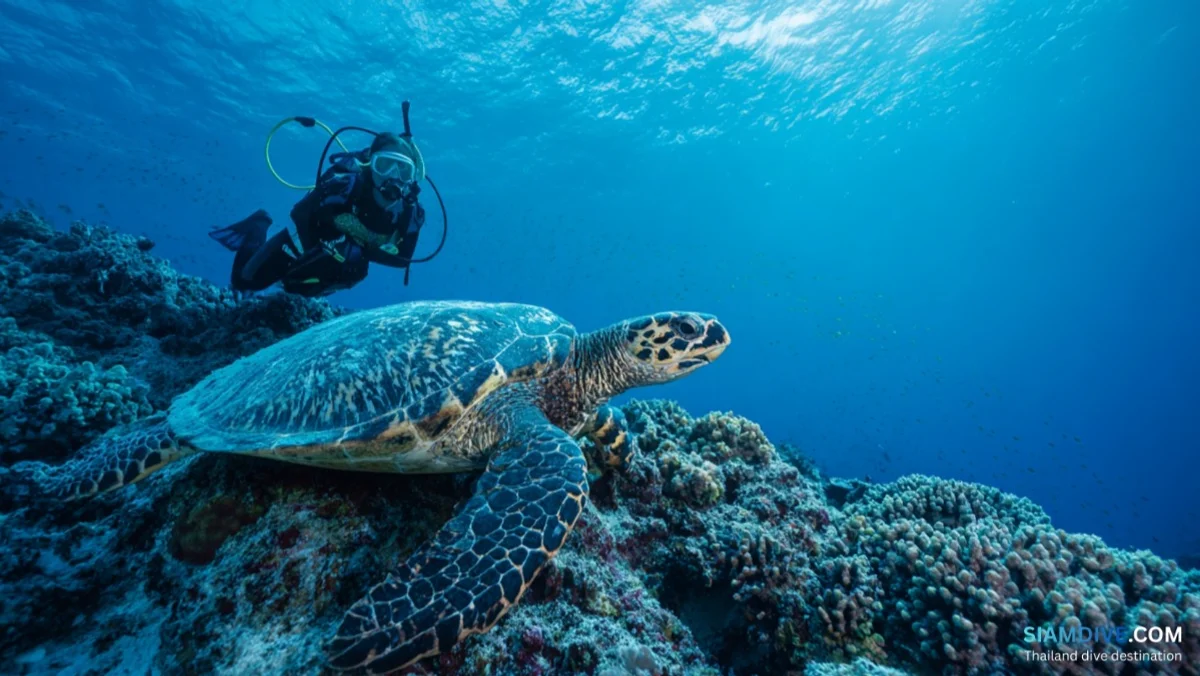
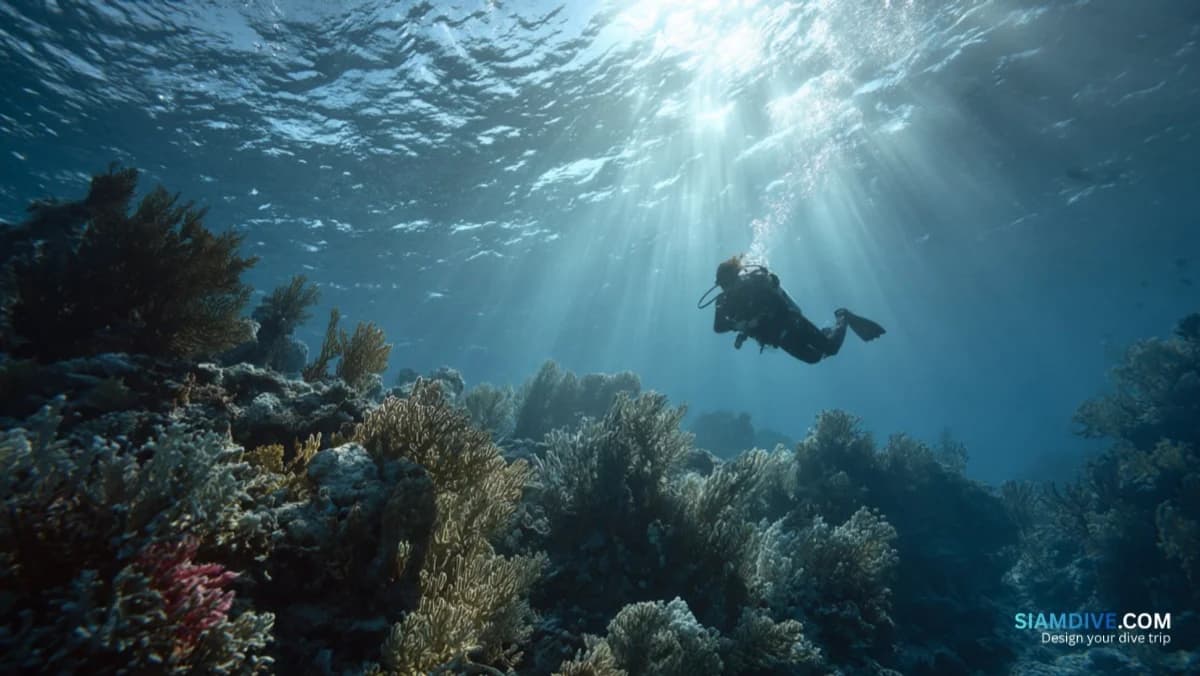
Twelve metres down on a Koh Tao training reef, a freshly certified diver hangs at a 30-degree angle, fins dragging silt across staghorn coral. The BCD inflator hisses every few seconds. The dive guide glances back, checks the gauge — 140 bar after 22 minutes. Nothing is technically wrong. The diver passed every Open Water skill two days ago. But neutral buoyancy, the one competency that separates a diver from a person wearing dive gear, barely appeared in the course.
What the Card Actually Proves
The PADI Open Water syllabus requires exactly one buoyancy skill: the fin pivot. Lie on the bottom, breathe in, rise on your fins like a see-saw, breathe out, settle back. Pass the skill in under a minute, move on. The course also introduces a surface weight check — float at eye level with an empty BCD and a full breath, sink slowly when you exhale. Together, these two exercises take roughly four minutes of a four-day programme.
That is the sum of formal buoyancy training for a recreational card. No hovering requirement. No horizontal trim assessment. No discussion of what happens when neoprene compresses at 25 metres or when a half-empty aluminium tank shifts the centre of gravity backward. These are not advanced-level concepts — they are the physical reality of every dive after dive one. Most newly certified divers head into the ocean without a framework for dealing with any of them.
Dives 1 Through 20 — Where Habits Cement or Fossilize
Instructors call it the 20-dive window. During this stretch, a diver either builds control through deliberate repetition or locks in compensatory habits that persist for years. The biggest offender is overweighting — carrying more lead than the dive requires.
The cascade starts there. Extra weight means more air pumped into the BCD to stay neutral. More BCD air means a larger bubble that shifts with every body movement, creating drag and instability. The diver kicks harder to compensate, burns air faster, and ends the dive 20 minutes before the group. DAN's fatality analysis puts the risk in plain numbers: overweighted divers face roughly six times the fatality risk of properly weighted divers. In 90% of fatal incidents, the diver still had their weight system attached.
Three drills can break this cycle in the first 20 dives:
- End-of-dive weight check — Most OW courses teach the weight check with a full tank. Aluminium tanks — standard in Thailand — swing roughly 1.5 kg from full to empty. A meaningful weight check uses 50 bar or less: deflate the BCD, hold a normal breath, and float at eye level. If you sink, drop a kilo. If you bob above the surface on an exhale, add half a kilo. PADI's instructor guidelines recommend re-checking at 50–35 bar, but few fun-dive briefings mention it.
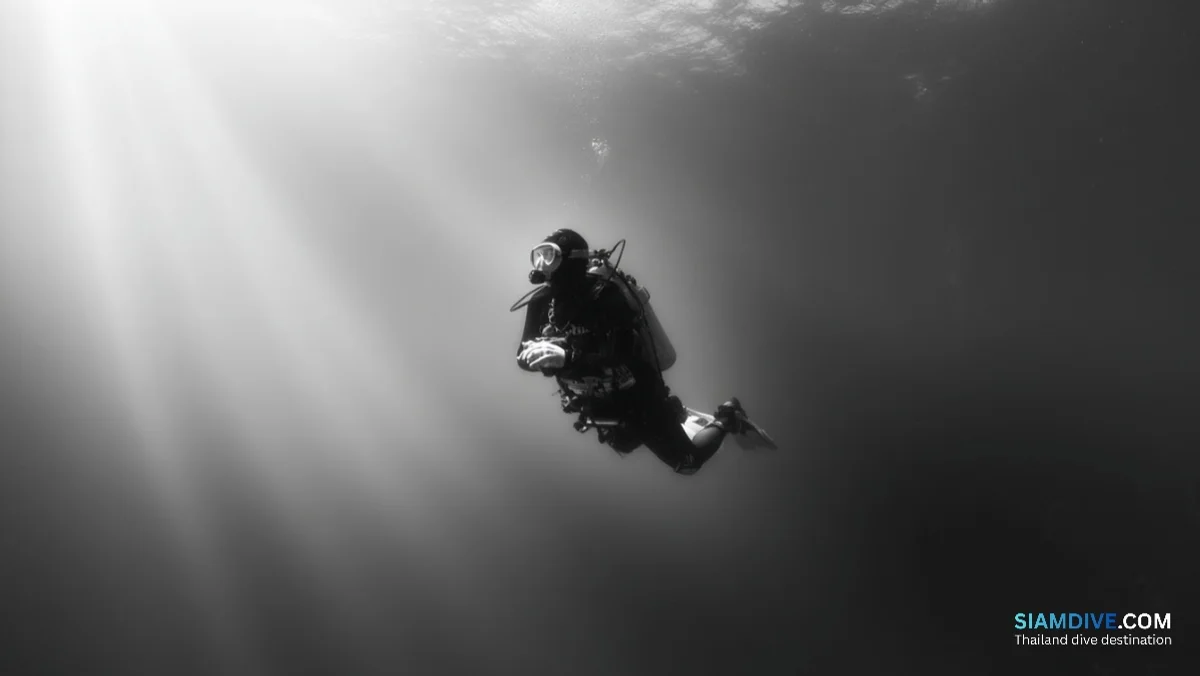
- Two-minute hover — The Peak Performance Buoyancy specialty requires 60 seconds of motionless hovering. Double it. Find a sandy patch at 5 metres, vent all air from the BCD, cross your arms, and hang using only your breathing for two full minutes. One normal breath shifts buoyancy by roughly half a kilogram — enough vertical authority for any fixed depth.
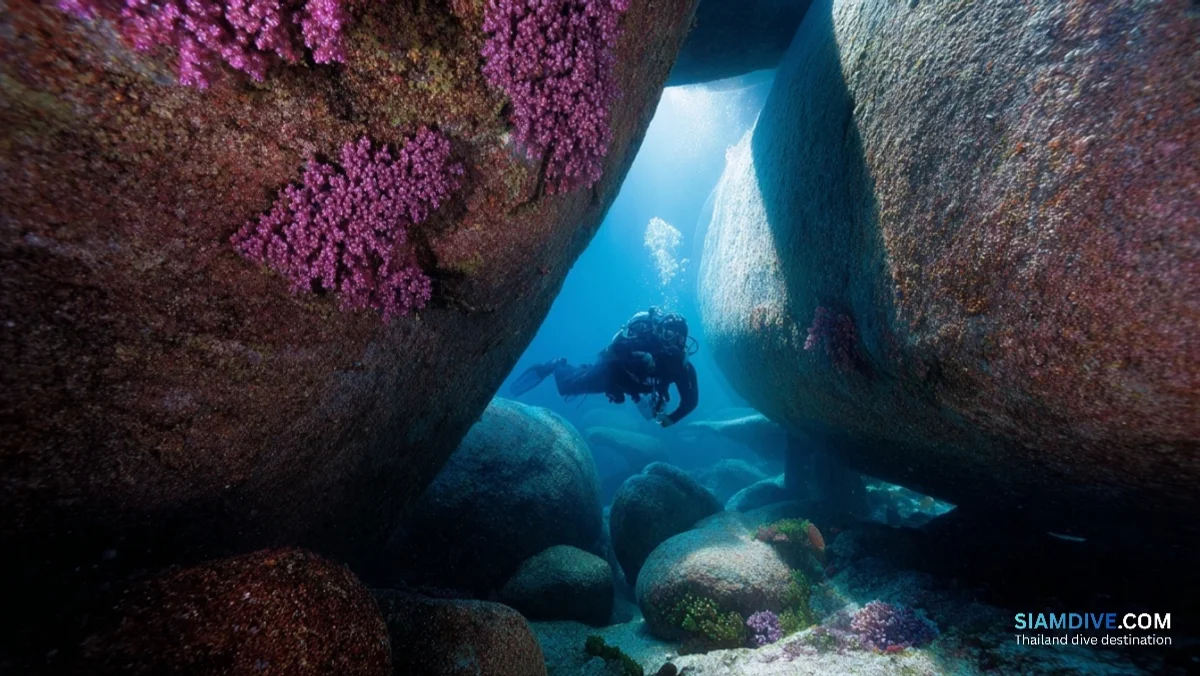
- Swim-through gate — Find a natural rock arch or set up a hoop. Swim through without touching the edges — fins included. This forces simultaneous control of vertical position and horizontal trim. If your fins clip the bottom, the problem is a tail-heavy centre of gravity: move weight higher on your torso or shift the tank up one notch on the BCD backplate.
None of these drills require a course, a guide, or special equipment. They need a buddy, five metres of water, and fifteen minutes at the start of a dive.
At AOW — When Depth Changes the Rules
The jump from 12 to 30 metres changes more than the colour palette. A 5 mm wetsuit loses roughly 40% of its buoyancy by 30 metres as compressed neoprene cells shrink. BCD air compresses in proportion. The gentle breathing adjustments that worked in the shallows barely register at depth, and new deep divers compensate by jabbing the inflator — creating the yo-yo pattern that instructors dread and reef corals pay for.
The relationship between breathing and air consumption sharpens at depth because every BCD correction costs gas. One unnecessary inflator press at 30 metres uses twice the air it would at 10 metres — Boyle's law, not opinion. Divers who rely on BCD adjustments instead of lung volume routinely surface with 30–40 bar less than buddies of similar build.
PADI's Peak Performance Buoyancy (PPB) specialty exists for this transition. It runs one day, requires only an OW card, and covers four competencies:
- Precision weight check — with near-empty tank, in the actual exposure suit
- Trim adjustment — redistributing weight between pockets, belt, and tank position
- Multi-orientation hovering — vertical, horizontal, and inverted, using breath alone
- Visualization — mental rehearsal of depth holds before the dive, borrowed from freediving training
In Thailand, the PPB specialty runs between 5,000 and 7,400 THB depending on location — Koh Tao at the lower end, Phuket and Koh Samui toward the top. Two open-water dives, no written exam. SSI's equivalent, Perfect Buoyancy, follows a similar structure. For divers planning an Advanced Open Water course, PPB counts as one of the five adventure dives, which means the cost effectively folds into the AOW investment.
After 50 Dives — When Breath Replaces Buttons
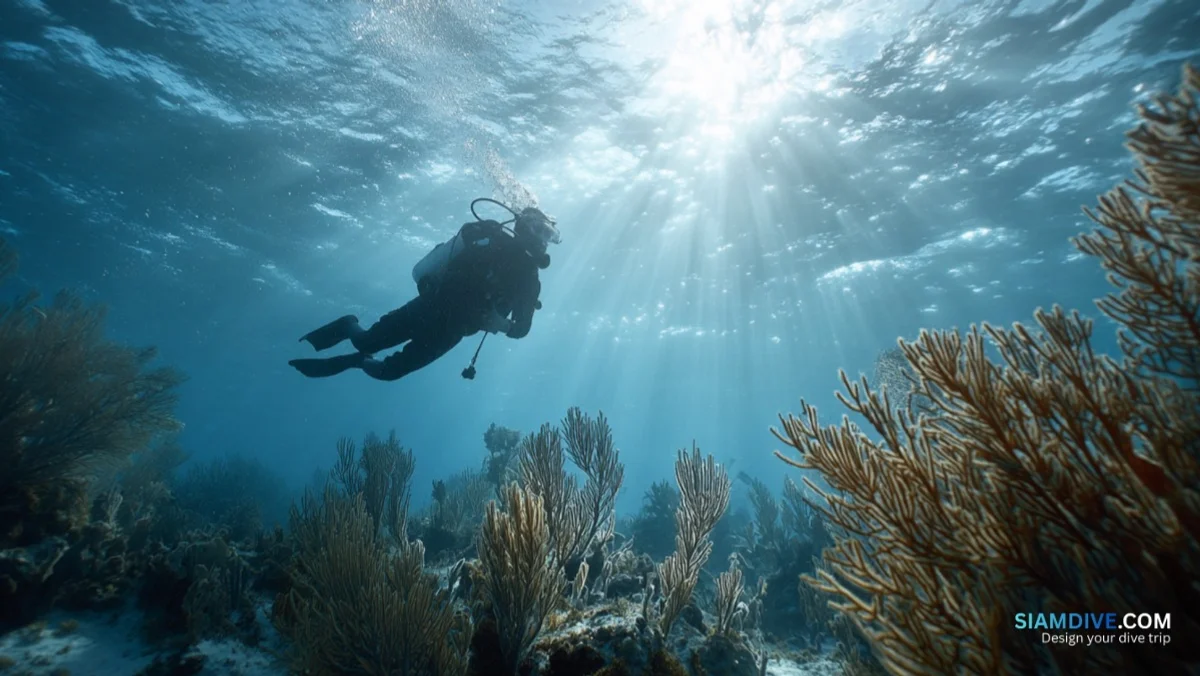
Somewhere around dive 40 or 50, something shifts. The inflator hose stays clipped to the chest D-ring and barely moves. Descents slow without conscious effort. Air consumption drops — sometimes by a third. This is not talent. It is accumulated muscle memory from a properly weighted rig and deliberate practice.
At this stage, your dive computer's algorithm starts to matter more than your BCD. Breath-controlled buoyancy means smoother depth profiles, which means fewer micro-ascents and better no-decompression limits. The drills change accordingly:
- Hands-free descent — Surface to planned depth without touching the inflator. Control the rate by exhale speed alone. Add air once at the target depth, if needed at all.
- Breath-only safety stop — Hold 5 metres for three minutes with fewer than two BCD adjustments. The benchmark is zero, but two is the functional threshold for competent control.
- Current trim hold — In mild current behind a rock or above a reef, hold position without finning. Tuck knees slightly, angle fins upward, and let breathing manage the vertical axis. This is how experienced guides stretch a single tank past 70 minutes.
The physics behind all three is the same. One resting breath displaces roughly half a litre of water — about half a kilogram of buoyancy. At any fixed depth, a slow inhale lifts the body 10–15 centimetres. A slow exhale drops it back. No buttons, no hoses, no delay. The full range of buoyancy correction a diver needs at a constant depth fits inside a single breath cycle.
The Weight Audit
Five hundred dives or five — the weight audit remains the highest-leverage single check a diver can run. Most divers have never done one properly because the OW course teaches it with a full tank, which is the wrong tank state for the test.
- Step 1 — End-of-dive surface check
- At 50 bar or less, BCD fully deflated, hold a normal breath. Float at chin-to-eye level.
- Step 2 — Exhale test
- Breathe out normally, not forcefully. Sink slowly — roughly 0.3 m per second. If you plunge, you are overweighted.
- Step 3 — Adjust in half-kilo steps
- Sinking on a held breath → remove 0.5–1 kg. Floating on an exhale → add 0.5 kg.
- Step 4 — Record the baseline
- Note total weight, wetsuit thickness, and tank material. This becomes the reference for that configuration.
- Step 5 — Re-check triggers
- New wetsuit, different tank material (steel vs aluminium), freshwater vs salt. Each change invalidates the previous number.
What changes with experience is not the procedure — it is the precision. A new diver rounds to the nearest kilo. A diver with 200 dives adjusts in half-kilo increments and feels the difference on the first descent.
Six Times the Risk
Ninety percent of divers who died in recreational diving incidents still had their weight system attached. That single number — from DAN's multi-year fatality analysis — captures the problem better than any course description. Additional data from the same reports:
- 50% of fatalities — the BCD was not inflated, suggesting task loading or inability to manage buoyancy under stress
- 6× fatality multiplier — for divers carrying significantly more weight than needed
- 20–30% higher gas consumption — typical for overweighted divers compared to properly weighted divers of similar build, reducing available dive time by 10–15 minutes per tank
The economics are plain. A diver who fixes overweighting gains roughly 10 extra minutes per dive. Over a five-day Thailand dive trip with three dives daily, that is 150 minutes of additional bottom time — the equivalent of two and a half extra dives at no extra cost.
What Is Changing in 2026
The Avelo Hydrotank — a system that replaces BCD air with water ballast for buoyancy control — has been gaining traction at dive centres and liveaboards through early 2026. The concept eliminates inflator-based buoyancy entirely, raising an interesting training question: does removing the BCD from the equation help new divers learn faster, or does it skip the progression that builds real control?
PADI, meanwhile, marks its 60th anniversary in 2026 with limited-edition retro certification cards. The branding is nostalgic, but the Open Water curriculum remains unchanged: buoyancy training still amounts to one fin pivot and one surface weight check. SSI's Perfect Buoyancy specialty and PADI's PPB remain the most direct routes to closing the gap.
That gap has not changed since 1966. Neither have the drills that close it. What has changed is access: a PPB course in Thailand still costs less than a single fun dive in the Maldives. Two dives, one day, and the most important skill progression a certified diver can make. The only prerequisite is accepting that the card was a starting line, not a finish.
If deep diving adds narcosis risk at 30 metres, buoyancy control is the skill that keeps the problem from compounding. Every metre of unintended depth change at that range tightens the margin. The divers who handle it are not the ones with the most expensive gear — they are the ones who spent fifteen minutes per dive, for twenty dives, deliberately practising.