28°C Above, 22°C Below: When 3mm Fails in Thailand
24 เมษายน 2569
Andaman thermoclines drop from 29°C to 22°C without warning. At 20 metres, 3mm compresses to barely 1mm — the spec-driven case for when 5mm earns its weight.
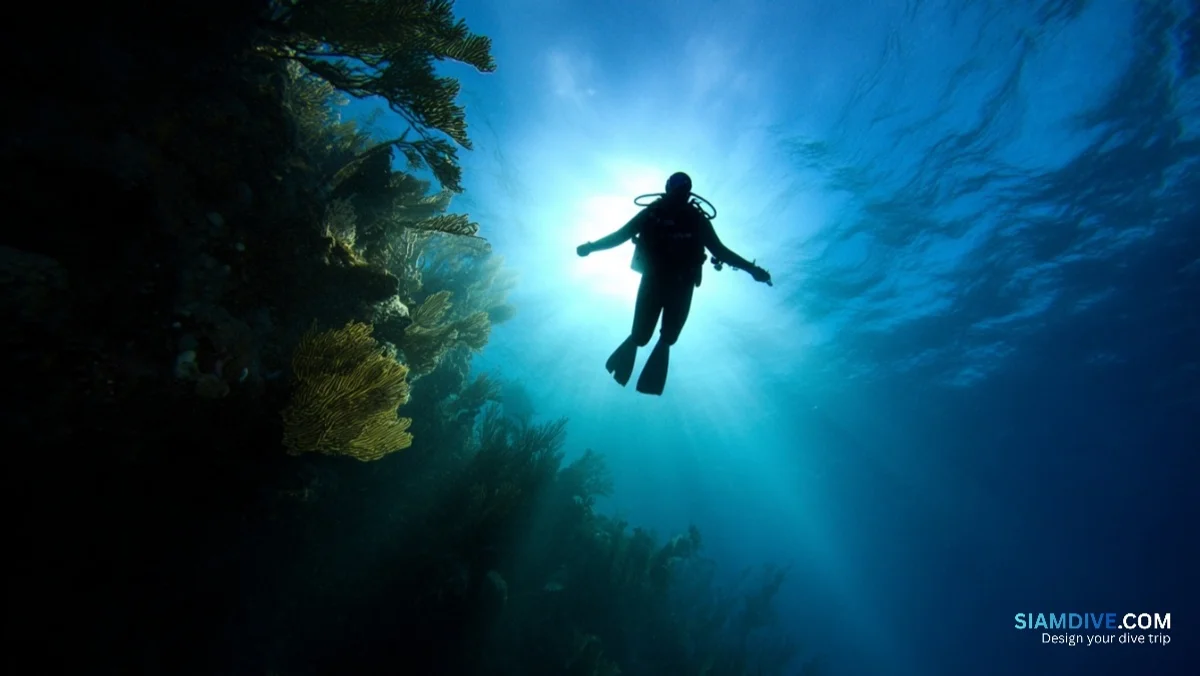
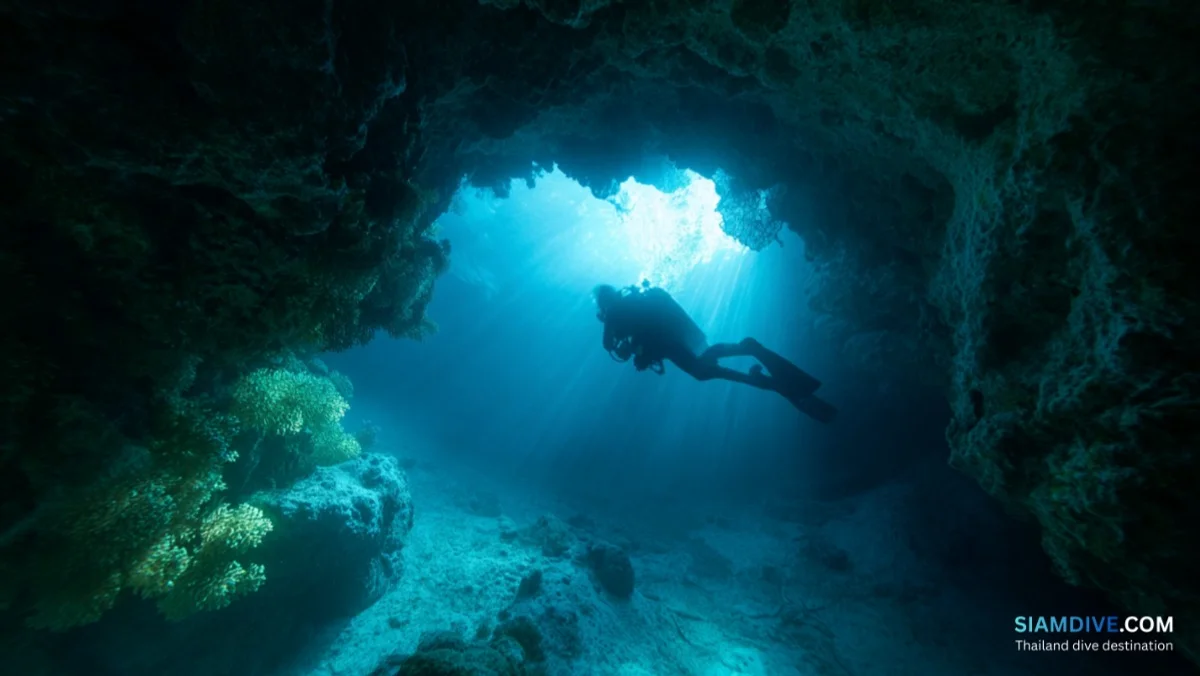
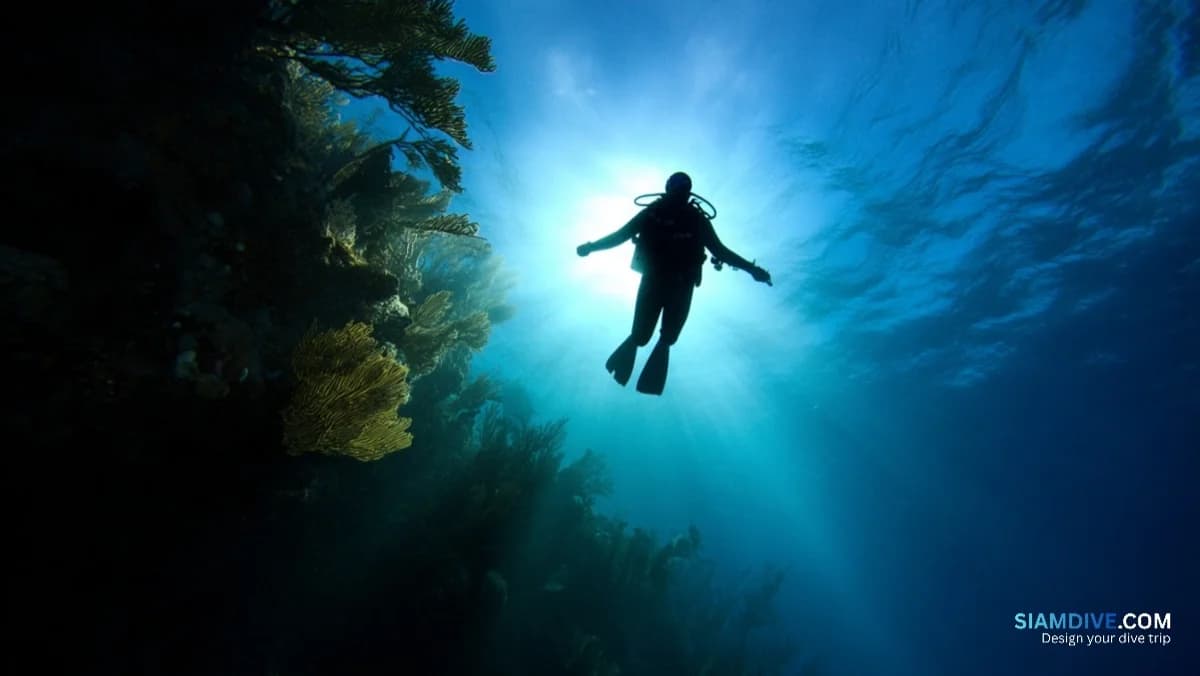
The surface reads 29°C. Warm, calm, the kind of water that makes a 3mm wetsuit feel like armour you do not need. Then, at 18 metres on Koh Bon's ridge, the colour shifts from blue to thick green. The dive computer flashes 23°C. Six degrees gone in the span of two fin kicks — and that thermocline is the reason half the boat shivers through a safety stop while the other half, zipped into 5mm neoprene, barely registers the change.
Thailand's warm-water reputation is earned at the surface. Below it, the Andaman Sea runs a different thermal programme entirely. The question — 3mm or 5mm — is not about comfort preference. It is about which number your wetsuit will read at depth, after compression, inside a cold-water event that nobody can predict from the sundeck.
What Happens to 3mm of Neoprene at 20 Metres
Neoprene insulates through millions of nitrogen gas bubbles trapped in a closed-cell rubber matrix. Those bubbles resist heat transfer — on the surface. Underwater, hydrostatic pressure compresses them, and every additional atmosphere of pressure crushes more insulation out of the material.
Research published in Polymers (MDPI, 2023) measured the damage precisely. At 20 metres — three atmospheres of absolute pressure — standard neoprene loses an average of 64.3% of its thickness and roughly 41% of its thermal resistance. The steepest loss happens in the first 10 metres, where thermal protection drops by nearly 30%. After that, compression slows because the most vulnerable bubbles are already crushed.
For a 3mm suit, the arithmetic is stark. At 20 metres, 3mm of neoprene compresses to just over 1mm of effective insulation — roughly the protection of a dive skin. A 5mm suit at the same depth retains approximately 1.8mm. Neither number inspires confidence in a cold thermocline, but 1.8mm provides about 60% more thermal barrier than 1.1mm. That gap is the difference between finishing a dive comfortably and cutting it short with ten minutes of air still in the tank.
Material quality widens the spread. Premium neoprene — often sourced from manufacturers like Yamamoto in Japan — uses smaller, more uniform gas cells that resist compression better than budget rubber with larger, irregular bubbles. Two suits both labelled "3mm" can perform measurably differently at depth depending on the neoprene source and the manufacturing process. The label on the hanger is a surface measurement; it tells you nothing about how the suit behaves three atmospheres down.
Fit matters as much as thickness. A loose-fitting 5mm that allows water to flush through gaps at the wrists, ankles, and neck will lose heat faster than a snug 3mm with sealed seams. Flushing — cold water entering and warm water escaping — bypasses the neoprene entirely, turning the suit into an expensive rash guard. Any thickness comparison assumes a properly fitted suit; without that baseline, the numbers above mean little.
Water pulls heat from the body approximately 25 times faster than air at the same temperature. Combined with neoprene compression, the result is that your wetsuit is weakest precisely where Thailand's thermoclines tend to sit — between 15 and 25 metres.
3mm vs 5mm — The Numbers
Strip the marketing copy and dive-shop counter advice, and the two thicknesses differ in six measurable ways:
- Recommended surface range — 3mm: 27–30°C (81–86°F) / 5mm: 20–27°C (68–81°F)
- Effective thickness at 20 m — 3mm: ~1.1 mm / 5mm: ~1.8 mm
- Added buoyancy at the surface — 3mm: 1–1.5 kg / 5mm: 2.5–4 kg
- Extra lead required — 3mm: ~5% of body weight / 5mm: ~10% of body weight
- Drying time in tropical air — 3mm: 2–3 hours / 5mm: 4–6 hours
- Packed weight and volume — 3mm: ~1.2 kg, ~2 L / 5mm: ~2 kg, ~3.5 L
For a 75 kg diver following PADI's weight-of-thumb guideline, that means roughly 3.5 kg of lead in a 3mm versus 7.5 kg in a 5mm. The extra four kilograms sit on the weight belt, shift the trim line, and ride in the luggage on the flight over. None of that is free.
The Buoyancy Tax You Pay Twice
Every millimetre of neoprene adds buoyancy at the surface that must be offset with lead. More lead means a heavier rig, slower fine-tuning of neutral buoyancy, and more air spent on BCD adjustments. Divers switching from 3mm to 5mm commonly report adding 2–3 kg of lead — with the range stretching from 1.5 kg for slim divers using steel tanks to 4 kg for larger divers on aluminium.
The part few gear guides mention: you pay this tax twice. At the surface, you carry extra lead to counteract the suit's float. At depth, the neoprene compresses and loses that buoyancy — but the lead stays. The result is a growing negative buoyancy swing as you descend. A 5mm suit creates a larger swing than a 3mm, which makes depth transitions — descents, ascents, safety stops — demand more BCD management and more attention to ascent rate.
For recreational dives in the 18–30 metre range typical of Thailand's Andaman sites, this swing is manageable with decent buoyancy skills. For newer divers still working on trim, or on dives with rapid depth changes across a pinnacle, the 5mm buoyancy swing adds a variable worth practising before the trip.
Thailand's Thermocline Map
A diver at Koh Tao can make four dives to 30 metres without feeling a chill. The same diver, on the same day, at Koh Bon could hit a six-degree thermocline on the first descent. The thermal split runs along the Malay Peninsula, and the difference is oceanographic, not just geographic.
Gulf of Thailand — Koh Tao, Sail Rock, Chumphon Pinnacle, Samae San. The Gulf is a shallow, semi-enclosed basin where water temperatures hold steady at 28–30°C from surface to bottom across the dive season. Thermoclines are rare and mild — a degree or two at most. A 3mm suit handles the Gulf comfortably, dive after dive, season after season.
Andaman — Coastal — Racha Yai, Racha Noi, Phi Phi, Shark Point, King Cruiser. Surface temperatures sit at 28–30°C. Thermoclines occasionally develop below 20 metres but typically soften the water to 26–27°C — noticeable, but not punishing. Most divers in 3mm manage fine, though a second or third dive at Racha Noi's deeper southern reef can leave you aware of the chill.
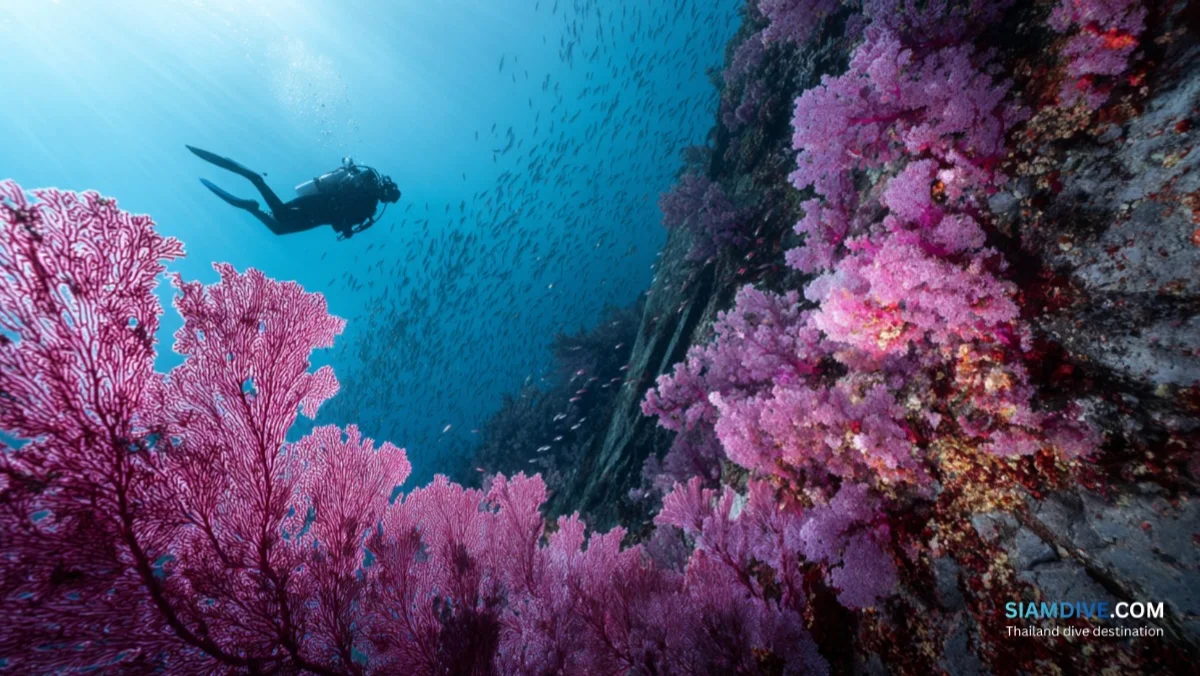
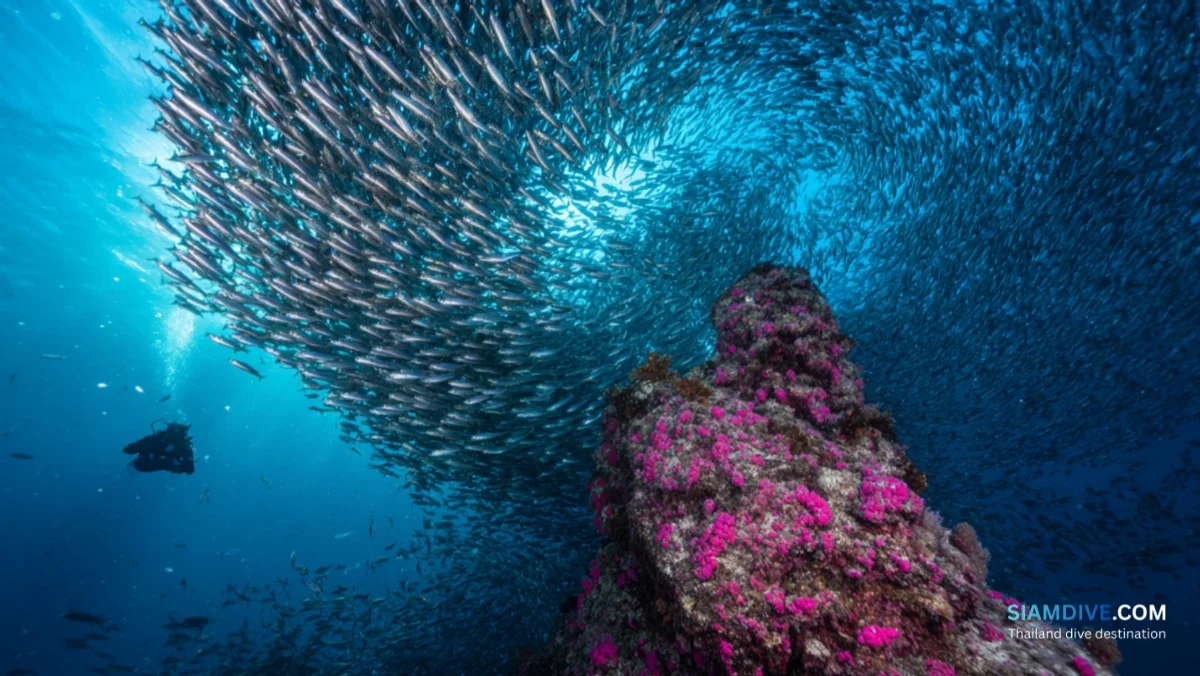
Andaman — Oceanic — Similan Islands, Koh Bon, Koh Tachai, Richelieu Rock, Surin, Burma Banks. This is where the physics changes. Deep-ocean upwelling, amplified by the Indian Ocean Dipole, pushes cold, nutrient-rich water toward the surface. Thermocline drops of 5–7°C are documented — water can plunge from 29°C to 22–23°C in the span of two body-lengths. Operators along the Khao Lak coast call it the "Green Monster": a band of cold, plankton-dense water that rolls across pinnacle sites without warning and vanishes minutes later.
During the 2025–2026 Similan season, January brought surface temperatures of 27–30°C, and February delivered visibility of 30–40 metres with manta ray encounters at Koh Bon. But the Green Monster appeared regularly at depth on the oceanic pinnacles, pushing temperatures into the low 20s on exposed ridges. The positive Indian Ocean Dipole has at times shifted the Andaman thermocline as shallow as 50 metres from the surface, making early-season liveaboards (November–December) particularly prone to cold surprises.
When 3mm Is the Right Call
A 3mm suit wins when thermal risk is low and mobility, weight, and drying speed matter more than worst-case insulation:
- Shallow reefs, max depth 18 m — Racha Yai, Phi Phi's Bida Nok, most Koh Tao sites. You stay above the thermocline band.
- Gulf of Thailand, any depth — Stable water column, no meaningful thermocline.
- Day trips with two dives — Cumulative cooling is minimal. Surface intervals in tropical air rewarm the body between dives.
- Late season, March–April — Surface temperatures reach 31–32°C. A 5mm in April is a genuine overheating risk, and late-season thermoclines have typically weakened.
- Multi-destination trips — Linking Thailand with Indonesia or the Philippines, 3mm rolls smaller, weighs less, dries faster. It is the travelling diver's practical default.
When 5mm Earns Its Weight
The thicker suit justifies the extra neoprene in specific, predictable scenarios — all of which involve either depth, repetition, or cold-water events:
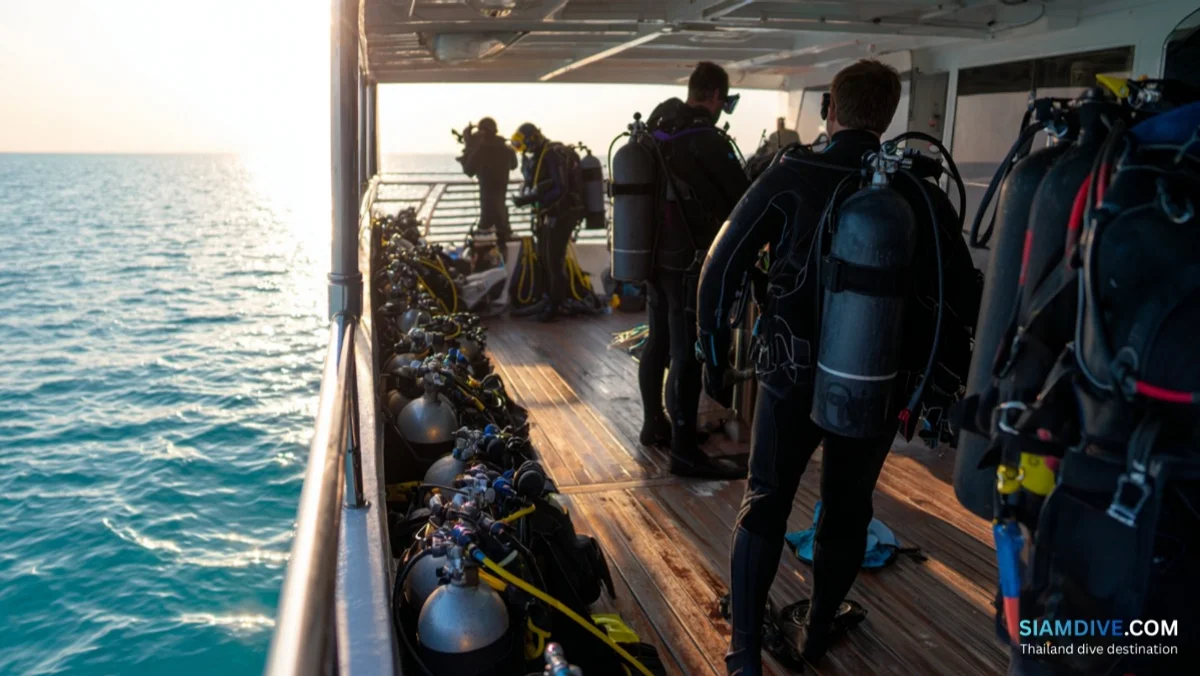
- Liveaboard diving, 3–4 dives per day — Cumulative heat loss compounds across immersions. By the fourth dive, even 29°C water feels cooler because core temperature has not fully recovered. The 5mm buys a thermal margin that extends bottom time and comfort across a full day.
- Oceanic Andaman sites below 18 m — Koh Bon, Koh Tachai, Richelieu Rock, Elephant Head. These pinnacle sites sit in the thermocline zone. A Green Monster event in a 3mm at 22°C — with neoprene compressed to barely 1mm — produces a cold, shortened dive.
- Early season, November–December — Indian Ocean Dipole activity pushes the thermocline higher. Early liveaboards encounter cold patches more frequently than the peak February–March window.
- Night dives — Without solar heating in the upper water column, temperatures at 12–15 metres sit 2–3°C below daytime readings.
- Divers who run cold — Individual cold tolerance varies enormously. Some divers are comfortable in 24°C wearing 3mm. Others shiver in 28°C with 5mm. Body composition, metabolism, age, and fatigue all factor in. If you know you run cold, the thicker suit eliminates the guesswork.
The Modular Play
On any Similan liveaboard, at least one diver boards with a 3mm suit and a neoprene vest stuffed in the side pocket. A 3mm fullsuit paired with a 2mm hooded vest delivers roughly 5mm of core protection — chest and back — while keeping arm and leg mobility closer to the 3mm baseline. The vest goes on for deep or cold dives and strips off for warm, shallow ones.
Operators along the Khao Lak and Phuket coast increasingly stock rental vests for liveaboard guests who arrived with only a 3mm. Rental typically runs 200–400 THB per day — considerably cheaper and lighter than checking a second wetsuit for the flight.
For divers who own their gear and dive Thailand more than once a year, a quality 3mm plus a hooded vest covers everything from April reef days to January liveaboards without the full buoyancy penalty of a dedicated 5mm. It is the closest thing to a one-suit solution for a country where surface water and deep water can differ by seven degrees.
The Decision by Dive Plan
The question was never which wetsuit is better. It is which dive plan you are booking.
- Day trips, Gulf, shallow reefs → 3mm.
- Similan or Surin liveaboard, 3+ dives per day, oceanic pinnacles → 5mm or 3mm + vest.
- One suit for everything in Thailand → 3mm + 2mm hooded vest. Maximum flexibility, minimum luggage.
The surface temperature is not the number that decides your comfort. The number that matters is the reading at 20 metres, inside a Green Monster thermocline, on the third dive of the day. Pack for that number, and the surface takes care of itself.
Sources
- MDPI Polymers — Neoprene thermal properties and compression at diving depths
- Scuba Diving Magazine — Wetsuit thickness and water temperature guide
- PADI — Diving in Thailand: conditions and site reference
- Thailand National Parks — Mu Ko Similan season, fees, and conditions
- The Nation Thailand — Andaman Sea cooling and Indian Ocean Dipole effects