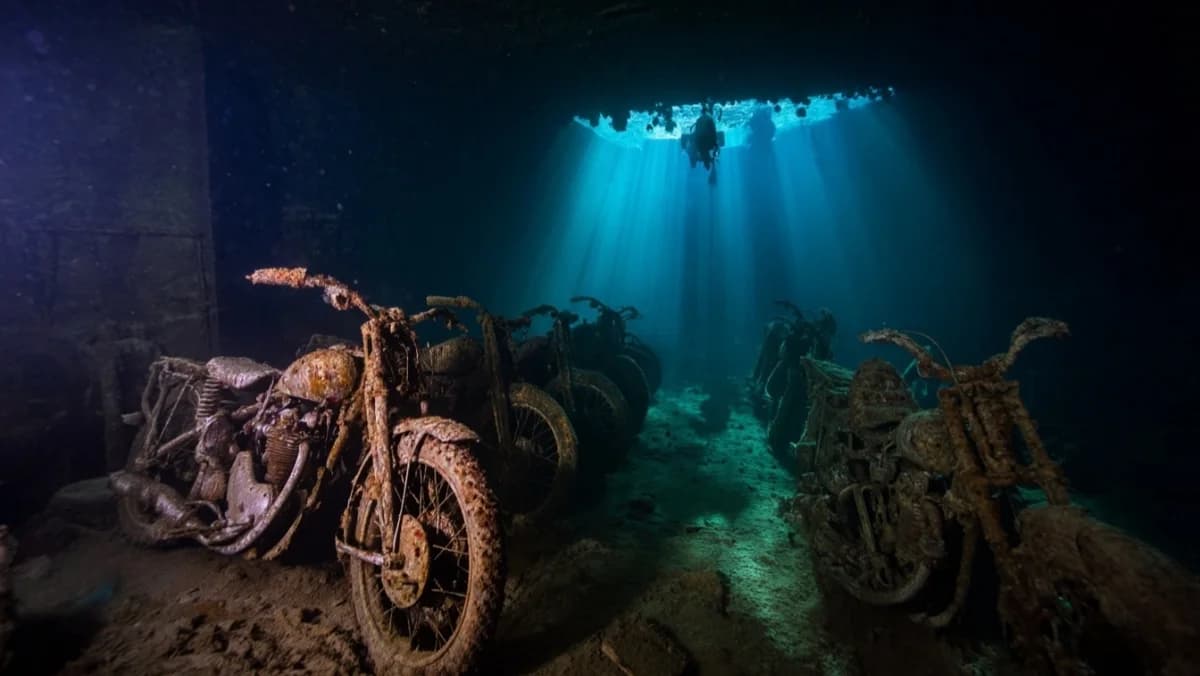
The Bombed Hold at 30 Metres Where 100 Motorbikes Wait
24 เมษายน 2569
Two bombs split a British supply ship in 1941. Eighty-five years later, her cargo of motorcycles, trucks, and locomotives sits exactly where the crew left it.
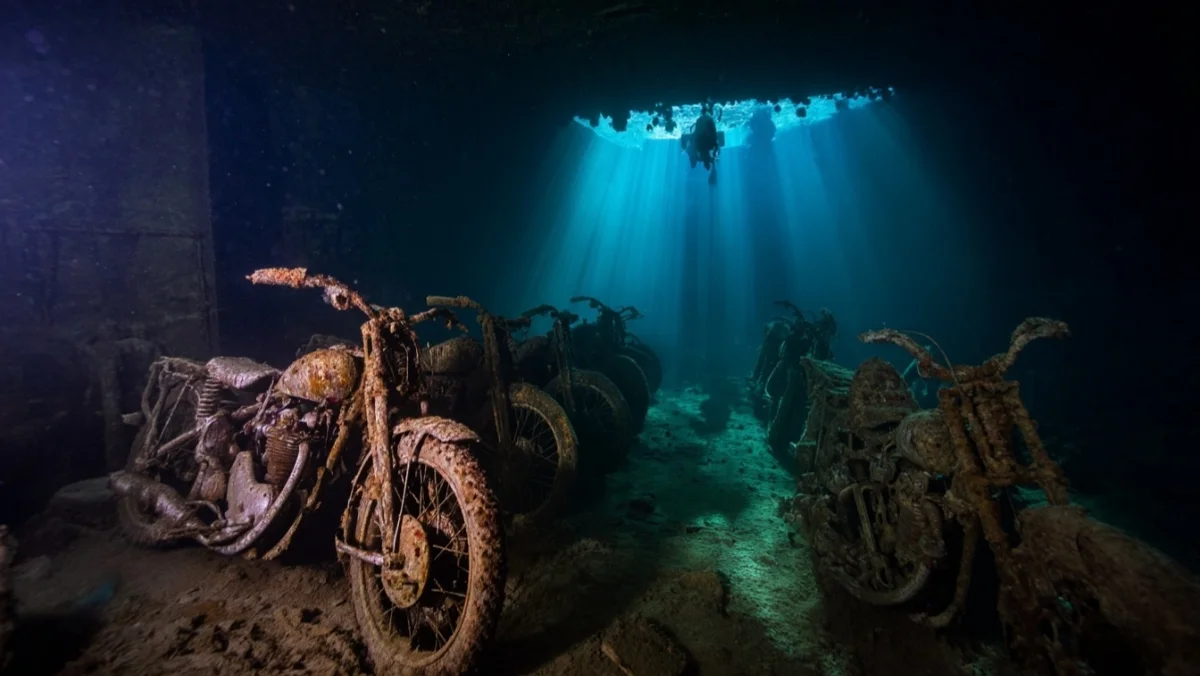
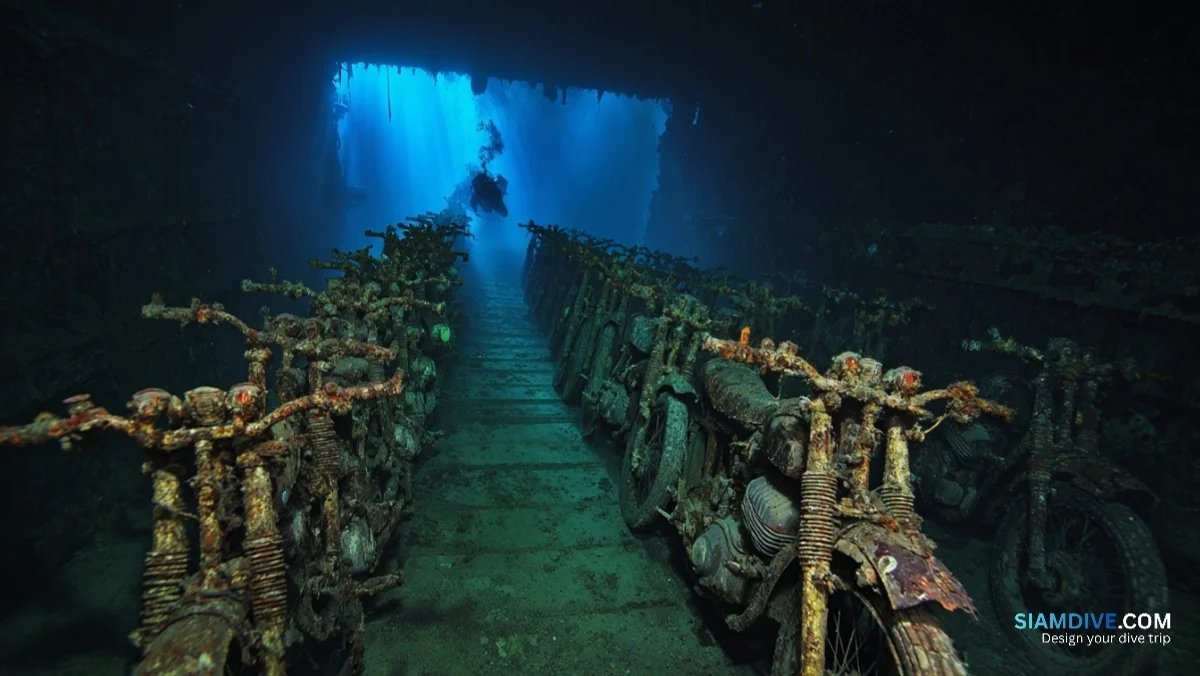
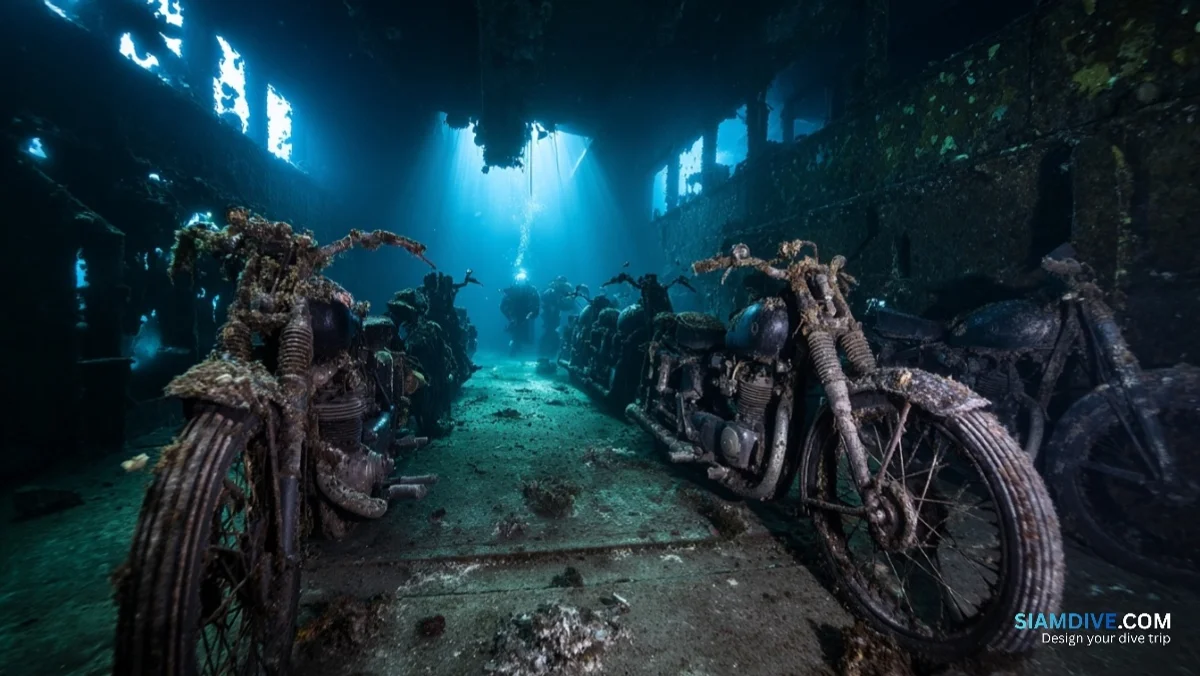
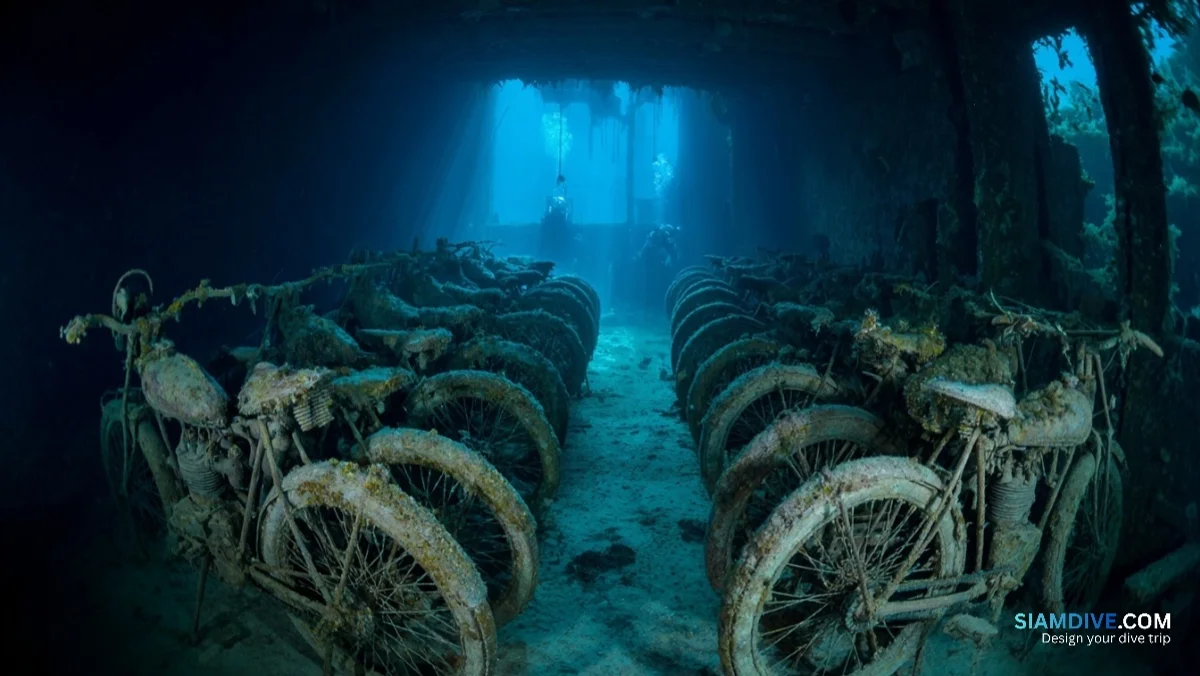
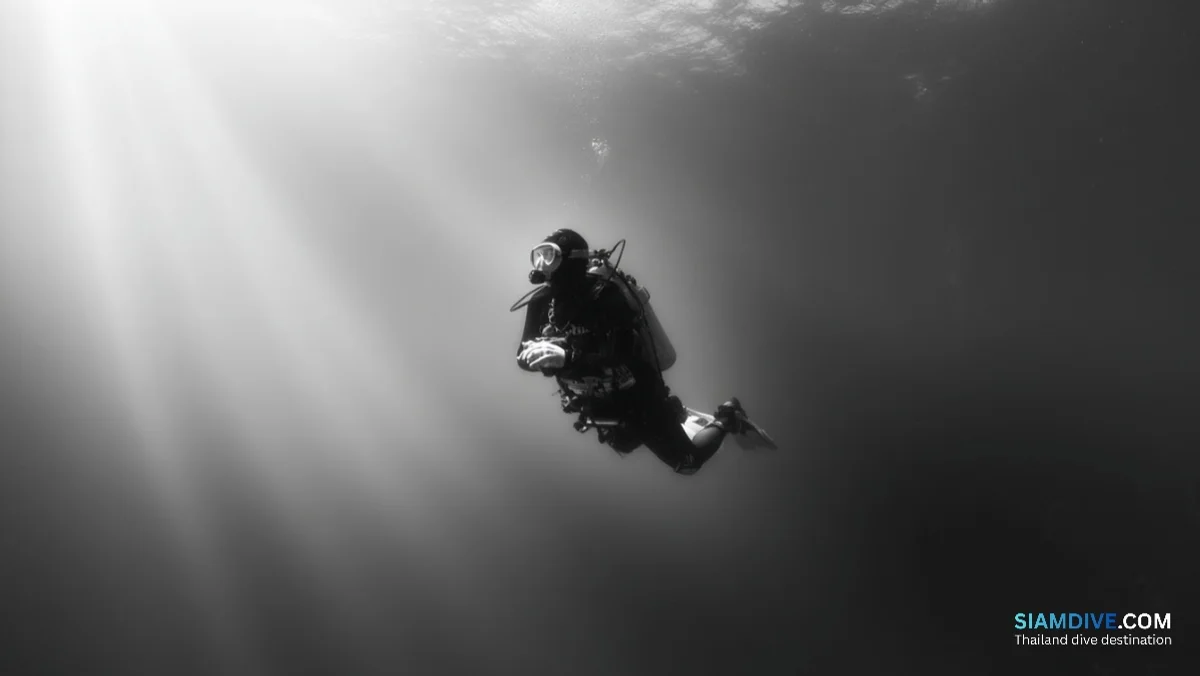
The rope drops into blue nothing. At 16 metres the bow appears — upright, encrusted, big enough to block your peripheral vision. Follow the hull aft and the damage begins: plating peeled back like tin foil, a gap wide enough to swim a dive team through. Beyond that gap, in Hold No. 2, rows of BSA and Norton motorcycles stand on their wheels in the half-light, handlebars intact, spokes still round. They have not moved since a Glasgow dockside crane lowered them aboard in June 1941.
What Sank the Thistlegorm?
At 0130 on 6 October 1941, two Heinkel He 111 bombers found the SS Thistlegorm anchored in the Strait of Gubal, near the southern tip of the Sinai Peninsula. She was waiting for clearance to transit the Suez Canal, loaded with supplies for the British Eighth Army in North Africa. Two bombs — each weighing roughly 2.5 tonnes — struck Hold No. 4 near the stern. The ammunition stored inside detonated. The explosion killed four crew members and five Royal Navy gunners, broke the ship's back, and sent her to the seabed in minutes.
The ship had been built just a year earlier, launched in April 1940 from the Joseph Thompson & Sons yard in Sunderland. She belonged to the Albyn Line's fleet of "Thistle" ships, all named after Scotland's national flower. Her triple-expansion steam engine produced 1,850 horsepower — modest even for the era, but enough to run convoy routes through the Mediterranean and around the Cape of Good Hope.
A Cargo Manifest Frozen in Salt Water
What makes the Thistlegorm extraordinary is not the sinking. Wartime wrecks litter every ocean. What sets her apart is the cargo — almost all of it still inside.
The forward holds, the ones the bombs missed, contain a cross-section of a 1941 military supply chain:
- Motorcycles — more than 100 Norton 16H and BSA M20 bikes, many still upright on their wheels
- Trucks — Bedford OY trucks and Morris CS8 utility vehicles, stacked in rows
- Armoured carriers — Universal Carrier Mk I tracked vehicles
- Small arms — Lee-Enfield .303 rifles, Bren light machine guns, crates of ammunition
- Equipment — Wellington boots, radio sets, aircraft spare parts, medical supplies
- Railway wagons — flat-bed rail cars intended for Egyptian infrastructure
The preservation is startling. Salt water and marine growth have softened every surface, but the shapes are unmistakable — a motorcycle's kick-start lever, a truck's steering wheel, a rifle bolt. Eighty-five years of submersion have turned the holds into something between an armoury and a natural history exhibit.
Two Locomotives on the Sand
The ship's most dramatic cargo never made it below deck. Two LMS Stanier Class 8F steam locomotives — each weighing over 70 tonnes — rode on the aft deck as deck cargo, bound for Egyptian National Railways. When Hold No. 4 exploded, the blast threw both locomotives off the ship. They now lie on the sandy seabed, one on each side of the wreck, at roughly 30 metres depth.
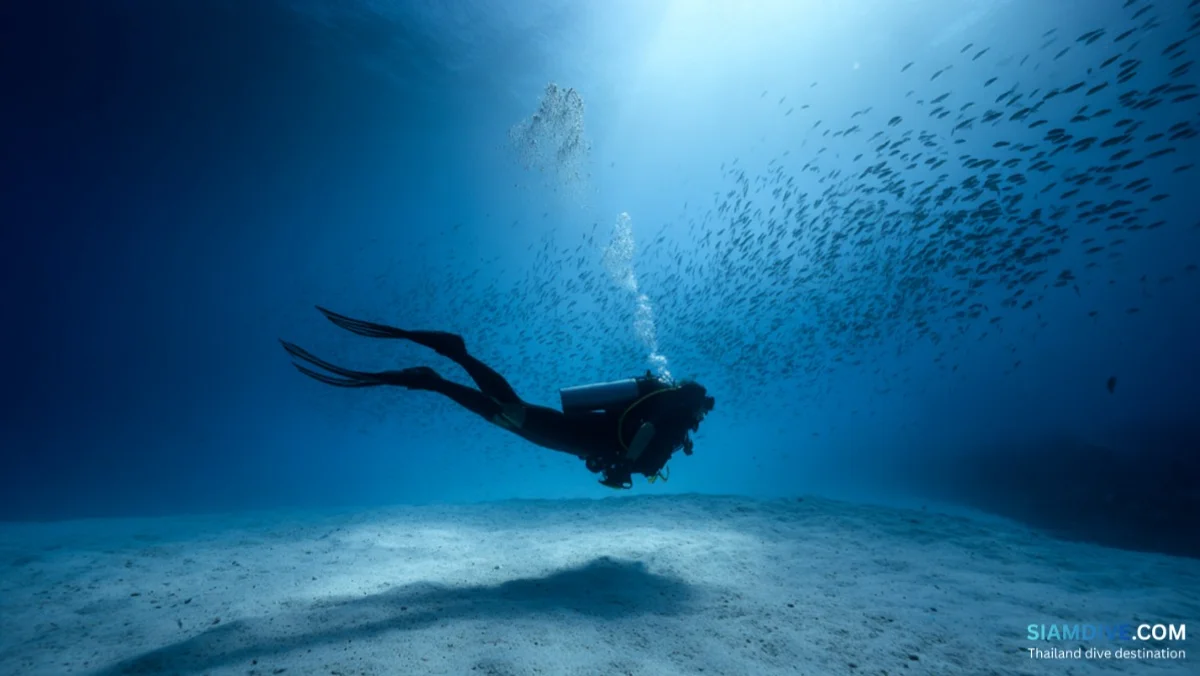
Swimming out from the hull to find a full-size steam locomotive sitting on sand, coal tender still attached, is one of those moments that makes wreck diving unlike any other kind. The scale resists comprehension — railway engines surrounded by fish, encrusted in coral, casting long shadows across a debris field of shells and tank parts.
Inside the Holds
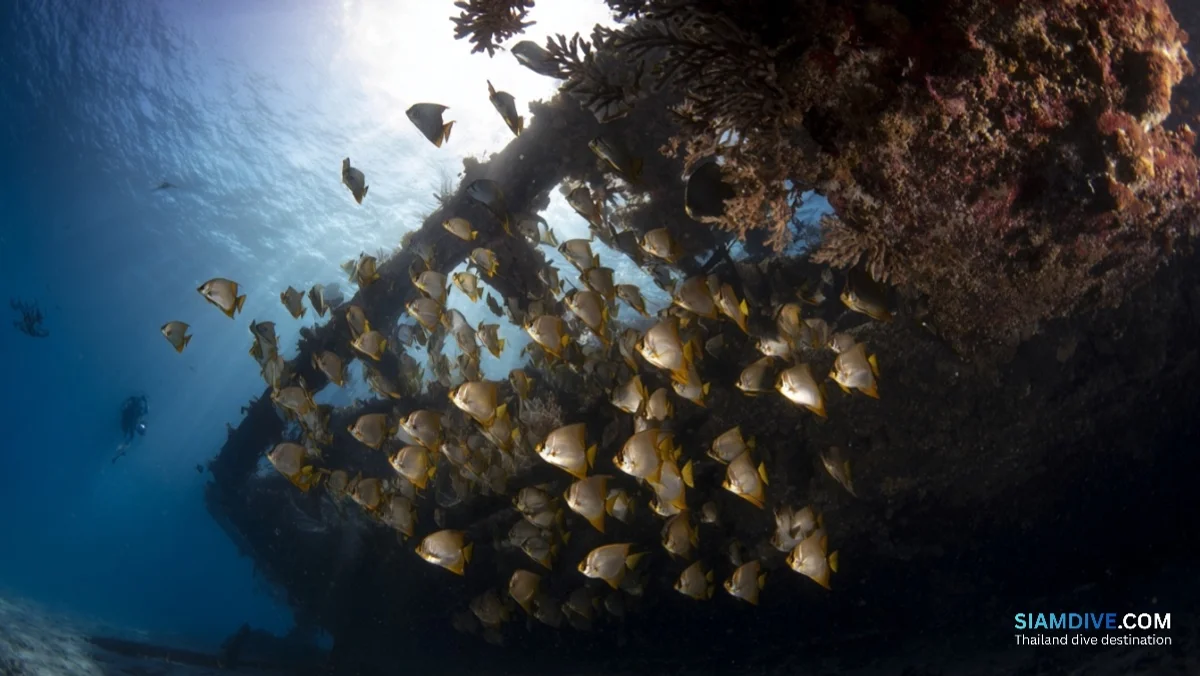
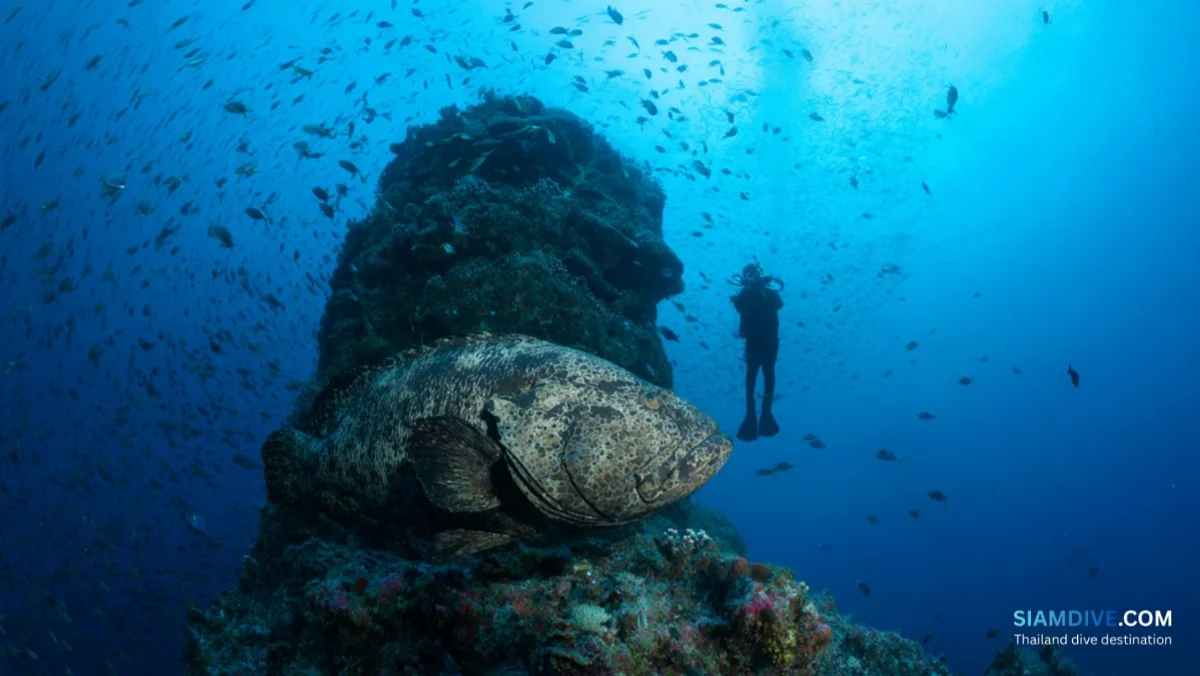
A typical first dive follows the exterior from bow to stern, pausing at the anti-aircraft gun platform near the stern before descending to the propeller at 32 metres — the deepest point, where the twisted metal of the explosion damage is most visible. Batfish and grouper tend to congregate around the stern, using the wreck's shadow as shelter from the open-water current.
The second dive enters through the bomb damage amidships, swimming forward through Hold No. 3 — once used for coal storage, now largely empty — into Holds 2 and 1 where the motorcycles and trucks wait. The light here comes from overhead hull breaches, filtering down in shafts that shift with the surface swell. Visibility inside depends entirely on how many groups have passed through before you: first group of the morning gets crystal-clear water and sharp shadows across the bikes; last group of the afternoon sees silt and torchlight.
Advanced wreck divers with overhead-environment training can penetrate the engine room and crew quarters. The corridors are tight, lit only by torch, but the reward is significant: brass fittings and gauges still reading their last values, personal effects scattered where the crew abandoned them, and the massive triple-expansion engine itself — a cathedral of Victorian engineering sitting in the dark at 28 metres.
The Small Things
The motorcycles draw the most attention, but the smaller items carry their own weight. Leather dispatch cases lie open on the floor of Hold No. 1. Boxes of .303 ammunition sit in neat stacks, wooden lids swollen but intact. Wellington boots — thousands of them — fill an entire section of Hold No. 3, still paired. Radio equipment with bakelite dials sits in waterproof cases that failed decades ago. A railway wagon's wheel assembly rests against the hull, its iron rim now a substrate for soft coral.
Each of these items was catalogued on a manifest filed in Glasgow before the ship departed on 2 June 1941. That manifest survives in the National Archives. Reading it and then seeing the same inventory on the seabed 85 years later is a strange collision of bureaucracy and entropy — a loading dock list turned into an underwater archaeological site by two bombs and eight decades of salt water.
How Deep, How to Get There
The Thistlegorm sits in the Strait of Gubal, roughly midway between Sharm el-Sheikh and Hurghada on Egypt's Red Sea coast.
- Shallowest point
- 16 m (bow)
- Cargo holds
- 18–25 m
- Deepest point
- 32 m (propeller and stern)
- Water temperature
- 22–30 °C (coolest Jan–Mar, warmest Jul–Sep)
- Typical visibility
- 20–30 m, reduced when multiple boats stir sediment
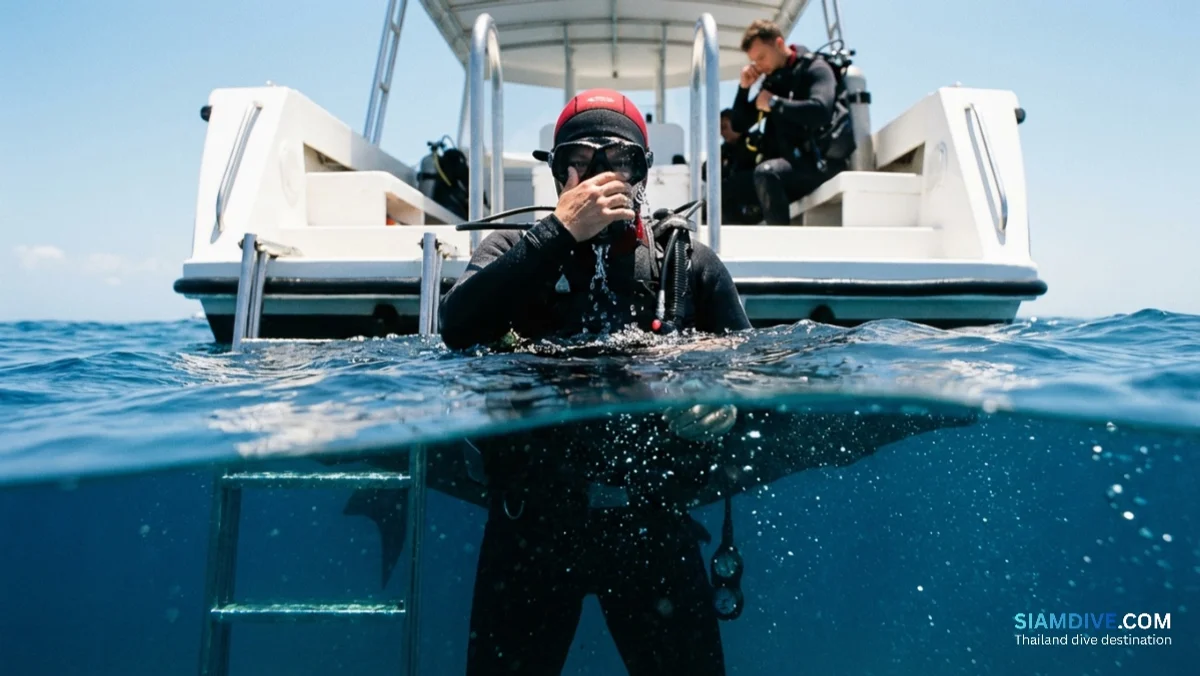
Most divers reach the Thistlegorm by liveaboard. Northern Red Sea itineraries — typically six to eight days — include the wreck as a flagship stop, usually scheduling two or three dives: one for the exterior and holds, one for penetration routes, and sometimes a night dive. Day boats run from Sharm el-Sheikh, but the three-hour crossing each way limits bottom time and usually means arriving after the liveaboard groups have already been through.
PADI recommends Advanced Open Water certification or equivalent. Strong currents sweep the strait regularly, and descents are made along a mooring line. Nitrox at 32% extends no-decompression time at the 24-metre average hold depth from roughly 25 minutes on air to over 35 minutes — critical on a wreck this size.
When the Current Stops and the Crowds Thin
The Red Sea is diveable year-round, but conditions on the Thistlegorm vary more than at shallow reef sites. April through June and September through November tend to offer the best combination of warm water (26–29 °C), manageable current, and good visibility. July and August bring peak temperatures but also peak diver traffic from European summer holidays. December through February sees cooler water (22–24 °C) and occasionally rough surface conditions in the strait.
Timing within the day matters as much as timing within the year. Liveaboard divers who drop in at dawn — before the Sharm day boats arrive around 10:00 — get the wreck in near-pristine visibility. By midday, fin kicks from dozens of divers churn silt through the holds, and the motorcycles disappear behind a brown haze. Early risers see a different wreck entirely.
The Clock Is Ticking
A November 2025 study published by researchers from Alexandria University and the University of Edinburgh — part of the ongoing Thistlegorm Project — compared photogrammetric surveys from 2017 and 2022. The findings were sobering: heavy structures had shifted, artefacts had been removed, and the debris field had expanded. The causes were a mix of natural corrosion, unsustainable mooring practices, and direct diver contact.
Thousands of divers visit the wreck each year. Bubbles from each group accelerate oxidation on overhead structures. Careless fin placement bends fragile metalwork. And despite regulations, artefact theft remains a documented problem — small items vanish season after season.
The Thistlegorm Project's 3D photogrammetric baseline now allows researchers to measure change precisely between survey periods. The goal is not to stop diving — the wreck's economic value to Red Sea tourism is too high for that — but to build evidence for better mooring systems, diver caps, and enforcement of no-touch protocols.
What It Costs to Reach the Most Famous Wreck
Northern Red Sea liveaboard itineraries that include the Thistlegorm range widely in price, depending on vessel class, season, and group size.
- Budget liveaboards — USD 1,150–1,500 per person, 6–7 nights, shared cabin, 18–22 dives
- Mid-range liveaboards — USD 1,500–1,900 per person, twin cabin, 20–24 dives, Nitrox often included
- Premium liveaboards — USD 1,900–2,200+ per person, smaller groups (max 16–20 divers), en-suite cabins
Low season — roughly June through September — can bring discounts of 20–30%. National park fees (USD 7–25 per day) are sometimes included, sometimes extra. Flights to Sharm el-Sheikh or Hurghada from Europe typically run EUR 200–400 return, making the total trip cost for a week's wreck diving lower than many comparable liveaboard destinations in the Indo-Pacific.
Beyond the Bucket List
The wreck's significance extends beyond recreational diving. In 2007, The Times named the Thistlegorm one of the ten best wreck dives on earth. UNESCO has assessed the site under its Convention on the Protection of Underwater Cultural Heritage, and the Egyptian government classifies it as a protected antiquity — making removal of artefacts a criminal offence, though enforcement remains inconsistent.
For underwater photographers, the Thistlegorm is a once-in-a-career location. The combination of clear Red Sea water, dramatic light shafts through hull breaches, and instantly recognisable subjects — motorbikes, trucks, locomotives — produces images that need no caption. The wreck has graced the covers of every major dive magazine and continues to generate some of the most shared underwater photography on the internet.
A Museum Without Walls
Jacques Cousteau found the Thistlegorm in the early 1950s, guided by local fishermen who knew the wreck's position. He filmed what he saw but chose not to publish the location — a decision that kept the wreck relatively undisturbed for another three decades. When sport diving caught up in the 1990s, the secret was out.
Eighty-five years after two bombs broke her back, the Thistlegorm remains the world's most accessible window into a wartime supply chain. The motorcycles are still there. The locomotives still cast shadows. The rifles still lie in their crates. Every season, a little more corrodes, a few more artefacts shift or vanish. The wreck is not waiting — it is actively, measurably disappearing.
For divers considering a Red Sea trip, the Thistlegorm is not a checkbox on a bucket list. It is a deadline.
Swim-Through Caves in Chumphon's Pierced Island · Where Mantas Queue at Koh Bon's 24-Metre Ridge · 4 Breathing Mistakes That Empty Your Tank · Where Did Koh Tao's Whale Sharks Go?