Boonsung at 18 Metres: The Reef a Tsunami Built
19 เมษายน 2569
A tin dredger sunk in 1984, split into five pieces by the 2004 tsunami, now hosts one of Khao Lak's densest reefs. Here is what grew back.
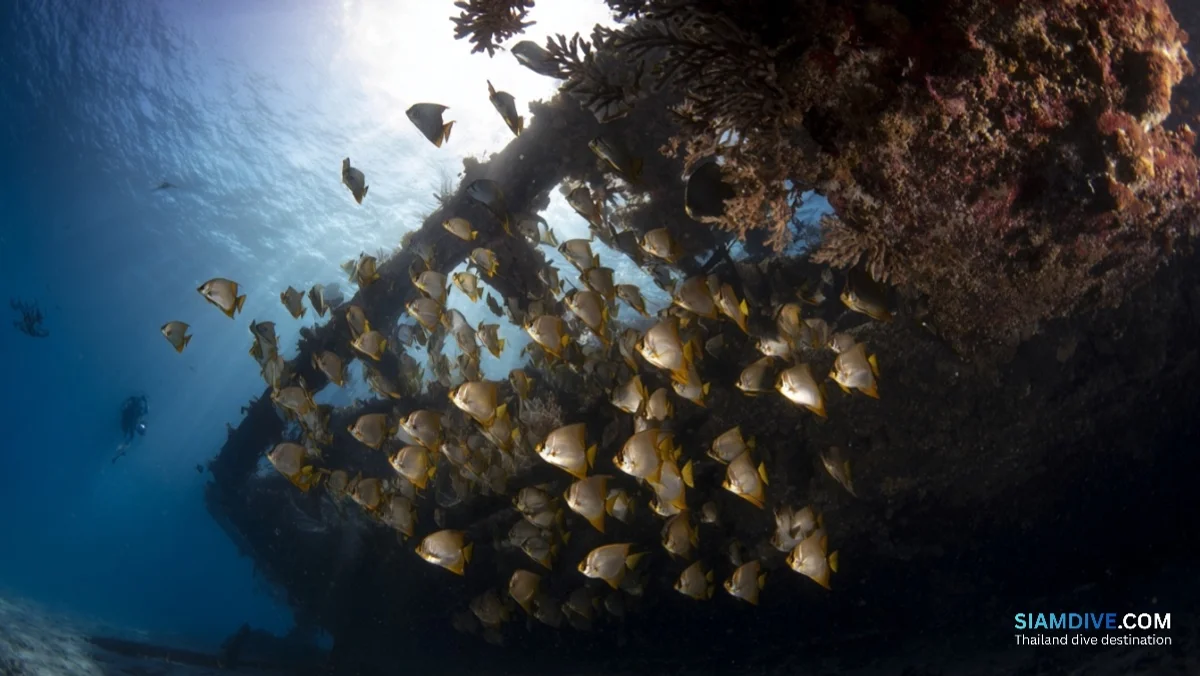
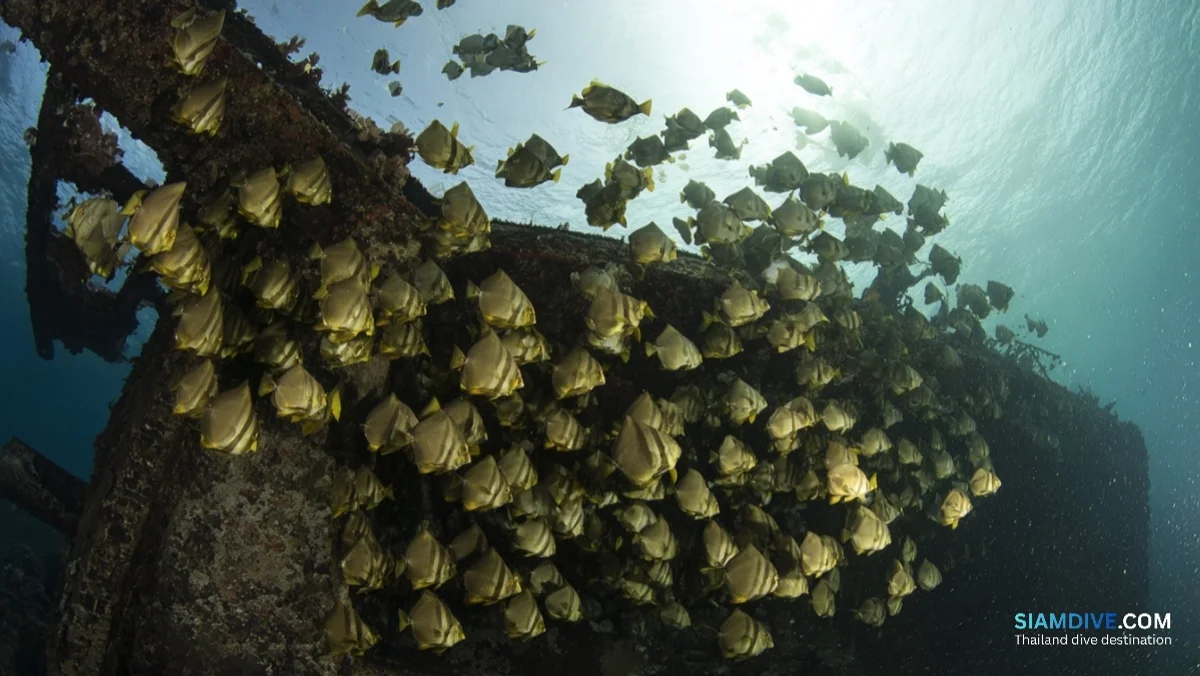
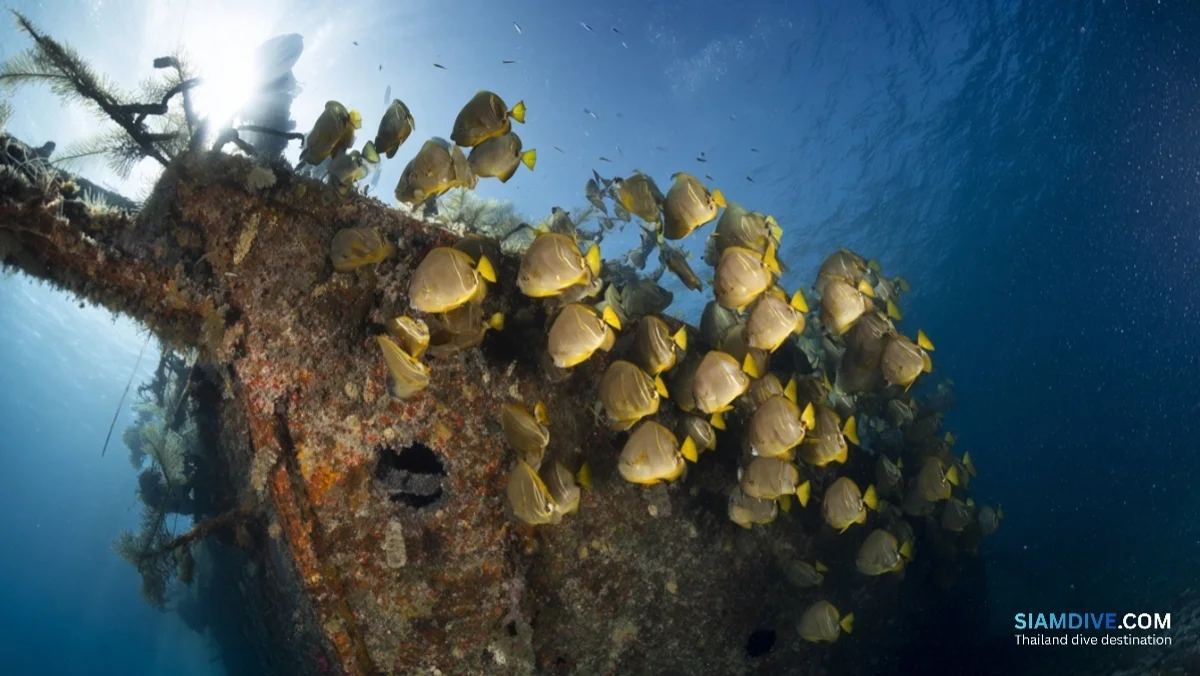
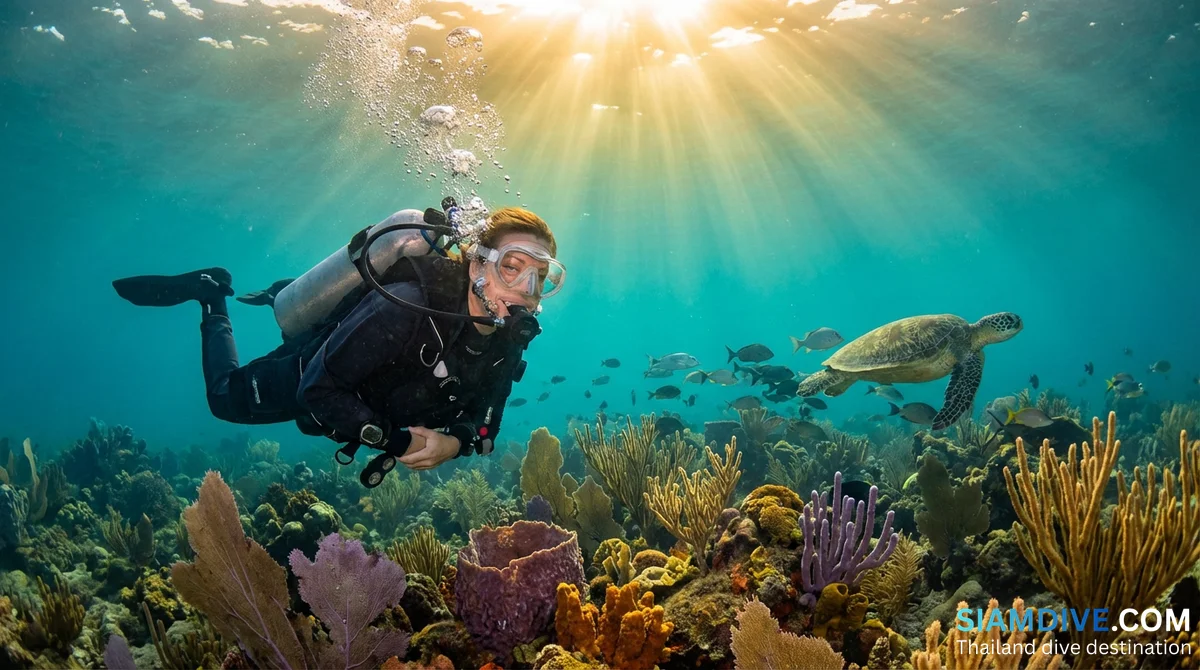
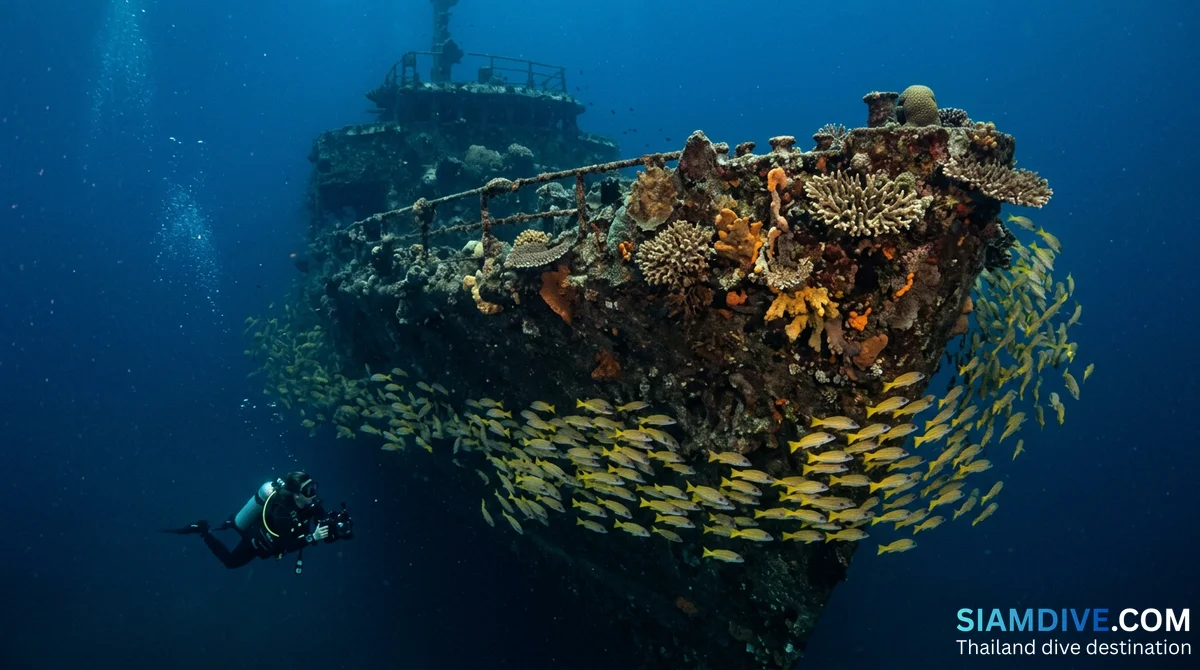
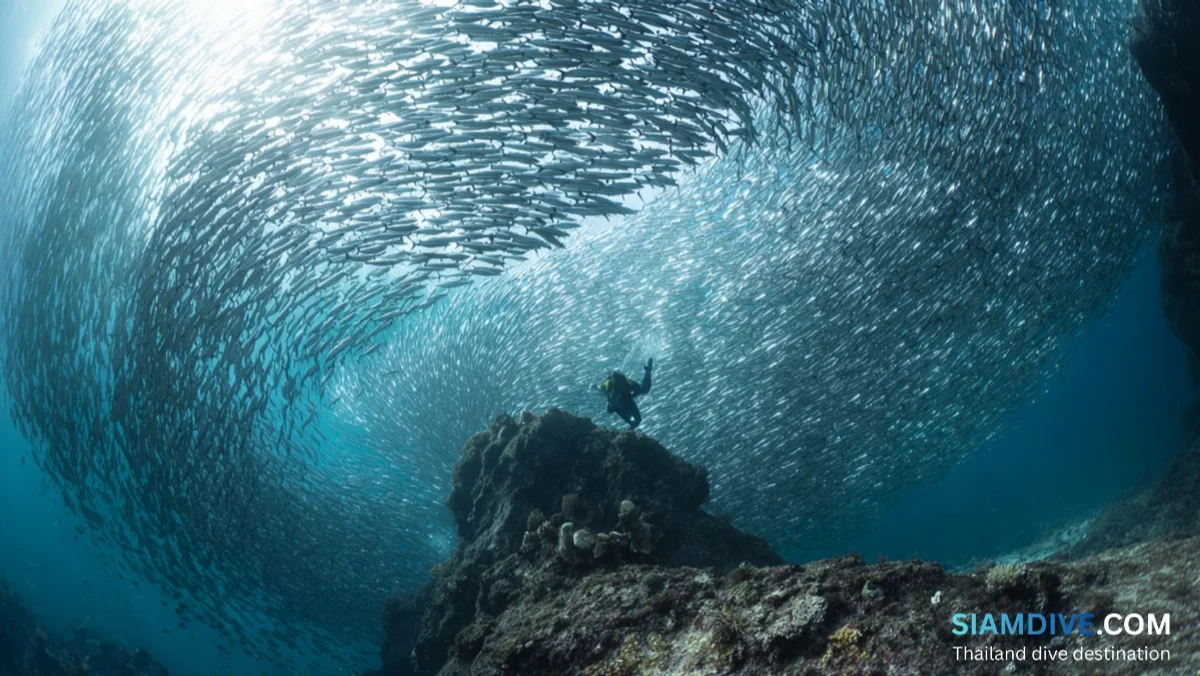
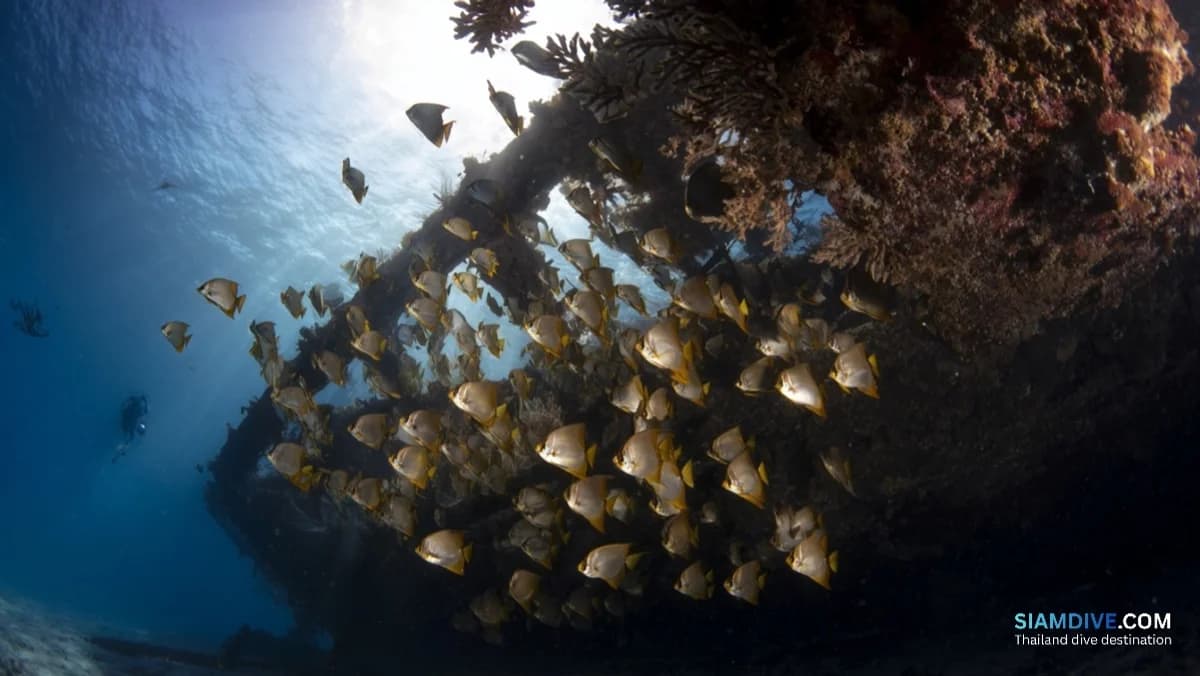
Descend to 18 metres off Khao Lak and the outline of a ship should appear. It rarely does. Instead, a wall of batfish drifts across the bow section, followed by a curtain of yellow-tail barracuda thick enough to dim the ambient light. Somewhere behind them, encrusted in two decades of hard coral, lies what remains of the Boonsung — a tin dredger that the sea discarded, a tsunami shattered, and marine life claimed entirely.
A Tin Dredger Nobody Wanted
The Boonsung spent its working life processing tin ore off the Andaman coast, likely from the 1950s onward. By 1984 the hull was redundant. The cheapest disposal method was the simplest: tow it seven nautical miles west of Bangsak Pier and let it sink. The roughly 60-metre vessel settled onto a flat sand bottom at around 18–20 metres, its decks sitting at 12–14 metres — shallow enough that even the Thai navy had to flatten its highest points to keep shipping lanes clear.
For twenty years the wreck sat in relative obscurity, a local site frequented mostly by Khao Lak dive shops running half-day trips. It accumulated growth the way any submerged steel does: a thin crust of barnacles, small colonies of soft coral, the first tentative hard-coral settlers. Nothing unusual for the Andaman Sea.
Then the Indian Ocean decided otherwise.
Five Pieces on the Sand
On December 26, 2004, the tsunami that killed more than 5,000 people in Phang Nga province hit the Boonsung with enough force to rip the hull into four or five major sections. The wreck that had been a single silhouette on the sand became a debris field spread across a much wider footprint.
From a diving perspective, the destruction created something the original wreck never offered: variety. Each broken section became its own micro-habitat — different angles of steel catching different currents, different depths collecting different species. The gaps between sections became corridors that channel fish. The exposed interiors, too corroded and fragile for safe penetration, grew new surfaces for coral larvae to settle on.
The tsunami did not improve the Boonsung. It multiplied it.
What Grew Back
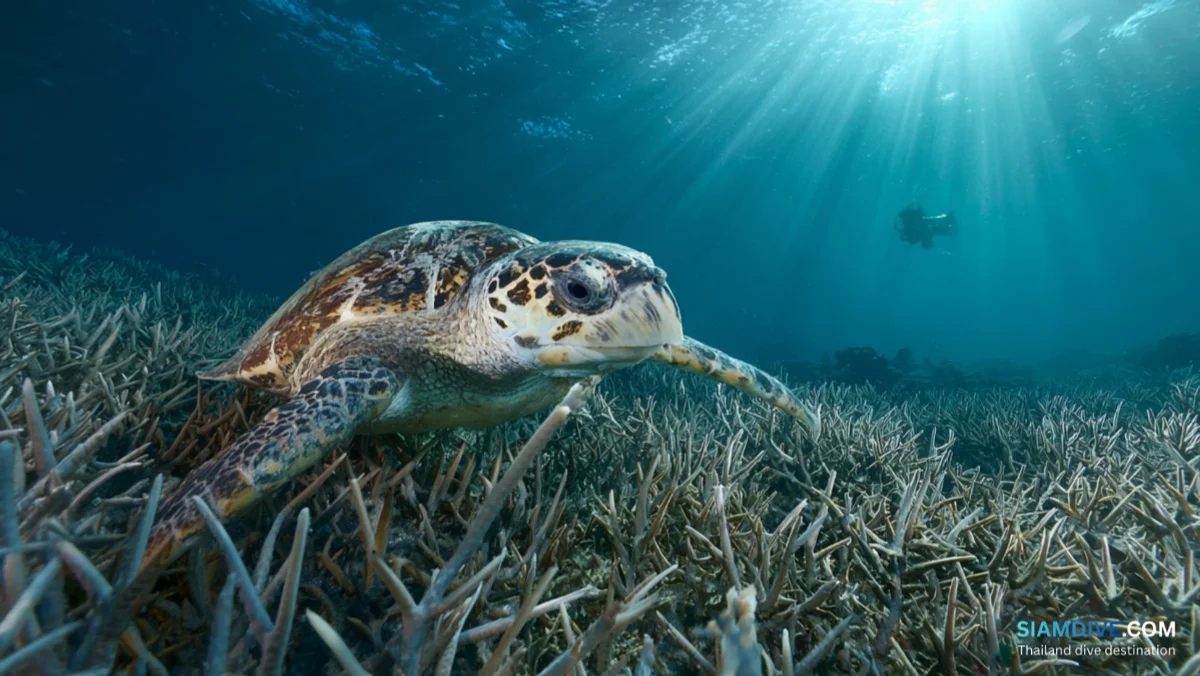
Post-tsunami coral recruits settled at up to 7.2 colonies per square metre per year on damaged Andaman Sea reefs — a rate that matched or exceeded undamaged controls, according to a 2010 study in Helgoland Marine Research. By 2006, just two years after the disaster, coral cover at several monitored sites had already surpassed their pre-tsunami 2002 baselines.
The broader picture was less catastrophic than the images suggested. Only about 13% of the Andaman Sea's coral reefs suffered high damage — defined as more than 50% of corals destroyed. Nearly 40% showed no measurable impact at all.
The Boonsung benefited from both its location and its structure. Sitting on open sand away from reef walls, it absorbed wave energy differently than shallow fringing reefs. The steel skeleton offered unlimited hard substrate for new settlement. And the wreck's position at 18 metres placed it below the worst of the tsunami's surge zone.
In 2010, a conservation group placed an artificial reef structure called The Great Pyramid near the Boonsung, adding more colonisable surface to the area. Within months, baby soft corals, juvenile white-eyed morays, and scorpionfish recruits had appeared on the new structure — confirming that the neighbourhood was actively seeding new habitat.
The 2024 Bleaching Test
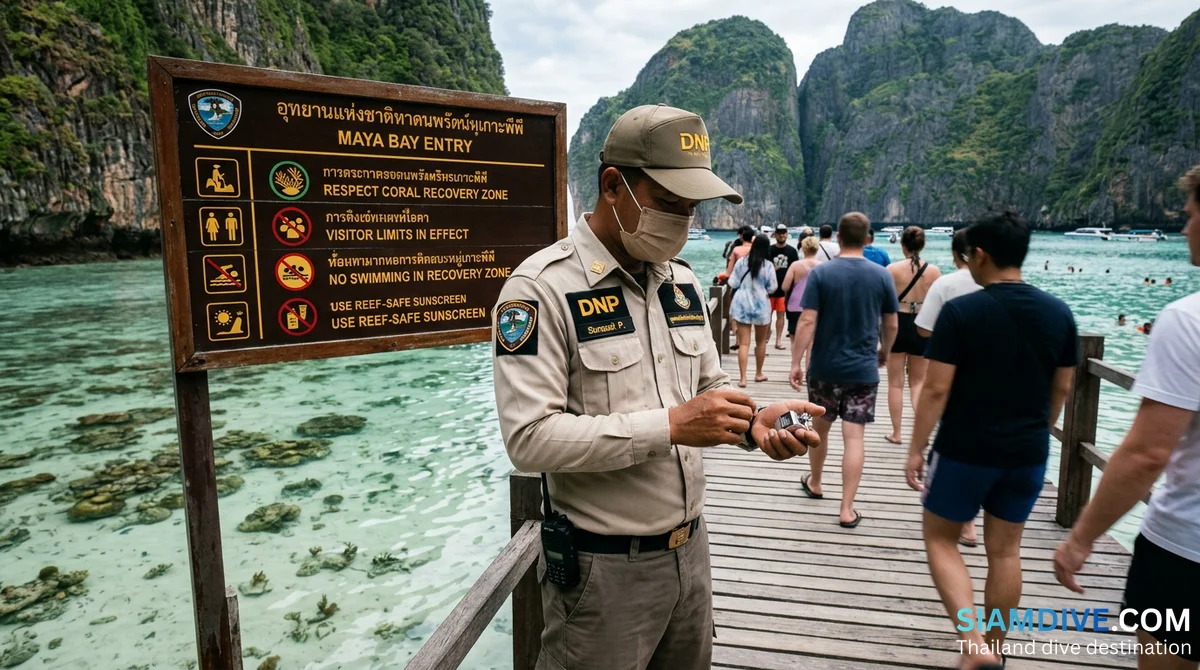
The Andaman coast faced another major stress event in 2024. Sea temperatures triggered widespread bleaching across 19 national parks along the Gulf and Andaman coasts. Thailand's DMCR responded with its "Reduce, Refrain, Rescue" framework: banning fish feeding, restricting sunscreen chemicals, temporarily closing hotspots, and relocating vulnerable colonies. By early 2025, Andaman Sea recovery rates had reached 60–70%, with the department reporting regrowth across 24 rai in seven provinces and 60,000 reproduced colonies under nursery care.
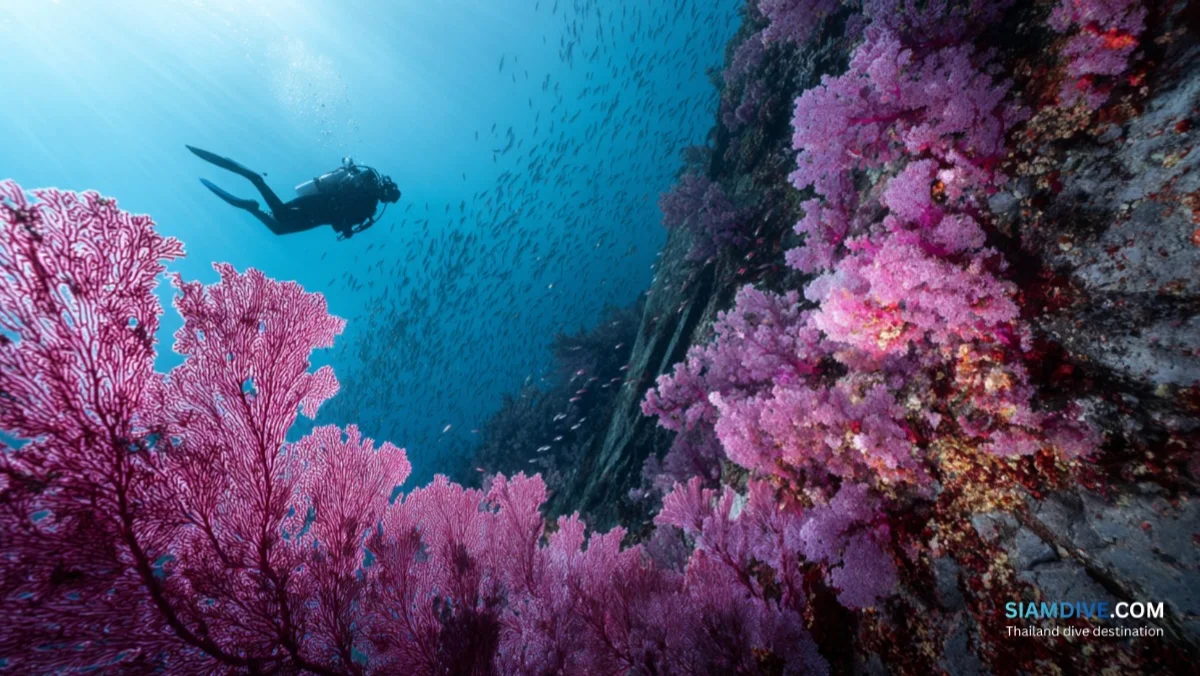
A January 2026 assessment published by Mongabay noted a more sobering trend: even as coral cover recovers, structural complexity is declining. Acropora staghorn and branching corals — the species that build the three-dimensional architecture fish depend on — are appearing less frequently than in decades past. Wreck sites like the Boonsung may play an underappreciated role here. Their steel frames provide the vertical structure that natural reefs are losing, offering refuge habitat at exactly the depths where complexity matters most.
Fish Soup at 18 Metres
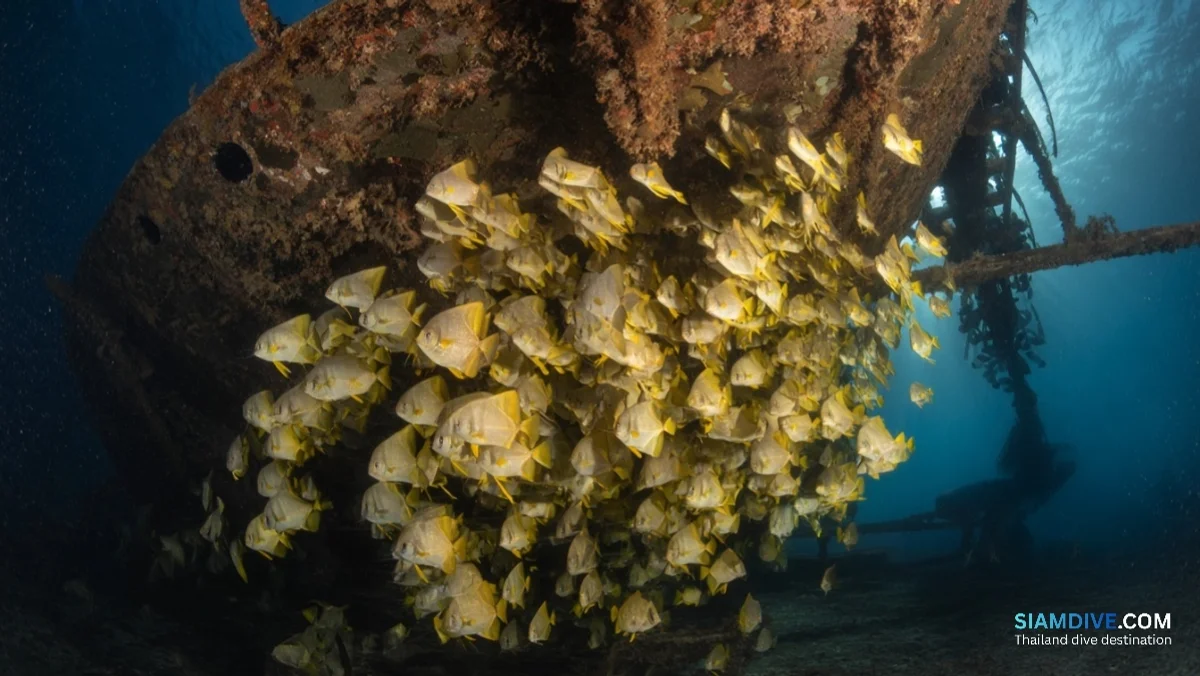
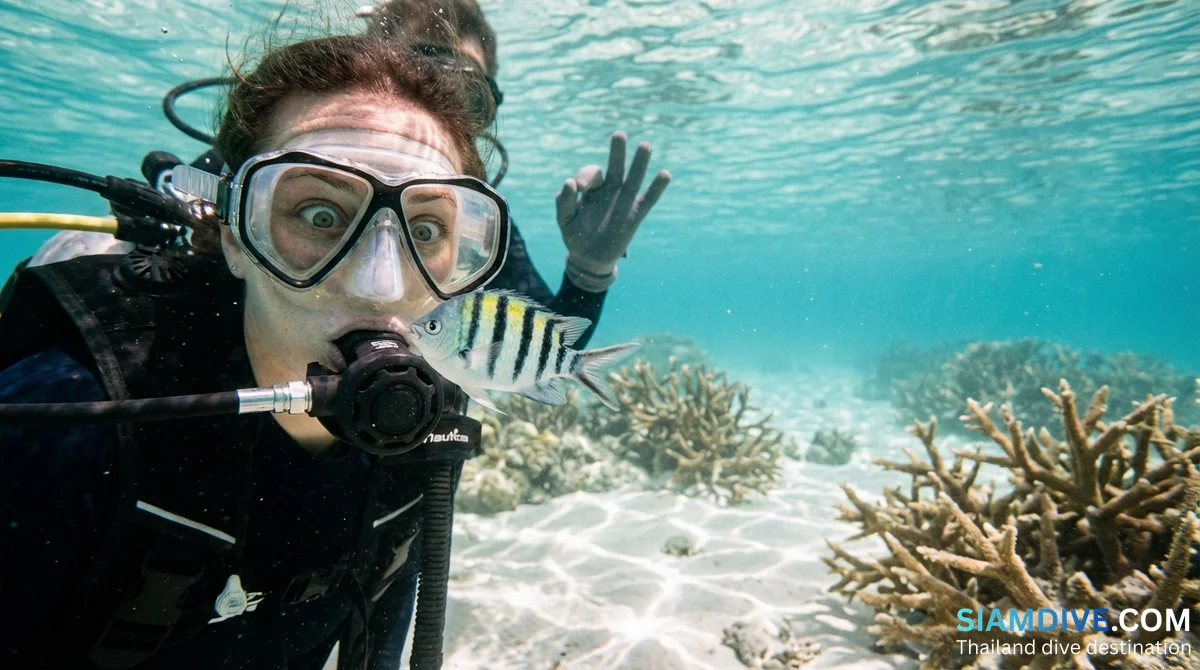
Khao Lak dive operators call the Boonsung "fish soup," and the name is not generous — it is accurate. The wreck sits on featureless sand, which means every schooling species in the vicinity treats it as the only structure worth gathering around. The concentration of biomass per square metre rivals many purpose-built artificial reefs at twice the depth.
- Schooling species — big-eye trevally, yellow-tail barracuda, yellowtail snapper, fusiliers, and batfish swarm the wreck in numbers that regularly obscure the structure itself
- Resident ambush predators — scorpionfish, stonefish, crocodile fish, and lionfish station themselves among the coral-encrusted steel, relying on camouflage against the textured surface
- Macro life — ornate ghost pipefish hide among crinoids, nudibranchs dot the corroded plates, and cuttlefish patrol the sand margins
- Moray eels — multiple species, including giant morays and white-eyed morays, occupy holes in the fractured hull
- Seasonal visitors — whale sharks have been spotted cruising past the wreck, drawn by the same plankton-rich currents that feed the barracuda schools
The density is partly a function of isolation. On a natural reef, fish spread across kilometres of habitat. At the Boonsung, everything compresses onto a footprint of maybe 30 by 10 metres per section — four or five such sections scattered across the sand. The effect underwater is immersive in a way that even larger, more famous wreck sites rarely match.
Two Dives at Twenty Metres
The Boonsung is an Open Water dive. Maximum depth on the sand sits around 18–20 metres, with the shallowest wreck sections at 12–14 metres. Any certified OW diver can handle it, though buoyancy control matters more here than at most sites — the corroded steel is fragile, and inadvertent contact damages both the coral and the structure.
- Visibility
- 5–15 metres, typically toward the lower end. The wreck sits on sand near the mainland, and particulate levels are higher than at offshore Similan sites. On good days, 15 metres opens up the full wreck. On average days, expect 8–10 metres — which actually intensifies the fish-soup effect.
- Current
- Generally mild. Occasional drift from the south, but nothing that requires an advanced certification. Guides adjust the dive plan to match.
- Penetration
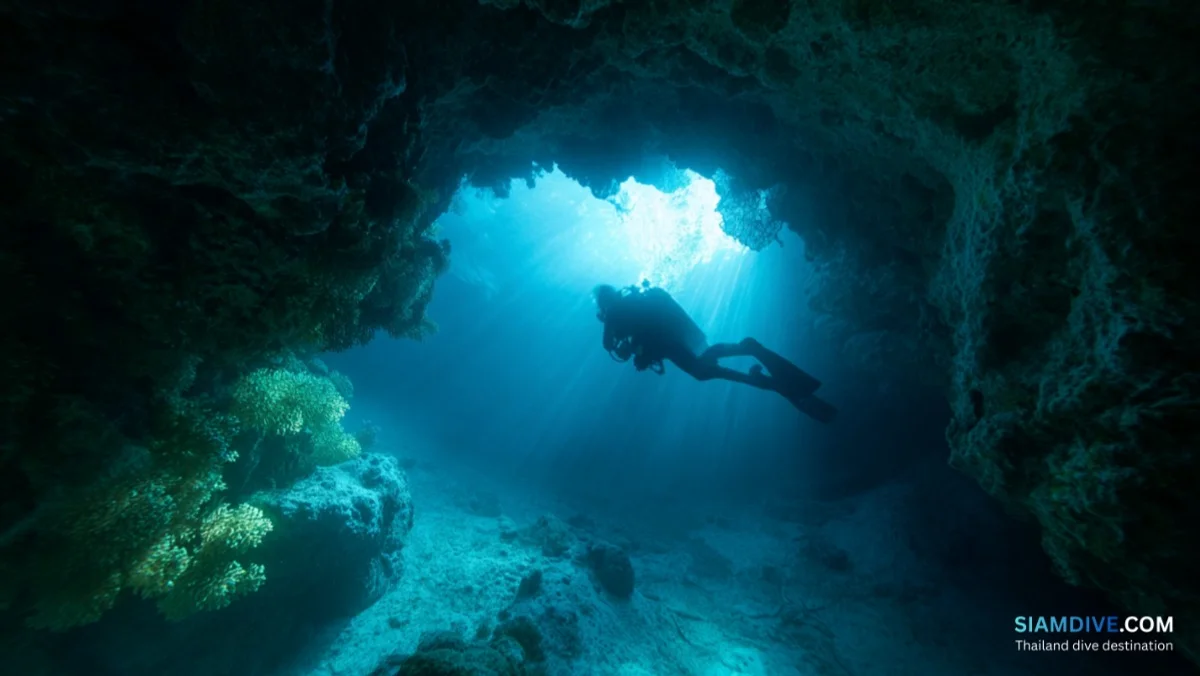
- Not recommended. The wreck's age, extensive coral growth, and corroded metal make entering enclosed sections a risk not worth taking. The outside offers more than enough.
- Temperature
- 27–29°C during the October–May season. Most divers are comfortable in a 3mm wetsuit or shorty.
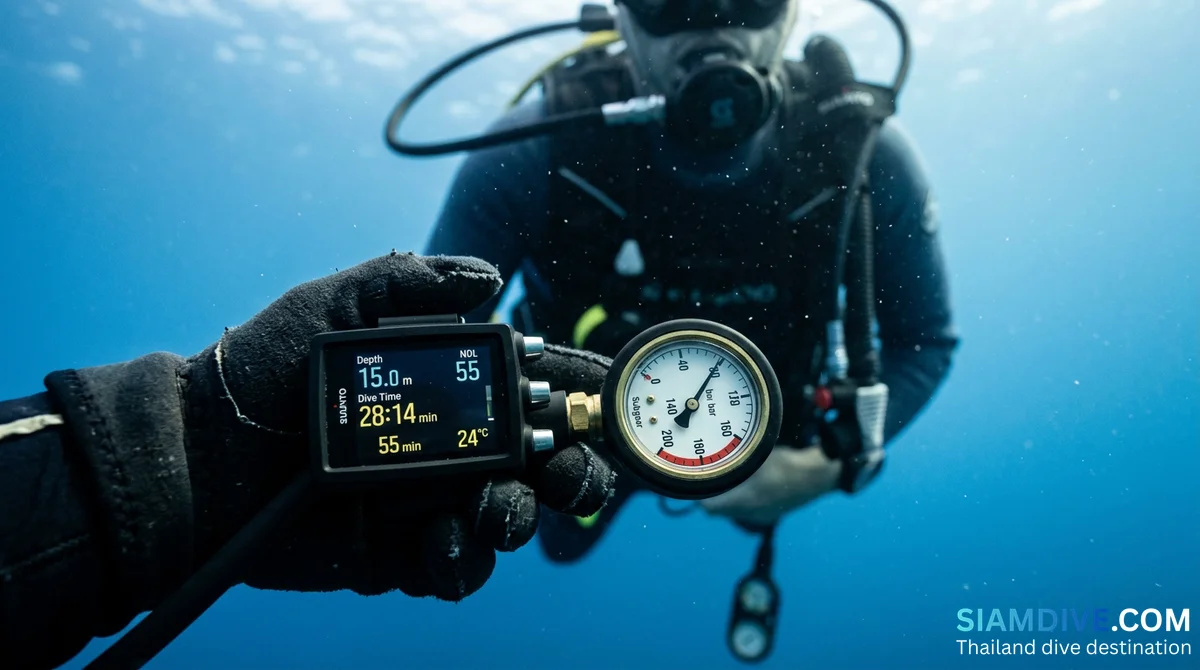
Day trips typically include two dives at the wreck, each running 45–60 minutes. Groups are small — four divers per guide at most shops — which keeps the site from feeling crowded even on peak-season weekends.
The Pier, the Price, the Season
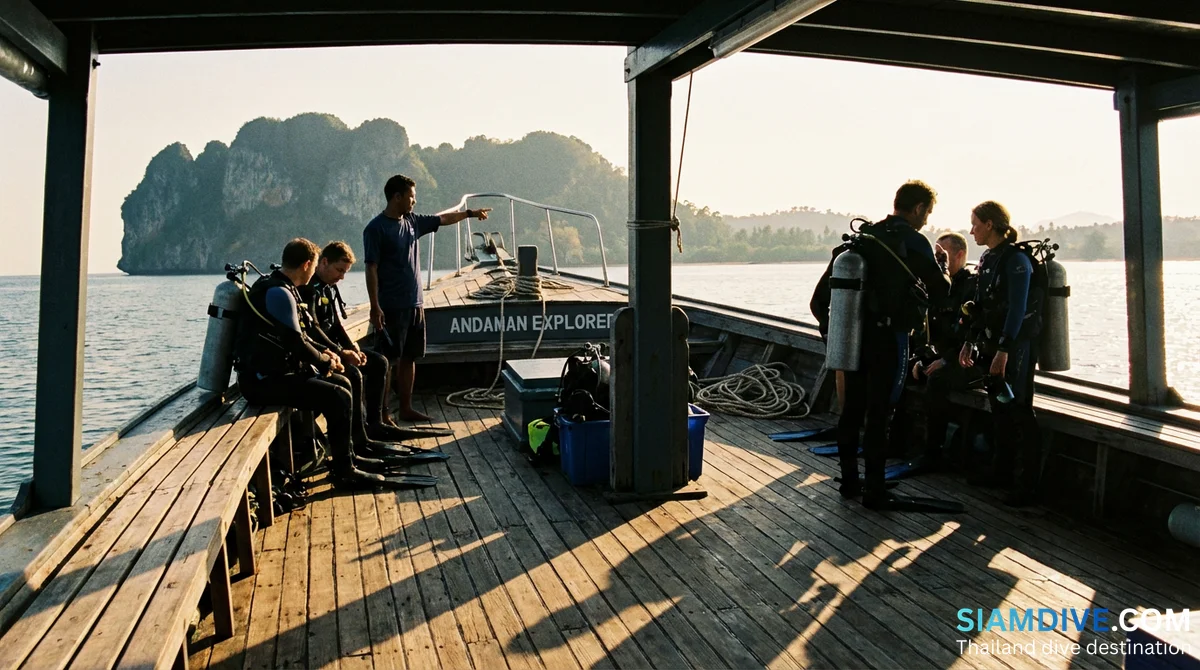
All Khao Lak dive boats depart from Thap Lamu Pier, a compact working harbour south of the town centre. The Boonsung sits roughly 45 minutes by boat to the west, making it one of the closest dive sites in the area — closer than the Similans, closer than Koh Bon, and accessible as a half-day trip.
- Season — October 15 to May 15, aligned with the Similan National Park calendar. The wreck itself is not inside the park boundary, but Khao Lak operations shut down entirely during the southwest monsoon.
- Price — day trips with two dives run approximately 5,600 THB per diver, plus a 700 THB national park fee payable on site. Prices typically include hotel transfers within Khao Lak, equipment, lunch, and basic insurance.
- Frequency — most shops schedule Boonsung trips three to four days per week, often combining the wreck with a second local site like Khao Na Yak reef.
- Who should go — OW-certified divers who want big fish life without the budget or schedule commitment of a Similan liveaboard. The site is particularly strong for photographers — the low visibility and dense fish schools create dramatic backlit compositions at midday.