Air Consumption in Scuba Diving: How to Make Every Tank Last
13 เมษายน 2569
Learn how to reduce your air consumption and extend dive time. Practical tips on breathing, buoyancy, trim, and gas management for every level.
Why Some Divers Burn Through Air Twice as Fast
You have probably noticed it — some divers surface with 100 bar while you are down to 50 from the same dive. It is not about lung size, fitness level, or gender. The divers who consistently use less air have three things in common: efficient breathing, good buoyancy control, and streamlined body position. None of these are natural talents. All of them are trainable skills that improve with every dive.
Understanding your air consumption rate matters for practical reasons. Better air consumption means longer dives, more flexibility on multi-stop trips, and a larger safety margin for unexpected situations. On a liveaboard doing four dives a day, the difference between a 45-minute and 60-minute dive adds up to a full extra hour of underwater time every single day.
Understanding SAC Rate and RMV
SAC (Surface Air Consumption) rate measures how much air you breathe per minute, normalized to surface pressure. A typical beginner has a SAC rate of 20-25 liters per minute. Experienced divers average 12-15 liters per minute, and very efficient divers can drop below 10.
RMV (Respiratory Minute Volume) accounts for depth. At 20 meters (3 atmospheres absolute), your regulator delivers air at three times surface pressure, so you consume three times the volume from your tank for every breath. A SAC rate of 15 liters per minute becomes 45 liters per minute at 20 meters — and 60 liters per minute at 30 meters.
To calculate your SAC rate: note your starting and ending tank pressure, the dive time, your average depth, and your tank volume. The formula is straightforward — (pressure used × tank volume) ÷ (time × depth in atmospheres). Track this over 10 dives and you will see a clear trend that shows where you are improving and where you are not.
Apps like Dive Kit and Subsurface can calculate SAC automatically from your dive computer data. Tracking the number over weeks reveals patterns — stress, cold water, current, and poor trim all spike your consumption in measurable ways.
Breathing Technique: The Biggest Factor
Most new divers breathe from their chest — short, shallow breaths that move air in and out of the top of the lungs without fully exchanging oxygen and carbon dioxide. This triggers a cycle: shallow breaths leave CO2 in the lungs, CO2 buildup makes you feel breathless, and you breathe faster to compensate, which makes the problem worse.
Switch to diaphragmatic breathing. Breathe into your belly, not your chest. Inhale slowly for 4 seconds, letting your abdomen expand. Pause for a beat. Exhale slowly for 6-8 seconds, letting the air flow out completely. This deep, slow rhythm maximizes gas exchange in the lower lungs where the blood vessels are densest, extracting more oxygen per breath and clearing CO2 efficiently.
The exhale matters more than the inhale. A full exhale empties stale air from the bottom of your lungs, making room for fresh air on the next breath. Most divers underestimate how long they can comfortably exhale — try extending it by one second each dive until you find your natural limit.
Never hold your breath. The golden rule of scuba exists for a reason — lung overexpansion injury is real and can be fatal. Slow, continuous breathing achieves the same air savings as breath-holding without any of the risk. If you catch yourself pausing between breaths, switch to a deliberate slow exhale instead.
Buoyancy Control: Stop Wasting Air on Your BCD
Every time you add or dump air from your BCD, you are spending air from your tank. Divers with poor buoyancy are constantly adjusting — a burst of air here, a dump there, another burst because they sank too far. This see-saw pattern uses significantly more air than you realize.
Good buoyancy starts with correct weighting. Most divers are overweighted, which forces them to put more air in the BCD to stay neutral. That extra BCD air shifts around as you change position, creating instability that requires more corrections. Do a proper weight check: at the surface with an empty BCD and a half-full tank, you should float at eye level while holding a normal breath. Exhale, and you should sink slowly.
Once your weighting is right, the goal is to touch your BCD inflator as little as possible during the dive. Adjust buoyancy with your breath — a slightly deeper inhale when you start to sink, a full exhale when you start to rise. Your lungs are a buoyancy device with zero air cost from your tank.
Practice hovering motionless at a fixed depth for 60 seconds without touching your BCD or kicking. This single exercise, repeated at the start of every dive, trains the micro-adjustments in breathing that eliminate the need for constant BCD correction. When you can hover without effort, you have crossed the threshold from air waster to air saver.
Trim and Streamlining: Reduce the Drag
Horizontal trim is the position where your body is flat and parallel to the seabed. This is the most efficient position in water because it minimizes your cross-sectional area — less drag means less effort means less air. A diver swimming head-up with legs dangling catches water like an open parachute.
Achieve horizontal trim by adjusting weight placement, not body effort. If your legs sink, move weight higher on your body — trim pockets on your BCD shoulders or a weight belt worn higher on the waist. If your head drops, shift weight lower. The goal is to be balanced in the water without muscular effort to hold position.
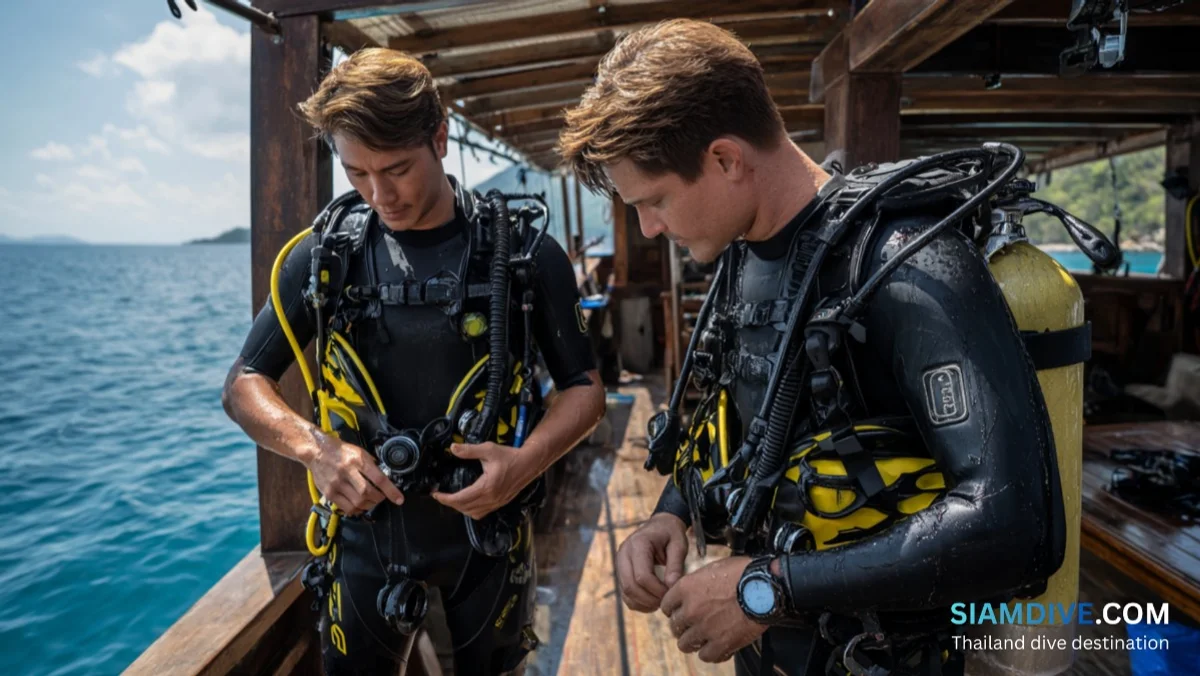
Tuck everything. Dangling gauges, loose octopus hoses, unclipped accessories, and trailing straps all create drag. Clip your console to a D-ring, secure your alternate air source in the triangle between your chin and lower ribs, and tuck hoses against your body. This five-minute gear check before every dive saves air for the full duration.
Swim with your arms still. Cross them on your chest, tuck them behind your back, or hold them along your sides. Arm movements create turbulence, disturb your trim, and burn energy without moving you forward. Your fins do 100% of the propulsion — arms are just drag generators.
Finning Technique: Efficiency Over Power
The flutter kick that most new divers use — rapid up-and-down leg movements — is the least efficient kick style in scuba. It generates turbulence, stirs up silt, and uses large muscle groups that demand high oxygen consumption. It works, but it costs you air.
The frog kick is the gold standard for air conservation. Bring your knees forward, splay your fins outward, then sweep them together and backward in a wide arc. Glide between kicks. The frog kick uses smaller muscle groups, produces a clean thrust without turbulence, and the built-in glide phase means you are moving forward while spending zero energy.
Match your kick rate to your actual need. Many divers fin continuously even when they are not going anywhere — a habit from surface swimming that wastes enormous amounts of air underwater. Kick only when you need to move. Between kicks, glide and let momentum carry you. Three powerful frog kicks followed by a 10-second glide covers more distance with less air than 30 seconds of continuous flutter kicking.
Gas Management: The Rule of Thirds
The rule of thirds divides your available gas into three equal portions: one-third for the outward journey, one-third for the return, and one-third as reserve. On a standard 200-bar aluminum tank, that means you begin heading back at 130 bar and surface with at least 65 bar. This leaves a margin for unexpected currents, navigation errors, or buddy assist situations.
Plan your dive, dive your plan. Before entering the water, agree with your buddy on turnaround pressure, maximum depth, and maximum time. The most conservative number always wins — if your buddy turns at 130 bar but you planned 120, you both turn at 130.
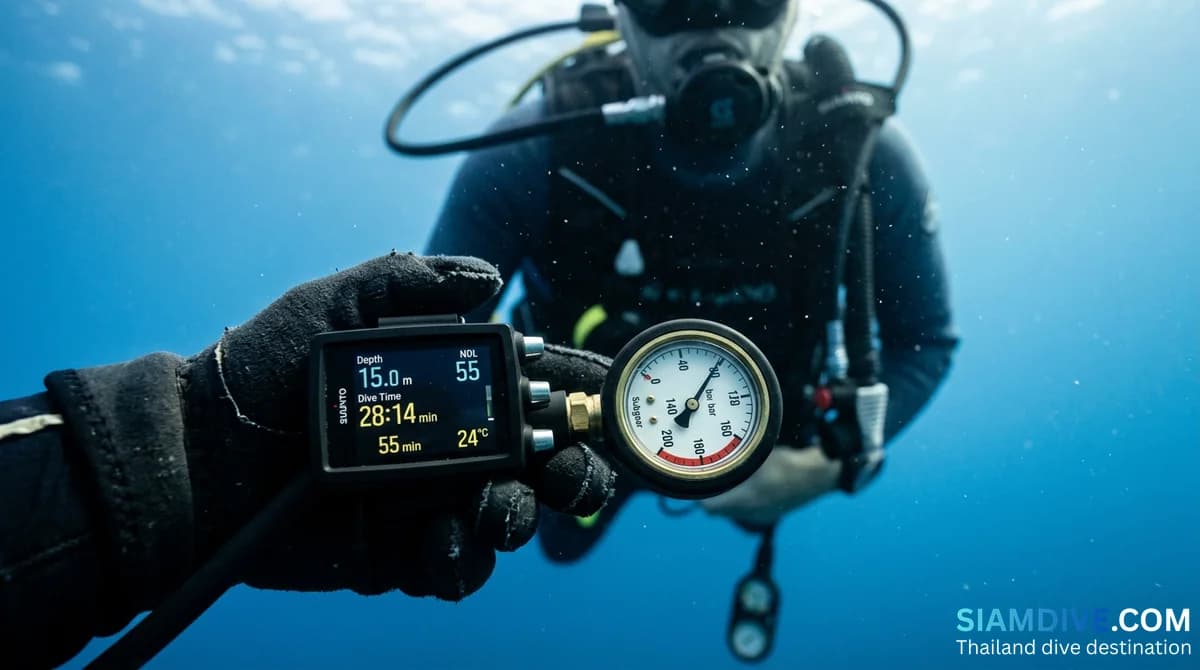
Monitor your gauge every 5 minutes, not just when you remember. Air consumption accelerates with depth, exertion, and cold, and these changes happen gradually enough that you will not notice without checking. A diver who checks their gauge regularly is never surprised by a low-air situation.
For multi-dive days common on Thailand liveaboards doing 3-4 dives, plan your deepest and most demanding dive first when your air consumption is lowest and your body is freshest. Save shallow, relaxed reef dives for the afternoon when fatigue increases consumption.
Environmental Factors That Spike Consumption
Cold water increases air consumption by 20-30%. Your body burns more energy maintaining core temperature, and the involuntary stress response from cold quickens breathing. Wear appropriate exposure protection — a 5mm wetsuit in 26°C water might feel unnecessary, but it pays for itself in extended dive times.
Current requires more finning and therefore more air. Plan for this: if you know the dive site has current, budget a higher consumption rate and adjust your turnaround pressure accordingly. Drift with the current whenever possible instead of fighting it.
Depth is the unavoidable multiplier. The same breath at 30 meters uses twice the tank air as the same breath at 10 meters. Spend more time at shallower depths when air conservation matters — the reef between 8 and 15 meters often has the best marine life density anyway.
Stress and anxiety double or triple consumption instantly. If you feel stressed underwater, stop moving, hold onto something stable, and focus on slowing your breathing for 30 seconds. The physiological response fades quickly when you address it directly instead of pushing through it.
Track, Improve, Repeat
Air consumption improves with deliberate practice, not just more dive experience. A diver with 500 dives and sloppy technique will use more air than a 50-dive diver who practiced buoyancy, trim, and breathing from the start. The fastest way to improve is to pick one variable per dive — breathing, trim, kick style, or weight — and focus on it exclusively.
Log every dive with pressure data. Over 10-20 dives, your SAC rate trend tells you exactly what is working. If your SAC dropped after fixing your trim but plateaued after breathing exercises, you know where to focus next.
Ready to put these skills to work? Find dive trips and liveaboards at siamdive.com where you can practice on world-class reefs — and enjoy the extra bottom time that better air consumption gives you.