Preventing Diving Emergencies: A Practical Safety Guide
13 เมษายน 2569
Learn to prevent the most common diving emergencies before they happen. From pre-dive checks to emergency response, stay safe on every dive.
Most Diving Emergencies Are Preventable
The vast majority of scuba diving incidents share a pattern: a small problem that was ignored or mishandled until it became a big one. A regulator free-flow that turned into an out-of-air situation because the diver panicked. A mild current that became a separation because the buddy team did not agree on a plan. An ear squeeze that became a barotrauma because the diver forced equalization instead of ascending a meter.
DAN (Divers Alert Network) data consistently shows that the leading causes of diving fatalities are drowning, cardiac events, and arterial gas embolism — and in most cases, these endpoints were preceded by a chain of smaller, preventable errors. Break any link in that chain and the outcome changes. This guide focuses on those links: the specific checks, skills, and habits that stop small problems from becoming emergencies.
The Pre-Dive Check That Prevents 80% of Equipment Issues
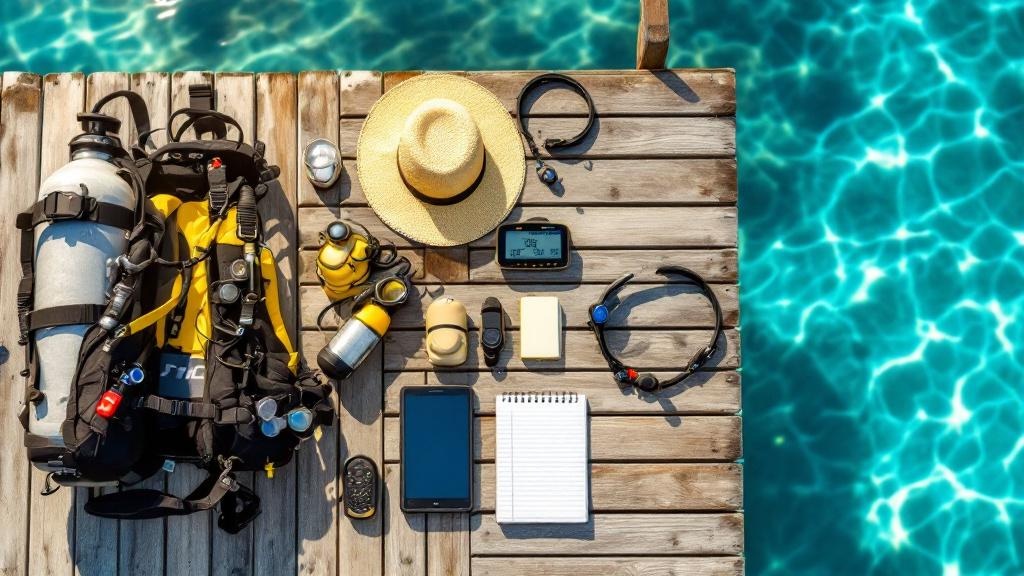
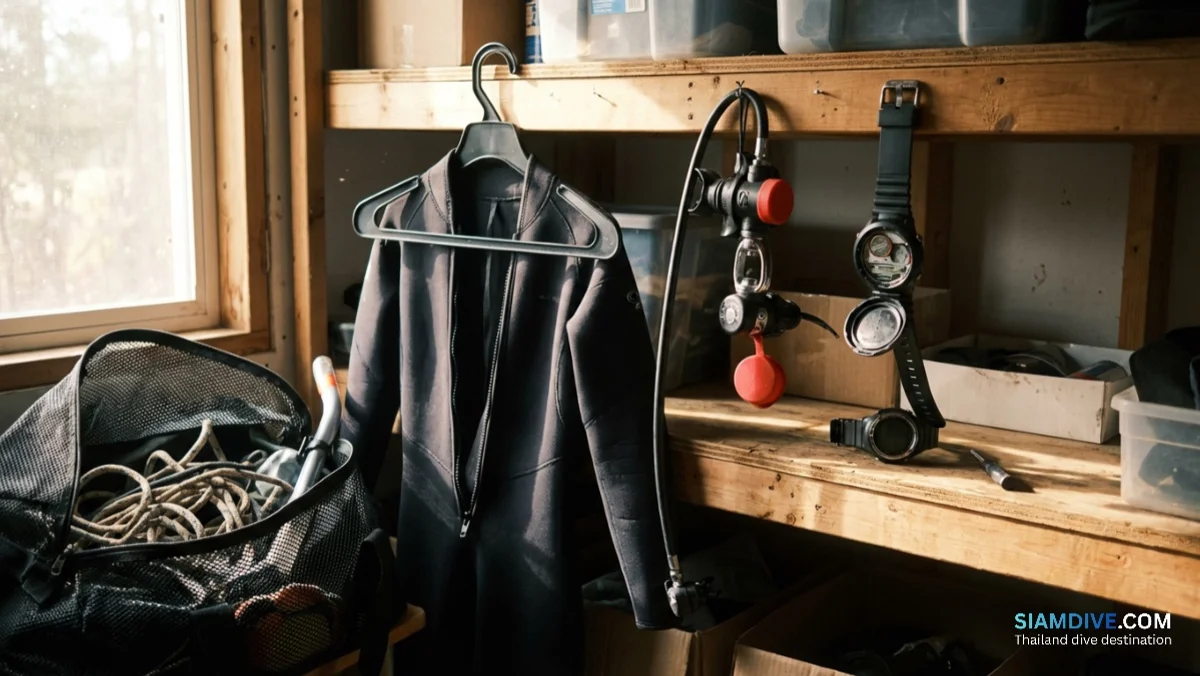
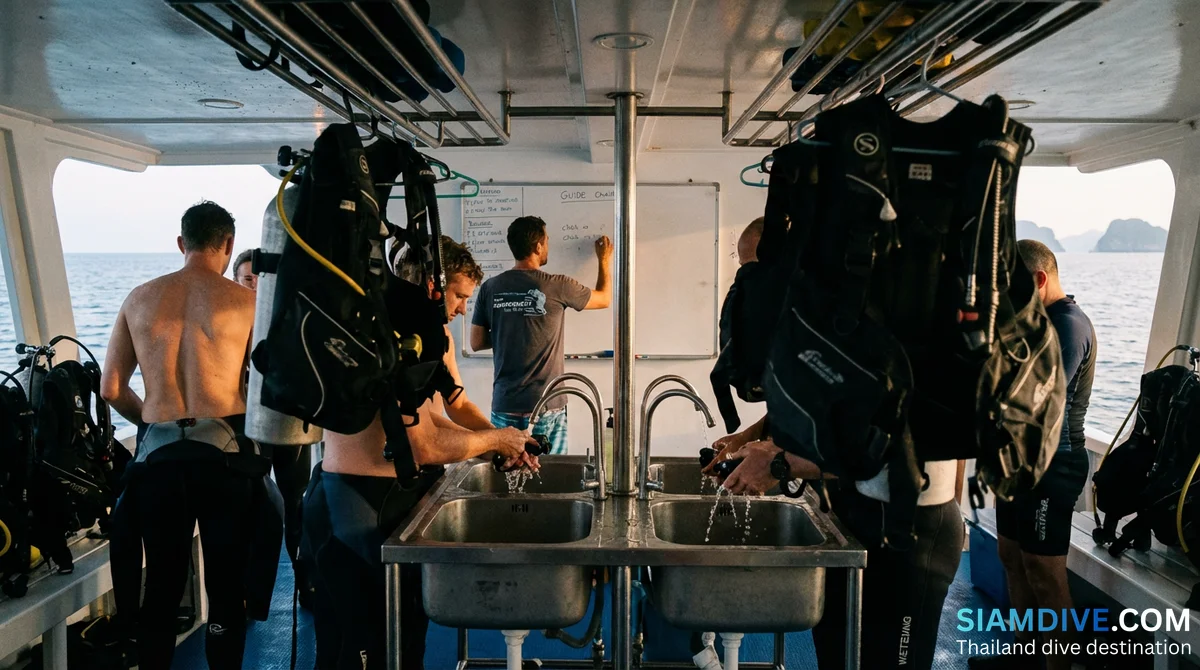
BWRAF — Buoyancy, Weights, Releases, Air, Final check. This five-point gear inspection takes 90 seconds and catches nearly every equipment problem before it matters. Yet experienced divers skip it routinely, assuming their familiar gear is fine. It is not always fine.
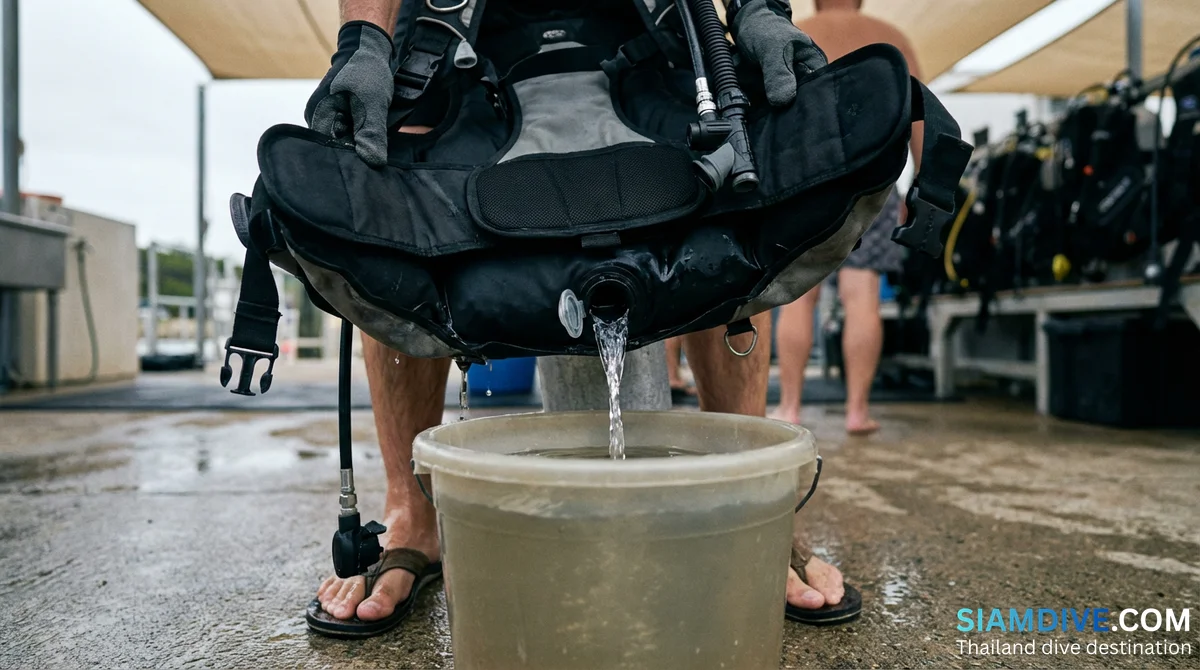
Buoyancy: Inflate your BCD fully, then deflate completely. Confirm the inflator button does not stick (a stuck inflator causes uncontrolled ascent), and that all dump valves work. Orally inflate a small amount and confirm it holds — a leaking BCD bladder drains air gradually, and you will not notice until you are negative at depth.
Weights: Confirm your weight system is secure and the release mechanism works with one hand. Check that integrated weight pockets are locked and will not fall out during the dive. Know your buddy's release system too — in an emergency, you may need to ditch their weights.
Releases: Trace every buckle and clip on your BCD. Confirm each one opens and closes properly. Your buddy should be able to identify and operate your releases in an emergency — point them out during the check.
Air: Turn your tank valve fully open, then back a quarter turn. Breathe from your primary and alternate regulators for several breaths each. Check your SPG reads full (180-220 bar depending on the fill). Confirm your buddy's alternate air source works and you know where it is clipped.
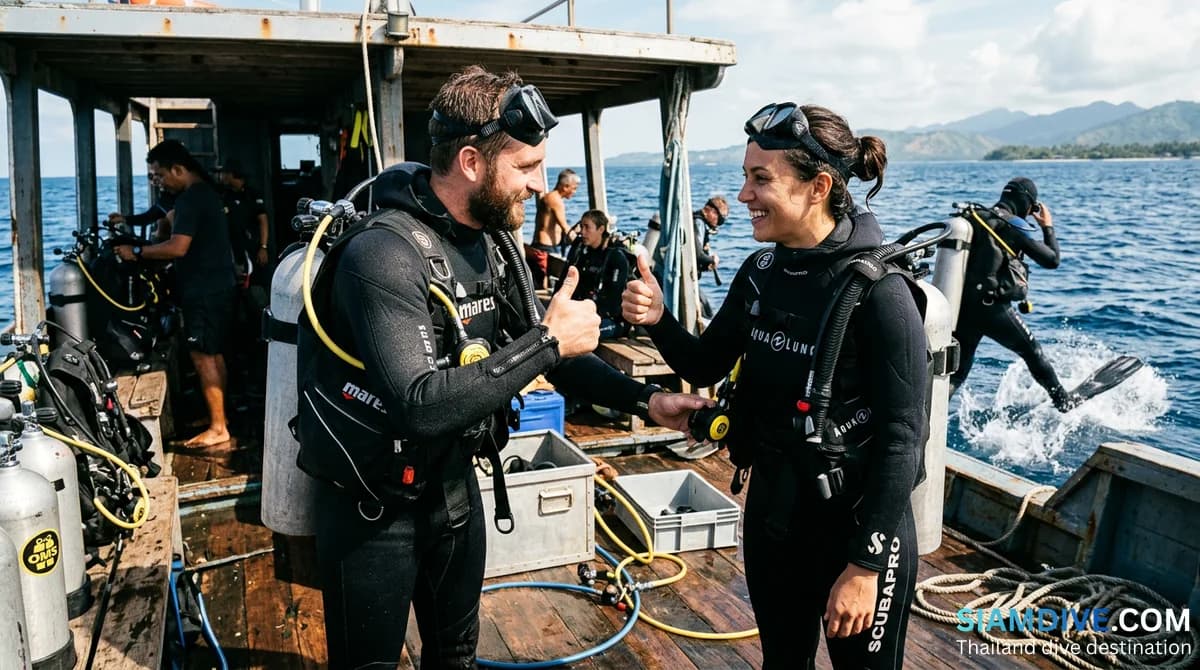
Final check: Mask strap secure, fins on, nothing dangling, computer on and showing correct gas mix. One last look at your buddy — are they ready? A nod, and you enter the water.
Decompression Sickness: Understanding and Prevention
DCS occurs when dissolved nitrogen forms bubbles in your blood and tissues during ascent. The risk increases with depth, bottom time, and ascent speed. Mild DCS causes joint pain and skin tingling. Severe DCS can cause paralysis, stroke-like symptoms, or death.
Follow your dive computer. Modern dive computers calculate nitrogen loading in real time and give you clear no-decompression limits. Stay within those limits. Do not push NDL to zero — leaving a 3-5 minute buffer gives you a safety margin for unexpected delays during ascent.
Ascend at no more than 9-18 meters per minute. Most computers alarm at 10 meters per minute. Slower is better — there is no penalty for ascending slowly, but ascending fast increases DCS risk exponentially. Make your safety stop at 5 meters for 3-5 minutes on every dive, even when your computer says it is optional.
Stay hydrated. Dehydration thickens blood and impairs nitrogen off-gassing. Drink water throughout the day, especially on liveaboard trips where heat, sun, and multiple dives compound dehydration. Avoid alcohol for at least 12 hours before diving — it dehydrates and impairs judgment.
Do not fly within 18-24 hours after diving. The reduced cabin pressure at altitude can trigger DCS even if you did everything right underwater. For repetitive or deep dives, DAN recommends at least 24 hours before flying. Plan your last dive day accordingly.
Out-of-Air Emergencies: Prevention and Response
Running out of air should never happen. It is entirely preventable through gas management — checking your gauge every 5 minutes, following the rule of thirds, and beginning ascent with adequate reserve. Yet out-of-air situations remain one of the most common diving emergencies because divers get distracted, forget to check, or push their limits.
If you are low on air, signal your buddy immediately. Do not wait until you are on empty — at 50 bar, you should already be ascending. At 30 bar, you are in genuine emergency territory with minutes of air remaining depending on your depth.
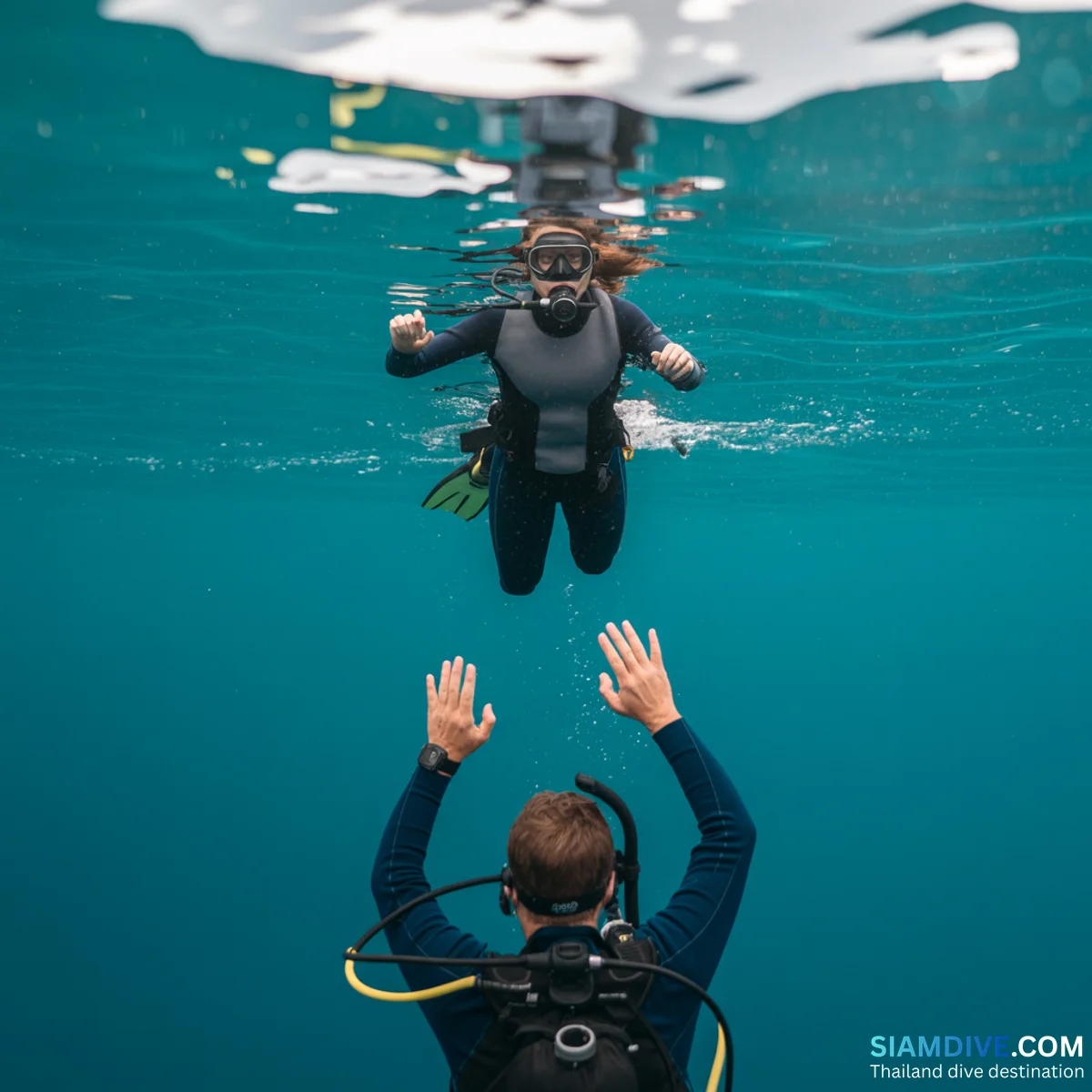
Practice alternate air source (AAS) sharing with every buddy, every dive trip. Locate your buddy's octopus before the dive. Confirm it works. Agree on the protocol: the out-of-air diver grabs the donor's alternate, secures it, signals OK, and both ascend together at a controlled rate. This drill should be muscle memory, not something you figure out at 25 meters with zero air.
CESA (Controlled Emergency Swimming Ascent) is the last resort when no alternate air is available. Exhale continuously while swimming toward the surface at a controlled rate. The expanding air in your lungs provides breathable gas during ascent. CESA works from depths up to about 9 meters — deeper than that, you are unlikely to make it to the surface before losing consciousness. This is why buddy diving and AAS protocols exist.
Equipment Failures: Free-Flows, BCD Leaks, and Mask Loss
Regulator free-flow: Your second stage jams open and air blasts continuously. Do not remove it from your mouth — you can still breathe from a free-flowing regulator by sipping air from the stream. Switch to your alternate if possible, signal your buddy, and begin a controlled ascent. A free-flow drains your tank fast, so act promptly but calmly.
BCD failure: If your BCD will not hold air, you lose buoyancy control. Establish buoyancy through lung volume and gentle finning. If you are sinking, drop weights. If you are rising uncontrollably, flare your body to increase drag and exhale to slow the ascent. Signal your buddy and ascend together.
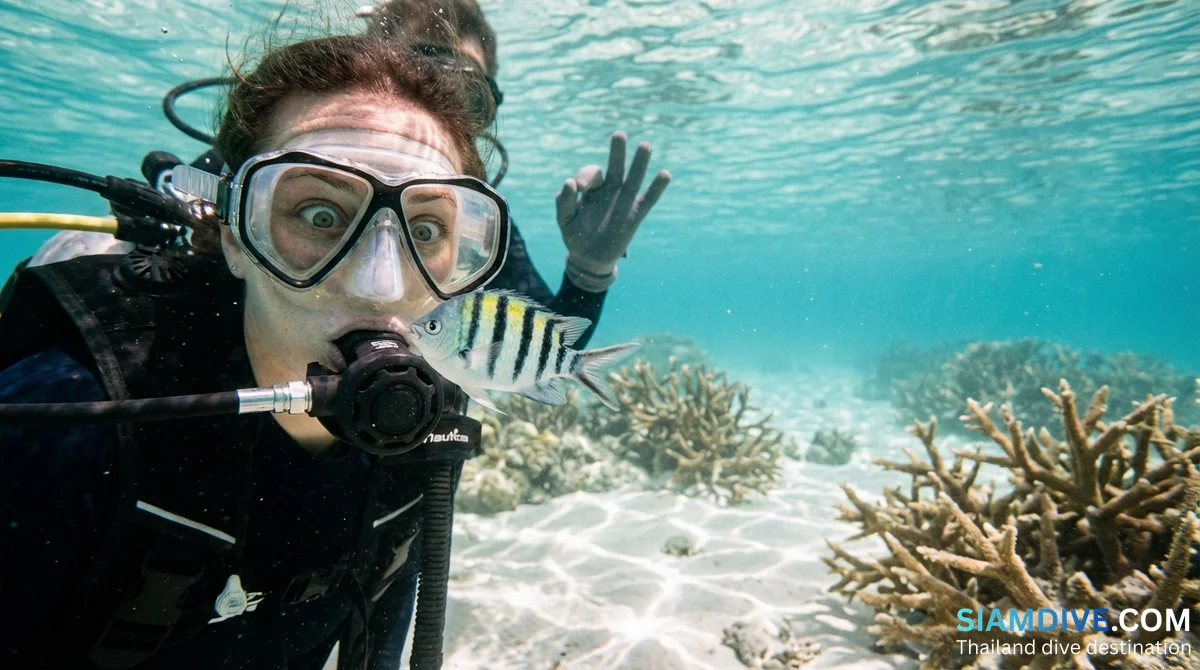
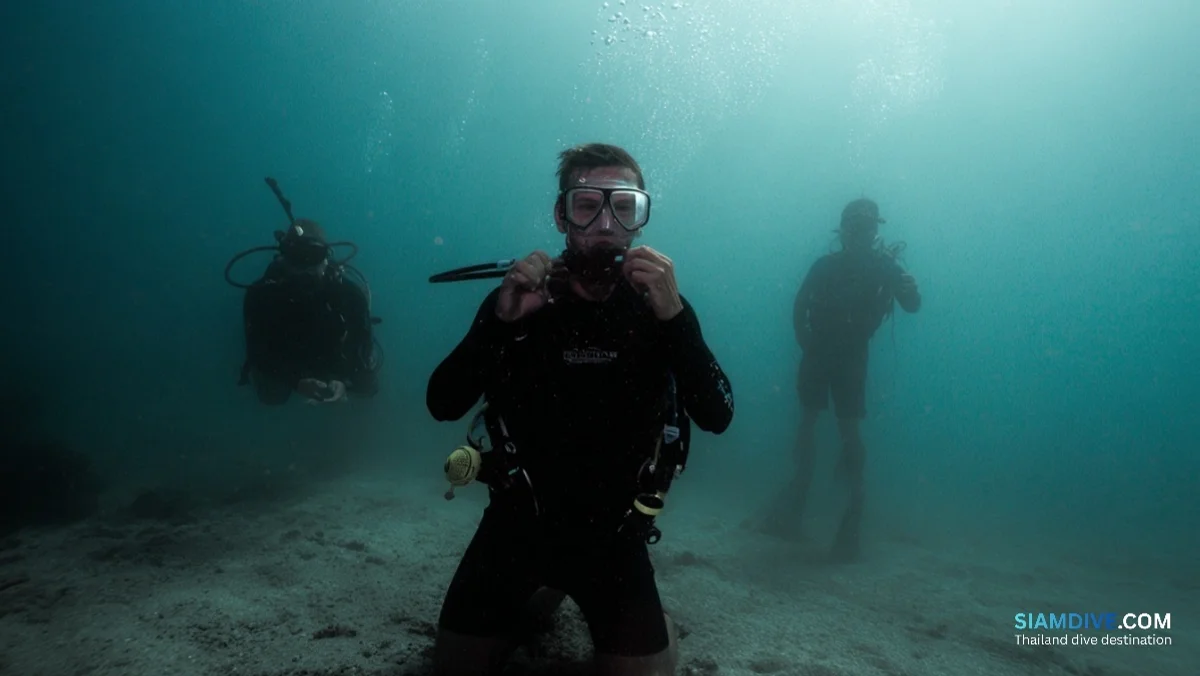
Mask flood or loss: A flooded mask is uncomfortable but not dangerous. Clear it by pressing the top of the frame against your forehead and exhaling through your nose. If your mask is knocked off entirely, keep breathing from your regulator, close your eyes or squint to protect them, and signal your buddy for assistance. You can ascend safely without a mask — vision is blurry but you have air.
Carry a backup mask clipped to your BCD on advanced dives. In overhead environments or deep dives far from the surface, losing your only mask adds significant risk. A compact backup mask weighs almost nothing and eliminates this problem.
Entanglement: Stay Calm, Stay Alive
Fishing line, abandoned nets, kelp, and mooring lines can trap divers. The instinctive response — thrashing and pulling — makes entanglement worse by tightening the snag and potentially damaging your equipment. Panic is the real danger, not the line itself.
Stop all movement immediately. Assess what is tangled and where. Most entanglements involve loose hoses, fin straps, or tank valves catching on lines. Slow, deliberate reverse movements often free you without cutting anything.
Carry a cutting tool. A dive knife, line cutter, or trauma shears should be accessible with either hand. Clip it to your BCD in a fixed, consistent location so you can find it without looking. Practice accessing it with gloves on — cold fingers and thick neoprene make fine motor tasks harder than you expect.
Signal your buddy before attempting to free yourself. Two sets of hands and eyes solve entanglement problems much faster than one. If you are alone and tangled, prioritize maintaining calm breathing — you have more time than your panic suggests, and a clear head makes better decisions than a racing one.
Building an Emergency Action Plan
Every dive should have a plan for what happens when things go wrong. This does not need to be complicated — a few agreed-upon responses that both buddies know cold.
Separation procedure: If you lose visual contact with your buddy, search for 30 seconds at current depth. If not found, ascend slowly to 5 meters and wait. If still separated, surface and reunite. Do not spend an entire dive searching — you have limited air and the surface is the meeting point.
Lost diver protocol: Dive boats should do head counts before moving. If a diver is overdue, the crew initiates a surface search while other divers stay out of the water. Know the boat's specific protocol before you dive from it.
DCS response: Administer 100% oxygen, keep the diver lying flat, hydrate with water (not alcohol), and contact DAN or local emergency services. In Thailand, hyperbaric chambers are located in Bangkok (Naval Medical Department), Pattaya, and Phuket. Know the nearest chamber to your dive site.
First aid kit: Every dive boat should carry oxygen, a first aid kit, and communication equipment. Verify this before the first dive. If the boat does not have emergency oxygen, that is a red flag about the operator's safety standards.
The Skills That Make You Emergency-Proof
Take a Rescue Diver course. PADI, SSI, and other agencies offer rescue certification that teaches you to recognize and respond to diving emergencies — in yourself and others. The course typically runs 3-4 days and covers self-rescue, panicked diver management, unresponsive diver recovery, and emergency scenario practice. It is the single best investment in your diving safety after open water certification.
Practice emergency skills regularly, not just during courses. Every 10 dives, run through mask removal and replacement, alternate air source deployment, CESA from 5 meters, and controlled buoyant lift. These skills decay with disuse — a Rescue Diver who last practiced two years ago is not much better prepared than an Open Water diver.
Dive within your limits. The most effective safety measure is choosing dives appropriate for your training and experience. A newly certified diver has no business on a 35-meter wreck in strong current, regardless of what the dive operator allows. Your certification level, logged dives, and honest self-assessment of your skills should determine where you dive.
Stay Prepared, Stay Safe
Diving emergencies are rare when you prepare properly. A 90-second pre-dive check, a clear buddy agreement, conservative gas management, and basic rescue skills handle the vast majority of potential problems. The goal is not to be fearless — it is to be so well-prepared that fear does not get the chance to take over.
Planning your next dive? Browse operators and destinations at siamdive.com — find trips with safety-conscious operators, proper equipment, and experienced guides who prioritize preparation as much as adventure.