48 Hours Post-Dive: The Ear Injury Nobody Expects
20 เมษายน 2569
Middle ear barotrauma often shows up days after the dive. How to spot delayed ear squeeze, when to ground yourself, and where to find help in Thailand.
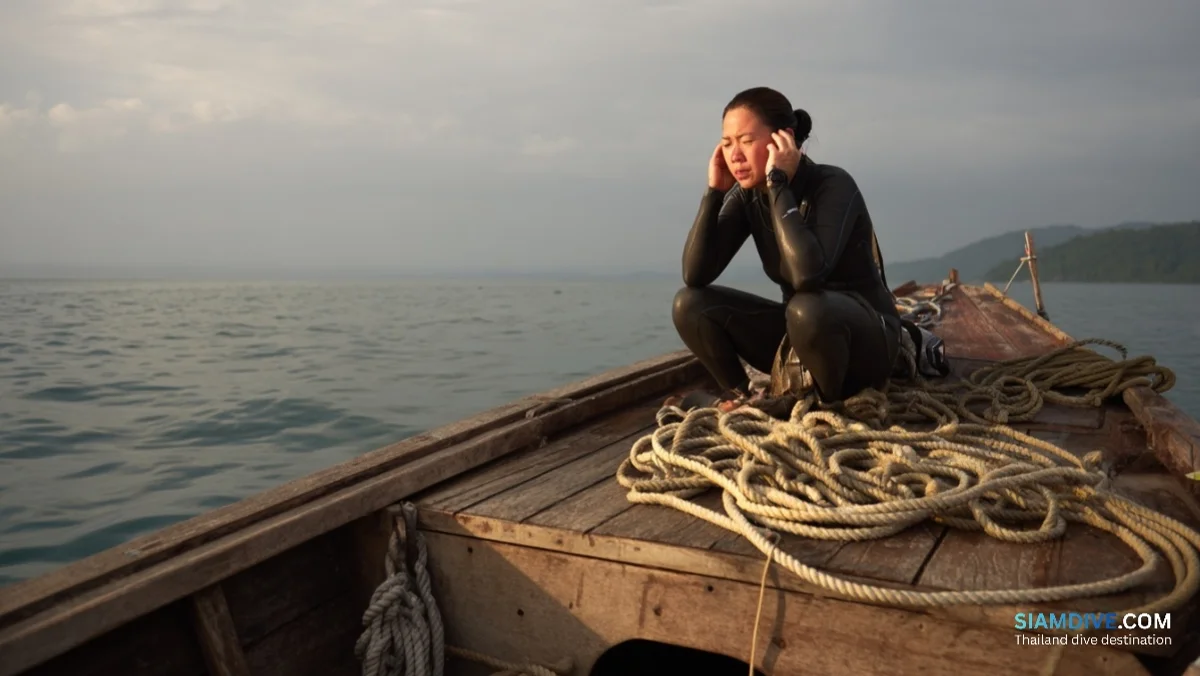
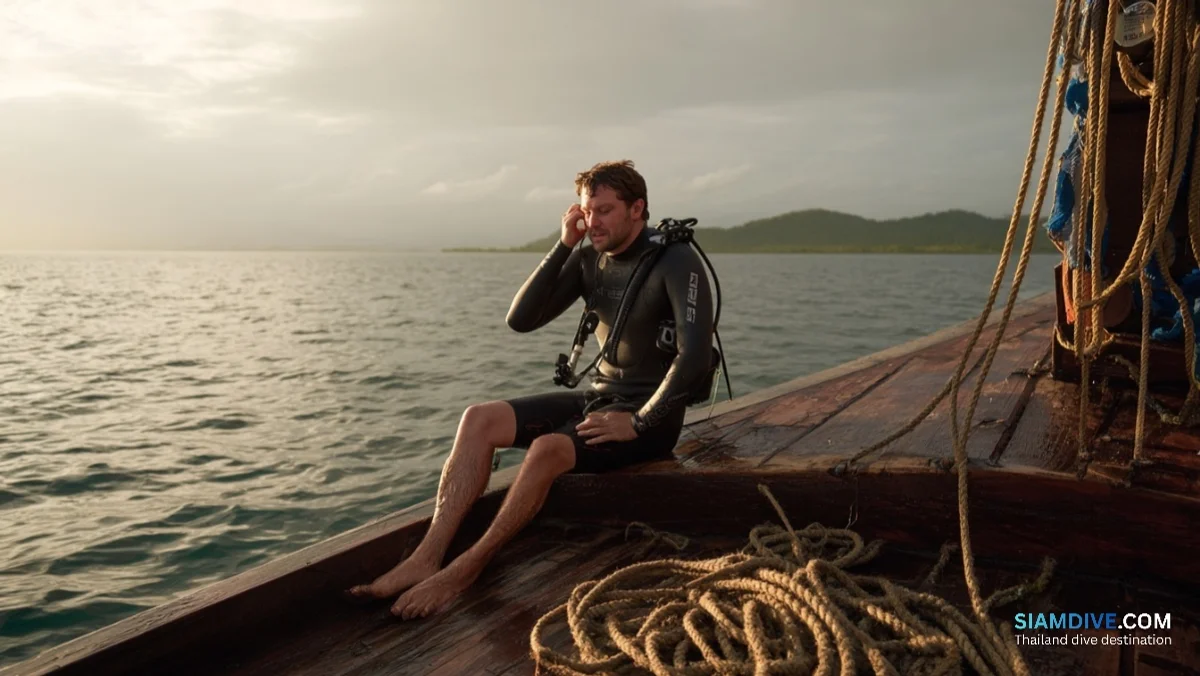
Two days after the last dive, halfway through a plate of pad thai on Kata Beach, the right ear goes muffled. No warning on the boat, no sharp pain at depth — just a slow, wet heaviness that crept in overnight and now refuses to leave. The dive felt fine. The equalization felt fine. But middle ear barotrauma does not always announce itself underwater. Sometimes it waits.
What Happens When Pressure Wins
Every descent puts the eardrum under siege. At just 1.4 metres — barely a body length below the surface — the middle ear already needs to equalize the mounting ambient pressure. The Eustachian tube, a narrow channel connecting the middle ear to the back of the throat, is supposed to open with each swallow or Valsalva manoeuvre. When it doesn't open, or opens too late, the pressure difference pushes the eardrum inward. Blood vessels in the tympanic membrane engorge, fluid seeps into the middle ear space, and in severe cases the membrane tears.
This is middle ear barotrauma — the most common medical injury in diving. DAN's annual injury database shows that nearly 38% of all logged diving injuries involve ear or sinus barotrauma, outnumbering decompression sickness by a factor of 2.3. Published research puts lifetime prevalence among recreational divers anywhere between 23.9% and 80.7%, depending on survey methodology and how broadly "barotrauma" is defined.
Most divers think of ear squeeze as something that happens on descent — a sharp, obvious pain that forces you to stop and equalize. That version is easy to recognize. The version that fools people is quieter: a partial equalization that lets the diver reach depth without screaming pain, while the eardrum absorbs just enough stress to begin a slow inflammatory chain reaction that won't peak until the diver is back on dry land.
Five Grades of Damage
In 1944, a U.S. Navy physician examined submarine escape trainees with an otoscope after hyperbaric exposures and created a grading system still used in every diving medicine clinic today. Where you fall on the Teed scale determines whether you lose one dive day or an entire trip.
- Grade 0 — Ear feels full or pressured, but the eardrum looks normal. Symptoms without visible damage.
- Grade 1 — Redness along the handle of the malleus and retraction of the eardrum inward.
- Grade 2 — Redness spreads across the entire tympanic membrane. Slight haemorrhage visible.
- Grade 3 — Haemorrhage within the eardrum itself. Fluid or blood begins pooling behind the membrane.
- Grade 4 — The middle ear fills with blood. An air-fluid level is visible on otoscopy, and the membrane may be close to rupturing.
- Grade 5 — Tympanic membrane perforation. The eardrum has torn.
Grades 0 through 2 often resolve within one to two weeks with decongestants and rest. Grade 3 and above typically ground a diver for three to six weeks — sometimes longer if fluid persists behind the drum.
The 48-Hour Trap
Here is the part that catches people off guard. A diver equalizes, feels a mild squeeze on descent, pushes through it, and surfaces with no obvious pain. The dive log reads normal. That night, maybe a faint fullness in one ear. By the next morning, hearing drops to roughly half on one side. By day two, the ear is genuinely painful.
Serous effusion is the mechanism — fluid accumulating behind the eardrum after the initial insult. The micro-damage from a borderline equalization triggers an inflammatory response that builds over hours. Capillaries leak. The middle ear space, normally air-filled, slowly fills with serous fluid. Research published on the NIH's StatPearls platform documents that 82% of affected ears demonstrated otoscopic evidence of barotrauma by day three, with all ears showing signs by day eleven.
The delay makes this injury particularly dangerous for divers on multi-day trips. Day one felt fine, so day two gets booked. Then day three. Each descent on a compromised Eustachian tube stacks more pressure on tissue that is already inflamed. What started as a Grade 1 can climb to Grade 3 or 4 before the diver connects the symptoms to that "minor squeeze" on the first morning.
Middle Ear Versus Inner Ear: The Line You Do Not Want to Cross
Middle ear barotrauma — the grades described above — involves the tympanic membrane and the air-filled space behind it. Painful, inconvenient, but almost always recoverable. Inner ear barotrauma is a different category entirely. It happens when excessive pressure transmits through the oval or round window into the fluid-filled cochlea and vestibular organs. The results can be permanent: sensorineural hearing loss, chronic tinnitus, persistent vertigo.
The crossover risk is real. A forceful Valsalva against a blocked Eustachian tube generates a spike in cerebrospinal fluid pressure that can rupture the round window membrane. This is why Step 2 in the protocol below — never force equalization on an inflamed ear — exists. One aggressive blow of the nose at the wrong moment can turn a week-long grounding into a career-ending injury.
Warning signs of inner ear involvement include spinning vertigo that does not stop after a few seconds, sudden hearing loss with a "roaring" quality, and nausea unrelated to seasickness. Any of these after a dive demand immediate medical evaluation — not tomorrow, not after the next dive. Now.
Protocol: When the Pain Shows Up Late
A muffled ear, a sense of fullness, tinnitus, or reduced hearing appearing 12 to 72 hours after a dive should trigger a specific response. Skip nothing.
- Step 1 — Stop diving immediately. Not "one more easy dive." Not "just the shallow reef." The Eustachian tube is compromised, and another pressure cycle could escalate the injury from fluid buildup to perforation.
- Step 2 — Do not forcefully equalize. Aggressive Valsalva on an inflamed tube risks rupturing the round or oval window, converting a middle ear problem into an inner ear emergency with permanent hearing loss potential.
- Step 3 — Start nasal decongestant. Oxymetazoline spray (available at any Watsons or Boots in Thailand for 100-200 THB) three times daily for no more than three days to avoid rebound congestion.
- Step 4 — Anti-inflammatory medication. Ibuprofen 400 mg every eight hours reduces the inflammatory cascade in the middle ear. Avoid aspirin — it thins blood and may worsen haemorrhage behind the membrane.
- Step 5 — See a doctor within 48 hours of symptom onset. An otoscope exam takes two minutes and tells you immediately whether this is Grade 1 redness or Grade 4 blood behind the drum. Tympanometry measures middle ear pressure and Eustachian tube function objectively.
When to Ground Yourself
Not every post-dive ear twinge means the trip is over. But certain signs require an absolute stop until medical clearance.
- Ground immediately — no exceptions
- Vertigo or dizziness after surfacing, which may indicate inner ear involvement. Sudden hearing loss in one ear. Blood or discharge from the ear canal. Complete inability to equalize on the previous dive despite multiple techniques.
- Ground for the day, reassess next morning
- Mild fullness in one ear that appeared after the dive. Clicking or popping when swallowing. Slight hearing reduction that resolves within a few hours.
- Safe to continue with caution
- Both ears equalized smoothly throughout the dive, no post-dive symptoms whatsoever, no congestion from cold or allergies. Even so, adequate surface intervals remain non-negotiable.
DAN's return-to-diving guidance is unambiguous: do not dive after a middle ear barotrauma episode until all swelling and inflammation has fully resolved and both ears equalize adequately, confirmed by an otoscopic evaluation.
Finding Help in Thailand
Ear barotrauma on a Thai dive holiday does not mean flying home untreated. Several facilities handle diving injuries routinely, and most clinicians are familiar with the Teed grading system.
- Bangkok Hospital Phuket — Diving Medicine Centre — A 24-hour on-call diving physician, full hyperbaric oxygen therapy capability, and ENT specialists on staff. Located in Phuket Town, reachable from Kata, Karon, or Patong within 30 minutes.
- Bangkok Hospital Siriroj (Phuket) — Operates a separate hyperbaric chamber facility, sometimes handling overflow cases from the main Phuket campus.
- Samitivej Hospital (Bangkok) — Offers dedicated diver medical screening packages that include tympanometry. Useful for pre-trip clearance or post-injury assessment for divers returning through the capital.
- Koh Samui — Thai International Hospital network — Clinics on Samui and Koh Phangan handle dive-related complaints. Complex ear cases can transfer to the main hospital on Samui within an hour.
- Koh Tao — local nursing clinics — Several clinics can perform basic otoscopic exams and photograph the eardrum digitally for remote specialist review. Good for triage; serious cases should transfer to Samui or Phuket.
DAN membership — starting around 35 EUR per year for Asia-Pacific coverage — includes a 24-hour emergency medical hotline staffed by diving physicians. Calling DAN before walking into any hospital means the physician on the line can brief the local doctor on diving-specific ear protocols, which is especially valuable at facilities that rarely see barotrauma.
Prevention That Costs Nothing
Equalize early and often. Begin gentle Valsalva or Frenzel at the surface before starting descent. Continue every half-metre for the first five metres, where pressure changes are steepest and where most barotrauma originates. If one ear lags, stop. Ascend a metre. Try again. New divers especially should resist the urge to chase the group down.
Abort the dive rather than force it. The cost of a missed dive is a few hundred baht. The cost of a Grade 4 barotrauma is a grounded trip, clinic visits, and weeks of recovery. Your body's recovery timeline does not care about your booking schedule.
Do not dive congested. Active allergies, a cold, or flu increase barotrauma risk up to five times. Pseudoephedrine before a dive is a common workaround, but it can wear off at depth — and if rebound congestion hits during ascent, reverse squeeze becomes the new problem. The safer call: skip the dive.
Two overlooked factors compound the risk. Seasickness medication with antihistamine properties dries out mucous membranes and stiffens the Eustachian tube. Dehydration from tropical heat thickens mucus. Stay hydrated, read your pill labels, and treat your ears as the most fragile equipment you carry underwater.
The Ear Remembers
A middle ear that has been barotraumatised once is more susceptible to repeat injury. Scar tissue on the tympanic membrane changes its compliance. Repeated inflammation can narrow the Eustachian tube opening over time. Divers who have experienced Grade 2 or higher barotrauma should schedule an ENT evaluation before their next dive trip — not after it goes wrong again.
The 48-hour window is not a grace period. It is the injury catching up. Treat early, ground early, and see a doctor before the ear makes that decision for you.
Sources
- DAN — Middle-Ear Barotrauma (MEBT): symptoms, treatment, return to diving
- NIH StatPearls — Ear Barotrauma: Teed classification, epidemiology, management
- NIH PMC — Middle ear barotrauma in diving: prevalence and risk factors
- Bangkok Hospital Phuket — Diving Medicine Centre overview
- CDC Yellow Book — Scuba diving decompression illness and injuries