4 Breathing Mistakes That Empty Your Tank Before the Group
23 เมษายน 2569
Beginners burn air at 20–30 L/min — double the rate of experienced divers. Four fixable habits close the gap, starting with a 12-second breath cycle.
Fifty bar. That is what the SPG reads — twenty minutes into a dive that the rest of the group stretches to fifty. The gear is identical, the depth is identical, the site is the same coral slope off the same boat. The only variable is the diver behind the regulator.
Beginners typically burn through air at 20–30 litres per minute at the surface, roughly double the 10–15 L/min that divers settle into after a hundred or so logged dives. The gap is consistent — it shows up on every dive boat from Koh Tao to Khao Lak — and it has almost nothing to do with lung capacity. It comes down to four fixable habits.
The Numbers Behind "Twice as Fast"
Surface Air Consumption rate — SAC — measures how many litres of gas a diver would use per minute if breathing at surface pressure. At depth, the actual draw from the tank rises with ambient pressure: at 20 metres, a surface rate of 20 L/min becomes 60 L/min from the cylinder. Small improvements at the surface compound dramatically the deeper a diver goes.
- Beginner (0–30 dives): 20–30 L/min SAC
- Intermediate (30–100 dives): 15–20 L/min
- Experienced (100+ dives): 10–15 L/min
- Technical / instructor level: 8–12 L/min
- GUE benchmark (imperial): below 0.75 ft³/min is good; above 1.0 ft³/min needs work
On a standard aluminium 80 tank — 11.1 litres, 207 bar working pressure — at 18 metres, the difference between a 25 L/min SAC and a 12 L/min SAC is the difference between a 26-minute dive and a 55-minute dive. Same tank, same reef, double the bottom time. Watch any open-water class surface after their first deep dive and the spread is obvious: half the students come up with 70 bar while the instructor still has 140.
Mistake 1 — Breathing from the Chest
Short, shallow inhales that lift the shoulders and barely reach the middle lobes — most people breathe this way on land without noticing. Underwater, it is the single fastest way to drain a tank.
Each breath cycles roughly 150 ml through the trachea and bronchi, anatomical dead space where no gas exchange occurs. When breaths are small, that 150 ml makes up a large fraction of each cycle. The body compensates by demanding more breaths per minute — up to 15 or 20, three to four times the efficient rate.
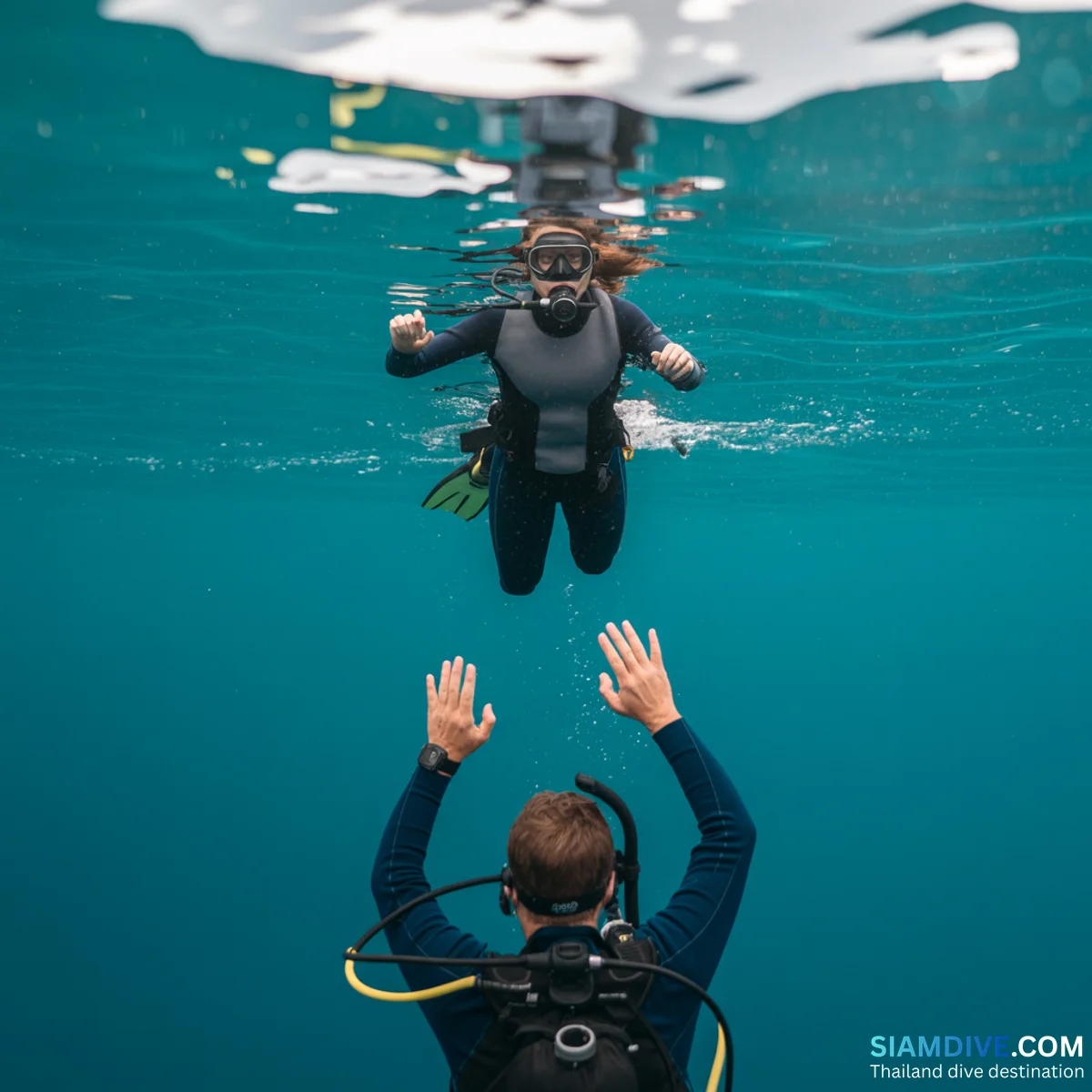
The fix is diaphragmatic breathing. Inhale for five to seven seconds so the abdomen pushes outward rather than the chest rising. Exhale for seven seconds or longer. A complete cycle should land between 12 and 15 seconds, producing roughly four to five breaths per minute. Dive Training Magazine identifies this window as the target for efficient underwater gas exchange, and the physiology is straightforward: deeper breaths push a larger proportion of fresh gas past the dead space and into the alveoli where oxygen and carbon dioxide actually trade places.
Practice on land first. Lie flat, place one hand on the chest — it should barely move — and one on the belly, which should rise and fall with each breath. Five minutes a night for a week builds the muscle memory. Then take it to the pool. The transition to open water is faster than most divers expect, especially on a calm, shallow reef like the coral garden at East of Eden, where 12 metres of depth and gentle current let a diver focus entirely on rhythm.
Mistake 2 — Carrying Too Much Lead
Two extra kilos on the belt. "Just in case." It sounds like a safety margin. In practice, it is the most expensive habit in recreational diving — paid for in air, one breath at a time.
An overweighted diver must inflate the BCD more than necessary to reach neutral buoyancy, then adjust constantly as depth changes. The legs sink, the body tilts head-up, and the diver starts fin-kicking not to go anywhere but simply to not sink. Each kick costs energy, and energy costs gas. A diver angled 30 degrees from horizontal presents roughly twice the frontal area of a streamlined, flat diver — pushing through water like a barn door for forty-five minutes while the tank drains at double speed.
The NCBI StatPearls reference on diving buoyancy puts the connection plainly: ineffective buoyancy control contributes to increased air consumption, fatigue, and a higher incidence of dive-related injuries. The chain is direct — excess lead forces BCD inflation, which forces adjustment, which forces finning, which forces breathing.
The fix requires a single honest weight check. Strip lead until neutral buoyancy at 5 metres on a safety stop with 50 bar in the tank requires zero fin input. That is the minimum weight. Anything above it is costing air on every dive. For high-current sites — the kind of water that flows over the pinnacle at Koh Tachai — proper weighting matters even more, because the energy spent fighting drift compounds fast when a diver is already over-ballasted.
Mistake 3 — Skip Breathing to "Save" Air
Hold the inhale an extra beat, stretch the gap between breaths, make the tank last longer. The logic sounds airtight. The physiology says otherwise.
Carbon dioxide — not low oxygen — is the primary trigger for the breathing reflex. When a diver holds air in, CO₂ accumulates in the bloodstream. Once the partial pressure crosses a threshold, the brain demands faster, deeper breaths to flush the gas. The diver who was trying to breathe less now breathes more, often without recognising the shift. Over the course of a forty-minute dive, skip breathing typically increases total gas consumption rather than reducing it.
Elevated CO₂ carries additional risks. It narrows the margin for oxygen toxicity at depth and is the most common cause of the dull post-dive headache that recreational divers wrongly blame on sun or dehydration.
The correct approach is what instructors call a "natural pause" — the briefest moment at the top of an inhale where the throat stays open and the glottis does not close. No held pressure, no sealed airway, just a soft transition into the exhale. PADI guidelines leave no room for interpretation: never hold your breath while breathing compressed gas.
Mistake 4 — Never Measuring What You Breathe
Depth, time, temperature — most dive logs capture all three. SAC rate almost never makes the list, which means most divers carry no baseline and have no way to tell whether a technique change is actually working or merely feels different.
The manual calculation is simple enough to do on a slate between dives:
- Step 1: Record start bar, end bar, tank volume (litres), average depth, and dive time
- Step 2: Gas used in litres = (start bar − end bar) × tank volume
- Step 3: Average consumption = gas used ÷ dive time in minutes
- Step 4: SAC = average consumption ÷ (average depth in metres ÷ 10 + 1)
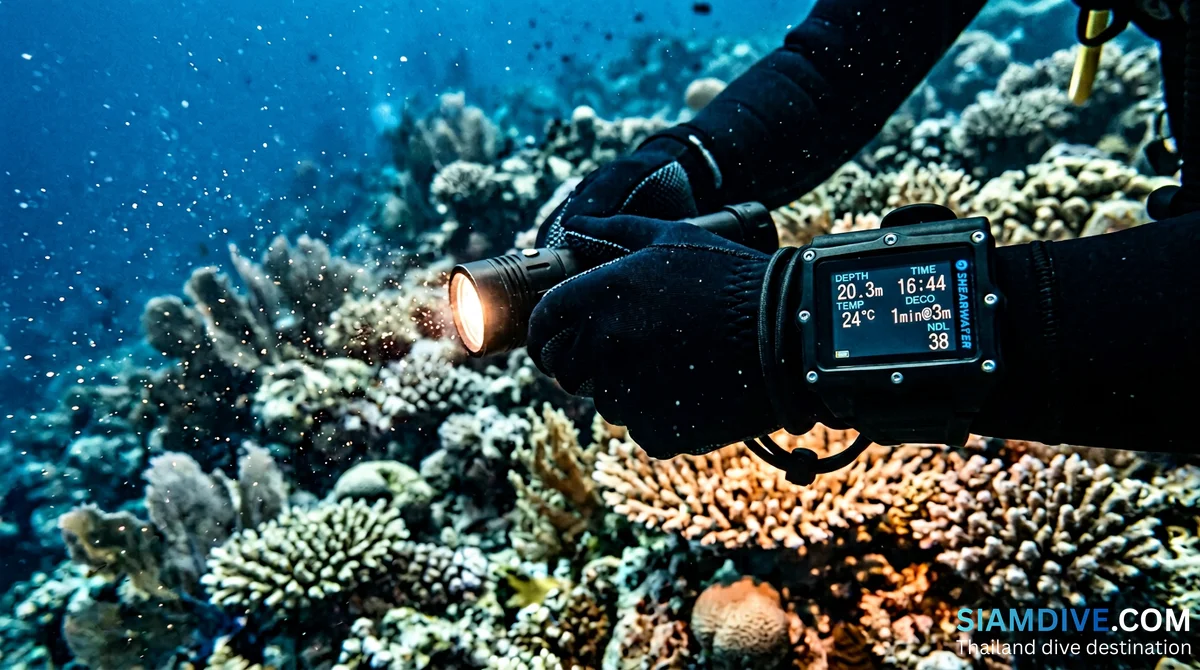
Or skip the arithmetic entirely. Air-integrated dive computers — Shearwater's Perdix 2, Peregrine TX, and Teric among current models — display a rolling SAC rate averaged over roughly the last minute. ScubaBoard forum threads from early 2026 show growing interest in these real-time readouts, with divers reporting that they become instantly aware of breathing spikes the moment the number climbs on the wrist screen.
Measuring SAC turns a vague worry into a training metric. Track it over ten dives and patterns emerge: SAC spikes during descents, drops on relaxed reef sections, climbs sharply when current picks up or a shark appears. That data is the roadmap for focused improvement.
- Standard AL80 tank: 11.1 L volume, 207 bar working pressure
- At 18 m (2.8 ATA), SAC 25 L/min: approximately 26 min bottom time
- At 18 m (2.8 ATA), SAC 12 L/min: approximately 55 min bottom time
- Minimum reserve: 35–50 bar (500 psi), non-negotiable
- PADI rule of thirds: one-third out, one-third back, one-third reserve
The 12-Second Breath Drill
Four steps, four weeks, no gear required for the first two. Think of it the way a cyclist thinks of cadence drills — the goal is to build a motor pattern that holds under load without conscious effort.
Step 1 — Inhale (5–7 seconds). Mouth open, draw air deep into the belly. The chest stays quiet. Feel the diaphragm push the abdominal wall outward.
Step 2 — Pause (1 second). Throat open, glottis relaxed. This is not breath-holding. It is a smooth handoff between inhale and exhale.
Step 3 — Exhale (7 seconds). Slow, steady, controlled release. The belly deflates on its own. Do not force the last bit out.
Step 4 — Wait. Let the next inhale start on its own. The body knows when it needs air. Trust the reflex rather than overriding it.
Week 1: Five minutes daily, lying flat on the floor. Time each cycle with a watch — it should land between 12 and 15 seconds.
Week 2: Same drill while walking. Harder, because movement raises CO₂ production and the body pushes for faster breathing.
Week 3: Pool session with a snorkel or regulator. The slight back-pressure of the exhale valve changes the rhythm — adjust the exhale length until it feels natural.
Week 4: Open-water dive where the breath cycle is the only task. A shallow site with good visibility works best — something like the rope trail at Koh Mattra in Chumphon, where the depth stays between 5 and 12 metres and there is no navigation stress.
Divers who commit to this four-week progression typically see a SAC drop of 5–8 L/min within 20–30 dives. Those who combine the breathing drill with a buoyancy overhaul tend to see the largest shifts.
What Realistic Improvement Looks Like
Nobody moves from 25 L/min to 12 over a long weekend. Air consumption improves in steps, and the curve flattens as the easy gains disappear.
Dives 1–30: The steepest drop. Comfort builds, survival-mode breathing gives way to something approaching relaxation, and SAC typically falls 30–40 percent in this window just from becoming less tense underwater.
Dives 30–100: Gains now come from buoyancy refinement and trim. The clearest marker is the safety stop: hanging motionless at five metres for three minutes without a single fin kick. Sites that demand precise buoyancy, like the granite swim-throughs at Elephant Head, reward good control with longer bottom time and less silting.
Dives 100–200: The plateau. Improvements become marginal and come from specific drills — breathing rhythm, equipment streamlining, and reducing the anxiety that task-loading brings.
Beyond 200: At this point, physical fitness matters more than technique. Swimming, yoga, and basic cardio training contribute directly to lung efficiency and lower resting respiratory rates, and the benefit follows the diver underwater.
PADI's updated Open Water course now introduces the "turning point" concept and the rule of thirds during knowledge development, pushing air awareness earlier in a diver's training than previous syllabi managed. In 2026 — PADI's 60th anniversary year — the agency's On Tour event schedule lists air-management workshops at multiple stops across Asia and Europe, a signal that the industry recognises the gap between what new divers learn about gas planning and what the reef actually demands of them.