7-Metre Wingspan and a Dark Chin: Thailand Has Two Mantas
11 พฤษภาคม 2569
Most divers log 'manta' without a second look. Thailand's Andaman Sea hosts two separate species — and the field clue takes three seconds to spot.
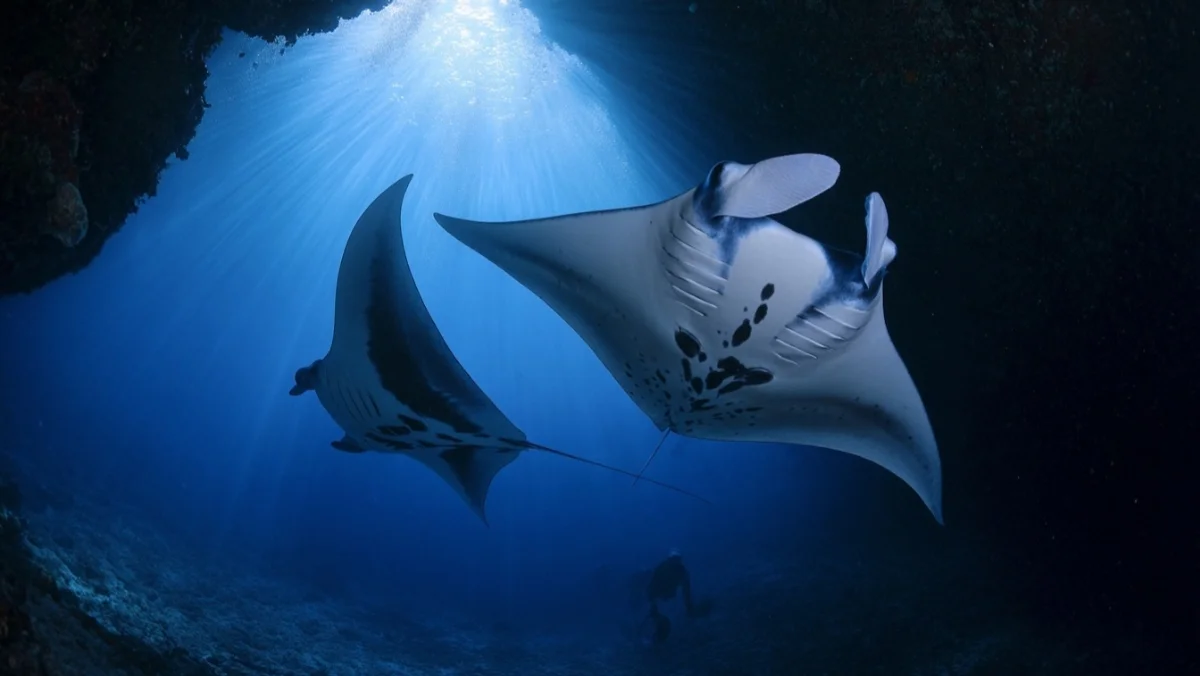
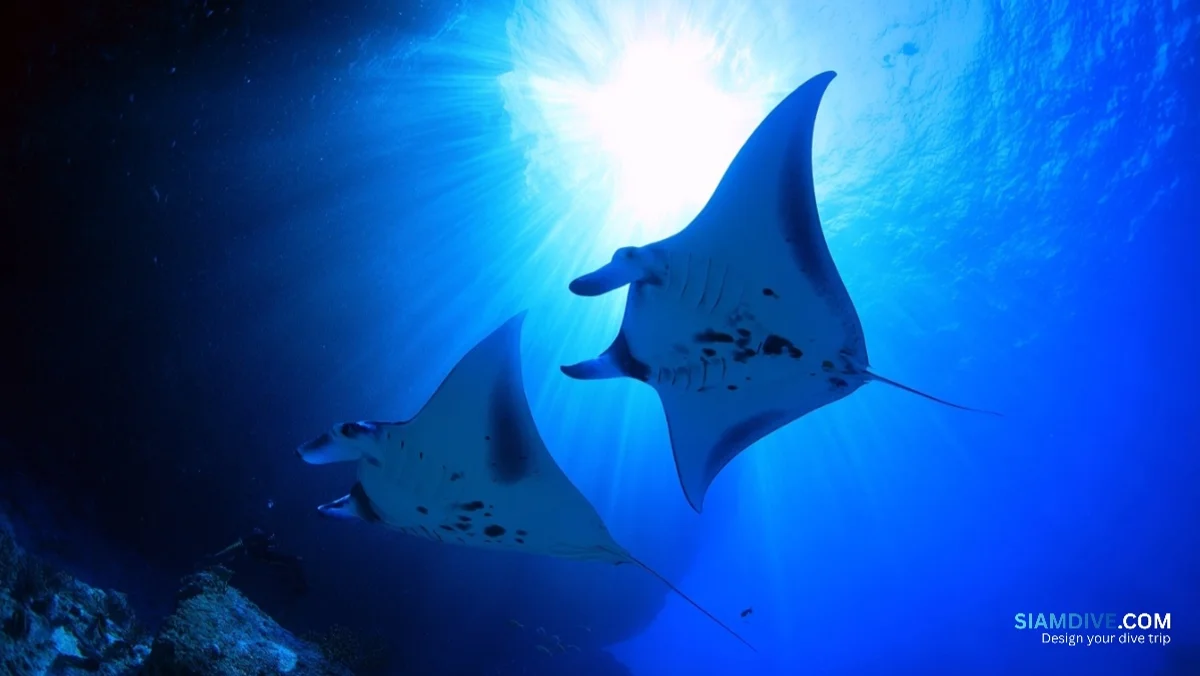
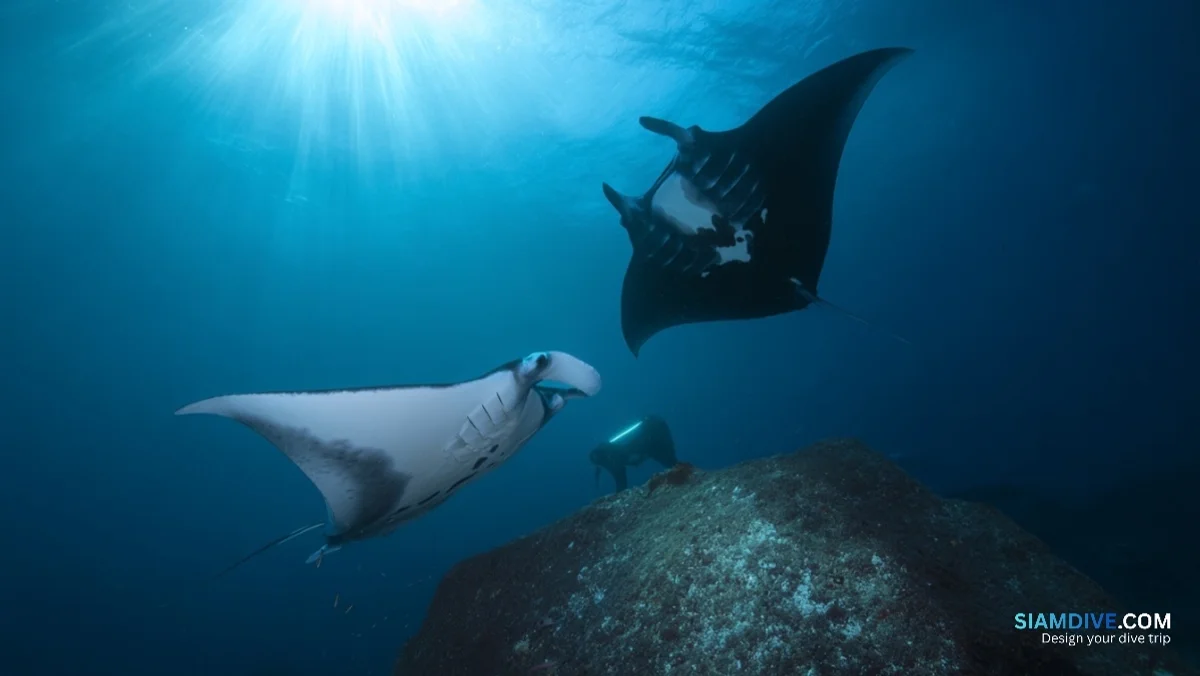
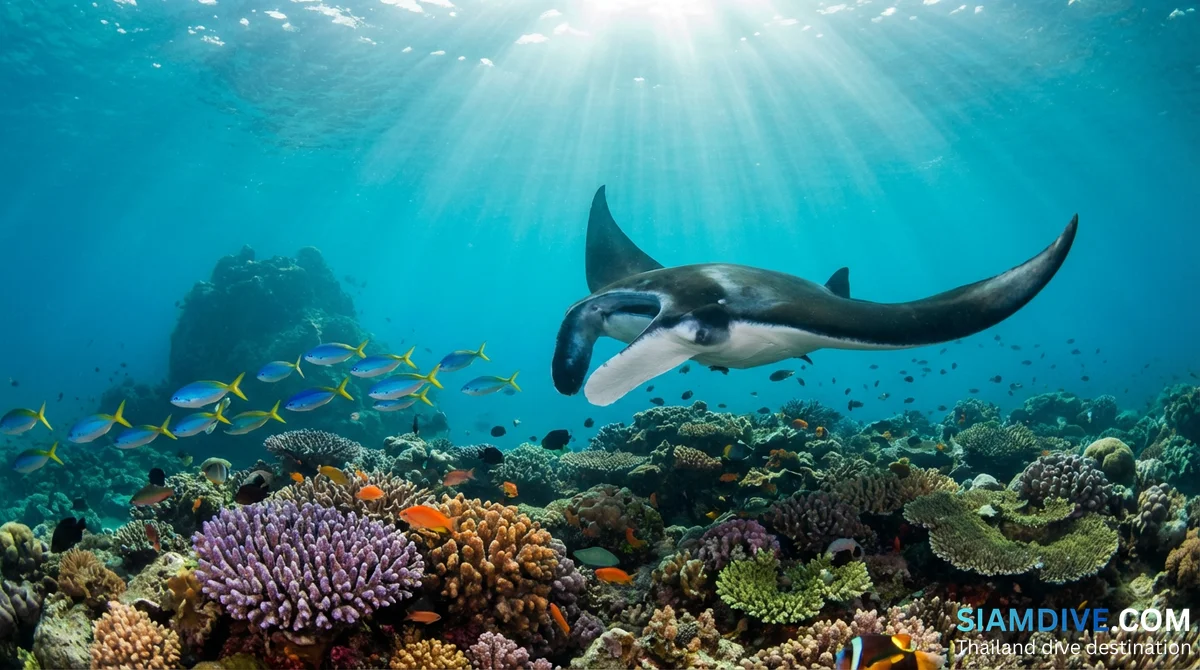
Two mantas circle Koh Bon's cleaning station at 18 metres. One hangs motionless while a pair of cleaner wrasse pick parasites from its gill plates. The other drifts in from the blue — wider by a full metre, visibly darker around the face — and settles into a holding pattern above the same rock. A dive guide signals "manta" on their slate. Most of the group nod, adjust their cameras, and start shooting.
Almost nobody notices that the two rays belong to different species.
Thailand's Andaman Sea is one of a handful of places where the reef manta (Mobula alfredi) and the giant oceanic manta (Mobula birostris) overlap in diveable water during the same season. The differences are real, consistent, and visible on a single pass — once a diver knows where to look. Yet most logbooks, trip reports, and social media captions still record one word: manta. No species, no belly shot, no data point for science.
The identification takes about three seconds. Here is what separates them.
A Full Car Width Between Them
Reef mantas average 3 to 3.5 metres tip to tip — roughly the width of a compact car. They max out around 5.5 metres, a figure confirmed by the Manta Trust's species guide based on decades of field observation across the Indo-Pacific.
The giant oceanic manta operates in a different weight class. Averages run 4 to 5 metres. The maximum documented disc width reaches 7 metres according to NOAA's species profile — wider than a standard parking space, heavy enough to exceed 2,000 kilograms.
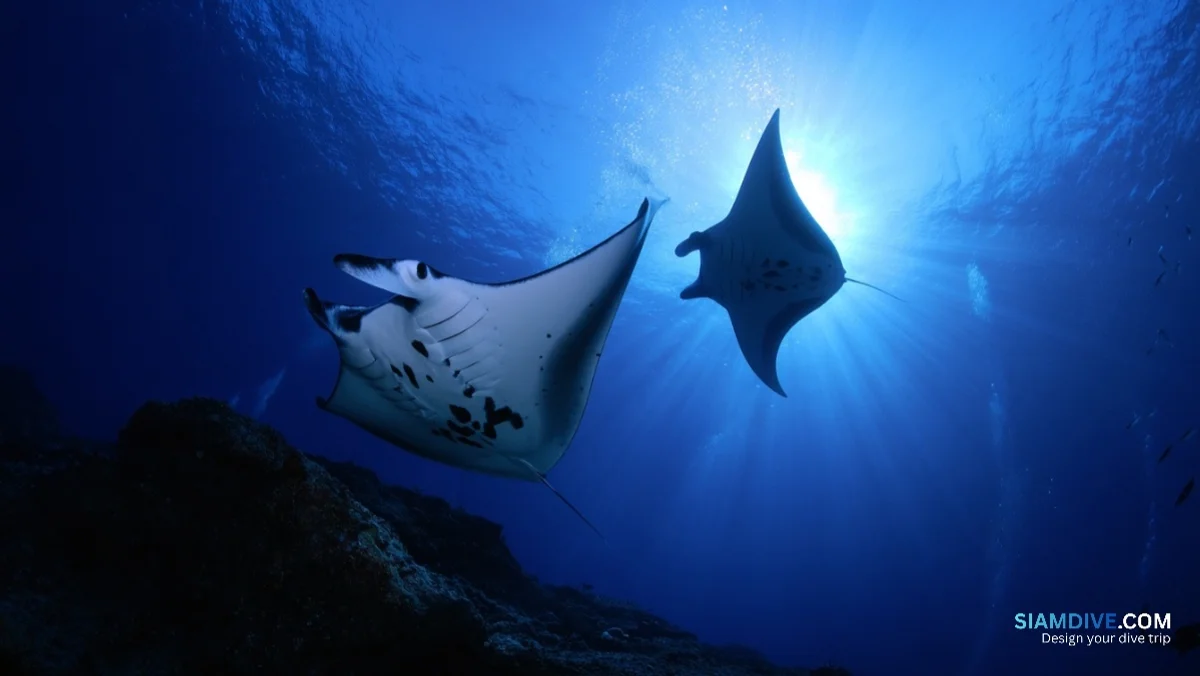
On a dive, the gap is harder to judge than it sounds. Water magnifies objects by roughly 25 per cent, depth strips away colour and contrast, and a solitary manta gliding against open blue has nothing to scale against. Size alone is unreliable unless two mantas occupy the frame at once.
When they do, the difference is unmistakable. The reef manta looks built for the reef — compact, agile, banking into tight turns around the cleaning station. The oceanic manta looks like it belongs somewhere larger, because it does. Its pectoral strokes are wider, slower, the animal carrying its own momentum the way a heavy aircraft does on final approach.
Dark Mouth or White — The 3-Second Field Check
Size needs a reference point. The mouth does not.
Reef mantas carry white or pale colouring around and inside their cephalic fins — the paired, horn-shaped scoops that unfurl forward when the animal feeds, funnelling plankton toward the mouth. The skin around the jaw and between the eyes is pale, sometimes with a faint grey wash but never dark.
Oceanic mantas are markedly darker in the same area. The inside of the cephalic fins is black, the colouring around the eyes is dark, and a shadowed margin often runs along the lower jaw and across the gill slits. The overall face reads heavier — a difference that registers even at distance, even in marginal visibility.
This trait holds across populations and geographies. It is not a function of age, sex, or individual variation. A diver who sees a pale-mouthed manta at Koh Bon and a dark-mouthed manta at Hin Daeng is, with high confidence, looking at M. alfredi and M. birostris.
Both species also appear in a melanistic colour morph — almost entirely black on both dorsal and ventral surfaces, sometimes called "black mantas." These individuals can muddy the mouth check because the overall body runs dark. In melanistic encounters, the belly spot pattern becomes the more reliable marker.
For standard-coloured individuals, the mouth check works in under three seconds of face-on observation. No equipment, no belly shot, no size comparison needed.
The Belly That Never Lies
Every manta ray carries a pattern of spots on its ventral surface that never changes across its lifetime. The pattern is unique to the individual — a biological fingerprint as reliable as a human one. But the layout of those spots also differs between species.
Reef mantas wear their markings broadly. Spots spread across the area between the gill slits, onto the trailing edge of the pectoral fins, and across the abdomen. The pattern can be dense — dozens of splotches — or sparse, but it occupies wide territory on the belly.
Oceanic mantas concentrate their spots into a tight central cluster on the lower abdomen. The rest of the ventral surface is often blank white. Where the reef manta's belly reads like a scatter chart, the oceanic manta's reads like a single data point circled at the centre.
This distinction powers one of the most productive citizen science programmes in marine biology. MantaMatcher, a global photo-ID platform, holds records for more than 10,000 individual mantas from over 70 countries — built almost entirely from belly shots submitted by recreational divers and snorkellers. The Manta Trust's automated biometric software, IDtheManta, works like facial recognition for ventral surfaces: upload a photo, and the algorithm cross-references it against every known individual in MantaBase.
A single dive photo from Koh Bon can confirm whether a manta was last recorded at the same cleaning station two seasons ago or has never been logged at all. For oceanic mantas, whose nomadic routes make them harder to track, a belly shot from Hin Daeng can tie an individual to sightings hundreds of kilometres away in Myanmar or the Andaman Islands.
Shooting the photo takes one opportunity: the moment a manta passes directly overhead or banks into a turn that briefly exposes the ventral surface.
One Stays Home, the Other Crosses Oceans
Reef mantas are coastal homebodies. They return to the same reefs, the same cleaning stations, the same plankton corridors season after season. At Koh Bon, a population of roughly 20 identified individuals — catalogued through the Thailand Manta Project, an affiliate of the Manta Trust — comes back to the pinnacle year after year. Some arrive within days of the same calendar week.
Oceanic mantas are long-range nomads. They follow currents and nutrient upwellings across open water, covering distances past 1,000 kilometres from their tagging point. When an oceanic manta appears over Hin Muang — Thailand's tallest submerged wall, dropping beyond 70 metres — it may have been feeding in deep pelagic water days earlier and could be gone by tomorrow.
The behavioural gap shapes dive briefings. At Koh Bon, the instruction is: hold your position at the cleaning station and wait — the manta will come to you. At Hin Daeng, the guide says: keep scanning the blue, because if one passes it will not circle back.
That difference matters for photo-ID. A reef manta at a known cleaning station will likely be re-sighted, building a long encounter history that researchers can track year over year. An oceanic manta sighting is rarer and therefore more valuable as a data point — each encounter extends the thin thread of records connecting one sighting to the next across vast reaches of open ocean.
Where Each Species Shows Up in the Andaman
- Koh Bon Pinnacle — The granite cleaning station at 18–22 metres is Thailand's most reliable reef manta encounter. Cleaner wrasse service incoming rays on a flat rock shelf. Season runs November to April, with peak sightings in February and March.
- Koh Tachai — Reef mantas visit the plateau during rising tides when nutrient-rich water floods the shallow top. Sightings are less predictable, but encounters here tend to involve feeding behaviour — cephalic fins unfurled, barrel-rolling through plankton clouds.
- Richelieu Rock — The horseshoe-shaped pinnacle attracts both species. Reef mantas feed on the plankton that clouds the upper rock; oceanic mantas occasionally pass through deeper water off the western edge. The site is better known for pelagic encounters, but manta sightings are a regular feature of peak season.
- Hin Daeng / Hin Muang — Open-water pinnacles south of Koh Lanta. Oceanic mantas — some exceeding 4 metres — feed here between February and April. The remoteness and depth filter out casual traffic, and sightings often involve animals cruising through mid-water rather than circling a fixed station.
A Third Species Just Changed the Count
The number held at two for decades. In 2024, it became three. Researchers from the Marine Megafauna Foundation confirmed Mobula yarae as a distinct species, identified genetically and morphologically from populations in the Atlantic Ocean. The discovery does not alter what divers encounter in Thailand — M. yarae has not been recorded in the Indo-Pacific — but it recalibrates how biologists understand manta diversity. The question of whether further cryptic species exist in under-surveyed waters remains wide open.
For Thailand divers, the practical point is straightforward: accurate photo-ID submissions matter more now than before. Every belly shot uploaded to MantaMatcher or MantaBase adds a data point to a puzzle that just grew more complex. An unidentified population, an unusual spot pattern, or a genetic outlier may yet be hiding in plain sight on a well-dived cleaning station.
How to Log a Manta Properly
Writing "manta" in a dive log is like writing "bird" in a field journal. The species matters, and the identification takes less effort than most divers assume.
- Step 1 — Mouth check
- White or pale inside the cephalic fins → reef manta (M. alfredi). Dark or black inside → oceanic manta (M. birostris).
- Step 2 — Belly shot
- If the manta passes overhead or tilts during a turn, photograph the ventral surface. Focus between the gill slits. One clear photo is enough for ID databases.
- Step 3 — Estimate wingspan
- A diver in horizontal trim spans about 1.8 metres. Two divers end to end make 3.6 metres — just above reef manta average. If the ray spans three diver-lengths, it is almost certainly oceanic.
- Step 4 — Submit
- Upload to MantaMatcher (mantamatcher.org) or MantaBase via the Manta Trust. Include date, site name, estimated wingspan, and your species call. The matching algorithms handle the rest.
- Step 5 — Note behaviour
- Cleaning, feeding (barrel roll with cephalic fins open), cruising, or courtship (chain of males trailing one female). Behaviour data maps habitat use patterns that static sightings cannot.
Thailand officially protected all six species of manta and devil rays in September 2018. Killing, trading, or possessing any of them is now illegal under Thai law. Accurate species logging by divers supports the monitoring and enforcement that legal protection depends on.
The 2026 Season Window
Permits have changed and the reef is still healing. Similan marine park management introduced updated requirements for the 2025–2026 season, while reef condition surveys after the 2024 coral bleaching event have shaped access at some southern Similan dive points. Koh Bon remains open and active as a cleaning station throughout.
Dive operators across Khao Lak report that manta sighting rates during the February–March 2026 window matched or exceeded previous season averages, with multiple liveaboard groups logging both species on the same trip — reef mantas at Koh Bon, oceanic mantas at Hin Daeng two days later.
The Andaman season closes in May. For divers building a trip around manta encounters, the window reopens in October. A solid dive plan and a camera with a wide-angle lens are the only preparation the species check requires.