10× Deadlier Than a Rattlesnake and Zero Diver Deaths
26 เมษายน 2569
The banded sea krait carries venom ten times more potent than a rattlesnake’s — yet no diver has ever died from its bite. The answer lies in its jaw.
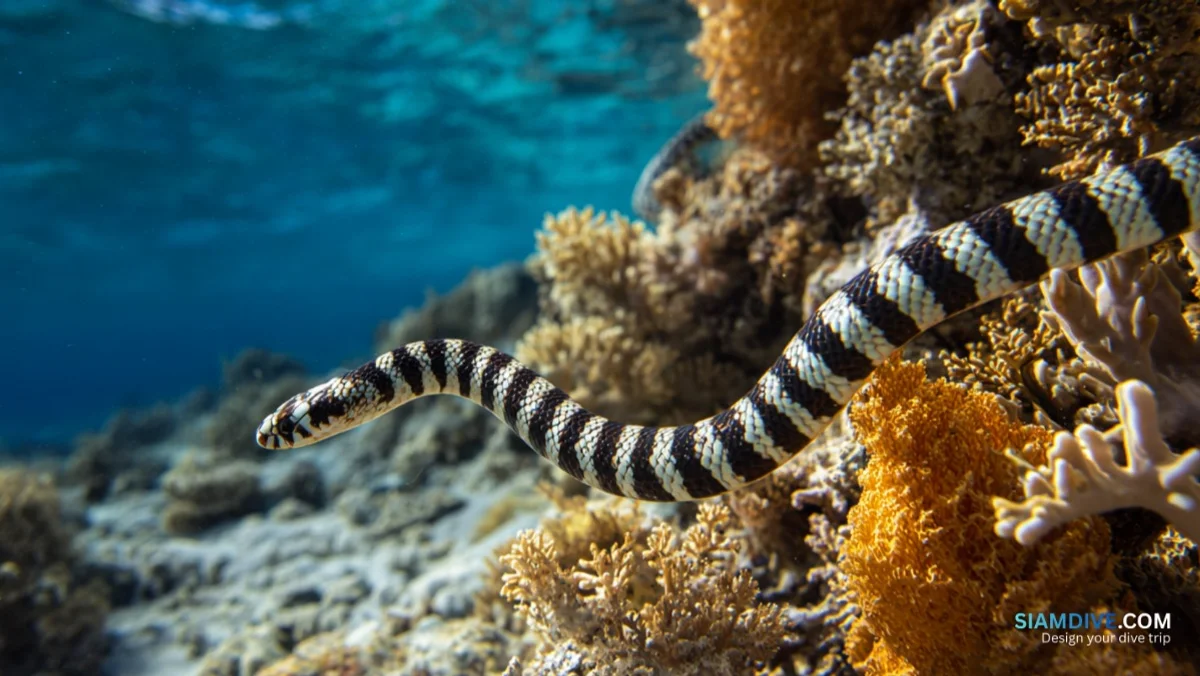
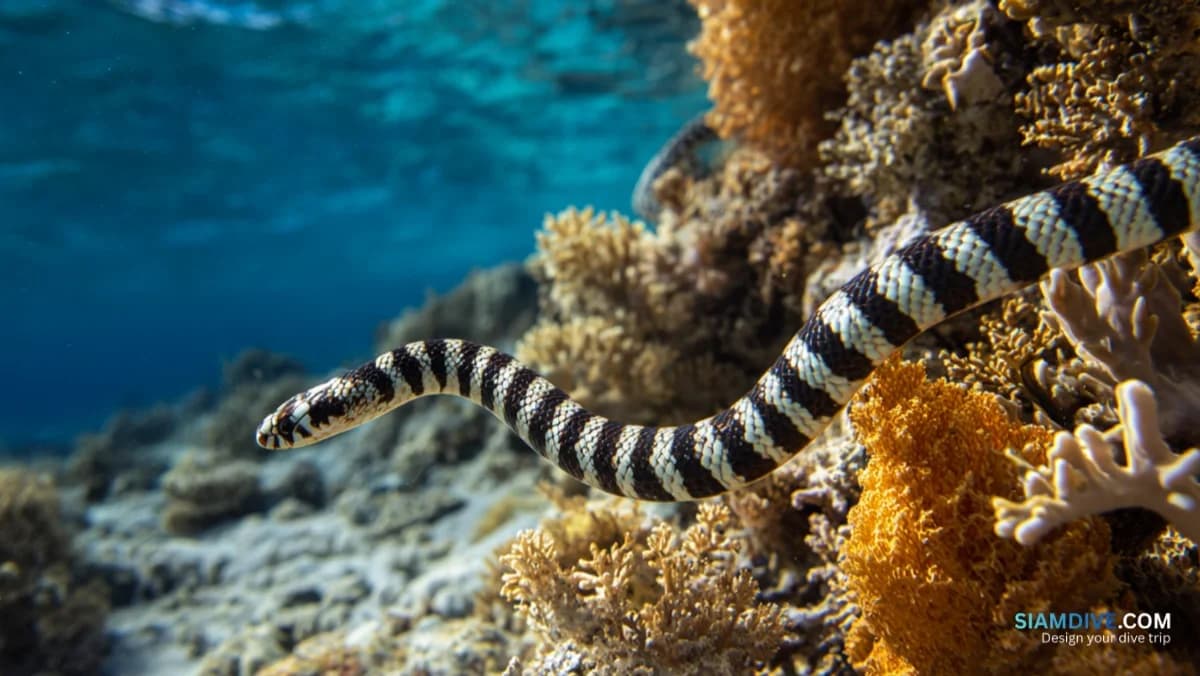
A black-and-white ribbon glides off the reef at Koh Bida Nok, barely an arm’s length from your mask. The animal is maybe a metre long, thinner than your wrist, and completely unbothered. It flicks a forked tongue against the coral, then threads itself into a crevice so narrow your fingers wouldn’t fit. That casual disappearing act sums up the entire relationship between banded sea kraits and the humans who share their reef: the snake has somewhere to be, and you are not on its list.
This is Laticauda colubrina, the yellow-lipped sea krait — an animal whose venom is ten times more potent than a Western diamondback rattlesnake’s, yet which has never killed a diver in recorded medical history. The disconnect between lethality on paper and risk in practice is one of the most misunderstood stories in tropical diving. Understanding why requires looking at jaw geometry, hunting specialisation, and a lifestyle that splits neatly between sea and shore.
A Jaw Built for Coral, Not for You
Pick up a moray eel skull sometime and notice how the jaws hinge wide — a predator designed to swallow prey nearly its own diameter. Now picture the sea krait’s head: narrow, almost cylindrical, built to slip into gaps between coral branches where morays hide. That shape is the first reason bites on humans are vanishingly rare.
Sea krait fangs sit at the front of the upper jaw, short and fixed. Two solid maxillary teeth follow behind. The whole apparatus is a precision tool for gripping slippery, eel-shaped prey inside tight spaces — not for striking large, warm-blooded targets. A rattlesnake can open a 150-degree gape and drive folding fangs deep into muscle. A sea krait’s gape barely accommodates a diver’s little finger.
Venom yield per bite runs between 10 and 15 milligrams. A lethal dose for a 70 kg human would require roughly 32 mg delivered subcutaneously — meaning even a full bite delivers well under half the lethal threshold. Combined with fangs too short to penetrate a 3 mm wetsuit sleeve, the mechanical odds of a dangerous envenomation are stacked against the snake from the start.
There is an evolutionary logic to this mismatch. Sea kraits did not evolve alongside large mammals. Their venom needs to paralyse an eel in a confined space within seconds — a task that requires extreme potency in tiny volumes. Scaling that system up to threaten a 70 kg diver would require a completely different delivery apparatus: longer fangs, wider gape, higher volume glands. None of those traits would help catch eels, so none of them developed.
The Deadliest Venom Nobody Receives
Laboratory numbers are where the sea krait earns its fearsome reputation. The subcutaneous LD50 in mice sits at 0.45 mg/kg, with 95 percent confidence limits of 0.34 to 0.60 mg/kg. Isolated neurotoxin fractions are even more potent: short-chain and long-chain neurotoxins clock LD50 values between 0.05 and 0.13 μg/g.
Those toxins work by blocking nicotinic acetylcholine receptors at the neuromuscular junction — the same mechanism as curare. In an envenomated prey animal, voluntary muscles shut down in sequence, and respiration fails last. It is an efficient system for immobilising a thrashing eel inside a coral hole where the snake cannot afford a prolonged fight.
- LD50 (subcutaneous, mice): 0.45 mg/kg — roughly 10× more potent than the Western diamondback rattlesnake
- Primary toxins: short-chain and long-chain neurotoxins (LD50 0.05–0.13 μg/g)
- Venom yield per bite: 10–15 mg
- Human lethal dose (estimated): ~32 mg subcutaneous for a 70 kg adult
- Recorded human fatalities from L. colubrina: zero
A 2017 proteomic study in the Journal of Proteomics revealed that venom composition varies geographically — Balinese populations show higher long-chain neurotoxin ratios compared to Philippine specimens, while certain phospholipase subfractions disappear entirely. The takeaway for divers: the species’ venom profile is complex, well-studied, and overwhelmingly irrelevant to anyone who keeps their hands to themselves.
60 Million Years of Hunting Eels
Every eel hiding in a Thai reef has one dedicated pursuer that will follow it into crevices no other predator can reach. Banded sea kraits eat eels — morays, conger eels, snake eels — and essentially nothing else. That narrow menu has shaped every part of their anatomy and behaviour over roughly 60 million years of evolution within the coral ecosystems where their prey hides.
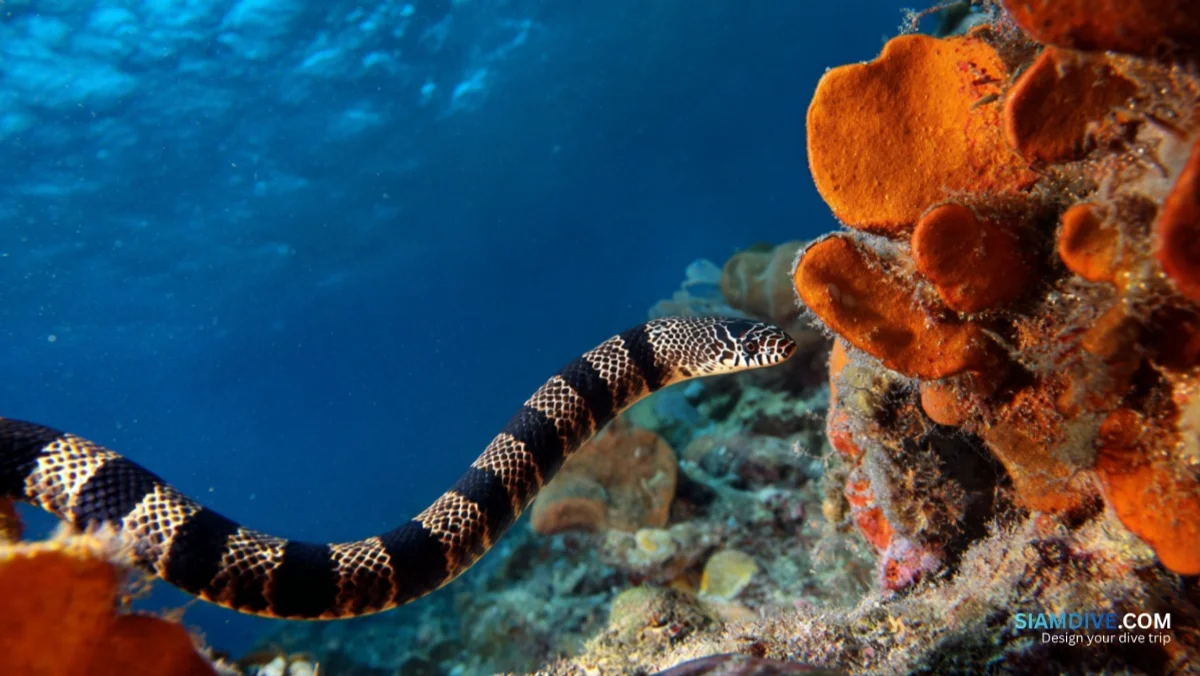
The hunting method is patient and physical. A sea krait probes crevice after crevice with its narrow head, tongue-flicking to chemically detect prey scent, then strikes within the confined space where the eel has no room to flee. It is the opposite of an open-water ambush: a search-and-extract specialist, like a living pipe cleaner armed with neurotoxin.
Slow swimmers by any measure, sea kraits cannot catch a fish in open water. Researchers clocking swimming speeds have measured sustained rates well below one body-length per second — leisurely even by reef standards. They rely entirely on the advantage of access. Their head fits where a moray’s other predators cannot follow, and their elongated body can coil deep into branching coral to drag prey out backwards. This specialisation makes humans doubly irrelevant: too large to fit the prey profile, and too open-water to trigger any hunting reflex.
On a reef level, this dietary focus makes sea kraits quiet regulators of moray eel populations. Remove them, and moray densities can shift upward, cascading into pressure on the small reef fish those eels also prey upon — wrasses, gobies, blennies, the maintenance crews that keep algae in check. It is a trophic role marine biologists increasingly recognise, even if divers rarely notice the ecological mechanics playing out beneath the surface. A reef with healthy sea krait numbers is, indirectly, a reef with healthier coral.
Half Reptile, Half Commuter
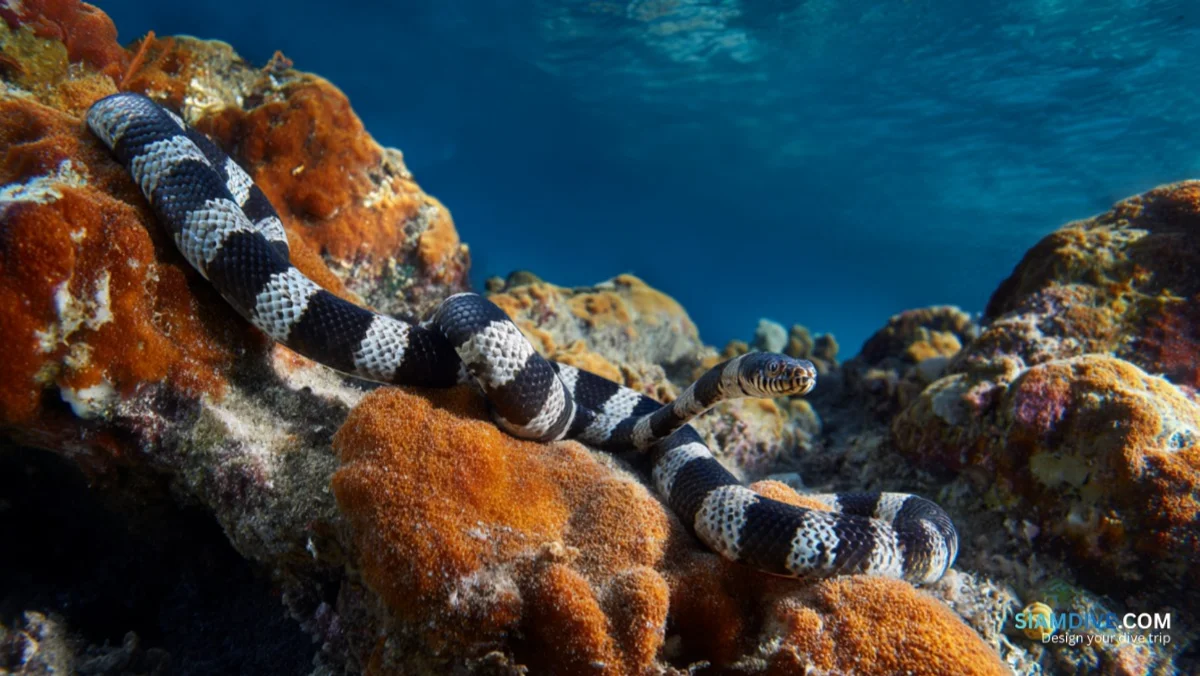
True sea snakes give live birth at sea and never touch dry ground. Banded sea kraits do both — and that amphibious double life is the key to understanding their temperament. They hunt underwater, then haul out onto rocks and beaches to digest, shed skin, mate, and lay eggs. Marine biologists classify them as the only fully venomous sea snake genus that routinely commutes between saltwater and dry ground.
The commute follows a homing pattern. Individual kraits return to the same stretch of coastline repeatedly, a fidelity more commonly associated with sea turtles than with snakes. Mark-recapture studies have documented individuals using the same rocky outcrop for months in succession. On small islands in the Philippines and Indonesia, researchers have counted dozens of kraits resting together on a single beach at low tide — a communal basking behaviour that looks almost social, though each animal forages alone once it re-enters the water.
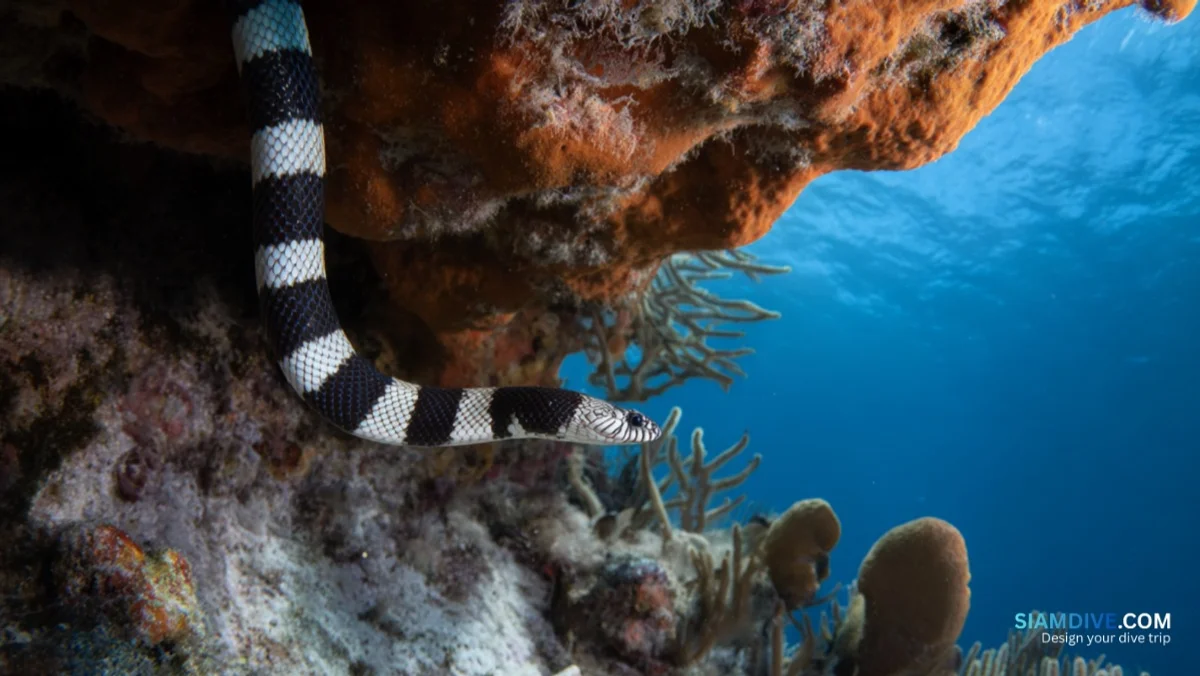
Underwater, a saccular lung — elongated compared to a terrestrial snake’s — allows dives to 60 metres, though most foraging happens between 10 and 30. A sea krait needs to surface roughly every six hours to breathe, which means an attentive diver on a shallow reef may spot one ascending: a slow, deliberate vertical rise, tongue tasting the air as the surface approaches. Watch for the moment its nostrils break the surface film — a single quick inhale, and it descends again, often along the same coral wall it climbed.
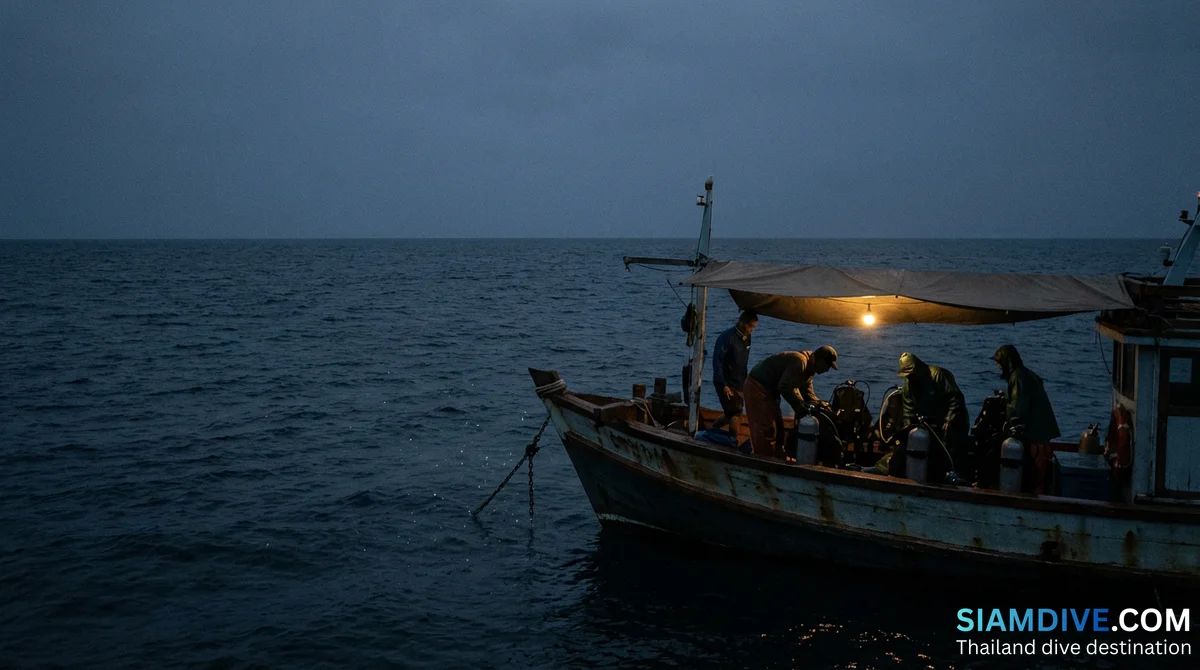
That surfacing rhythm also explains the most common human encounter scenario. Fishermen pulling nets at dawn occasionally haul up a sea krait that has been resting in shallow water or tangled while hunting. The handful of documented bites in medical literature almost all involve net handling, not recreational diving.
Where Sea Kraits Show Up in Thailand
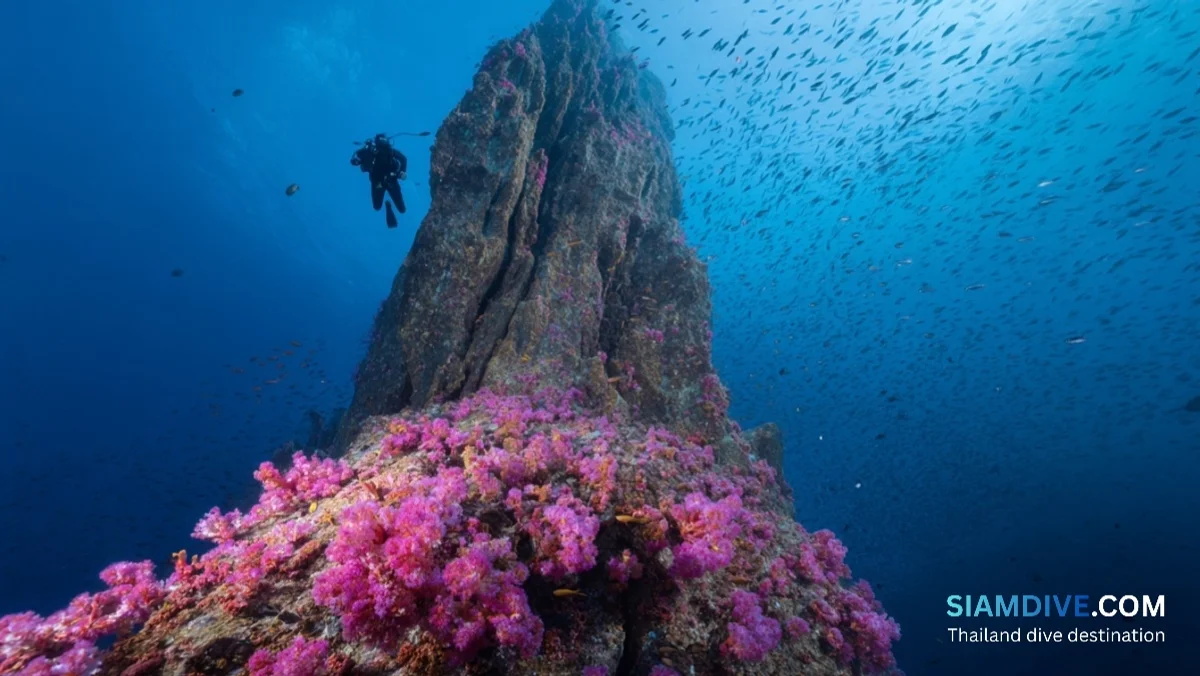
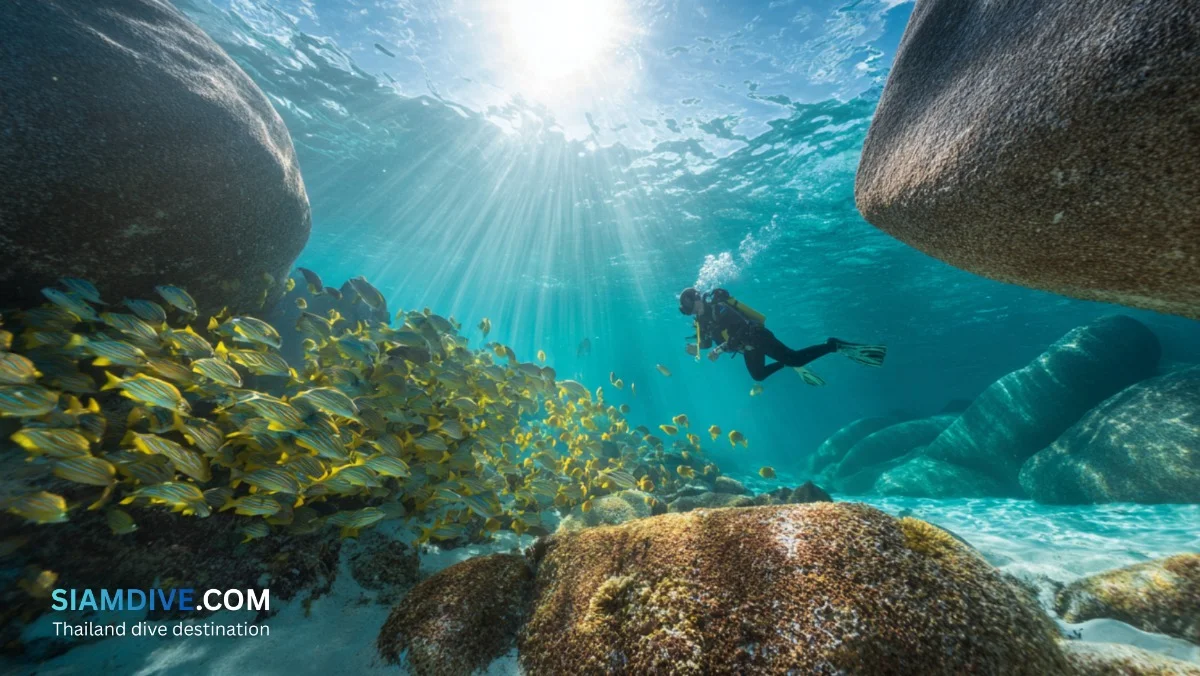
Koh Bida Nok, the small limestone stack south of Phi Phi Leh, holds the unofficial title of Thailand’s sea krait capital. Divers on the Bida Island circuit regularly clock two or three sightings per dive here — the craggy, undercut walls are ideal krait habitat, with crevices stacked floor to ceiling.
The Gulf of Thailand delivers its own hotspots. Koh Tao’s Japanese Gardens, Red Rock, Green Rock, and Hin Wong Pinnacle all host resident populations year-round, thanks to the island’s dense coral cover and abundant moray habitat. Sightings are most common on morning dives when kraits are active and hunting in the shallows — look along boulder edges and coral overhangs between 5 and 15 metres.
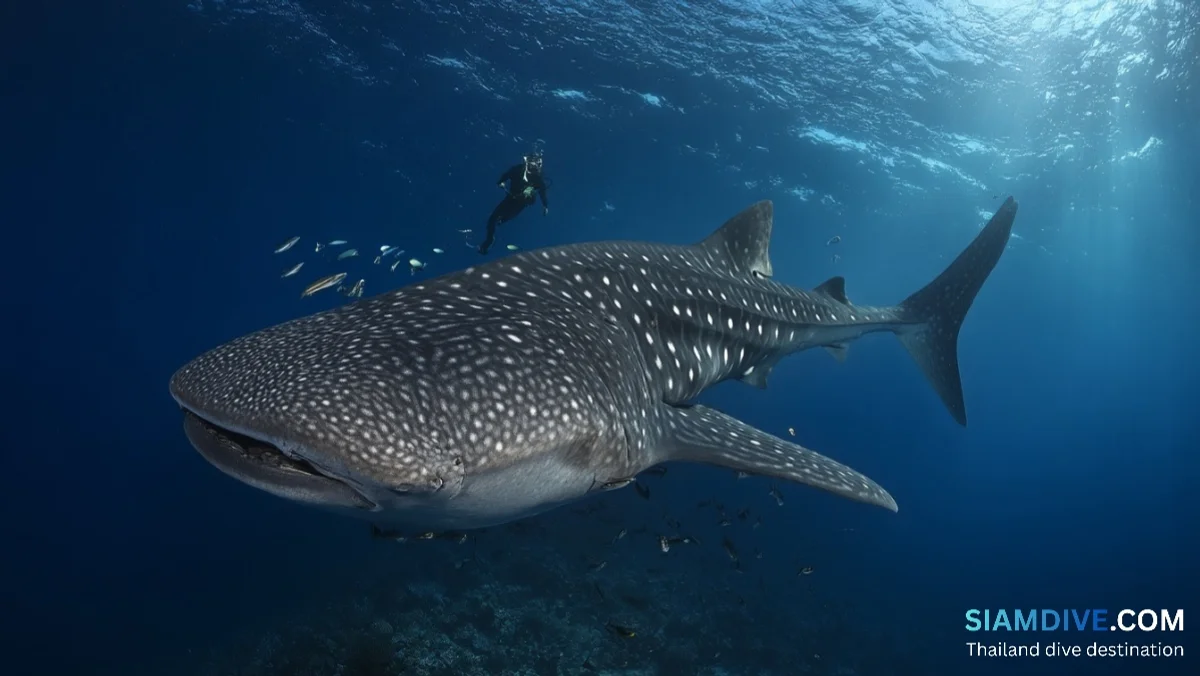
On the Andaman side, Koh Bon and Koh Tachai see regular appearances during liveaboard season (October–May), and Richelieu Rock occasionally serves up an encounter alongside its whale sharks and seahorses.
- Koh Bida Nok (Phi Phi): highest sighting density — craggy limestone, year-round
- Koh Tao (Gulf): Japanese Gardens, Red Rock, Green Rock, Hin Wong — year-round, best Jan–Apr
- Koh Bon & Koh Tachai (Similan): liveaboard season Oct–May
- Richelieu Rock: occasional, Andaman season only
A late-March 2026 Andaman expedition covering the Similan chain through to Koh Bon reported consistent sea krait sightings on morning dives when water temperatures held at 28–29 °C — conditions that keep both kraits and their moray prey active on the reef.
The Five-Second Rule When One Swims Past
Sea kraits are curious. They will investigate a diver’s bubbles, circle a camera housing, and occasionally tongue-flick a wetsuit boot before losing interest. None of this constitutes aggression — it is the same exploratory behaviour the snake uses to check every surface it passes.
The protocol is simple: hold still, keep your hands in, and watch. Do not block the animal’s path to the surface — remember, it needs to breathe. Do not grab, prod, or attempt to pose with it. The overwhelming majority of documented sea snake bites worldwide involve handling, not passive observation.
If the rare envenomation does occur, symptoms to watch for include localised numbness, muscle ache, and progressive weakness — signs of neurotoxic onset that can take 30 minutes to several hours to develop. Left untreated, severe envenomation can progress to respiratory paralysis, though this outcome is extremely uncommon and associated with prolonged handling rather than brief contact. DAN recommends applying a pressure-immobilisation bandage and evacuating to a medical facility with marine envenomation protocols. Sea snake antivenom — effective across multiple Laticauda species — is stocked at major Thai hospitals in coastal provinces including Krabi, Phuket, Surat Thani, and Trang.
For the vast majority of encounters, though, the five-second version applies: the krait appears, the krait investigates, the krait moves on. The entire exchange is a reminder that venom evolved to solve problems between predator and prey — and you, floating in open water with no resemblance to an eel, are not a problem worth solving. Sixty million years of specialisation have made the banded sea krait extraordinarily good at one thing. Biting divers is not it.