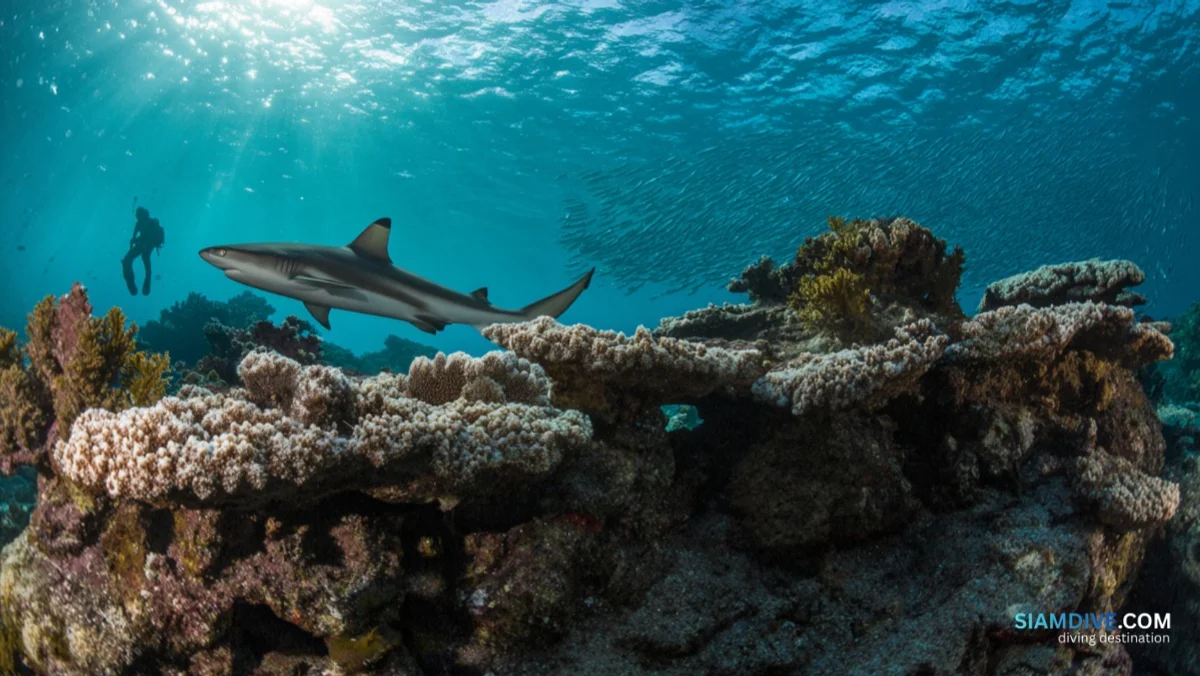
Blown Safety Stop: Your Body's Next 60 Minutes
14 พฤษภาคม 2569
A blown safety stop rarely means DCS — but the next hour decides. Red flags to watch, when to call DAN, and Thailand's chamber network numbers.
The ascent alarm screams at 12 metres. Your buddy's eyes go wide behind the mask. One of you — maybe both — just blew past the safety stop, and now you're staring at daylight from the wrong side of the protocol. The computer blinks a red warning. The dive is over. The hour that follows is not.
What happens next depends less on how fast you came up and more on what you do in the 60 minutes after your head breaks the surface. Most rapid ascents end in nothing worse than embarrassment and a lecture from the divemaster. A few end in a hyperbaric chamber. The difference between those outcomes is almost always what happened — or didn't happen — in the first hour.
Not Every Missed Stop Ends in a Chamber
The safety stop — three to five minutes at five metres — is a recommendation, not a decompression obligation. Skipping it raises risk, but the arithmetic matters. DCS affects roughly 3 cases per 10,000 recreational dives, and most of those involve deeper profiles, repetitive days, or both — not a single blown stop on a 20-metre reef dive.
The body handles some bubble formation without symptoms. Silent bubbles — microbubbles too small to cause trouble — form on nearly every ascent. The safety stop isn't the only off-gassing mechanism; surface interval time does the same work, just slower. That's why the first hour matters: it's the window where silent bubbles either resolve quietly or grow into something that hurts. If you want to understand how no-decompression limits work and why they matter before the ascent even begins, the maths behind 56 minutes at 18 metres lays it out.
What tilts the odds: depth, bottom time, cold water, exertion during the dive, dehydration, and how fast the ascent actually was. A diver who blew the stop after 40 minutes at 30 metres on a repetitive day has a very different risk profile from someone who missed three minutes at five metres after a conservative 18-metre single dive. Two identical ascent rates can produce radically different outcomes depending on how much nitrogen the tissue loaded before the ascent began.
Surface — The First 10 Minutes
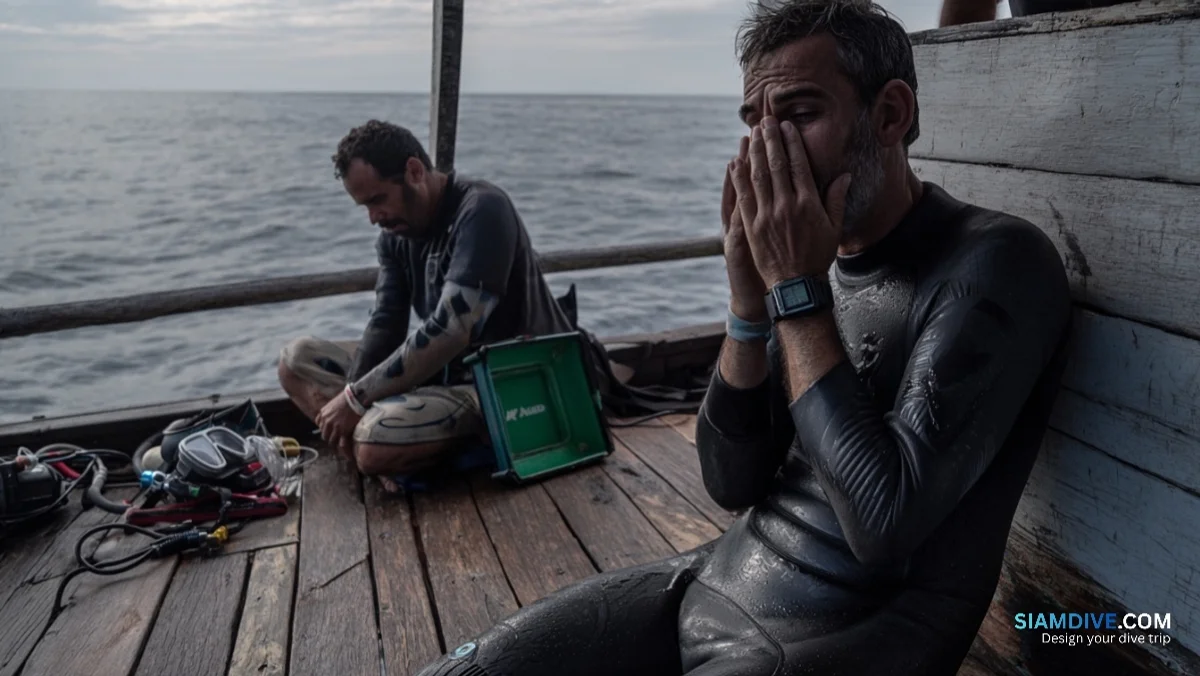
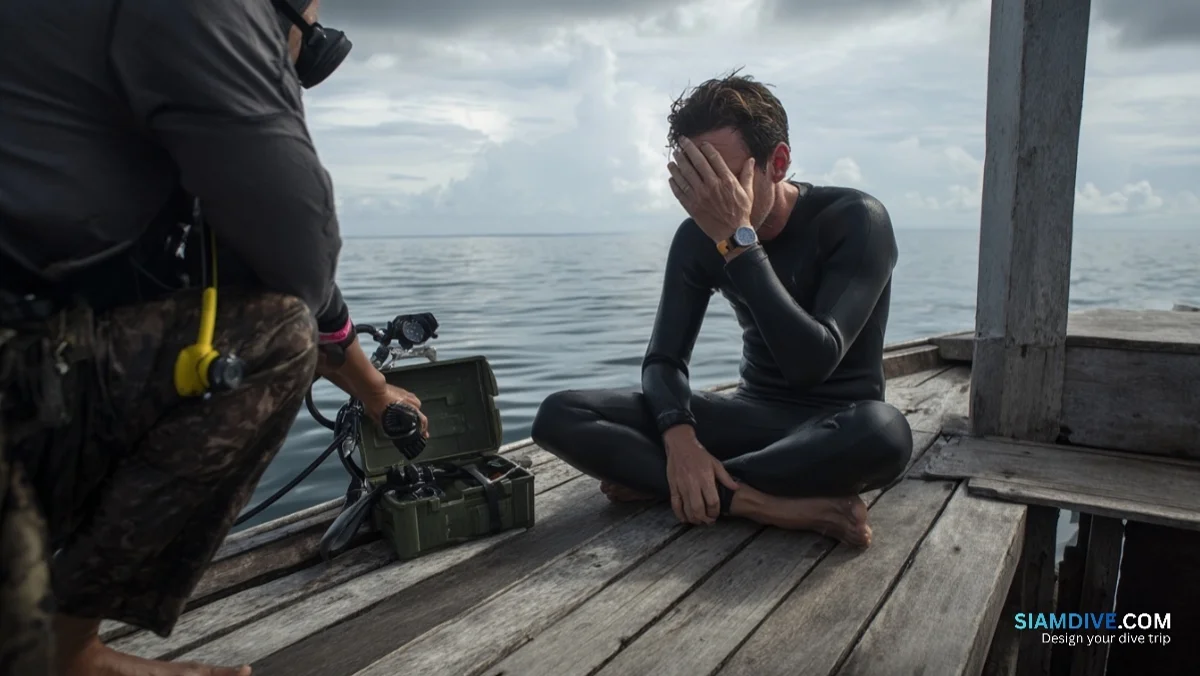
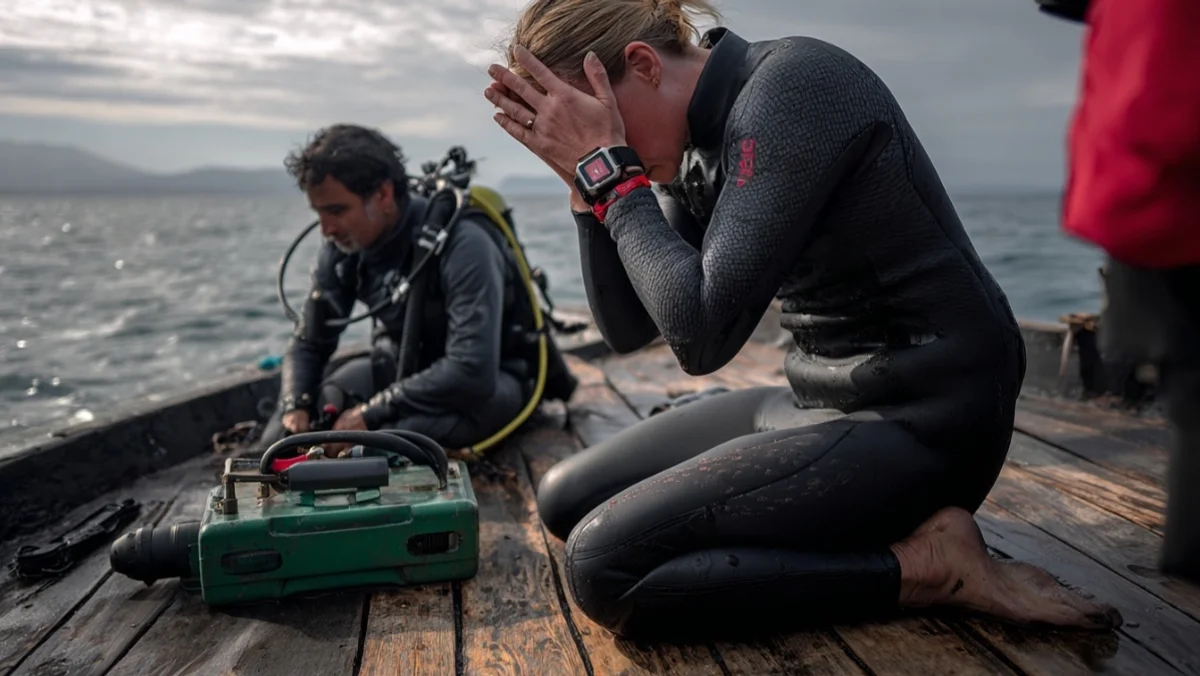
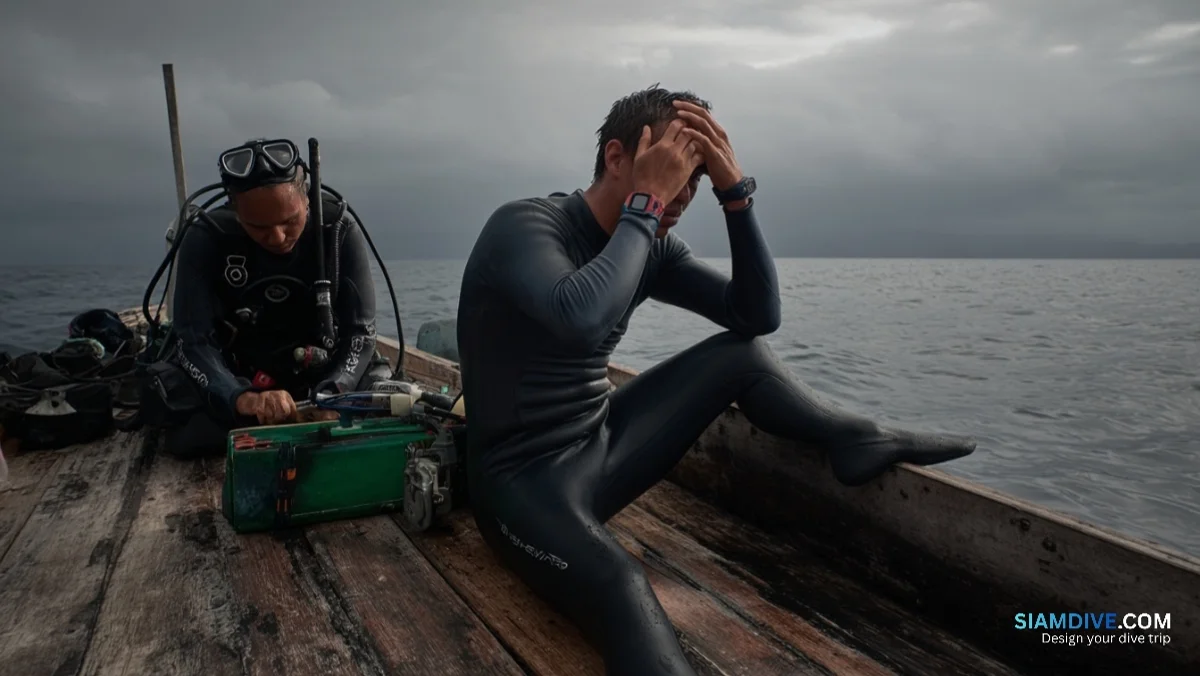
Gear off, sit down, and tell someone what happened. Those three acts sound obvious. Under the adrenaline of a blown ascent, people skip all three — hauling tanks up the ladder, staying silent out of embarrassment, and jumping straight into a second kit-up they should not be doing.
- Stop all activity. No gear breakdown, no climbing the ladder with tanks on. Sit on the deck or hold the float line.
- Breathe normally. Hyperventilating after a rapid ascent shifts blood CO₂ levels and makes things worse, not better.
- Signal the crew. Tell the divemaster or boat captain what happened — your depth, bottom time, and how fast the ascent was. That data matters if a DAN call follows.
- Start oxygen if available. A demand valve delivering 100% O₂ is the gold standard. Even a non-rebreather mask at high flow flushes nitrogen faster than ambient air. The oxygen kit is the single most useful item on any dive boat after a blown stop.
- Hydrate. Water, not beer. Dehydration thickens blood and slows nitrogen elimination. Aim for 500 ml in the first 20 minutes.
- Do not re-enter the water. In-water recompression without proper training, gas supply, and surface support creates more problems than it solves. DAN advises against it for recreational divers.
If the boat doesn't carry an emergency oxygen kit, note that in your logbook — and reconsider booking with them again. Most liveaboards and professional day boats in Thailand carry one, but not every budget day-trip operator does. Knowing what's on board before the dive is the same principle as checking your SPG before every descent.
Red Flags — Minute 10 to Minute 60
Seventy-five percent of DCS cases show symptoms within the first hour after surfacing. That hour is your monitoring window. Some of these signs are subtle enough that the diver dismisses them as seasickness or fatigue. A buddy watching from outside catches what the patient cannot.
Type I — Musculoskeletal and Skin
- Joint pain. A dull ache in the shoulders, elbows, knees, or wrists that deepens over the hour. Often described as a throb that can't be pinpointed — it moves, it spreads, it doesn't behave like a pulled muscle.
- Skin mottling. Blotchy reddish-purple patches on the torso or upper arms. Not sunburn. Not wetsuit chafe. If it looks like marble, it's a flag.
- Itching (skin bends). A persistent itch on the chest or back that doesn't respond to scratching.
- Unusual fatigue. Not the normal post-dive tiredness — a heavy, leaden exhaustion that feels disproportionate to the dive.
Type II — Neurological (Escalate Immediately)
- Tingling or numbness. Pins and needles in hands, feet, or around the mouth. Spinal DCS often starts here.
- Dizziness or vertigo. The world tilts. Inner-ear DCS mimics motion sickness but doesn't resolve with fresh air or a fixed horizon.
- Visual changes. Blurred vision, floating spots, or a narrowing visual field.
- Difficulty walking. Stumbling, loss of coordination, legs that won't cooperate on a flat deck.
- Confusion or slurred speech. The diver may not realise they're impaired — this is why buddy monitoring matters more than self-assessment.
- Chest pain or breathing difficulty. Known as "the chokes" — a rare but serious sign of pulmonary DCS.
- Bladder problems. Inability to urinate or loss of bladder control signals spinal cord involvement.
One complication sits outside the DCS timeline entirely. AGE — arterial gas embolism from lung over-expansion — hits faster, often within seconds to 10 minutes of surfacing. If a diver loses consciousness or shows sudden neurological symptoms immediately after a rapid ascent, treat it as AGE until a physician says otherwise. The first-aid response is the same: oxygen, horizontal position, emergency call. The distinction between AGE and DCS matters to the treating physician inside the chamber, but on the boat deck, the protocol is identical — recognise, oxygenate, evacuate.
Call DAN — or Just Watch?
The decision tree is simpler than it feels in the moment.
Call DAN immediately (+1-919-684-9111, 24 hours, collect calls accepted) if:
- Any Type II symptom appears — tingling, dizziness, visual changes, coordination loss, confusion, or breathing difficulty
- Type I symptoms that worsen over 30 minutes despite oxygen and rest
- The diver was at significant depth (beyond 30 metres) and/or on repetitive dives that day
- Any loss of consciousness, however brief
Monitor and extend surface oxygen if:
- No symptoms at 60 minutes — continue resting, hydrating, and observing for another two to three hours
- Mild joint ache that plateaus or improves within 30 minutes on oxygen — still report to DAN for guidance, but the urgency is lower
- The dive profile was conservative (single dive, 20 metres or shallower) and the ascent was fast but not explosive
DAN's medical team triages by phone. They decide whether the diver needs a chamber, a hospital visit, or extended observation — and they coordinate transport if needed. The call is free for DAN members and accepted collect for everyone else. In Southeast Asia, DAN Asia-Pacific (+61 8 8212 9242) handles regional coordination and can connect to the nearest SSS facility within minutes.
Thailand's Recompression Network — Numbers to Save Before the Trip
Three chambers cover Thailand's major dive regions, all operated by the SSS (Sub Sea Services) network. Each runs 24 hours a day, seven days a week, and works directly with DAN and major dive insurance providers.
- Phuket — SSS Hyperbaric Chamber, operational since 1996 in liaison with Bangkok Hospital Siriroj. Treatment depth capability to 50 metres. Emergency: +66 81 081 9000
- Koh Samui — SSS facility covering the Gulf islands including Samui, Phangan, and Tao. Emergency: +66 81 081 9555
- Koh Tao — On-island chamber, critical for the island's year-round training and diving population. Emergency: +66 81 081 9777
Transfer time drives outcomes. Recompression within two hours of symptom onset delivers the best results; within six hours, most cases still improve significantly. Past 24 hours, the numbers drop. The CDC's current guidance — updated through 2026 — reinforces that early recognition and rapid evacuation to a chamber remain the most important factors in DCS prognosis.
DAN membership starts at around USD 40 per year and includes emergency evacuation coverage. SSS chambers treat first and sort billing later, but insurance removes the financial question from an already stressful moment. The gap between "I'll sort out insurance when I get home" and "evacuate now, the policy covers it" can be measured in hours — hours that matter. For divers heading to remote sites like the Similan Islands or Burma Banks, where the nearest chamber is a two-hour boat ride away, that coverage is not optional.
After the First Hour — Flying, Diving, and the Days That Follow
No symptoms at 60 minutes is good news, but the watch doesn't end there. DCS can appear up to 36 hours after a dive, though onset beyond 12 hours is rare.
No-fly rules tighten after a blown stop. DAN's standard guidelines recommend at least 12 hours after a single no-decompression dive and 18 hours or longer after repetitive dives. After a rapid ascent or missed stop — even without symptoms — extending to a full 24 hours is the conservative call. If any symptoms appeared at any point, do not fly until cleared by a dive medicine physician. The interaction between altitude and residual nitrogen isn't something to gamble on, which is why so many diving hazards hide in the physics most people ignore.
No more diving that day. Full stop. Some divemasters on liveaboards may suggest a shallow "blow-off" dive to off-gas. That advice is outdated and risky. Rest, hydrate, observe.
Log everything. Depth. Bottom time. Ascent rate — your computer records this. Time to surface. Symptoms or absence of symptoms. Oxygen administered. DAN call, if made. This log helps any treating physician reconstruct the event days or weeks later.
Follow up, even if you feel fine. A phone call to DAN or a visit to a dive medicine clinic after the trip is cheap insurance. Published follow-up data shows that 14–16% of Type II DCS cases result in some form of lasting neurological effect — sometimes subtle enough that the diver doesn't connect post-dive headaches or mild tingling to a blown stop that happened weeks earlier. The body keeps score, even when the diver has moved on.