18,000 Dolphins Chase One Shoal off South Africa Every June
30 เมษายน 2569
Every winter, billions of sardines migrate along South Africa's Wild Coast — and 18,000 dolphins, six shark species, and breaching whales follow. Here is what the four-week window looks like from inside the water.
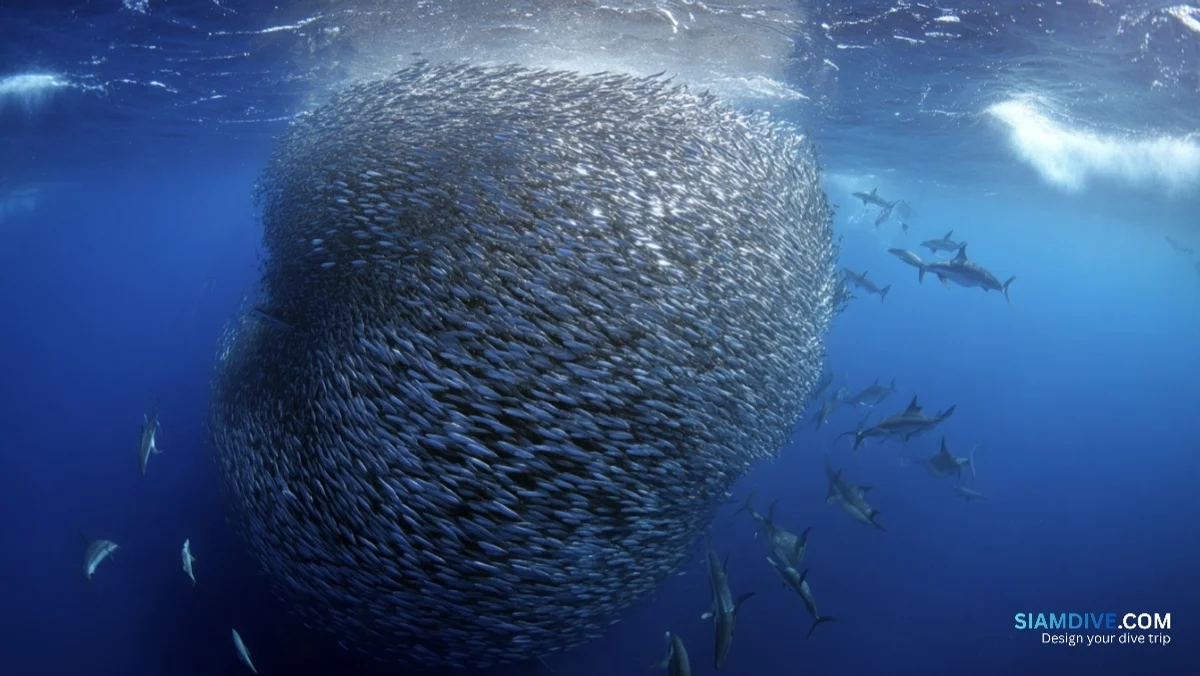
Eighteen thousand common dolphins hit the water in a single coordinated sweep off Port St Johns. Below them, a shoal of sardines stretches longer than the coastline of a small city — silver, compacted, moving north. Above, Cape gannets fold their wings and fall like javelins at a hundred kilometres per hour. Between the surface and the seafloor, copper sharks patrol the perimeter, patient and unhurried. This happens once a year, in a four-week window between mid-June and late July, along a 200-kilometre stretch of South Africa's Wild Coast. Nothing else in the ocean comes close.
Why the Indian Ocean Has to Cool Down First
The timing is not random. It is not even seasonal in the way most migrations are seasonal. It is thermometric — locked to a water-temperature threshold that the fish cannot negotiate. South African pilchard (Sardinops sagax) spawn on the Agulhas Bank — a shallow continental shelf off the country's southern tip — and the adults stay put in cool water year-round. Each winter, as the cold Benguela influence pushes around the cape and the Agulhas Current weakens along the east coast, the nearshore water off KwaZulu-Natal drops below 20°C. That temperature shift opens a thermal corridor — a narrow band of tolerable water hugging the coastline — that the fish can follow. When temperatures hit 14–20°C, a fraction of the population — less than 10%, according to a 2021 study in Science Advances — peels off and migrates northeast.
That fraction — a splinter of the total stock — still amounts to staggering volume. After severe declines that bottomed out at around 250,000 tonnes in 2020, stock assessments recorded recovery to more than one million tonnes by early 2024 — above the long-term average of 820,000 tonnes. The run involves a small share of this biomass, but "small" is relative. Even 10% of a million-tonne population produces a river of fish visible from spotter aircraft. Researchers have compared the event to East Africa's wildebeest migration in terms of sheer biomass on the move — the difference being that the Sardine Run happens underwater, compressed into a fraction of the time.
Six Predators, Zero Turn-Taking
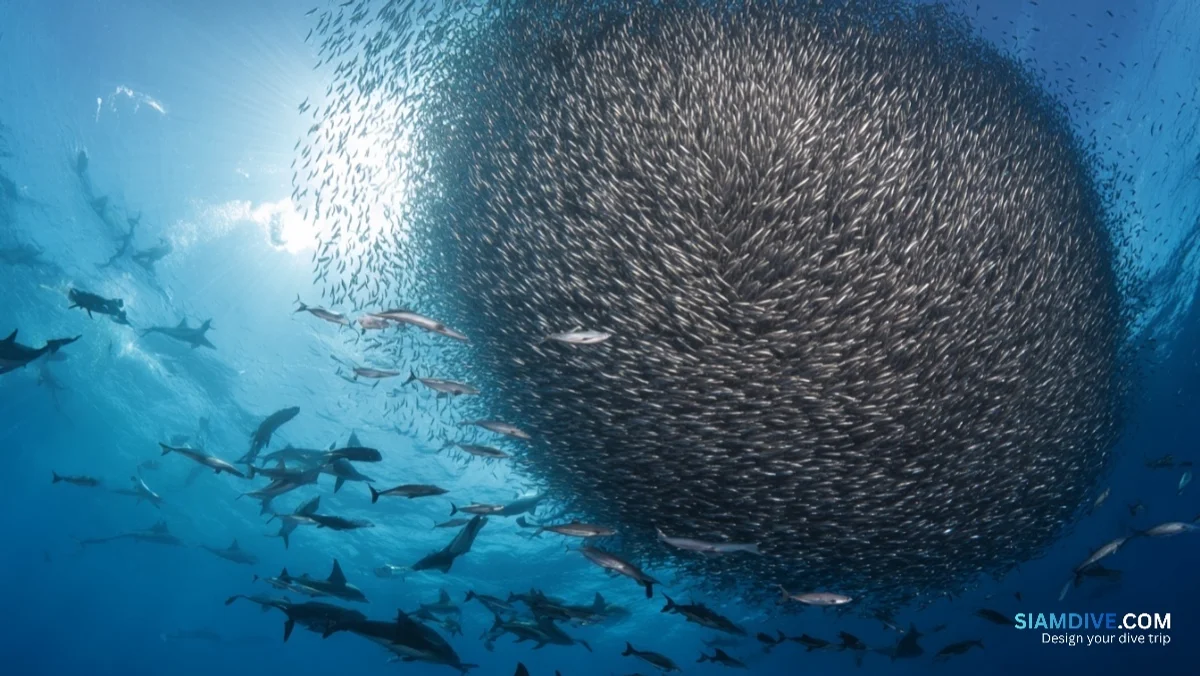
The water erupts from every direction at once. Dolphins corral sardines from the flanks. Sharks materialise from the deep blue below. Gannets punch through the surface from thirty metres up. Whales lunge sideways through whatever structure remains. At least six predator groups converge on the shoals, and none of them wait.
- Common dolphins — Pods numbering up to 18,000 individuals herd sardines into tight bait balls near the surface, working the perimeter like border collies around sheep.
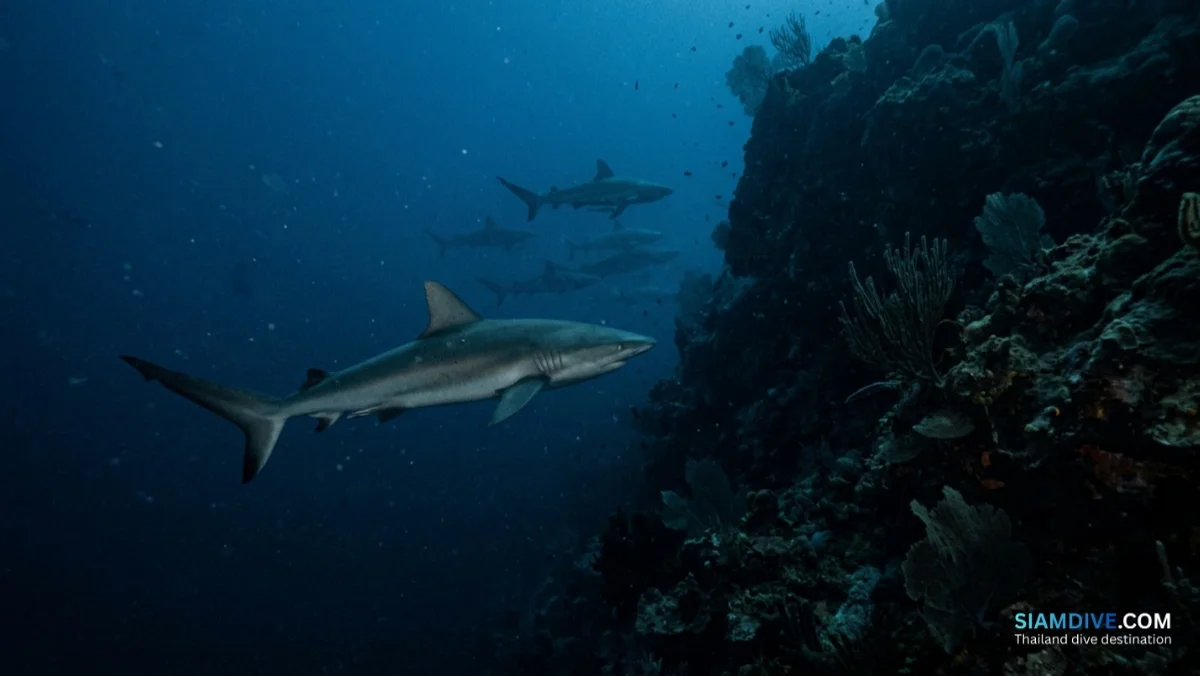
- Copper sharks — The most abundant shark species in the run, slicing through bait balls from below while dolphins compress them from the sides.
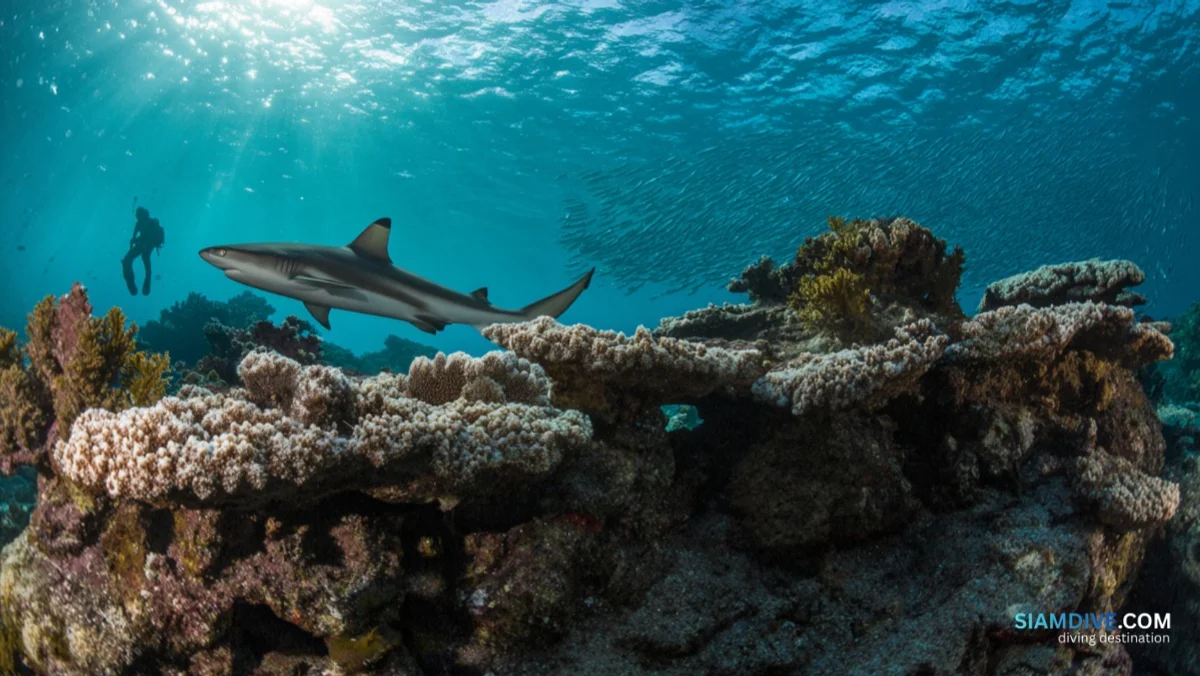
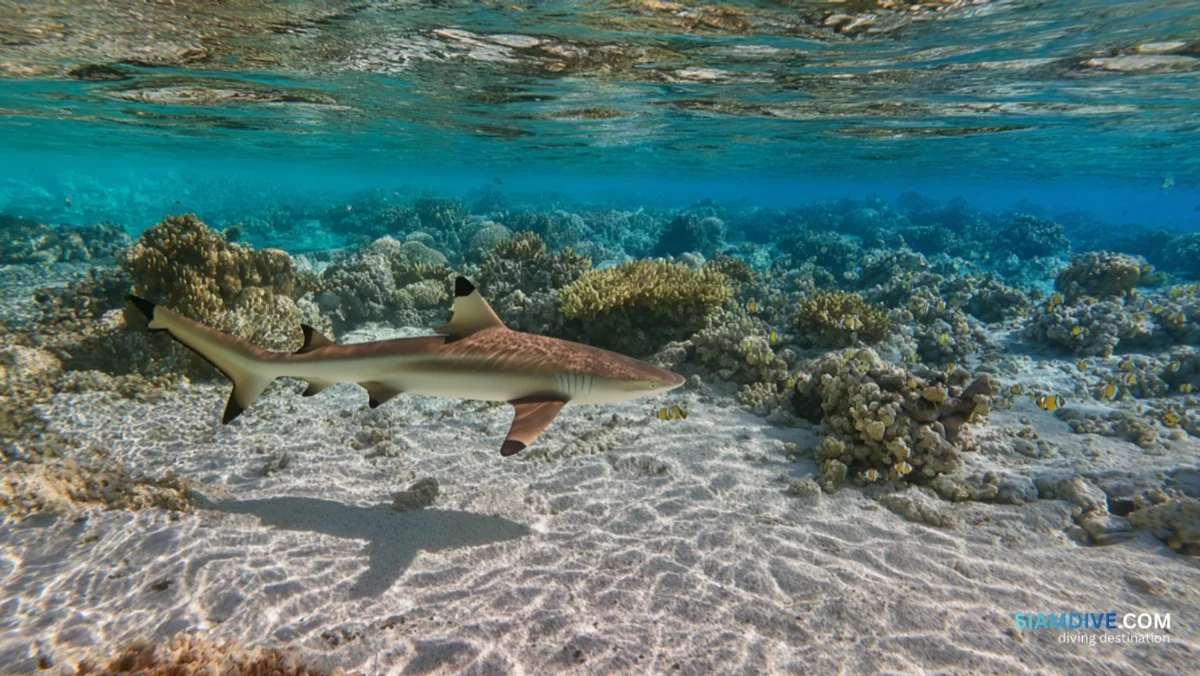
- Dusky and blacktip sharks — Both species feed alongside copper sharks, sometimes in mixed groups of over a hundred individuals.
- Bryde's whales — Present year-round in KwaZulu-Natal waters, these 15-metre baleen whales lunge through bait balls with mouths agape, swallowing hundreds of kilograms per pass.
- Humpback whales — Migrating north from Antarctic feeding grounds, humpbacks arrive in the run zone from June to July, adding their own lunging assaults.
- Cape gannets — The aerial component. Gannets plunge-dive from 30 metres, entering the water at speeds that would knock a person unconscious. Where gannets cluster, sardines are close — they are the most reliable indicator species.
A bait ball that starts at 20 metres across can be gone in under ten minutes. The coordination is not choreographed — it is competitive, frantic, and loud enough to hear through the water column.
Ten Minutes Inside a Bait Ball
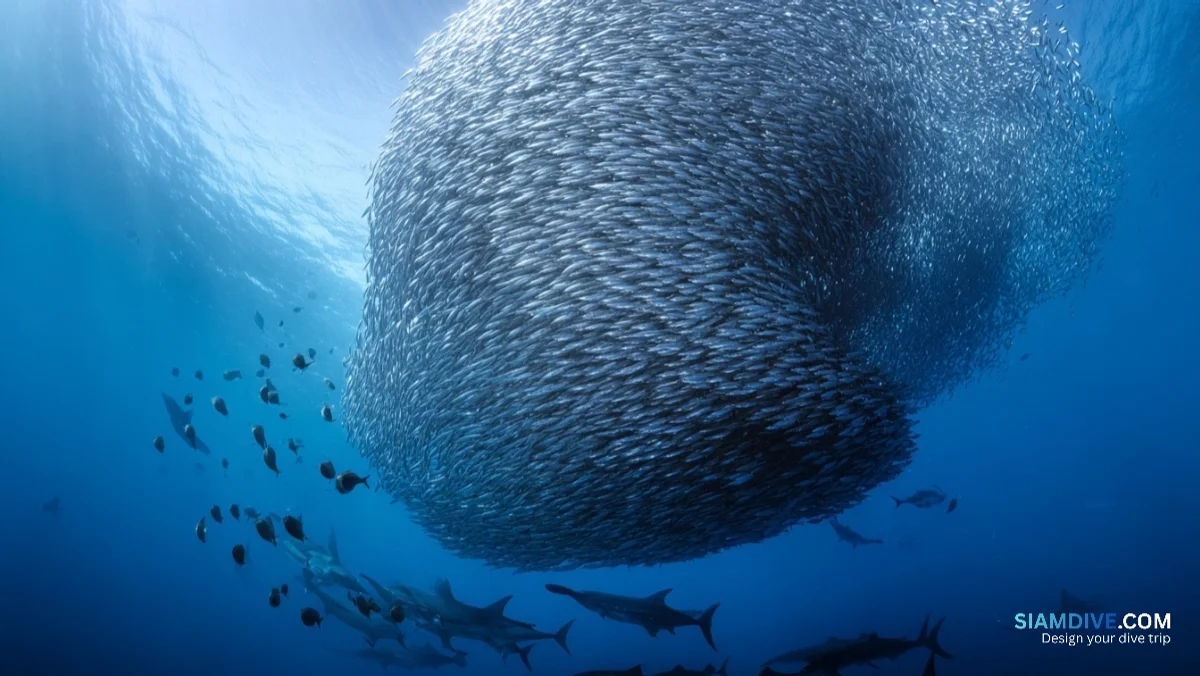
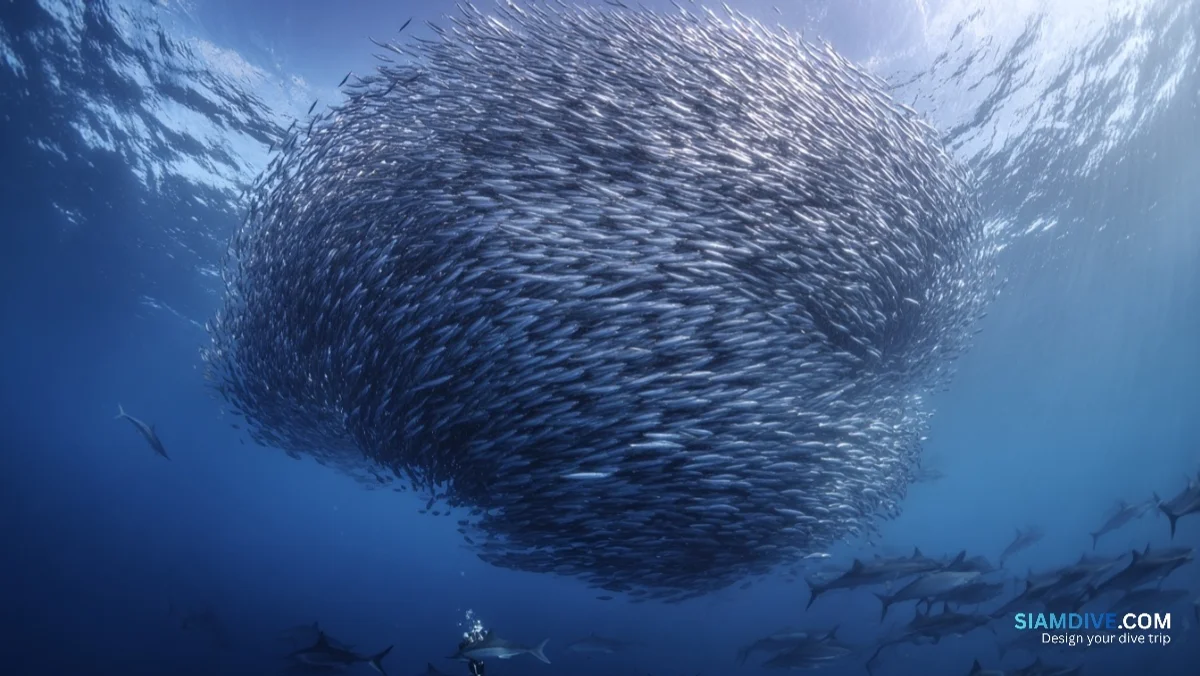
A bait ball forms when dolphins isolate a section of the shoal and begin driving it toward the surface. The sardines respond by packing tighter — a defensive reflex that, paradoxically, makes them easier to target. The resulting sphere can reach 10–20 metres in diameter and extend 10 metres deep.
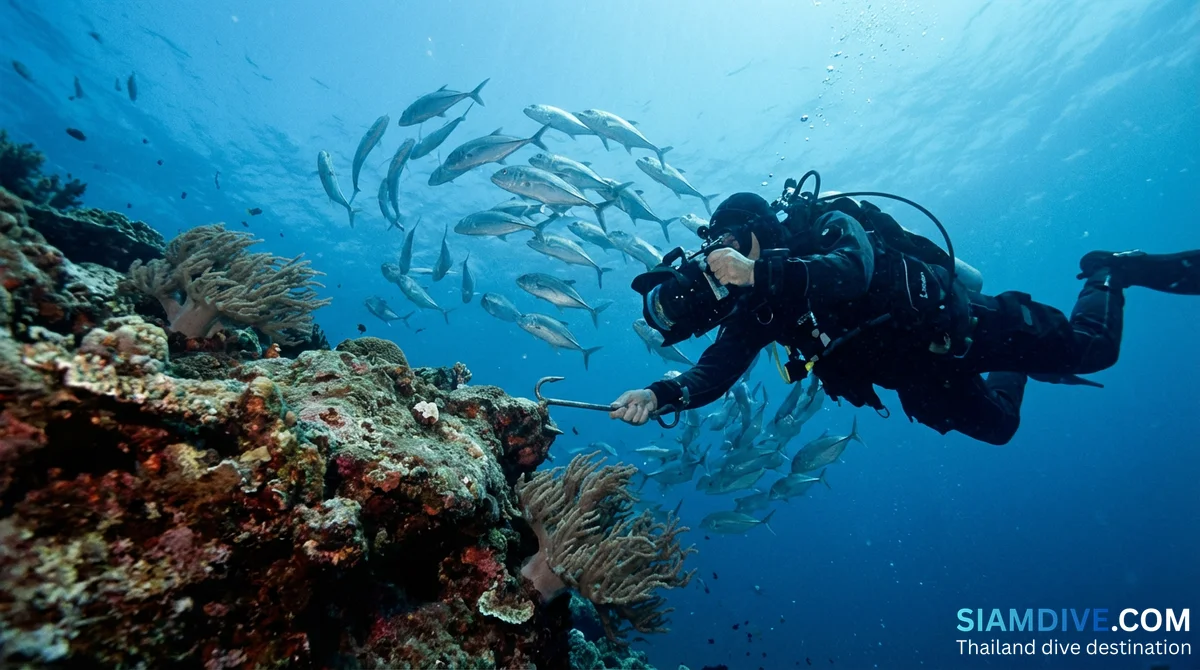
The sequence for divers is fast. A spotter plane radios coordinates. The boat runs hard. Snorkellers and divers roll off the RIB into open blue — no reef, no wall, no fixed reference point. Then the ball appears: a shimmering, spinning mass of silver that darkens the water around it. Dolphins streak through in pairs, mouths open. Sharks materialise from below, their approach barely visible until they are inside the ball. The sound — a crackling, crunching wall of noise from thousands of jaws snapping shut simultaneously — carries through the water column with an intensity that no video recording has ever faithfully captured.
Then it is over. The ball fragments, the predators scatter, and the boat is already chasing the next cluster of gannets. This is not reef diving where you return to the same wall tomorrow. There is no bottom. The action is mobile, unpredictable, and entirely weather-dependent.
Port St Johns to Durban — Following the Fish North
The migration tracks the coastline of South Africa's Eastern Cape and KwaZulu-Natal provinces. Shoals are typically first sighted off the Bashee River mouth near Port St Johns around early June — historically around the 8th or 9th — and, given cooperative weather, reach the Durban South Coast by roughly June 25.
- Port St Johns / Mbotyi — The epicentre. Deep water close to shore, steep drop-offs, and a narrow continental shelf concentrate the fish. Most dedicated sardine run operators base here.
- Coffee Bay / Mdumbi — Slightly south, used by operators running flexible packages that chase the fish along the coast.
- Cintsa (East London) — A staging base for the southern end of the run, paired with shore-based reef diving during downtime.
- Durban South Coast — Where the run historically climaxes before the fish disperse or move offshore into warmer water.
The distance from Port St Johns to Durban is roughly 450 kilometres by road — a five-to-six-hour drive through some of South Africa's most rugged coastal terrain. Operators commit to a single base and work a radius from there rather than chasing the entire coastline. The coastline itself is raw — no marinas, no sheltered harbours, no concrete slipways. Every launch goes through surf, and every return means riding a wave back onto the sand. For a sense of how different conditions can be at the opposite end of the temperature spectrum, the contrast with tropical diving could not be sharper.
What Seven Days on the Wild Coast Actually Cost
Sardine Run packages are all-inclusive by necessity — the Wild Coast has limited infrastructure, and operators handle everything from accommodation to boat launches. Pricing for 2026 spans a wide range depending on duration and comfort level.
- 5-night flexible (Port St Johns) — from ZAR 29,500 per person sharing (~USD 1,640)
- 7-night standard (Coffee Bay / Mdumbi) — from ZAR 45,500 per person sharing (~USD 2,530)
- 7-night superior (Cintsa / East London) — from ZAR 49,500 per person sharing (~USD 2,750)
- 9-day ultimate (Port St Johns, maximum water time) — from ZAR 79,950 per person sharing (~USD 4,440)
Most packages include transport from Durban or East London, accommodation, all boat launches and sea days, cylinder fills, weights, and diver permits. Gear rental is usually extra. Flights into Durban (King Shaka International) connect through Johannesburg from most international hubs.
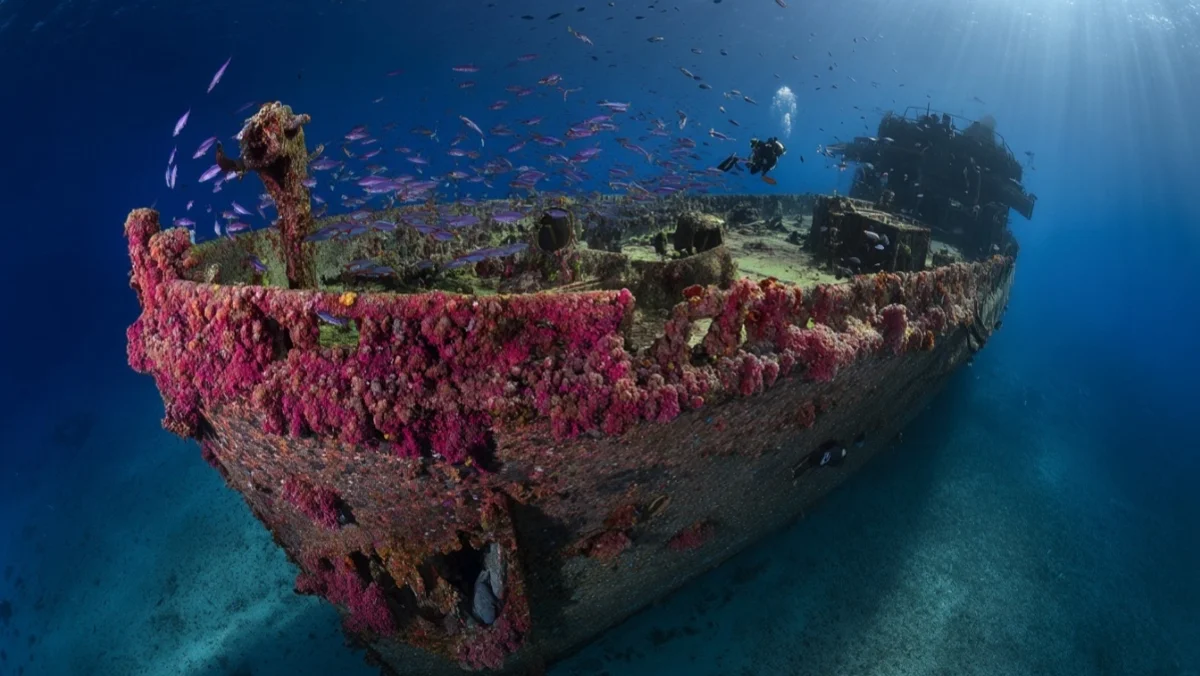
The value equation resists easy comparison. A week on the Wild Coast costs roughly what ten days of Similan liveaboard diving costs out of Khao Lak — but there is no reef to revisit, no second chance at the same bait ball, and no other destination that concentrates this many predator species into one visible event.
The Certification and Gear Floor
This is not a trip for new divers. Most operators require PADI Advanced Open Water (or equivalent) with at least 50 logged dives. The reasoning is practical: entries are from a RIB through surf, currents run hard, visibility can drop to single digits, and the pace leaves no time for hesitation.
- Exposure protection
- 5–7 mm wetsuit with hood — non-negotiable in water temperatures of 13–21°C.
- Fitness
- Beach launches through surf, repeated entries from a RIB, and long days on the water demand cardiovascular fitness. Operators recommend gym work in the months before the trip.
- Useful specialties
- Drift Diver certification pays off — currents along the Wild Coast define the challenge. Comfort with drift entries and exits separates those who keep up with the action from those who watch it disappear.
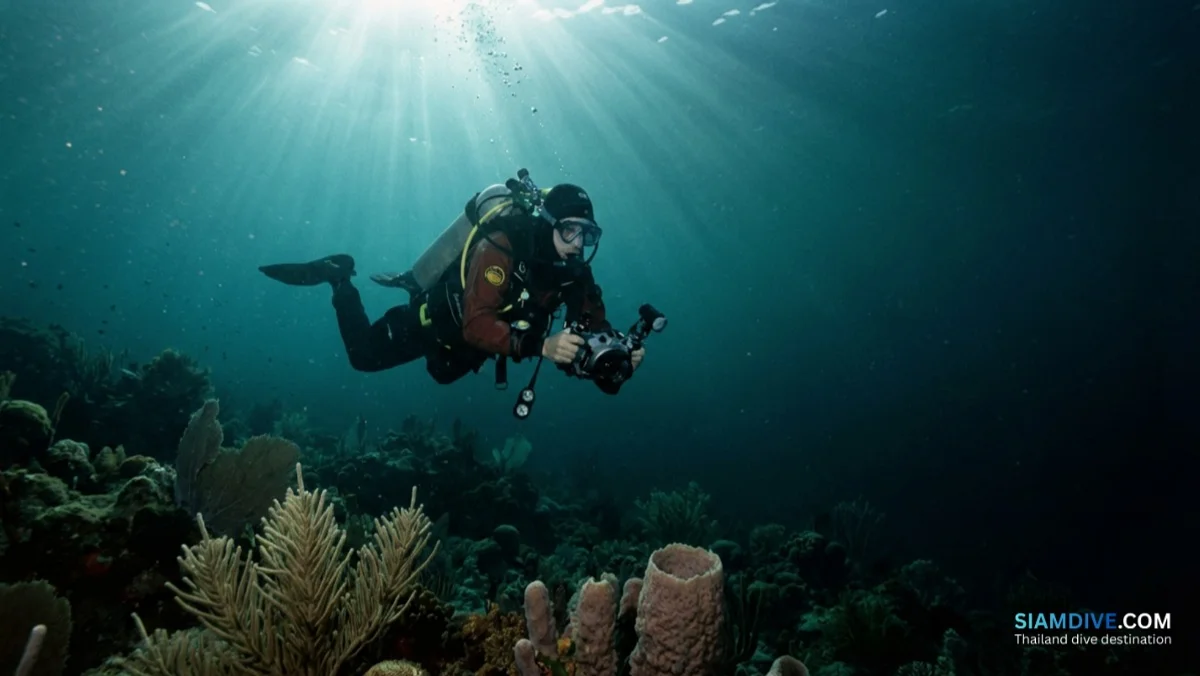
Underwater photography adds another layer of difficulty. The fast-moving targets, variable light, and heavy backscatter potential make the Sardine Run one of the most technically demanding shoots in dive photography. Wide-angle is essential — a 14–30 mm or fisheye behind a dome port covers the scale of a bait ball while keeping dolphins and sharks in frame. Strobes are a gamble: they light the particulate as much as the subject, and many photographers work with available light only, relying on the god rays that punch through the churned surface. When it all comes together — light, action, composition, a shark cutting through the silver — the results rank among the most published underwater images in the world.
Why 2026 Bookings Started Last Year
The Sardine Run is not something you walk up to. Operator capacity along the Wild Coast is limited by boat size, accommodation, and the logistics of launching through surf. Popular operators sell out 12–14 months in advance. For 2026, some outfits were already fully booked by late 2025, with 2027 waitlists open.
The 2026 season officially runs June 10 to August 10, though the peak action — the window when bait balls form with reliable frequency — compresses into roughly four weeks from mid-June to mid-July. Tour start dates range from May 17 (early-season scouting packages) through late July.
Recent years have been encouraging. Both the 2024 and 2025 runs saw early fish movements, with large pilot shoals arriving on the Durban South Coast in the first week of June. The biomass recovery from 250,000 tonnes in 2020 to over a million tonnes by early 2024 suggests the population can sustain strong runs through the mid-2020s.
For divers who measure trips by adrenaline-per-hour rather than reef coverage, the Sardine Run sits alone. There is nothing else in recreational diving where this many predator species converge on one prey source, in water shallow enough to reach with a standard single tank, for a window short enough to miss entirely. The reef will still be there next month. The wreck is not going anywhere. The Sardine Run waits for no one — and neither do 18,000 dolphins.
Sources
- Wikipedia — Sardine run overview and predator species data
- Science Advances — The sardine run as a mass migration into an ecological trap (2021)
- DAN Alert Diver — Beneath the Birds: diving the Sardine Run
- PADI Blog — South Africa's Sardine Run conditions and requirements
- SANBI — South African sardine species profile