A Fin Clips Your Mask at 18 Metres — Now What?
16 พฤษภาคม 2569
Eighteen metres down, a fin catches your strap and the mask drops. Five steps, fifteen seconds — the protocol that separates a drill from a drowning.
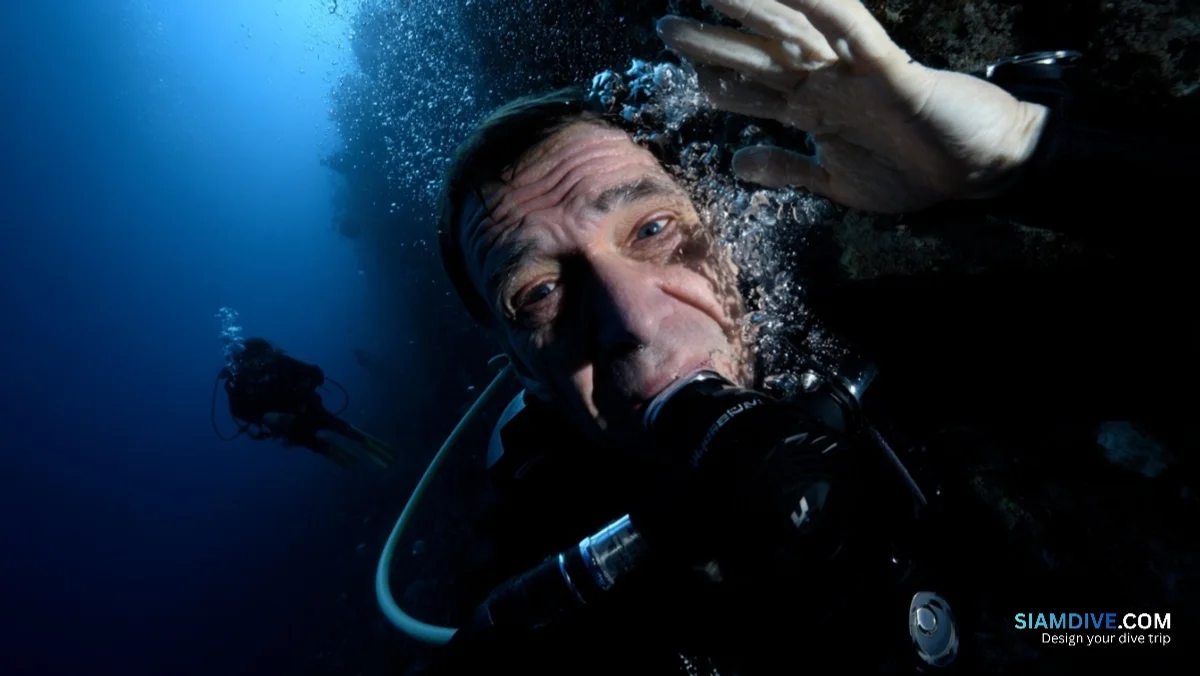
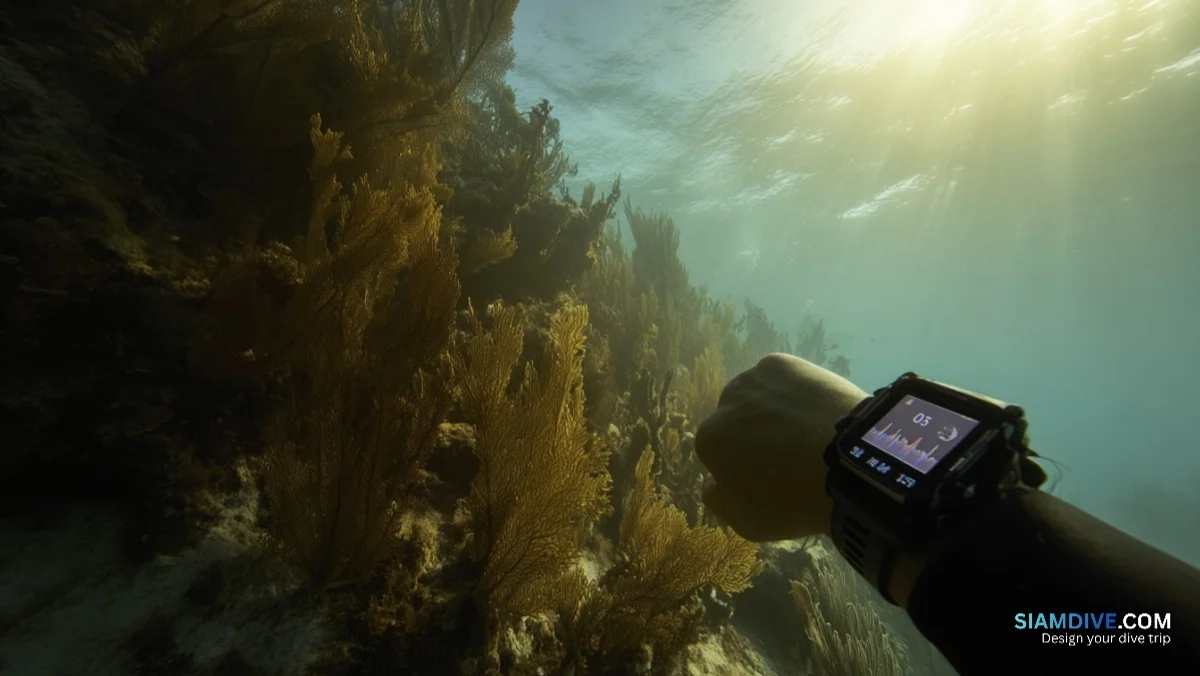
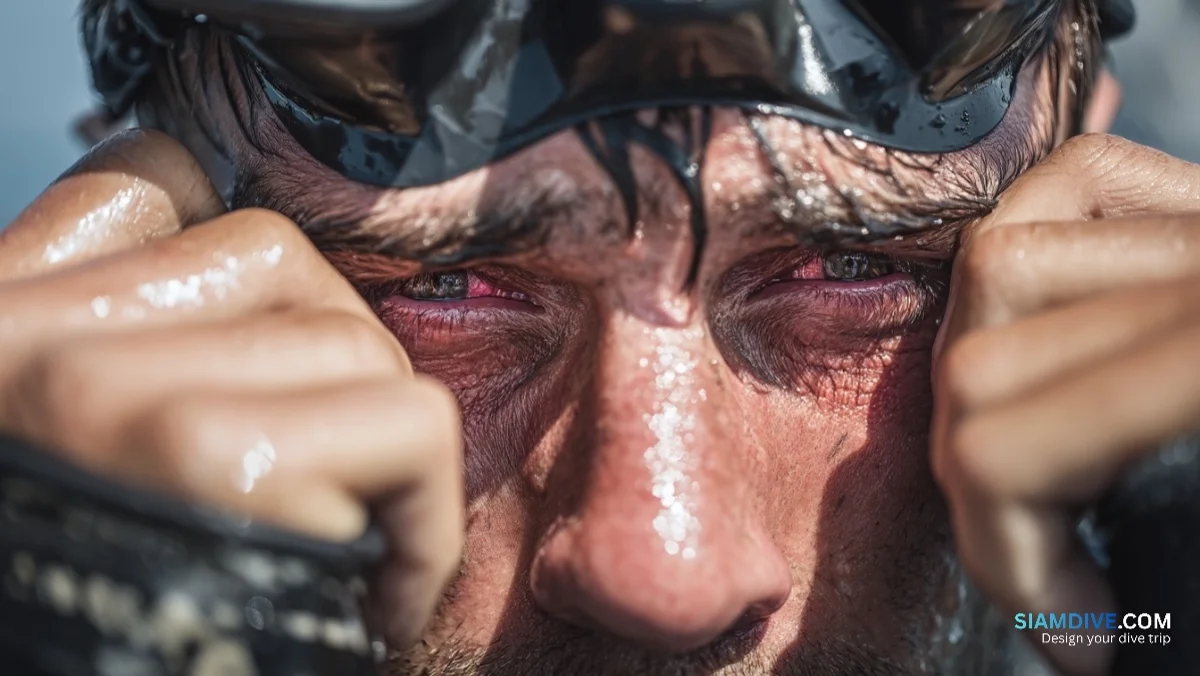
Eighteen metres down on a reef wall, the group bunches at a cleaning station. Someone's fin catches the edge of your strap. The mask lifts, floods, and drops around your neck in one smooth motion. Eyes stinging, everything a blue blur — but the regulator is still in your mouth. Your body does not care about the regulator. Your body wants air, light, and the surface, in that order. What happens in the next five seconds writes the rest of the dive.
Five Seconds, Five Steps
The protocol fits on a slate, and every certified diver learned it once. The problem is that once was a long time ago.
- Step 1 — Freeze. Stop kicking. Stop turning. A motionless diver does not ascend, descend, or collide with anything. Freezing buys time without costing depth.
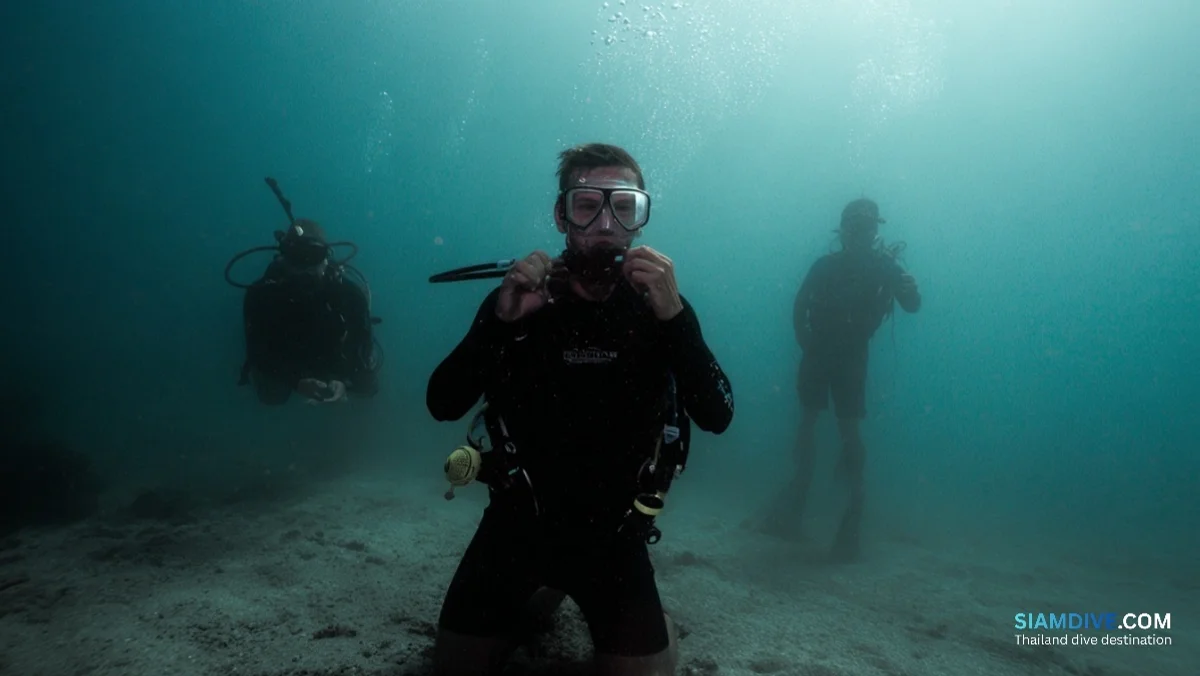
- Step 2 — Breathe. The regulator is still in your mouth. Breathe through it. Slowly. Water touching the face triggers a reflexive urge to inhale through the nose — override it. Mouth in, mouth out. One controlled breath breaks the panic loop before it starts.
- Step 3 — Reach. Most displaced masks land on the forehead, around the neck, or dangle from one strap loop near the ear. Sweep a hand across the forehead, then down each side. In current, the mask can drift behind the head — run a hand along the strap path. If ten seconds pass without finding it, signal your buddy: point to your eyes, then shrug. A buddy with functioning eyes locates your mask faster than you can.
- Step 4 — Seat. Press the lens against your face, pull the strap over the crown of your head. No rush. A poorly seated mask clears worse than no mask at all.
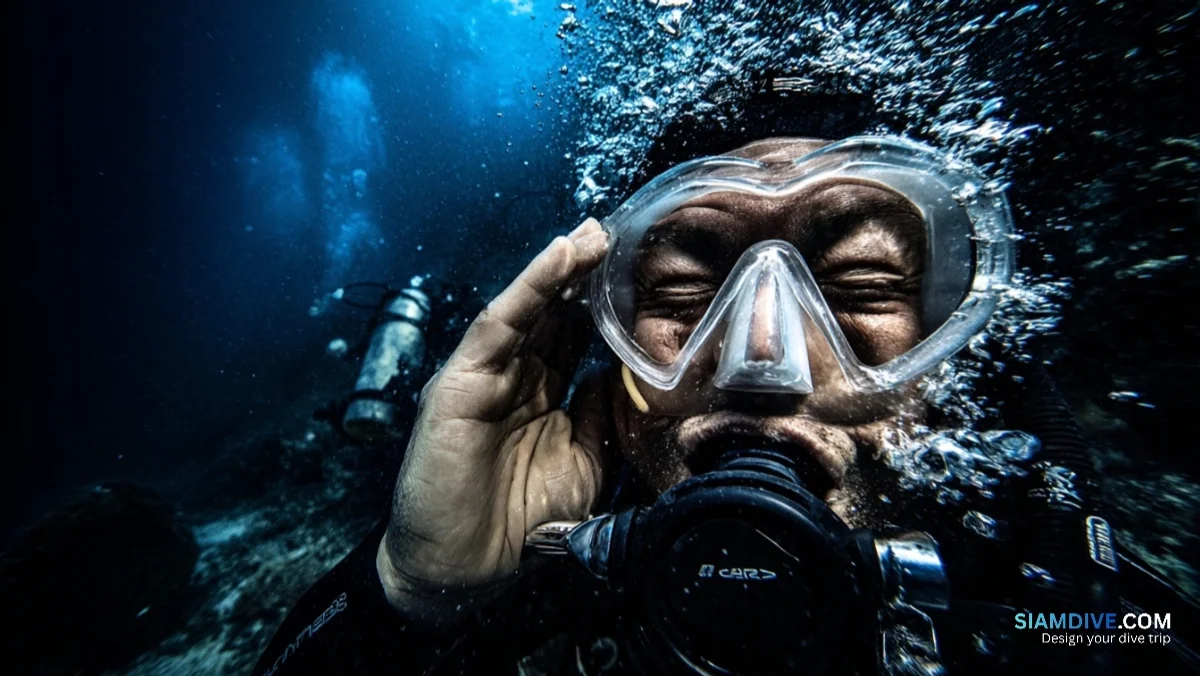
- Step 5 — Clear. Tilt your chin up so the bottom edge of the skirt becomes the lowest point. Press the top frame against your forehead with two fingers. Exhale firmly through your nose. Air displaces the water out through the bottom seal. One or two exhales and the world snaps back into focus.
The entire sequence — freeze, breathe, reach, seat, clear — takes less than fifteen seconds for a diver who has practised it. For a diver who has not, fifteen seconds is long enough to drown.
What Panic Does at Depth
The mask comes off. The diver bolts. That sequence kills people.
DAN's annual diving reports identify panic as a contributing factor in 40 to 60 per cent of recreational diving fatalities. In 26 per cent of fatal incidents, an uncontrolled emergency ascent was the precipitating event — and in nearly a third of buddy breathing failures, the victim's mask was already displaced before the situation spiralled.
The chain is predictable. Mask loss triggers water contact with the nose and eyes. The trigeminal nerve fires a reflex that mimics suffocation. The diver inhales sharply through the nose, chokes on saltwater, and abandons the regulator. Positive buoyancy from a half-inflated BCD or a panicked kick drives an ascent. At 18 metres, an uncontrolled bolt to the surface takes under 30 seconds — fast enough for pulmonary barotrauma if the diver holds a breath, slow enough for a trained diver to catch and stop it.
The fix is not courage. The fix is muscle memory. A diver who has practised no-mask breathing two dozen times does not panic when the mask leaves. The trigeminal reflex still fires, but the trained response — mouth breathing, stillness, reach — overrides it before the conscious brain even registers what happened.
How Masks Actually Come Off
Certification videos show a calm instructor lifting the mask in a pool. Reality is messier.
Buddy fin strike. Thai dive boats run groups of six to eight divers. On a wall dive or at a cleaning station, spacing shrinks. One diver backs up to frame a shot, a fin swings wide, and the blade catches a mask strap from behind. It is the single most common cause of accidental mask loss in group diving.
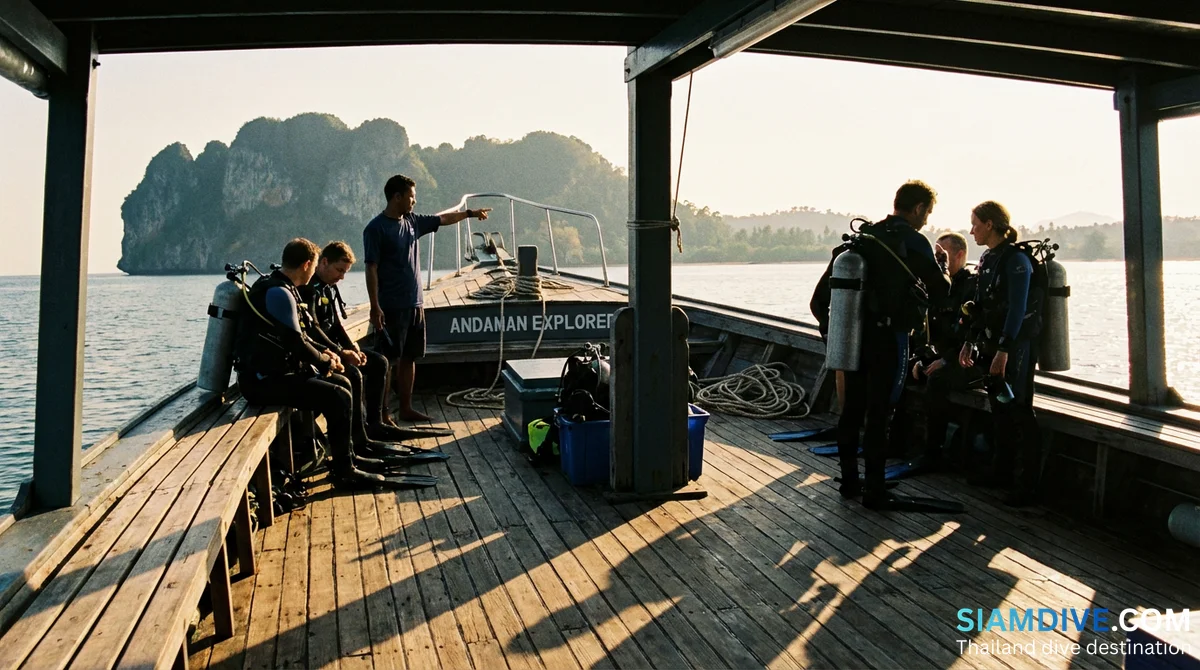
Boat entry gone wrong. A giant stride off a day-trip boat demands the right hand pressing regulator and mask frame simultaneously, left hand securing the weight belt buckle. Rush that hand placement on a rocking longtail and the water impact rips the mask upward. Back rolls carry a different hazard: the strap can hook on the tank valve on the way over, pulling the mask clean off before the diver surfaces.
Current and surge. A diver pushed against a boulder by surge can lose a mask to friction. Low-profile masks with recessed frames survive this better than high-volume masks with exposed skirts, but nothing survives a strap that is already loose.
Worn rental gear. Silicone straps degrade in UV and salt. A strap that has lived on a rental rack for two seasons stretches, slides on wet hair, and gives up under any lateral force. Many experienced divers carry their own mask for exactly this reason — bringing personal gear to Thailand eliminates the rental-strap lottery entirely.
The 60-Second Drill You Passed and Forgot
Sixty seconds. That is how long the PADI Open Water course asks a student to breathe without a mask in confined water. Every certified diver passed that exercise once — and the vast majority never revisited it.
Skill decay in motor tasks is well documented. The confidence built in a pool session fades within months. A diver who was comfortable breathing maskless at four metres in a calm pool may find the same exercise terrifying at 18 metres on a reef two years later. The water is colder, darker, and moving. The audience is not an instructor with a reassuring hand — it is a barracuda and a current.
Dive professionals recommend treating no-mask breathing like a fire drill: practise it on a schedule, in increasingly realistic conditions, until the response is automatic. Not brave — automatic. Bravery requires thought. Thought requires time. At depth without a mask, time is the resource in shortest supply. Knowing the right hand signals to call for help and understanding how blood sugar affects decision-making at depth are companion skills worth reviving on the same calendar.
Gear That Keeps a Mask on Your Face
Not every mask loss is preventable, but many are a gear problem dressed up as a skill problem.
- Neoprene slap strap. The single best upgrade for mask retention. A neoprene strap wraps wider surface area around the skull, grips wet hair without pulling, and uses Velcro closure for quick tension adjustment — even underwater. Factory silicone straps grip dry skin well but slide on wet hair, hoods, and sweaty foreheads. A replacement neoprene strap runs 200–400 baht and fits most masks.
- Low-volume mask. Less air space means less water when flooded, less air needed to clear, and a lower profile that current or a stray fin cannot catch as easily. Freediving masks offer the lowest volume but sacrifice peripheral vision. A good middle ground: a dual-lens recreational mask with a silicone skirt that wraps close to the cheekbones.
- The sniff test. Press the mask against the face without the strap. Inhale gently through the nose. If the mask stays, the skirt seal is good. If it drops, air is leaking — usually at the nose bridge or above the upper lip. No strap tension fixes a bad seal.
- Mask lanyard. A lightweight clip connecting the mask frame to a BCD D-ring means a knocked-off mask drifts on the cord instead of falling into blue water. Not elegant, but effective — especially on dives where both hands may be occupied.
Rebuilding the Reflex — Pool to Ocean in Four Steps
Boredom is the milestone. When pulling the mask off at depth feels like a chore instead of a crisis, the reflex is built.
- Pool — partial and full flood. Start at 1.5 metres. Flood the mask partially, clear. Flood fully, clear. Remove entirely, breathe without it for 60 seconds, replace and clear. Repeat until anxiety gives way to irritation. That irritation is progress.
- Confined water — add task loading. Mask off, perform a fin pivot to hold neutral buoyancy. Or hold a slate and write a name. Task loading while blind forces the brain to separate breathing from problem-solving — breathing stays on autopilot while the hands do something useful.
- Open water at 5 metres — buddy removes the mask. Signal a buddy to pull the mask off without warning mid-dive. Recover, seat, clear. Five metres is shallow enough that any panic-driven ascent is harmless, deep enough that conditions feel real.
- Night dive — torch management. Remove the mask in open water at night. Darkness amplifies every instinct. Hold the torch in one hand, sweep for the mask with the other. Master this and daytime mask loss will feel trivial.
Why This Matters More in Thailand Right Now
Thailand's dive industry runs fast. Day-trip boats out of Chalong, Khao Lak, and Koh Tao load groups, back-roll off RIBs into current, and descend walls where spacing shrinks at every photo stop. The conditions that knock masks off — tight groups, current entries, rental gear on its last season — are not edge cases here. They are the default.
Since April 2025, Thailand's enhanced marine regulations require all dive operators to conduct full pre-dive briefings covering buoyancy control, no-touch rules, and site-specific hazards, with fines up to 100,000 THB for violations. In 2026, Koh Tao has tightened operator licensing standards, verifying staff certifications and enforcing environmental compliance. The regulatory direction is clear: operators are expected to prepare divers properly, not just clip a lanyard and point at the reef.
In March 2026, the U.S. Consumer Product Safety Commission recalled 84,000 full-face snorkel masks sold online after reports of laboured breathing, CO₂ buildup, and one drowning death. The recall targeted snorkel gear — not scuba — but the principle transfers directly: a mask that fails underwater creates a cascade. The difference for a scuba diver is depth. At the surface, a bad mask is a swim back to the boat. At 18 metres, a bad mask is the beginning of a protocol — or the beginning of a panic.
No regulation or gear recall replaces the 60 seconds of discomfort it takes to pull a mask off at depth and breathe through it. That discomfort is the cheapest safety investment in diving.