50% of Divers Have Panicked — Their Lungs Made It Worse
1 พฤษภาคม 2569
Half of all recreational divers report at least one panic episode. The real danger isn't the fear — it's the CO₂ loop your lungs trigger next.
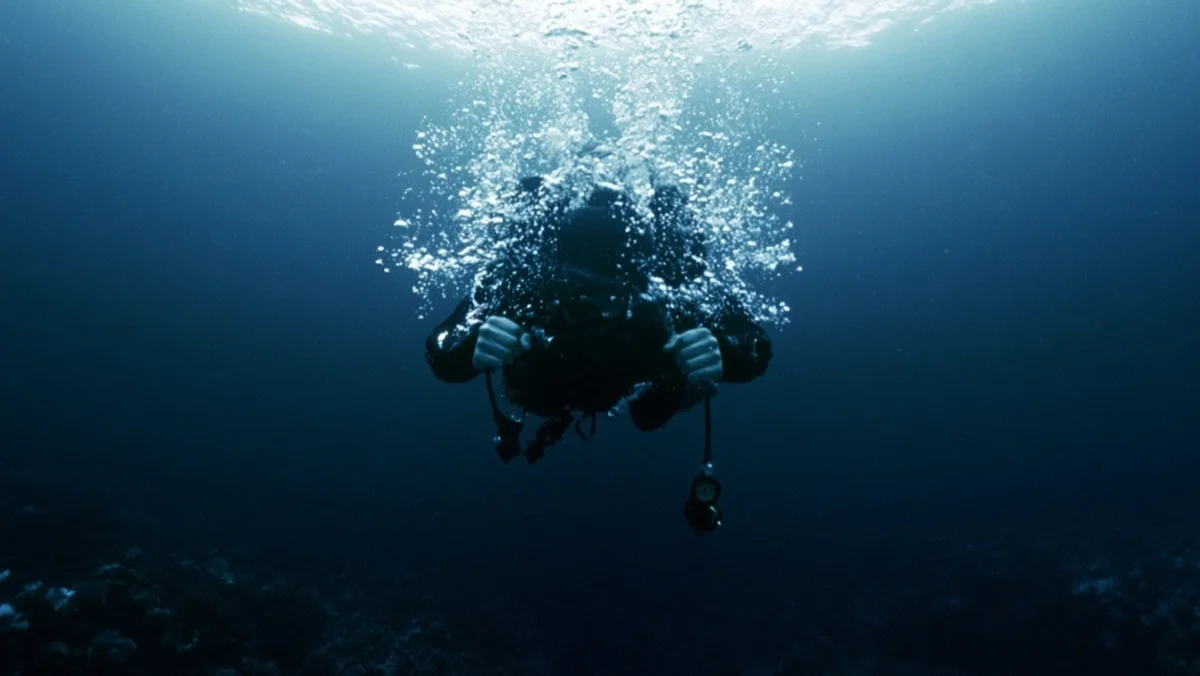
A diver at 28 metres watches the current pick up. Visibility drops from 15 metres to three in under a minute. Heart rate doubles before the next breath cycle finishes. Breathing rate triples. And in the next ninety seconds, the tank gauge drops further than it did in the previous ten minutes of calm finning.
This is what underwater panic looks like from the inside — and a DAN survey found that more than half of all recreational divers have experienced at least one episode of it.
The Amygdala Fires Before You Think
Two almond-shaped clusters buried in the temporal lobe run threat detection faster than conscious thought. When the amygdala registers danger — real or imagined — it triggers the hypothalamic-pituitary-adrenal axis in under 100 milliseconds. Adrenaline floods the bloodstream. Heart rate spikes. Blood redirects from extremities to major muscle groups. Every signal screams the same instruction: fight or run.
Neither option works underwater. There is nothing to fight. And running means a bolt to the surface — the single most dangerous response available to a scuba diver. A rapid, uncontrolled ascent invites arterial gas embolism, pulmonary barotrauma, and decompression sickness simultaneously. The stress system evolved for land-based predators, not for an environment where the only exit is straight up through four atmospheres of water.
The CO₂ Loop That Makes Everything Worse
Once the stress response fires, breathing changes shape. Panicking divers rarely hold their breath — they breathe faster and shallower. Each rapid inhalation pulls air into the upper lobes of the lungs, where gas exchange is least efficient. Less oxygen reaches the blood. Less CO₂ leaves it.
Rising blood CO₂ hits the brainstem's chemoreceptors, which read the signal as suffocation. The brain's answer: breathe faster. But faster shallow breathing only drives CO₂ higher, the suffocation alarm intensifies, and the cycle accelerates into a feedback loop with no natural off-switch.
Peer-reviewed diving physiology research assigns CO₂ a narcotic index roughly 20 times higher than nitrogen. At elevated levels, it impairs judgment, amplifies anxiety, and degrades fine motor control. A diver caught in this loop does not just feel frightened — cognitive function is actively deteriorating, making it progressively harder to remember how to dump air from the BCD, locate the inflator hose, or signal the buddy.
Your Tank Empties in Double Time
Watch the gauge. A relaxed recreational diver uses roughly 15–20 litres of air per minute at the surface. During a panic episode, that rate can triple. At depth, the difference between calm and chaos becomes a countdown:
- Calm at 30 m (4 ATA) — ~20 L/min surface rate → 80 L/min actual → a 12-litre, 200-bar tank lasts roughly 30 minutes
- Panicking at 30 m — ~55 L/min surface rate → 220 L/min actual → the same tank lasts barely 10 minutes
- Net loss — panic cuts available bottom time by two-thirds at recreational depth
DAN fatality data draws a direct line from breathing rate to outcome: 41% of diving fatalities involve a diver who was running low or completely out of breathing gas. In DAN's injury-mechanism breakdown, rapid ascent (31%), running out of gas (31%), and panic (30%) account for the three most common pathways to a casualty — three strands of the same rope, each pulling the others tighter.
Who Panics Most — and Why It Isn't Who You'd Guess
Experience does not immunize. The DAN survey that flagged panic in more than half of divers did not single out beginners. Certified, logged, outwardly confident divers panic too — sometimes precisely because confidence carries them into conditions that exceed their training envelope.
Several factors raise the baseline risk:
- Anxiety sensitivity — divers with higher baseline anxiety show amplified physiological responses to identical stressors, a pattern consistent across multiple peer-reviewed studies. Generalised anxiety disorder also raises CO₂ sensitivity, meaning the panic feedback loop ignites at a lower threshold.
- CO₂ retention — some divers naturally retain more CO₂ due to habitual shallow breathing, smoking history, or low cardiovascular fitness. These individuals hit the feedback threshold faster and with less warning.
- Task loading — managing a camera, a lift bag, a compass heading, and a depth check simultaneously narrows the cognitive bandwidth available for threat detection. When a stressor arrives, there is no margin left to absorb it.
- Cold and fatigue — cold water diverts blood from extremities, raises heart rate, and accelerates gas consumption before any psychological trigger fires. A diver who skipped sleep, missed breakfast, or is mildly dehydrated starts the dive already closer to the edge.
What Loads the Panic Gun
Panic rarely strikes in warm, calm, clear water at five metres. Specific environmental conditions reliably prime the stress response:
- Sudden visibility loss — silt-outs, thermoclines, or current-driven plankton blooms can reduce visibility to arm's length in seconds. The loss of visual reference fires the amygdala before the diver has time to check the depth gauge.
- Current shifts — unexpected current means effort, and effort means CO₂. A diver finning hard into a current doubles their metabolic rate — and CO₂ production — without registering the change consciously.
- Depth below 30 m — nitrogen narcosis begins building around 30 metres and deepens fast. Narcosis layered onto a stress response is accelerant on a fire that is already burning.
- Entanglement — fishing line, monofilament, old net remnants, even a fin strap snagging on dead coral. Restricted movement triggers a primal confinement response that bypasses rational assessment.
- Marine life startle — a jellyfish brush against bare skin or a large shape materialising from peripheral vision. The startle fires the same amygdala pathway as any mechanical threat.
- Equipment malfunction — a free-flowing regulator, a stuck BCD inflator, or a fogged mask. Each demands a trained motor response at exactly the moment training is hardest to access.
The 6-Second Override
The amygdala fires in milliseconds. But the vagus nerve — the body's longest cranial nerve, threading from brainstem to abdomen — can slow the entire cascade. The lever is the exhale.
STOP — BREATHE — THINK — ACT is taught by PADI, SSI, and every major certification agency. Few divers practise the protocol with the specificity it demands:
- Stop all motion. Finning during panic is instinct. It is also the fastest route to spiking CO₂. Cease movement. Achieve neutral buoyancy or grab something stable — reef, line, anchor chain.
- Breathe — exhale for six full seconds. A long, slow exhale activates the parasympathetic nervous system through the vagus nerve. Heart rate drops measurably. The CO₂ loop begins to crack. Inhale for four counts, exhale for six. Three full cycles — thirty seconds total — is enough to lower heart rate by 10–15 beats per minute.
- Think — name the problem. Low air? Current? Mask squeeze? The act of labelling a threat forces the prefrontal cortex back online and pulls executive control away from the amygdala. Most triggers have a rehearsed solution.
- Act on the problem, not the fear. Low air means a controlled ascent with a safety stop if gas permits. Current means dropping to the reef and crawling. Zero visibility means stopping, checking compass, and waiting for the buddy's torch.
Two additional tools that work at depth:
- Box breathing (4-4-4-4) — inhale four counts, hold four, exhale four, hold four. Military combat divers use this pattern for stress inoculation training in high-threat water. The hold phases force the diaphragm to reset, breaking the shallow-rapid pattern that feeds the CO₂ loop.
- Buddy contact — a hand on the forearm signals safety to the limbic system faster than any OK sign flashed across three metres of murky water. Established pairs should agree on a physical "settle" signal during the pre-dive briefing.
Research published in Frontiers in Psychiatry (2021) confirmed that cold-water contact on the face triggers the mammalian dive reflex — a measurable bradycardia response — even in individuals experiencing active panic symptoms. In cooler water, pressing the mask firmly against the face or briefly flooding it can initiate this reflex. In tropical water above 28 °C the effect is weaker, but the deliberate act of mask manipulation still serves as a cognitive interrupt — a task that pulls attention away from the fear spiral.
Before You Even Get Wet
The cheapest panic intervention happens on land, hours or days before the splash.
- Stress inoculation drills — practise mask removal at depth, out-of-air sharing, and buddy breathing in current during controlled training sessions. The goal is not comfort but familiarity. A brain that has rehearsed the motor pattern three times can execute it even when the amygdala is firing at full volume.
- Mental rehearsal — before the dive, walk through a panic scenario: current picks up → stop → exhale six seconds → check air → signal buddy → begin controlled ascent together. Sport psychology research supports three visualisations as enough to reduce response latency during a real-world event.
- Pre-dive honesty — cold, tired, hungover, anxious about conditions. Any of these lowers the panic threshold. Saying "I'm fine" when the body says otherwise is the single highest-risk behaviour a diver can bring to the water. A dive called off on the surface costs nothing. A dive aborted at 30 metres costs air, composure, and sometimes a life.
- Track your SAC rate — divers who regularly log their surface air consumption know their personal baseline. A rate running 30% above normal during the first five minutes is a clear signal: the system is loading before the diver consciously feels it.
A paper published in Frontiers in Psychiatry in May 2025 added a new dimension: researchers found that the mammalian diving response could measurably alter CO₂ sensitivity in panic disorder patients, suggesting therapeutic applications that borrow directly from diver training protocols. The boundary between clinical anxiety management and what happens in a wetsuit at 20 metres has never been thinner.
Sources
- DAN — Psychological Issues and Diving
- Frontiers in Psychiatry — The Implications of the Diving Response in Reducing Panic Symptoms (2021)
- NCBI — DAN Annual Diving Report: Diving Fatalities
- GUE — Carbon Dioxide, Narcosis, and Diving
- Frontiers in Psychiatry — Diving Response and CO₂ Sensitivity in Panic Disorder (2025)