2 km from Phi Phi, a Reef That Only GPS Can Find
4 พฤษภาคม 2569
Hin Klai sits 6 metres below the surface with no marker, no buoy, and more barrel sponges than any reef near Koh Lanta. Here is what hides between the boulders.
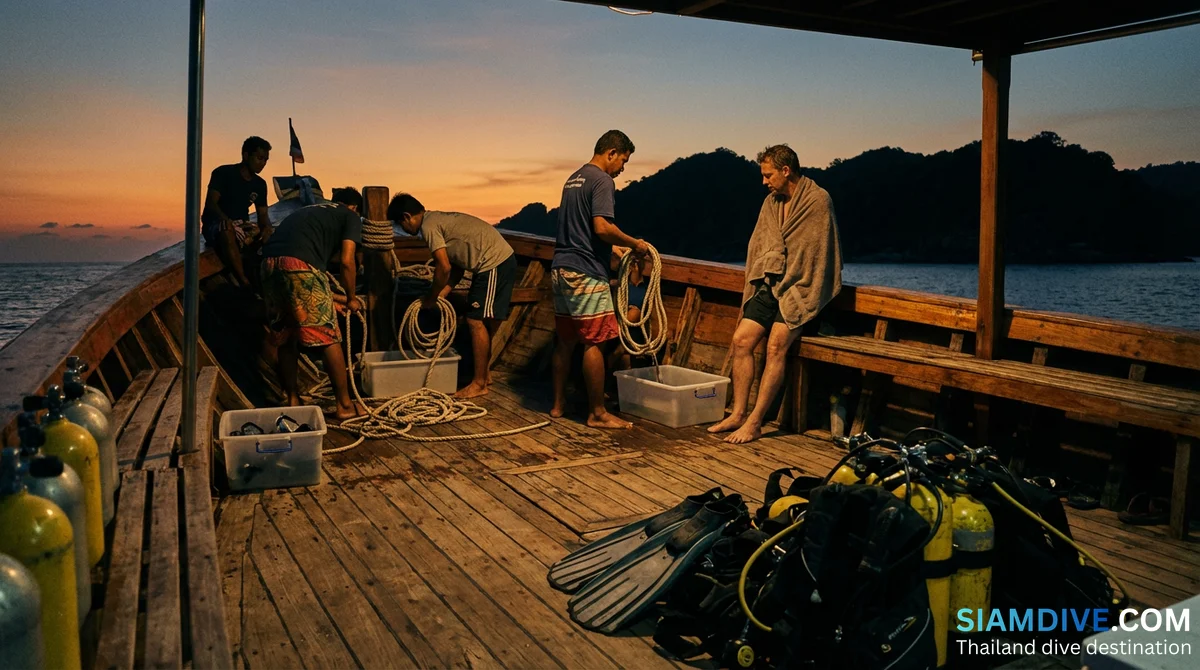
Dive boat captains around Koh Lanta know the spot exists — they just cannot see it. No mooring buoy breaks the surface. No marker float. No island peak to line up against the horizon. The oval reef sits 2 km east of Phi Phi Leh, entirely submerged, its shallowest point six metres below a surface that looks no different from open Andaman water. Without a GPS waypoint handed from another captain over a beer at Saladan pier, you would motor straight past at full throttle and never feel a thing beneath the hull.
That invisibility is exactly why Hin Klai still looks the way Thai reefs looked thirty years ago — and why the divers who know the coordinates guard them like a family recipe.
A Reef That Does Not Want to Be Found
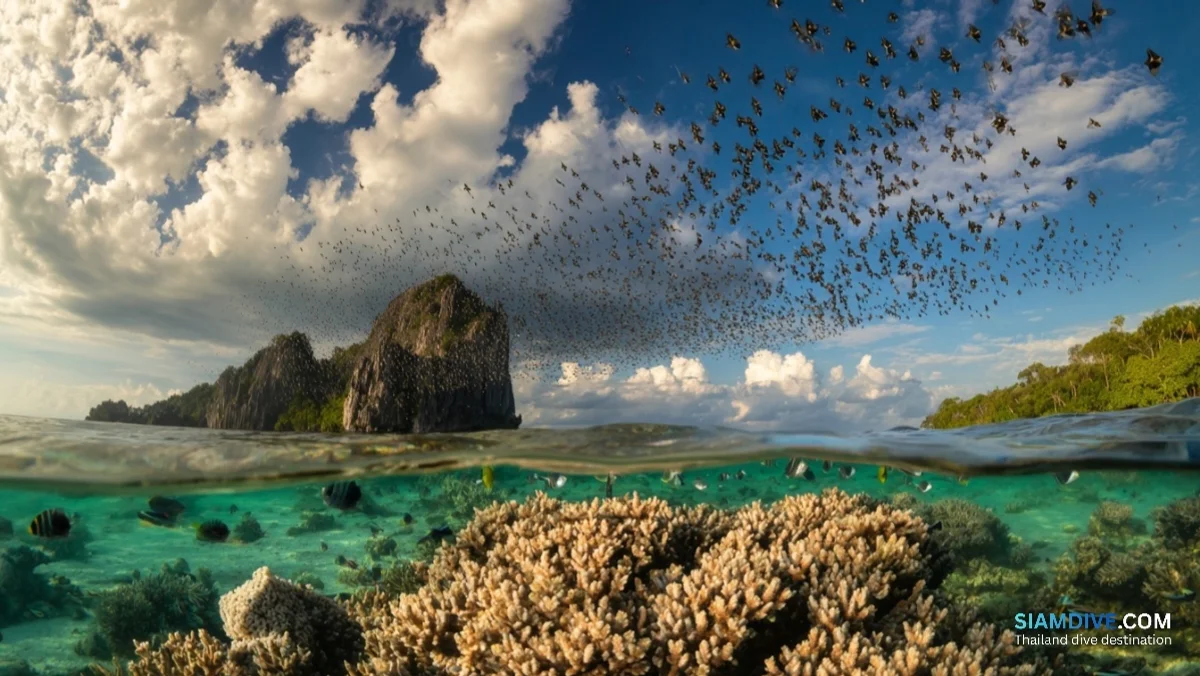
Hin Klai — sometimes logged as Garang Heang on older Thai navy charts — is a submerged pinnacle shaped like a slightly squashed oval, roughly 80 metres across at its widest. The crown sits at 6 metres, the boulder-strewn perimeter slopes gently to 13–18 metres, and beyond that the sand drops away into deeper blue. There is no rock breaking the surface, no bird colony overhead, no telltale colour change in the water unless you are directly above it at the right time of day with the sun behind you.
For decades, Koh Lanta operators focused their marketing on the headline sites — Hin Daeng, Hin Muang, Koh Haa — and left Hin Klai to the handful of captains who bothered programming the waypoint. The result is a reef that receives a fraction of the foot traffic of its neighbours, and it shows in every square metre of hard coral.
What Sits on the Bottom
Drop below the surface at Hin Klai and the first thing you notice is colour density. Boulder-sized rocks carpet the pinnacle from crown to base, and between them — rising from crevices, clinging to overhangs, spreading across every horizontal surface — hundreds of giant barrel sponges grow in clusters so thick they resemble a terracotta army left to weather underwater. Marine surveys referenced in Mu Ko Lanta National Park records note more barrel sponges per unit area at Hin Klai than at any other monitored reef in the local park system.
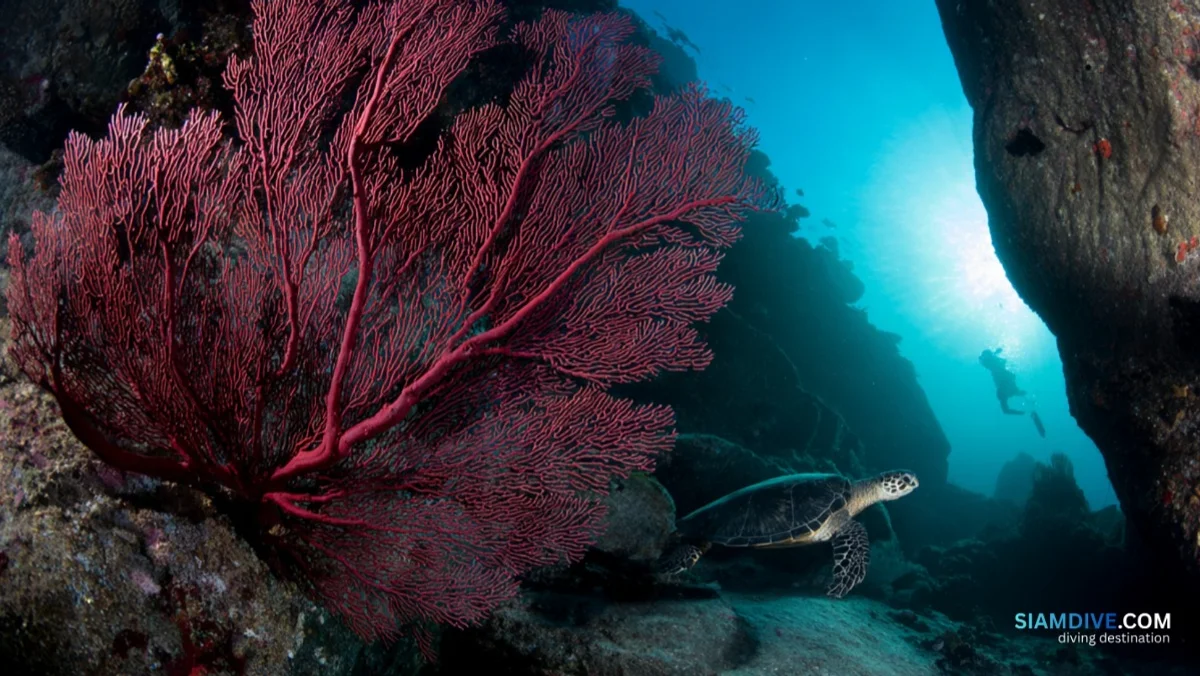
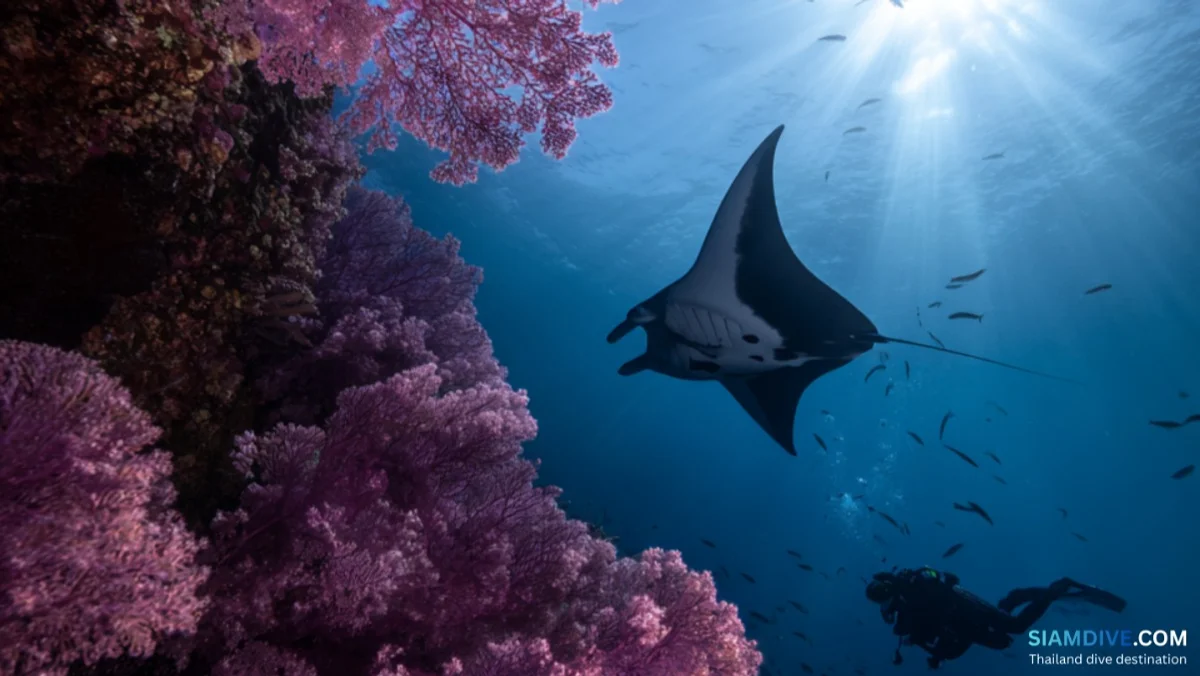
Gorgonian sea fans spread in terraces along the outer edges of the pinnacle, their broad faces angled perpendicular to the prevailing current. Some span wider than a diver's armspan — old growth that takes a decade or more to reach that size. The polyps feed constantly in the flow that sweeps the site, and the fans' condition — unbroken, symmetrical, fully extended — tells you that nobody has been crashing into them.
Shallower saddles between the main boulders host extensive staghorn coral gardens: branching thickets of Acropora in browns and pale blues, fragile and intact. Lanta dive operators who run the site note that the staghorn coverage at Hin Klai exceeds anything they see on Koh Haa's shallow shelves or the walls around Phi Phi's Bida islands. Staghorn is the first coral to break under fin kicks, so its presence — abundant and healthy — is a direct measure of how few divers pass through.
Why the Coral Stays Unbroken
Foot traffic shapes reef health more than depth charts, marine park budgets, or water temperature. Hin Daeng and Hin Muang draw full-day boats from Lanta every morning during high season, anchor lines down by 08:30, groups rotating across the wall in half-hour waves. Koh Haa receives daily visits from two or three operators running back-to-back dives in its lagoon. Hin Klai? Most weeks it sees one dive boat — sometimes none for days at a stretch.
Three factors keep the reef empty:
- No visual reference — captains without the GPS coordinate simply cannot locate the pinnacle. There is nothing on the surface to aim for, and the depth makes sonar confirmation unreliable from a moving speedboat.
- Unpredictable current ��� the open-water position between Lanta and Phi Phi catches tidal flow from both directions, generating surface chop and mid-water drift that discourages less confident divers. Operators screen passengers before committing to the site.
- Short seasonal window — Hin Klai sits inside the Mu Ko Lanta National Park boundary, accessible only during the official open season from 15 October to 15 April each year. Half the calendar is simply off-limits.
The combination means coral grows undisturbed through the entire six-month monsoon closure, then faces only sporadic visitors during the remaining season. Even the 18 inadvertent coral contacts per hour that research attributes to an average diver barely registers when those divers appear once a week instead of once an hour.
What Moves Through the Current
Current-swept pinnacles concentrate marine life the way a river bend concentrates driftwood. Plankton-rich water hits the rock, accelerates around its flanks, and creates feeding opportunities at every level. At Hin Klai, that flow organises life in visible layers:
- Resident reef fish — butterflyfish, angelfish, moorish idols, lionfish, boxfish, pufferfish, clownfish nestled in thousands of anemones clustered across the shallows. Damselfish territories mark almost every flat rock.
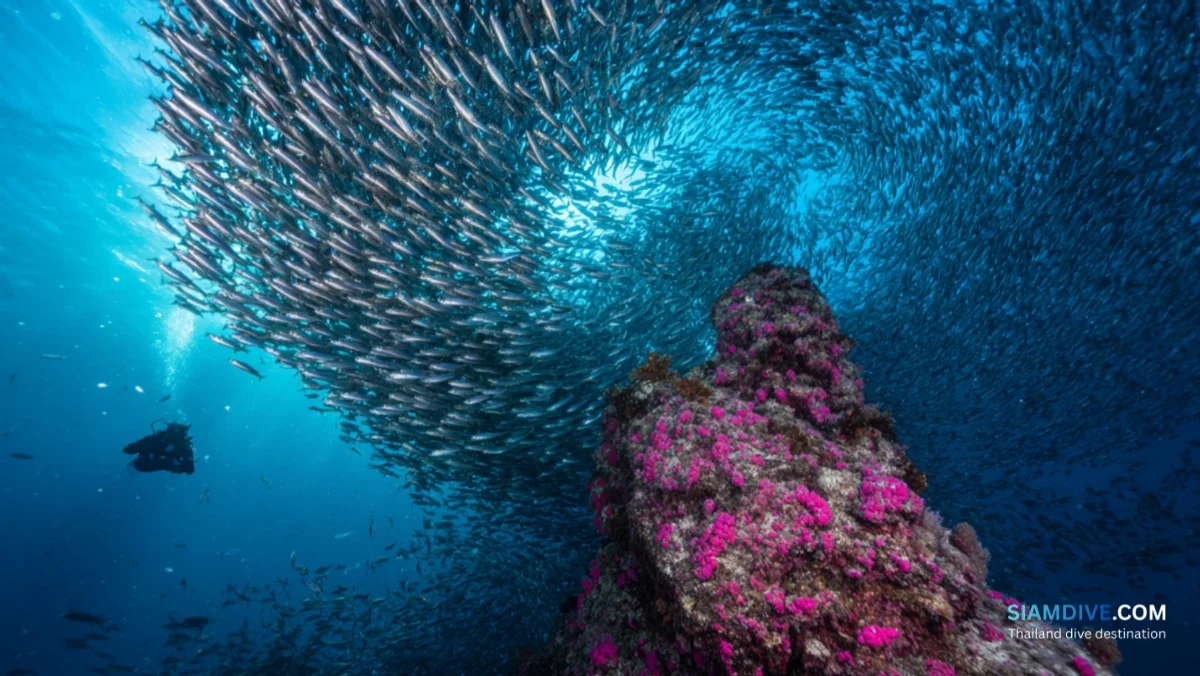
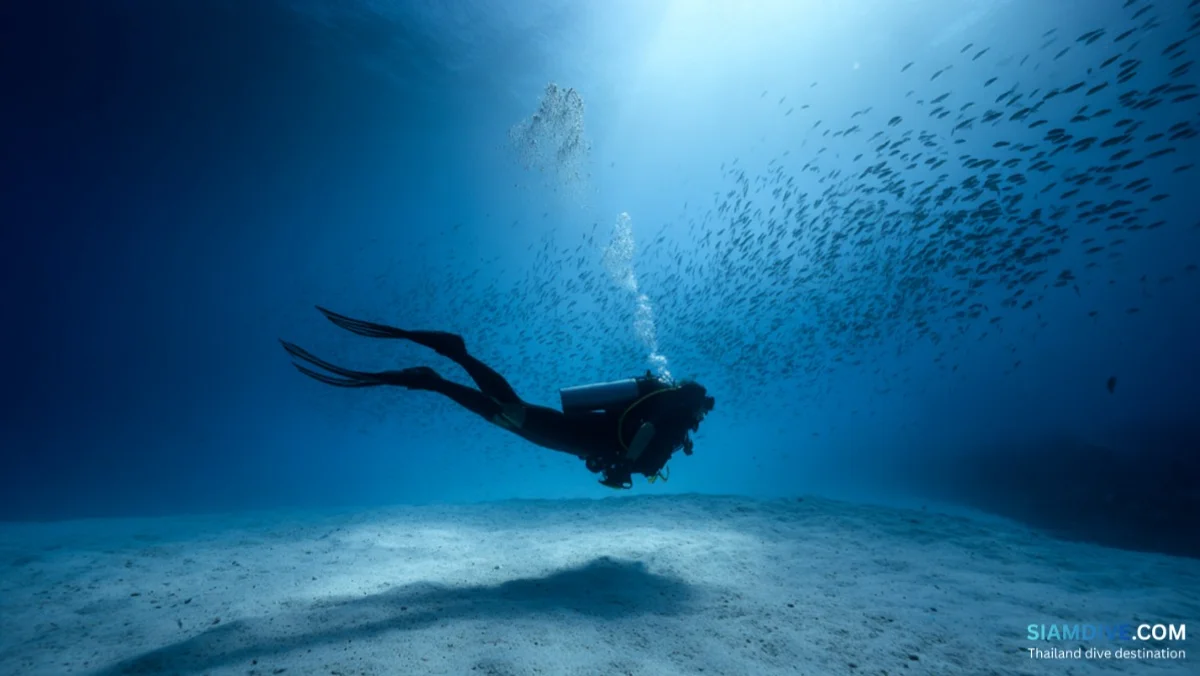
- Schooling mid-water hunters — huge shoals of yellowtail snapper and fusilier hang in the current above the reef top, their silver flanks catching the light in synchronised turns. Passing packs of giant trevally circle the edges, picking off stragglers with burst attacks visible from twenty metres away.
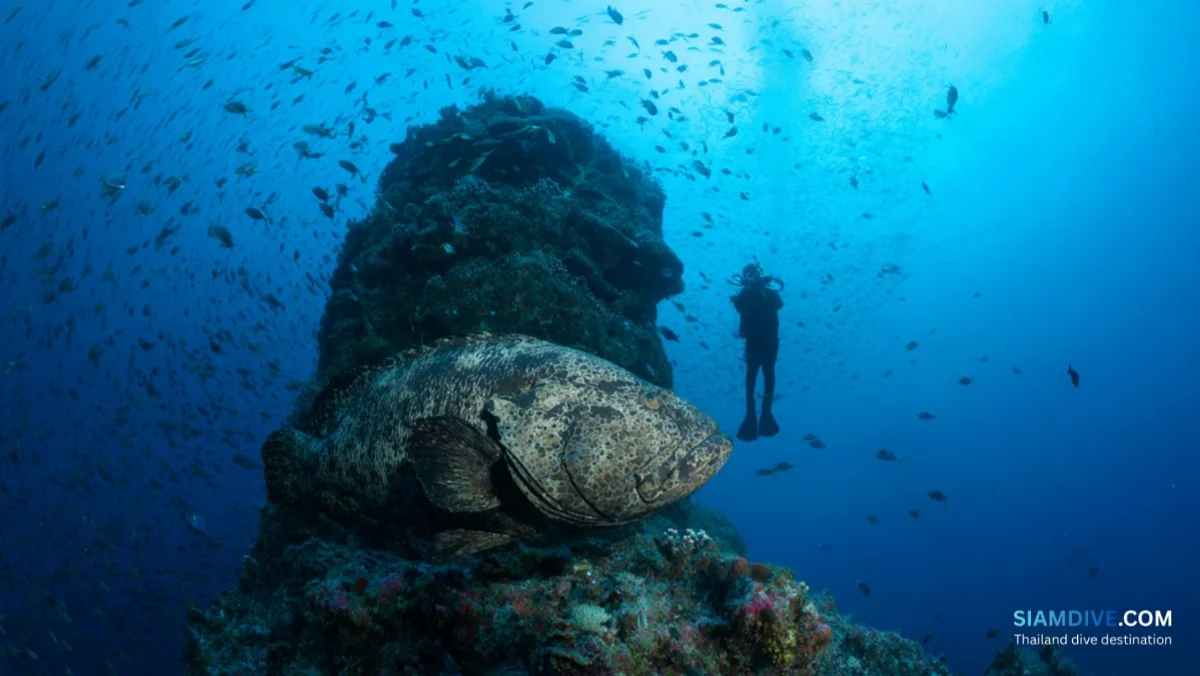
- Bottom dwellers — leopard sharks resting on sand patches between boulders, sighted regularly through the November-to-April season. Blue-spotted stingrays tucked under overhangs. Larger grouper holding position in crevices, opening their jaws slowly as they pump water across their gills.
- Occasional visitors — hawksbill turtles passing through the pinnacle's upper reaches, and on rare lucky days, the shadow of a small manta moving overhead in the blue beyond the reef edge.
Leopard sharks are the site's signature encounter. Unlike Shark Point near Phuket — where multiple dive boats queue at depth to photograph a single resting animal — Hin Klai's leopard sharks sit in 12–15 metres, often in pairs on the sand, unbothered by the rare human presence overhead. The shallow depth means longer bottom time and less air consumption for photographers willing to settle on the sand at a respectful distance and wait.
How Hin Klai Differs from Hin Daeng and Hin Muang
Every Koh Lanta dive briefing eventually mentions Hin Muang's 60-metre purple wall or Hin Daeng's manta cleaning station. Those sites deserve the fame — vertical drops painted floor-to-ceiling in soft coral, pelagics crossing through open blue at the edge of recreational limits. But they serve a fundamentally different appetite than Hin Klai does.
- Hin Daeng / Hin Muang
- Deep walls (30–60 m+), soft coral dominated (red and purple), pelagic-focused encounters (mantas, whale sharks, grey reef sharks). Strong current standard. Advanced certification recommended. 2–2.5-hour boat ride south from Saladan Pier.
- Hin Klai
- Shallow pinnacle (6–18 m), hard coral and sponge dominated, macro-to-midsize life (leopard sharks, schooling fish, invertebrates). Moderate current. Confident Open Water divers. 45-minute speedboat ride toward Phi Phi.
The distinction is not better versus worse — it is wall versus garden, blue-water drama versus reef intimacy, air-hungry deep profiles versus relaxed shallow dives where a single tank lasts over an hour. Photographers chasing wide-angle pelagic shots will still head south. Photographers who want macro detail on gorgonian polyps backlit by surface light, or a leopard shark exhaling into white sand at twelve metres, will find that frame at Hin Klai with time to spare on the NDL clock.
Practical Numbers
- Depth range — 6–18 m (crown to perimeter sand)
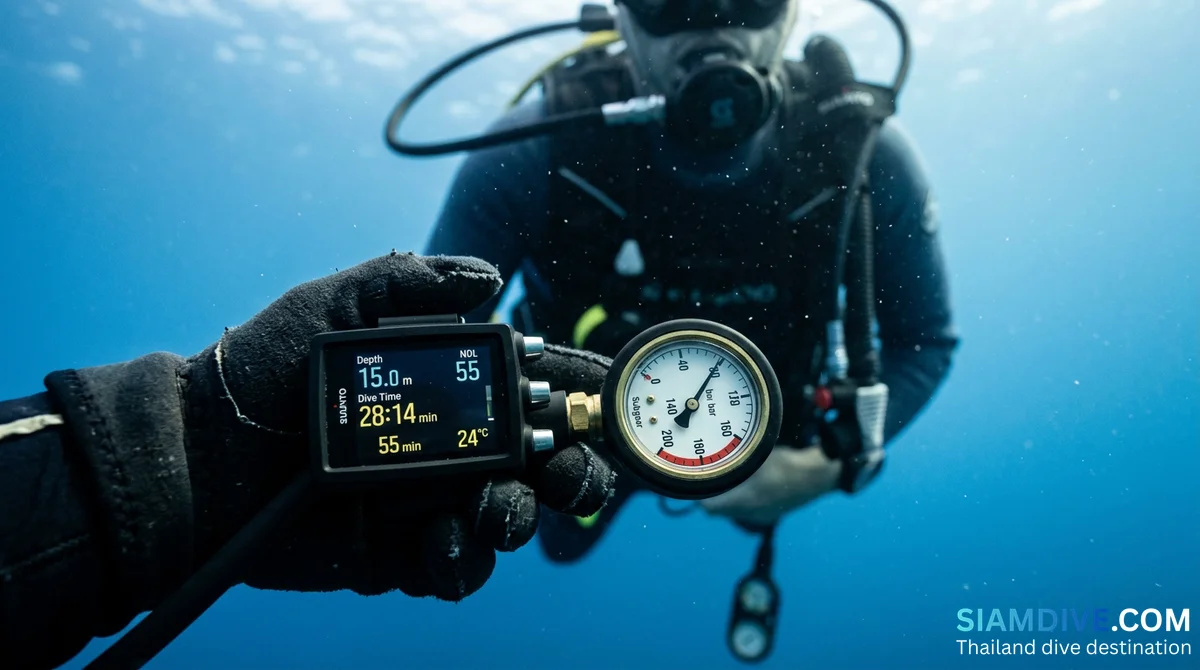
- Visibility — 15–30 m during season; typically 20+ m between December and March; can drop to 10–15 m in April when plankton blooms fill the water column
- Water temperature — 28–30 °C (November through April)
- Current — mild to moderate on most days; can spike unpredictably on spring tides. Operators assess conditions on approach and abort if flow exceeds safe limits for the group.
- Minimum certification — PADI Open Water or equivalent. Operators recommend confident buoyancy control and comfort in mild drift due to the open-water location.
- National park fee — 600 THB per diver (paid once per day, foreigners; 100 THB for Thai nationals)
- Day-trip cost from Koh Lanta — 2-dive trips including full gear rental, guide, and lunch start around 3,150 THB (approximately US $88 at current exchange)
- Boat time — roughly 45 minutes from Saladan Pier by speedboat, heading east-northeast toward Phi Phi
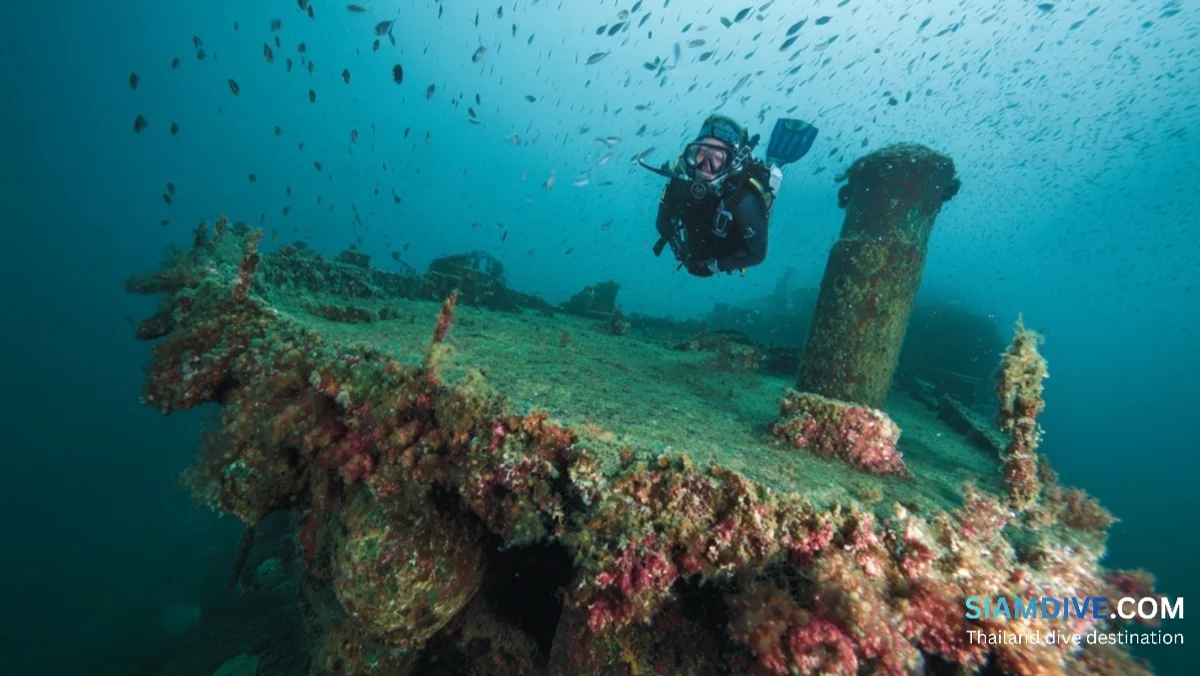
- Common pairing — most operators combine Hin Klai with a second dive at the nearby Kled Kaew wreck or Koh Bida Nai, making a full morning of it before returning to Lanta by early afternoon
The Monsoon Window — and What Reopening Looks Like
As of early May 2026, the Mu Ko Lanta National Park has closed for the monsoon season (official closure date: 15 April). Dive operators on Lanta have pulled boats, stowed compressors, and the reef is once again alone — growing, healing, accumulating another six months of undisturbed growth before the first boats return in October.
For divers planning their 2026–27 season, the sweet spot for Hin Klai runs December through March. Surface conditions settle into flat calm by late November, visibility opens beyond 20 metres by December, and leopard shark sightings peak in January and February when water temperatures stabilise at 28–29 °C. April still works for adventurous divers willing to trade visibility for plankton-fuelled activity on the gorgonians — filter feeders extend fully, schools pack tighter, and the reef buzzes with a different kind of energy.
The liveaboard pricing landscape around Thailand continues shifting, but day-trip diving from Koh Lanta remains among the most affordable in Southeast Asia for the quality of reef available within 45 minutes of shore. Hin Klai — no celebrity status, no Instagram hashtag, no TripAdvisor page — sits at the quiet end of that value proposition.
Why It Matters That Nobody Goes
Reef sites deteriorate in direct proportion to traffic. Fin kicks shatter staghorn branches that took three years to grow. Dropped weights crack barrel sponges that took twenty years. Anchor chains — still used by operators who have not invested in mooring systems — can flatten a mature gorgonian sea fan in a single careless drag across the bottom.
Hin Klai has avoided all of this largely because it cannot be found by accident. There is no landmark, no visible rock, no "oh, what's that?" moment from a passing longtail. You must intend to go there, and you must have the numbers to do it. That barrier — simple, unintentional, geographical — has done more for the reef's health than any management plan could.
Whether that accidental protection lasts depends on traffic pressure. If every Lanta operator adds the waypoint to their schedule, if a mooring buoy appears and the site gets a slot on the daily rotation between Koh Haa and Hin Bida, the barrel sponges will show cracks within a season. Gorgonians will fold. Staghorn will thin. The site's very appeal — its untouched condition — will erode under the weight of visitors drawn to see it.
For now, the reef sits quiet — six metres below the surface, invisible from above, dependent on the simple fact that most boats motor past without a second glance. The captains who know the coordinates are still the gatekeepers. And the GPS waypoint, passed captain to captain over years of evening beers at Saladan pier, remains the only key.