29-Cent Shark Satay From a Village That Still Hunts Sharks
← Blog

29-Cent Shark Satay From a Village That Still Hunts Sharks

15 พฤษภาคม 2569

In Tanjung Luar, wooden boats return from 20-day voyages with holds full of sharks. Twenty kilometres inland, their meat becomes satay sold for pocket change.

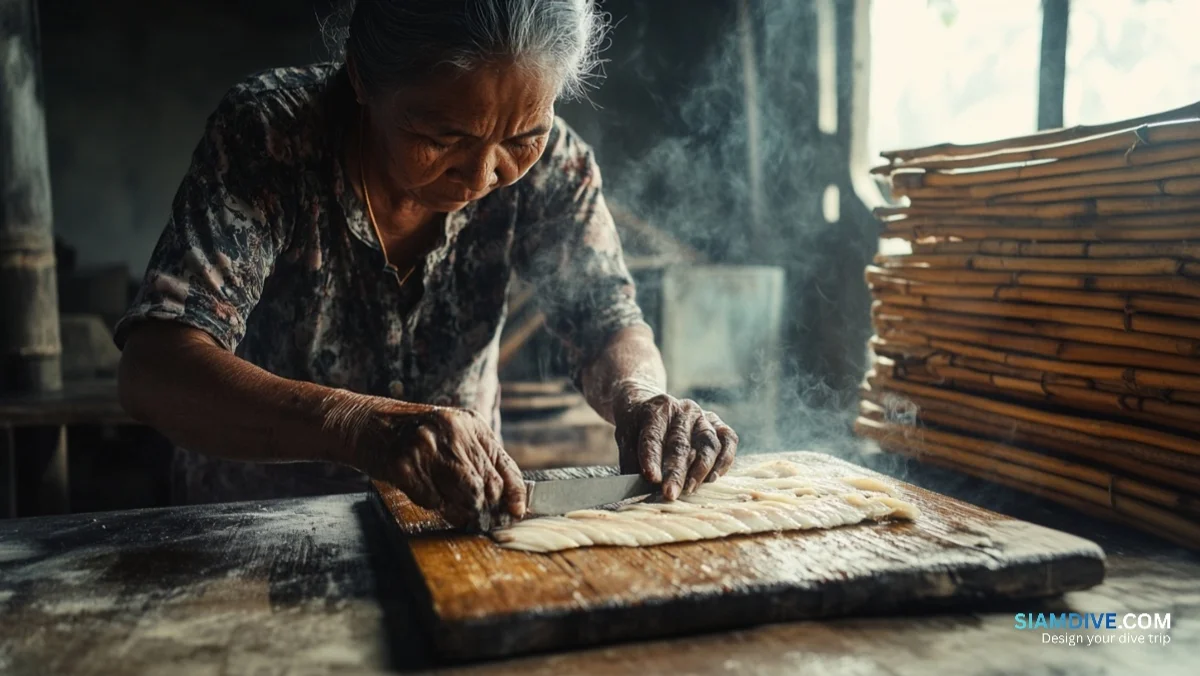
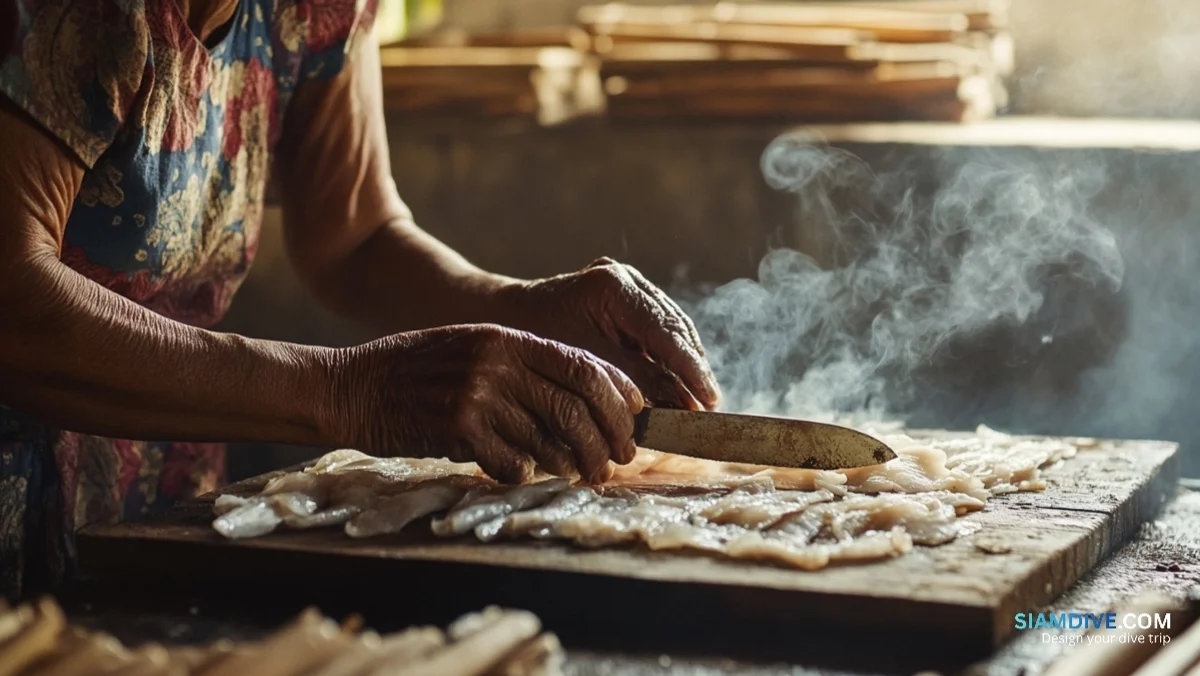
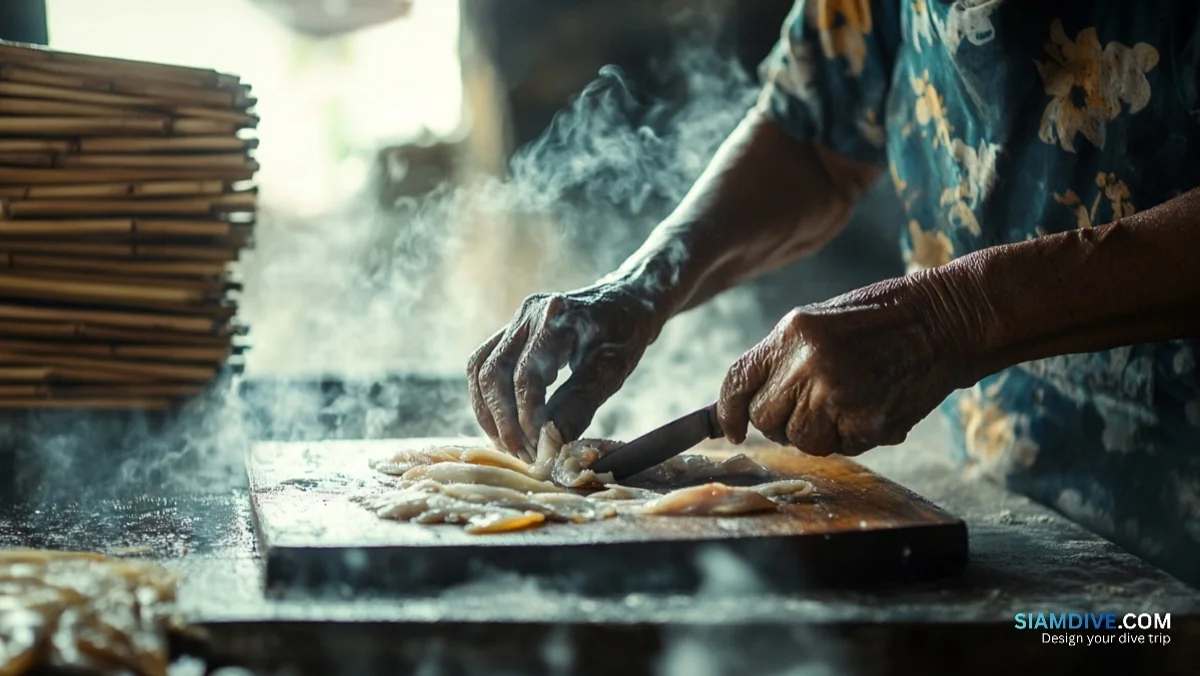
The blade meets cartilage at the joint with a sound like tearing cardboard. In a concrete shed twenty kilometres inland from Tanjung Luar's fish landing site, a woman in a faded headscarf separates a blacktip reef shark into seven commercial cuts — fins, belly flaps, backbone strips, jaw, head, skin, and the remaining trunk that will become satay by sundown. She has done this since she was fourteen. Her mother did it before her.

This is Rumbuk, the processing heart of eastern Lombok's shark trade, where the catch from Indonesia's largest elasmobranch market arrives by truck and leaves as crackers, meatballs, smoked strips, and skewers selling for 5,000 rupiah — about 29 US cents.

Twenty Days at Sea for a Hold of Sharks

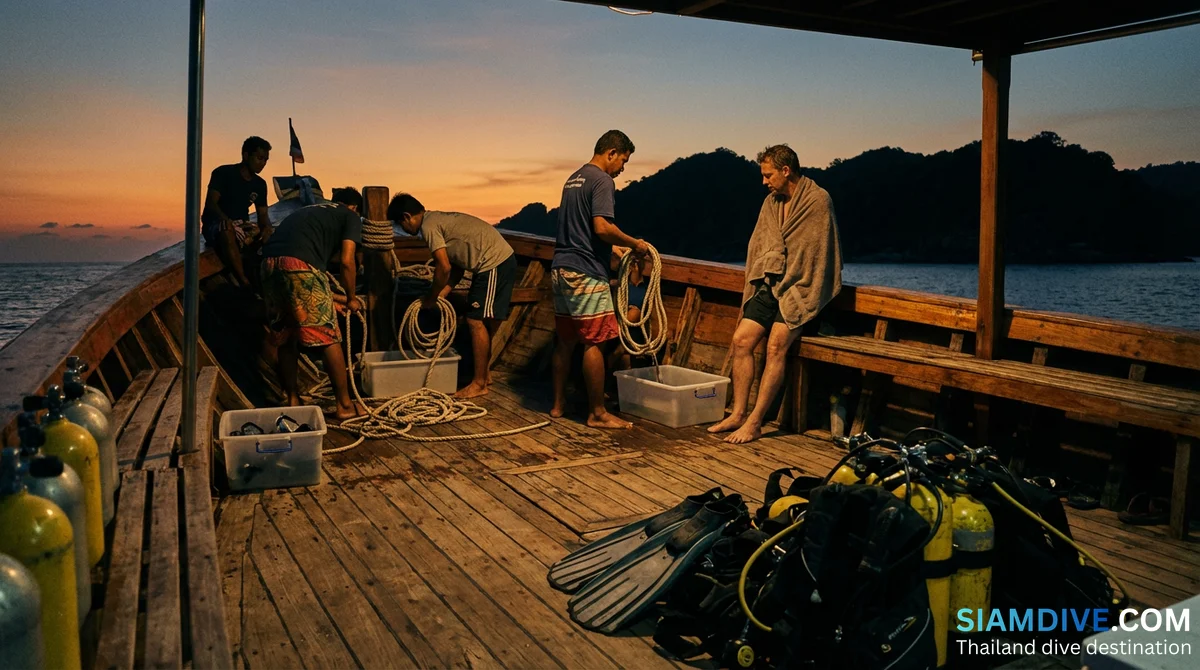
The boats that supply Tanjung Luar are wooden vessels of 15–30 gross tonnes, crewed by four to five fishermen who spend 15 to 20 days at sea per voyage. They work longline gear across waters stretching from Sumbawa Strait to the deep channels around Sumba, targeting pelagic and demersal sharks alike.

A single trip costs roughly IDR 15 million (approximately USD 940) in fuel, ice, bait, and provisions. A productive day yields 10–30 sharks averaging 20–30 kilograms each. At landing prices of IDR 600,000–1,000,000 per animal, a good voyage returns three to five times the operational cost — margins that have sustained this fleet since the early 1990s.

"This has been a hereditary job from the previous generation to our generation," fisherman Safruddin told Mongabay Indonesia in April 2026, standing beside a row of thresher carcasses. Knowledge — tide patterns, longline spacing, shark behaviour around seamounts — passes father to son with the boat itself.

From Dock to Rumbuk: The Processing Chain

Tanjung Luar's landing site operates like a wholesale clearinghouse. Sharks arrive whole, are auctioned at dawn, and within hours are loaded onto trucks bound for Rumbuk and smaller processing hamlets. The market handles an estimated 13,000 individual sharks per year across 57 documented species — from silky sharks and blue sharks to CITES-listed hammerheads.

At Rumbuk, the division of labour is total. Men split carcasses with cleavers. Women prepare secondary cuts. Children stack drying racks in the afternoon heat. The products serve different price tiers and markets:

  • Sate ikan (shark satay) — marinated trunk meat on bamboo skewers, grilled roadside, IDR 5,000 per skewer (~USD 0.29)
  • Abon (shredded dried shark) — sold in bags as a rice topping, IDR 25,000–40,000 per kilogram
  • Kerupuk (shark crackers) — mixed with tapioca starch, a common snack across Lombok
  • Bakso and otak-otak — meatballs and fish cakes for market stalls and street vendors
  • Sirip kering (dried fins) — exported to middlemen, the high-value cut that draws international scrutiny

Why 29-Cent Protein Matters on Lombok

Eastern Lombok ranks among Indonesia's less-developed regions. Shark meat fills a protein gap that chicken and beef cannot always close at the same price point.

  • Shark trunk meat — IDR 25,000–40,000/kg at local markets
  • Chicken breast (comparison) — IDR 45,000–55,000/kg in the same markets
  • Family meal cost — five people can eat protein-rich shark satay for under IDR 25,000 (~USD 1.50)

For communities within a fifty-kilometre radius of Tanjung Luar, this price point is not a novelty — it is a nutritional baseline. A Mongabay Indonesia photojournalism report published in April 2026 captured the economic scale: entire villages whose daily income flows directly from the catch, the cut, and the grill.

This does not make the trade environmentally sustainable. It does explain why it persists despite mounting regulatory pressure, and why conservation programmes that ignore the affordability equation face resistance at the village level.

The Conservation Bind

Indonesia ratified CITES Appendix II protections for several shark species traded through Tanjung Luar, including scalloped hammerheads and silky sharks. Enforcement, however, meets a community where the entire economic chain — boat crews, processors, vendors — depends on the catch.

The tension is not abstract. Banning the trade overnight would collapse a local economy without a ready alternative. Conservation programmes that have gained traction — such as the Alor regency's 91% shark-fishing reduction through marine-tourism conversion — took years of community negotiation and required viable substitute income. Eastern Lombok's tourism infrastructure is not yet at that stage.

For divers who encounter shark conservation as a marine issue, Tanjung Luar is a reminder that it is equally a food-security issue, a labour issue, and a generational-identity issue. The path from 57 species on the dock to a 29-cent skewer on a roadside grill runs through every one of those dimensions.

What Divers Can Do With This Knowledge

Understanding the supply chain does not require endorsing it. But it changes the quality of conversation divers bring to shark conservation.

  • Ask about alternatives, not just bans — effective programmes replace income, not just prohibit extraction
  • Support marine-tourism ventures in eastern Indonesia — every dive dollar that reaches communities like Tanjung Luar strengthens the economic case for live sharks
  • Recognise the CITES gap — listing a species protects it on paper; enforcement in remote fishing villages depends on funding, education, and economic substitution
  • Read the sourcing — shark meat appears in Southeast Asian markets under local names; knowing the chain helps divers make informed food choices when travelling

The sharks circling Aliwal Shoal's caves and the reef systems near resort coastlines exist in a connected ocean. What happens at Tanjung Luar's dock at dawn reaches the water column everywhere.

Sources

← กลับไปหน้า Blog

Gallery

29-Cent Shark Satay From a Village That Still Hunts Sharks — image 129-Cent Shark Satay From a Village That Still Hunts Sharks — image 229-Cent Shark Satay From a Village That Still Hunts Sharks — image 329-Cent Shark Satay From a Village That Still Hunts Sharks — image 429-Cent Shark Satay From a Village That Still Hunts Sharks — image 5

บทความแนะนำ

Why a Maldives Week Costs More Than Two Similan Safaris

Why a Maldives Week Costs More Than Two Similan Safaris

A budget Maldives liveaboard starts at $1,200 for seven nights — roughly what two Similan safaris cost combined. The mantas are the same genus. The invoice is not.

What to Eat Before Diving (And the Meal That Could Ruin It)

What to Eat Before Diving (And the Meal That Could Ruin It)

Your pre-dive meal matters more than you think. Learn the best foods, hydration tips, and what to avoid before scuba diving to stay safe and comfortable underwater.

The Pre-Dive Buddy Check Most Scuba Divers Skip

The Pre-Dive Buddy Check Most Scuba Divers Skip

Half of all scuba accidents could be prevented by a five-minute BWRAF buddy check. Here's why experienced divers skip it and how to do it right.

Night or Deep First? Thailand's Reefs Already Chose for You

Night or Deep First? Thailand's Reefs Already Chose for You

Thailand's most popular reefs peak between 10 and 25 metres — which makes one specialty far more useful than the other for your first card.

Why Cave Divers Fly to Russia for 5 km of White Silence

Why Cave Divers Fly to Russia for 5 km of White Silence

Orda Cave hides 5 km of white gypsum passages under the Urals — 46-metre visibility, 4°C water, and walls older than dinosaurs.

Koh Thalu: Swim-Through Caves in Chumphon's Pierced Island

Koh Thalu: Swim-Through Caves in Chumphon's Pierced Island

A small limestone island in Mu Koh Chumphon National Park with a massive cavern punched clean through the rock — plus a heart-shaped cave, dense anemone colonies, and blacktip reef sharks on the deeper margins.

The Alien Jaws Hiding in Every Crevice at Richelieu Rock

The Alien Jaws Hiding in Every Crevice at Richelieu Rock

Giant morays carry a second set of jaws in their throat — the only vertebrate alive with this mechanism. Richelieu Rock hosts five species in one reef.

2 km from Phi Phi, a Reef That Only GPS Can Find

2 km from Phi Phi, a Reef That Only GPS Can Find

Hin Klai sits 6 metres below the surface with no marker, no buoy, and more barrel sponges than any reef near Koh Lanta. Here is what hides between the boulders.

The Phuket Diving Calendar: When to Actually Book

The Phuket Diving Calendar: When to Actually Book

Honest month-by-month guide to diving Phuket and the Similan Islands: visibility, water temp, marine life, crowds and when to book your trip.

5 Narcosis Red Flags Your Buddy Misses at 30 Metres

5 Narcosis Red Flags Your Buddy Misses at 30 Metres

Nitrogen narcosis hits at Chumphon's 36-metre floor. Five warning signs appear before a diver knows they're impaired — here's how to catch them.

Explore 9 Eco Centers

Explore 9 Eco Centers

Discover 9 PADI Eco Centers in Thailand certified by UN Reef-World Green Fins for responsible scuba diving. Your ultimate guide by Siam Dive Center to sustainable dive sites.

March in Thailand: Why the Andaman Always Wins the Dive Trip

March in Thailand: Why the Andaman Always Wins the Dive Trip

Thailand has two seas. In March, only one delivers peak visibility, whale shark odds, and liveaboard access. Here's why seasoned divers always pick the Andaman.

How Cuttlefish Rewrite Their Skin in 50 Milliseconds

How Cuttlefish Rewrite Their Skin in 50 Milliseconds

A pharaoh cuttlefish fires 200 chromatophores per square millimetre in under a second. Most divers on Thai reefs swim right past the fastest light show on the reef.

One Kick Snaps 19 Corals an Hour, the Other Glides Past

One Kick Snaps 19 Corals an Hour, the Other Glides Past

Research counted 19 coral breaks per hour from careless fins. The frog kick changes that equation — here is how it evolves from OW to cave level.

40 Metres of Visibility Under a Metre of Ice at Lake Baikal

40 Metres of Visibility Under a Metre of Ice at Lake Baikal

Lake Baikal freezes a metre thick by February — and beneath that ice, visibility stretches past 40 metres into a 25-million-year-old ecosystem found nowhere else on Earth.

I'm Afraid of the Ocean — Can I Still Learn to Dive?

I'm Afraid of the Ocean — Can I Still Learn to Dive?

Anxious about scuba diving? You are not alone. Learn how fear, claustrophobia and panic are gently managed by patient instructors, breathing techniques and Discover Scuba trials.

The Navy Cut Holes in a WWII Ship and Sank It Off Pattaya

The Navy Cut Holes in a WWII Ship and Sank It Off Pattaya

The Thai Navy cut holes through every deck of a WWII landing craft and sank it off Koh Phai. Twenty-three years later, it is Pattaya's best penetration wreck.

48 Hours Post-Dive: The Ear Injury Nobody Expects

48 Hours Post-Dive: The Ear Injury Nobody Expects

Middle ear barotrauma often shows up days after the dive. How to spot delayed ear squeeze, when to ground yourself, and where to find help in Thailand.

We Did the Math: Thailand Costs a Third of the Maldives and Matches the Red Sea's Best

We Did the Math: Thailand Costs a Third of the Maldives and Matches the Red Sea's Best

We priced a week of diving in Thailand, the Maldives, Egypt, the Philippines, and the Caribbean. Here's the real per-dive cost — and why Thailand wins for most divers.

What Makes Thailand Special for Scuba Divers

What Makes Thailand Special for Scuba Divers

Two coasts, year-round warm water, world-class sites you can actually reach, and prices that don't punish you. Here's what really sets Thailand apart for divers.

ทริปแนะนำ

Vela Liveaboard
liveaboard

Vela Liveaboard

MV Vela / Vala — massive 43 m steel-hull liveaboard with only 20 guests max for ultimate space and privacy. King and twin AC en-suite cabins, large dive deck, indoor saloon and rooftop sun deck. Highest international safety standards.

Hug Ocean Boat
daytrip

Hug Ocean Boat

Discover Phuket's Andaman Sea aboard Hug Ocean — a luxury 3-deck dive yacht for 80 guests with a thrilling water slide, sun-soaked top deck, and PADI-certified diving at Racha Yai and Racha Noi.

Aquarian Liveaboard
liveaboard

Aquarian Liveaboard

MV Aquarian — striking 2021-built red steel liveaboard, 31.4 m × 7.5 m, max 28 guests in 14 cabins. Free unlimited Nitrox via Coltri Sub membranes, one of Thailand's largest dive platforms, and full premium-hotel comfort.

Issara Liveaboard
liveaboard

Issara Liveaboard

MV Issara — high-end Thai steel-hulled liveaboard built 2016–17, 28.5 m × 6.5 m, 4 decks, max 22 guests in 11 hotel-style cabins. Indoor saloon, jacuzzi sun deck, full-board buffet dining.