Nine Frogfish Species Share One Strait of Black Sand
9 พฤษภาคม 2569
Lembeh Strait packs nine frogfish species, a dozen octopus varieties, and hundreds of rare critters onto 16 km of volcanic black sand — here is what lives there.
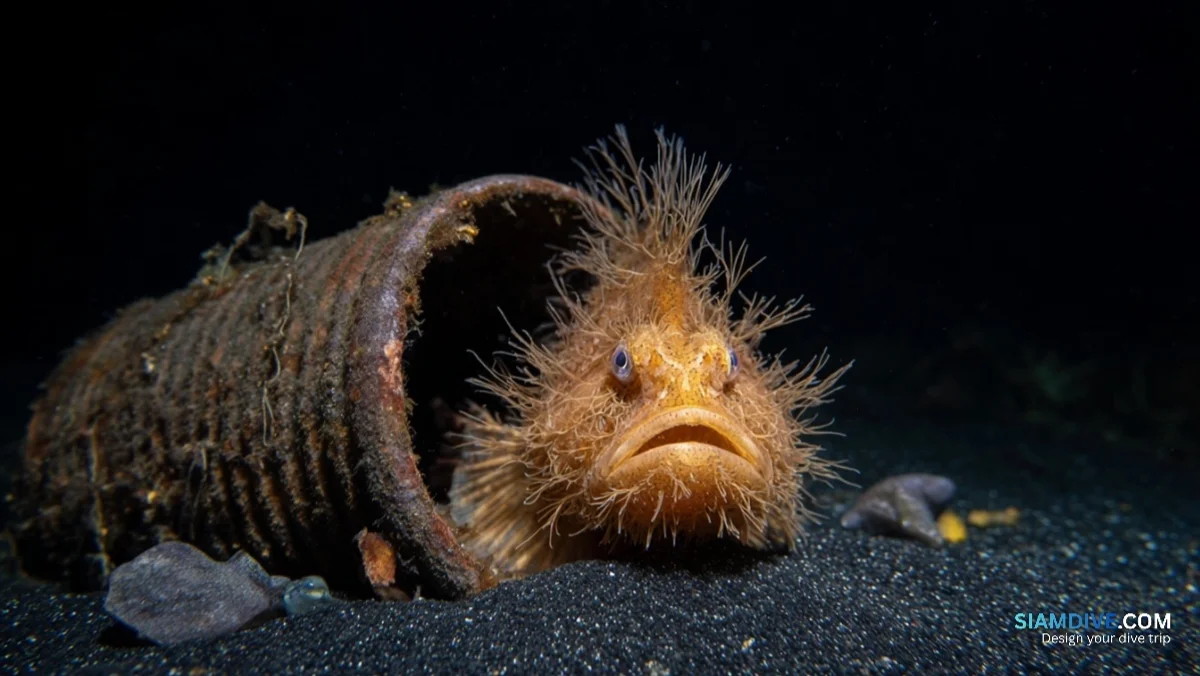
The frogfish sits motionless on a rusted tin can, its lure twitching in a slow figure-eight above its gaping mouth. Three centimetres away, a goby drifts closer. Through a macro lens, the scene fills the entire frame — but pull back, and the stage is just a patch of black volcanic sand on a gentle slope, fifteen metres deep in the Lembeh Strait. This narrow channel between mainland North Sulawesi and Lembeh Island, barely two kilometres wide at its narrowest, has built a global reputation not on coral walls or pelagic encounters but on mud. Muck diving — the art of finding extraordinary creatures in seemingly featureless sediment — was essentially born here in the early 1990s, and the strait remains its undisputed capital.
What Makes Black Sand Worth Crossing an Ocean For
Lembeh Strait runs roughly 16 kilometres north to south, sheltered from open-ocean swell by the island on its eastern flank. The bottom is a patchwork of volcanic sand, rubble, scattered debris, and patches of seagrass — habitat that most divers would fin past without a second look. Yet this unpromising substrate supports one of the highest densities of rare macro species anywhere on the planet.
More than 60 catalogued dive sites line both shores. Local regulations cap each site at 15 divers at a time, keeping the sand undisturbed and giving critters space to behave naturally. Depths are forgiving: most sites sit between 5 and 25 metres, with a handful reaching 30. Currents are typically negligible. What the strait lacks in vertical drama, it delivers in sheer creature density — the kind of biodiversity that rewards patience and a steady hand over fin speed and air consumption.
The Frogfish Lineup
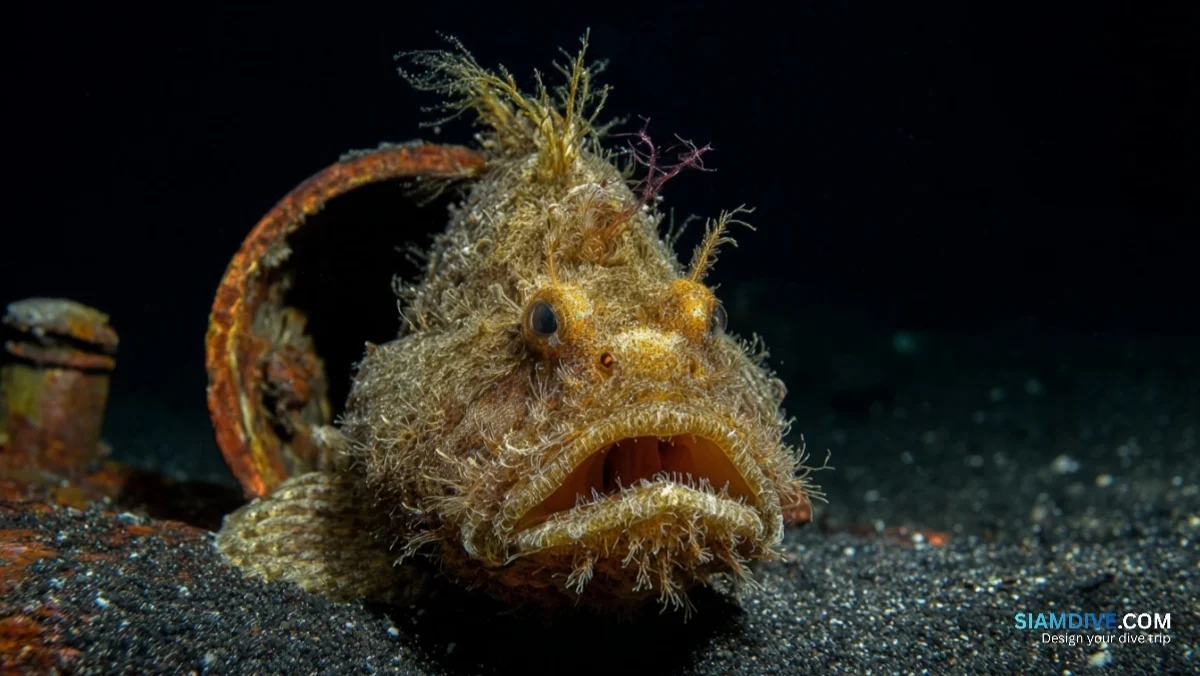
Up to nine species of frogfish have been documented in the Lembeh Strait, a concentration that rivals any body of water on Earth. The roster reads like a collector's checklist: giant, hairy, painted, warty, clown, hispid, freckled, ocellated, and sargassum frogfish — each with a different size, texture, colour palette, and hunting strategy.
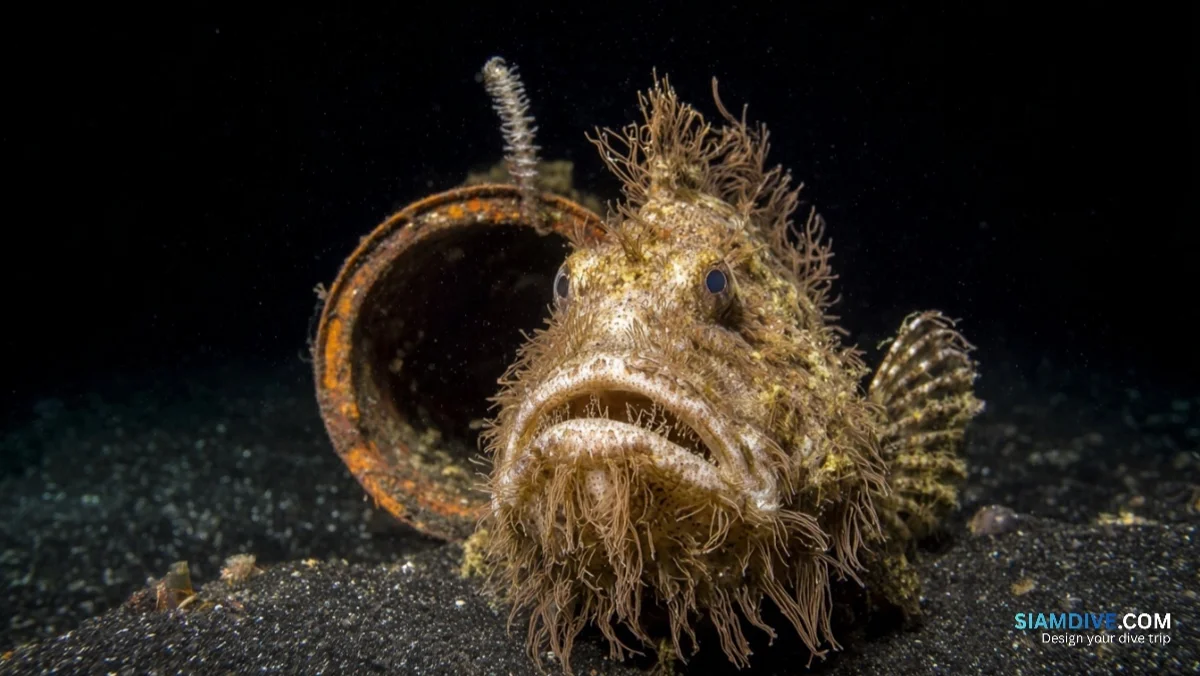
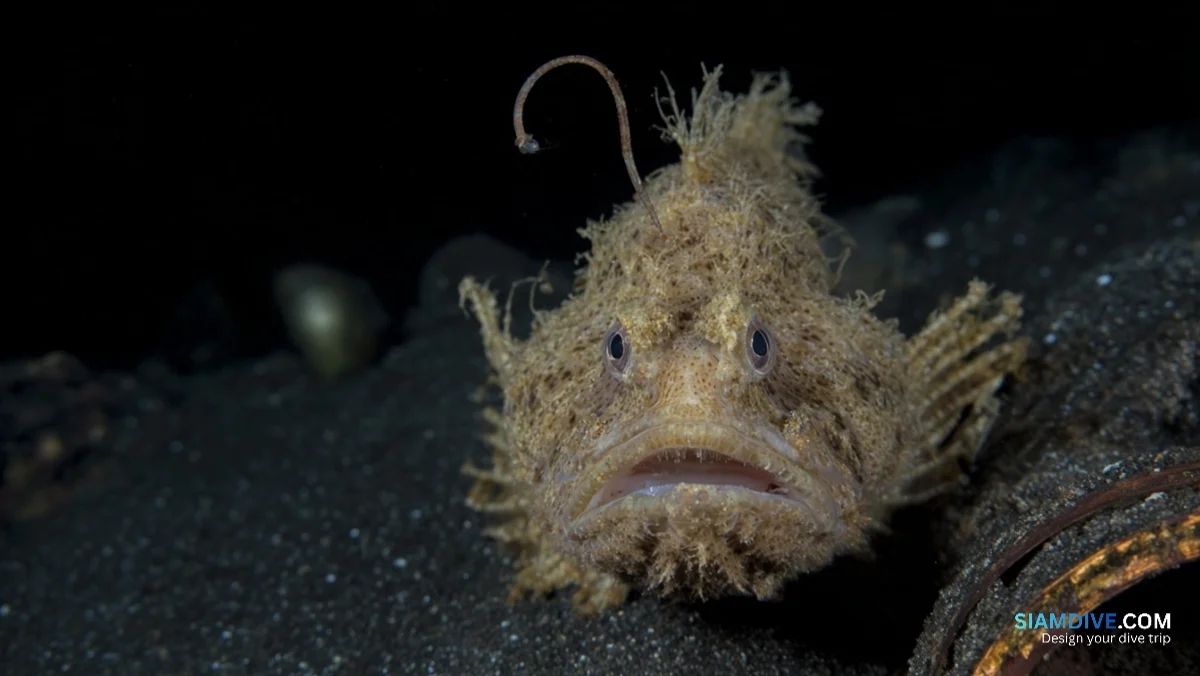
The hairy frogfish (Antennarius striatus) is the headliner. Covered in long skin filaments that mimic algae and hydroids, it crouches on rubble or discarded bottles, waving a worm-shaped lure — the illicium — to draw prey within strike range. Colour varies wildly between individuals: white, yellow, orange, jet black, and pink specimens all appear in the strait. The strike itself takes roughly six milliseconds, among the fastest predatory movements recorded in the animal kingdom.
At the Hairball dive site, named after the species itself, guides routinely locate multiple frogfish species on a single descent. A painted frogfish may sit on a sponge two metres from a giant frogfish the size of a football, both invisible until pointed out. Photographers running a 105 mm macro lens can burn an entire 70-minute dive within a 10-metre radius and still surface wishing for more bottom time.
For anyone working on common macro shooting mistakes, Lembeh's frogfish provide both the test and the reward — patient enough to allow careful composition, unpredictable enough to punish a lazy focus lock.
A Dozen Eight-Armed Shapeshifters
At least twelve species of octopus inhabit the strait, and several of them behave in ways that rewrite what divers think they know about cephalopods.
The mimic octopus (Thaumoctopus mimicus) can impersonate a flatfish, a lionfish, or a sea snake by rearranging its arms and shifting its colour pattern in real time. It was first scientifically described from Sulawesi specimens, and Lembeh remains one of the most reliable places on Earth to watch it perform. Mating activity runs from January through July, and experienced guides know the specific sand flats where courting pairs display.
The blue-ringed octopus, measuring just 12 to 20 centimetres across, carries enough tetrodotoxin to kill a human — yet it is docile unless handled, and Lembeh photographers shoot it routinely at arm's length. Females carrying eggs are most common between January and March, tucked into crevices with their mantle wrapped protectively around the clutch.
The coconut octopus collects discarded shells and coconut halves, stacking them into a portable shelter and carrying them across the sand in a stiff-legged bipedal "walk" that looks startlingly deliberate. The wonderpus (Wunderpus photogenicus), formally named only in 2006, emerges from its burrow at dusk and hunts with banded arms splayed wide across the substrate.
Then there is the hairy octopus — so rare that November is considered the best month to find one, and even then, a sighting is cause for celebration. During a recent season, hairy octopuses turned up at four different dive sites, a concentration that drew attention from visiting marine biologists.
Creatures That Walk, Flash, and Ambush
Lembeh's cast extends well beyond frogfish and octopus. The sand shelters species that seem engineered to test a photographer's composure.
The flamboyant cuttlefish (Metasepia pfefferi) does not swim — it walks on modified arms along the bottom, pulsing with waves of purple, orange, yellow, and white when disturbed. It ranks among the three known venomous cephalopods on Earth. In Lembeh, pairs appear in shallow sand near seagrass beds, often in water as shallow as eight metres.
Rhinopias scorpionfish — the weedy and paddle-flap varieties — sit near the top of any macro photographer's wish list. Recent reports noted specimens at unusually shallow depths, around nine metres, perched on rubble and swaying with the surge in near-perfect mimicry of surrounding algae.
Bobbit worms lie buried in the sand with only their iridescent jaws exposed, snapping shut on passing fish with enough force to sever a goby in half. Ornate ghostpipefish hover vertically alongside crinoids, their leaf-like fins rendering them nearly invisible. Three species of pygmy seahorse — confirmed in the strait — cling to gorgonian fans at sites like Nudi Falls and TK3, each less than two centimetres tall.
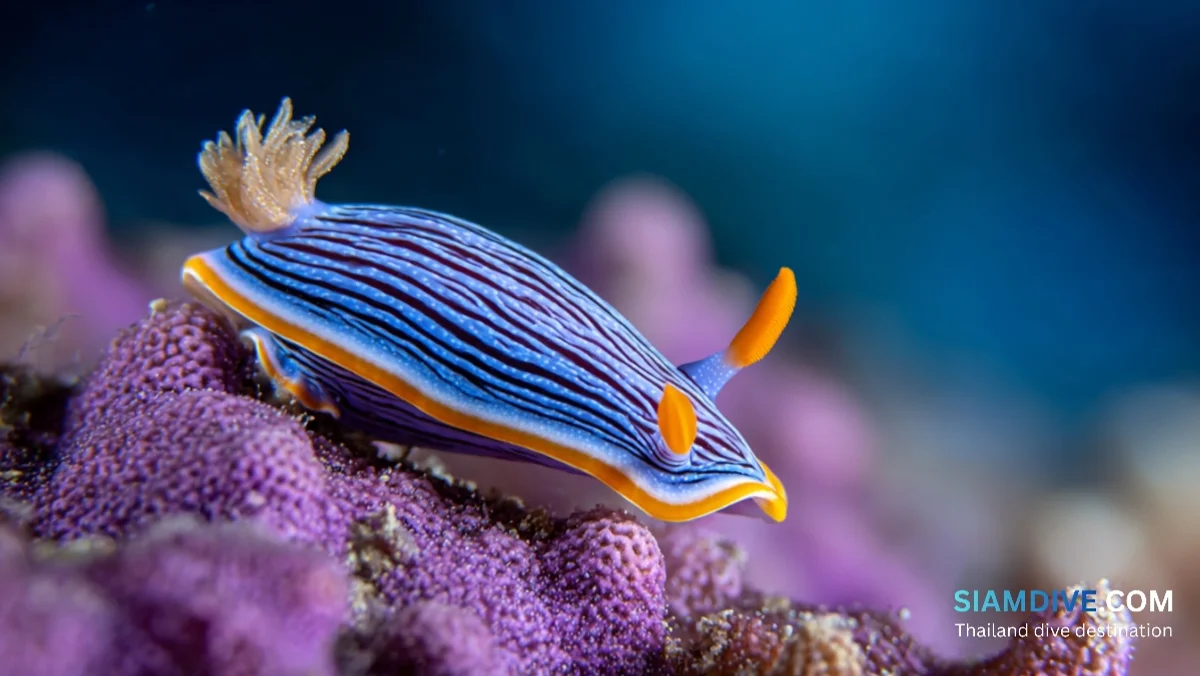
The nudibranch diversity alone could fill a pocket guide. The rare Janolus savinkini was recently documented here, its cerata tipped with purple, gliding across rubble in footage that spread quickly through the macro photography community.
Reading the Conditions
Lembeh is a year-round destination, but conditions shift enough to influence planning. The figures below reflect data from published operator references and regional dive guides.
- Water temperature
- 25 °C in July–September, rising to 28 °C in December–February
- Visibility
- Typically 5–20 m; clearest window October through December
- Depth range
- Most sites 5–25 m, select sites to 30 m
- Currents
- Generally negligible; occasional mild drift near channel openings
- Wet-season wind
- November–June, blowing west to east; operators shift to Sulawesi-mainland sites
August through October is the favoured window for photographers: cooler water pushes critters into shallower hunting grounds, visibility climbs, and rainfall drops. But muck diving in Lembeh produces results in every calendar month — the critters do not migrate; they just shift positions on the slope.
A 3 mm wetsuit works for most divers from October through May. When the thermocline dips in July and August, a 5 mm suit or a hooded vest earns its extra luggage weight.
Getting There and Getting Underwater
Manado's Sam Ratulangi International Airport (MDC) connects to Singapore, Jakarta, and several Indonesian cities on direct routes. From the terminal, the drive to the strait's western shore takes roughly 90 minutes. Most resorts arrange transfers as part of their packages.
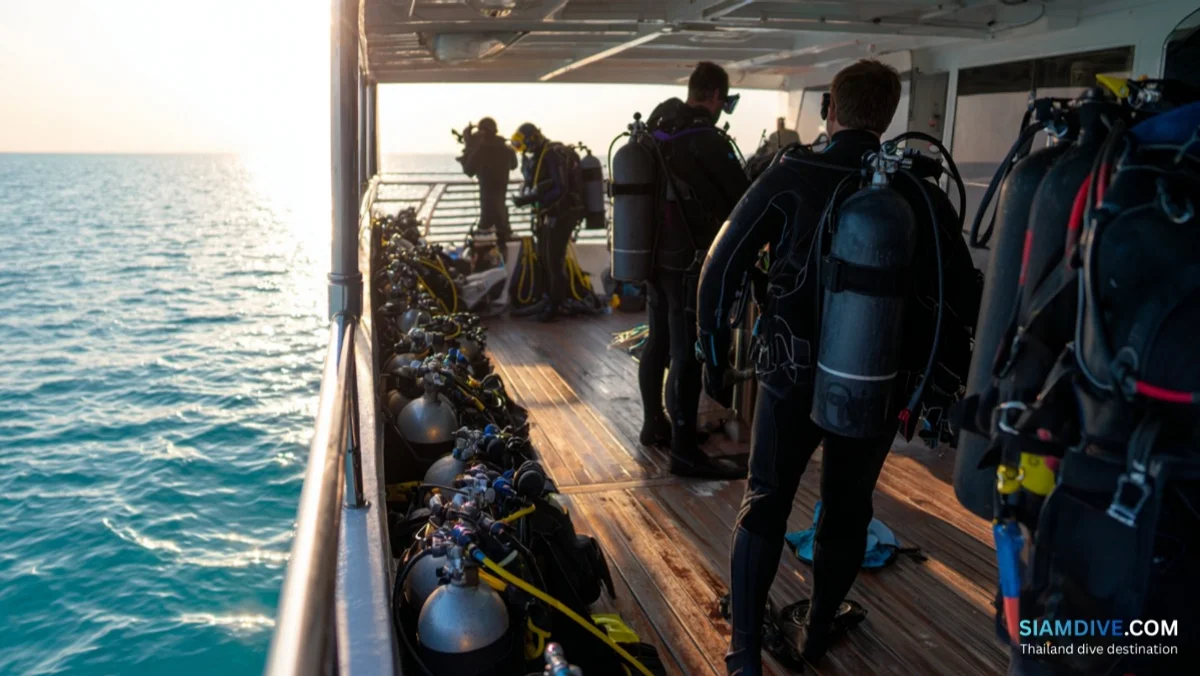
The Lembeh dive economy runs on all-inclusive resort packages rather than walk-in day boats. A standard bundle covers accommodation, full board, two to three guided boat dives per day, and unlimited house-reef access.
- Budget range — US $100–140 per person per night, including meals and 2–3 guided dives
- Mid-range — US $140–200 per person per night, adding camera room, dedicated photo guide, and Nitrox
- Premium — US $200+ per person per night, with private guide, spa, and photography workshop access
- Nitrox surcharge — around US $7 per tank, capped at approximately US $20 per day
- Equipment rental — roughly US $23 per day for a full set
- Marine park fee — US $3 per year
Guide ratios define the Lembeh experience. Most resorts assign one guide for every two divers — a ratio that would count as luxury elsewhere but is considered baseline here. These guides are critter specialists, trained to spot animals smaller than a fingernail, and they communicate finds by tapping a metal pointer against their tank.
What Guides Found This Season
The 2026 season has continued Lembeh's track record of delivering surprises even to veteran guides. Recent photography workshop groups logged hundreds of priority critter species across multi-day dive itineraries — an output that underlines why the strait remains the benchmark destination for macro shooters worldwide.
Coral spawning events across the strait documented 25 different species of coral releasing gametes over several consecutive nights, with sponges joining at dawn. The nutrient pulse attracted planktivores into unusually dense feeding clusters, creating secondary photo opportunities above the sand.
A juvenile orange-and-black dragonet (Dactylopus kuiteri), just two centimetres long, was spotted skimming the sand at one site — a species rarely seen at that life stage. At another, three male blue-ringed octopuses were observed competing for a single female, a courtship sequence seldom documented and even more rarely captured on camera.
For divers who track marine species through photo identification, Lembeh's resident rhinopias offer a parallel project: individuals can be re-identified across seasons by their unique colour patterns and wart distributions, building a local dataset that helps guides predict where to find them next.
Whether the subject is a creature resting on a favourite sand patch or a two-centimetre dragonet dashing across rubble, Lembeh delivers encounters that make divers extend trips and rebook before the return flight lands.