Your Tank’s Test Date Expired — Can You Still Dive It?
12 พฤษภาคม 2569
Three stamps on every cylinder neck decide whether you dive or walk. What they mean, what Thai law requires, and what happens when the date runs out.
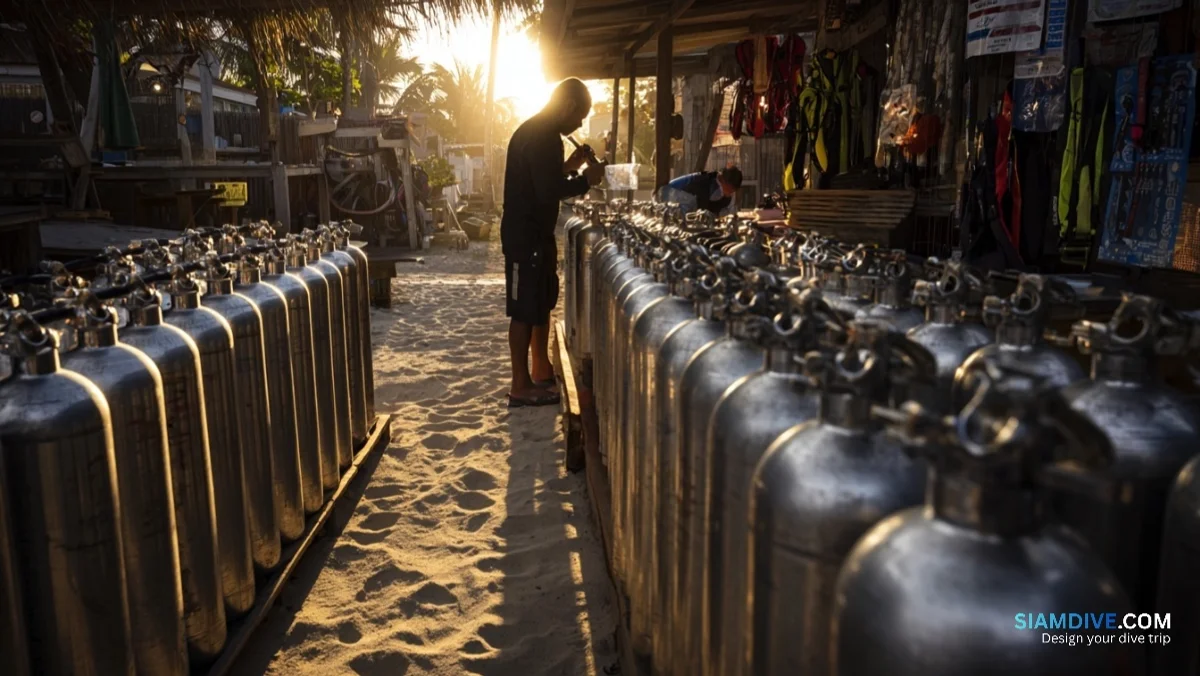
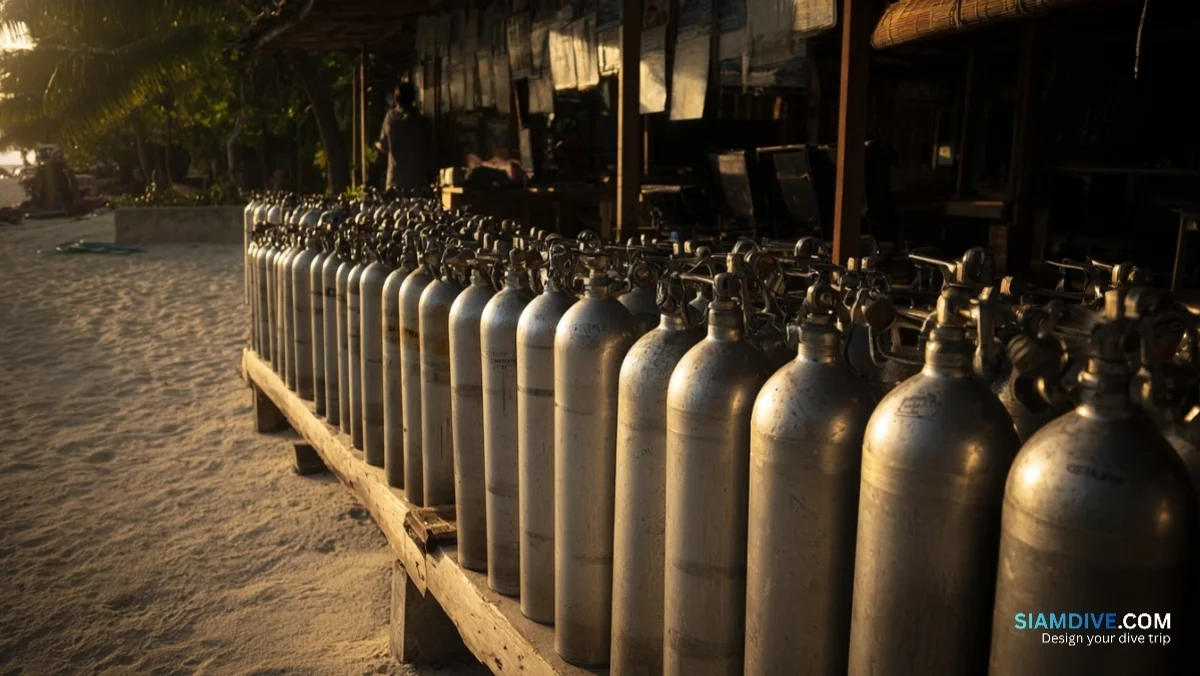
The fill-station operator runs a thumb over the crown mark, tilts the cylinder toward a strip light, and shakes his head. The last hydro stamp reads 03/21 — more than five years ago. No fill. No debate. The tank stays dry until a test facility says otherwise. For every diver who owns a cylinder, this moment is built into the calendar. The metal remembers every fill cycle, every salt-water rinse that didn't happen, every season stored upright with moisture pooling at the base. The stamp is just a date. What it represents is a countdown.
Three Marks That Decide Whether You Dive
Every scuba cylinder carries its biography stamped into the shoulder or neck ring. Three lines matter:
The manufacturer code and serial number are the birth certificate — they tie the cylinder to an alloy, a wall thickness, and a rated working pressure. Lose the serial and no test facility can requalify the tank.
The original test date (month and year) records the first hydrostatic test, usually performed at the factory. Combined with the alloy designation, it tells you roughly how much service life remains.
The most recent hydro date is the one that gates every fill. If today's date is more than five years past that stamp, the cylinder is out of test. Full stop.
On some cylinders a + mark appears after the date. That means the tank qualified for a 10 per cent overfill above its rated pressure — a useful margin on a long liveaboard day. Not every tank earns it, and the qualification must be renewed at each hydro.
One more detail: the crown mark — a small logo or number identifying the test facility — sits beside the date. If it is missing or unreadable, the test record is void even when the date is current.
Between the five-year hydros, annual visual inspections — what the industry calls a VIP — keep the cylinder in check. An inspector removes the valve, threads an inspection light inside, and examines the interior for pitting, corrosion, coating delamination, and neck cracks. The outside gets scrutinised for dents, gouges, heat damage, and stress lines. A current VIP sticker is what most fill stations check first — it is faster to read than the hydro stamp and tells the operator the tank was in someone's hands within the past twelve months.
What Happens Inside the Hydro Chamber
A hydrostatic test is the only procedure that measures whether the metal in your cylinder has fatigued past its safety margin.
The tank is emptied of air and filled entirely with water. Water, not air — because water is nearly incompressible and stores almost no energy if the cylinder ruptures during the test. An air-filled failure is a bomb. A water-filled failure is a crack and a puddle.
The filled cylinder goes inside a sealed jacket, also filled with water, connected to a precision burette — a calibrated glass tube that tracks displaced water down to fractions of a millilitre. The test station then pressurises the cylinder to five-thirds of its working pressure. For a standard 200-bar tank, that means 333 bar — far above anything a recreational diver encounters.
Pressure is held for at least 30 seconds, then released. The burette records two numbers: total expansion (how much the tank grew under pressure) and permanent expansion (how much it stayed larger after pressure dropped). If permanent expansion exceeds the threshold — typically 10 per cent of total expansion under US DOT rules — the cylinder fails.
A failed tank gets drilled through the sidewall or crushed flat. No retest, no second chance. The metal has spoken.
For reference: aluminium tanks typically show total expansion of 3–6 per cent, steel tanks 2–4 per cent. A cylinder creeping toward 8–9 per cent passes today but sits on borrowed time.
Steel, Aluminium, or the Banned Alloy?
What your cylinder is made of determines how you read the stamps — and what you do next.
Steel has no hard retirement age. A well-maintained steel cylinder can pass hydro tests for four decades. Steel corrodes visibly: surface rust is treatable, threads can be chased, and the alloy does not suffer from the hidden cracking that haunts certain aluminium grades. If your steel tank passes its five-year hydro and annual visual inspection, it dives. Indefinitely.
Aluminium 6061 — the industry standard since the late 1980s — has a practical ceiling of roughly 15 years. Aluminium fatigues with each pressure cycle, and permanent expansion creeps upward over time. A 12-year-old 6061 tank showing 7 per cent total expansion is whispering about retirement. It might pass two more hydros. It might not pass the next one.
Aluminium 6351 is the alloy that changed the rules. Luxfer, the largest cylinder manufacturer in the world, stopped using 6351-T6 in June 1988 after identifying its susceptibility to sustained-load cracking — microscopic fractures that propagate slowly through the neck and shoulder area under ordinary fill pressure, invisible from the outside. Since 1994, the US Pipeline and Hazardous Materials Safety Administration (PHMSA) has logged thirteen ruptures caused by SLC in 6351 cylinders. The requirement now: every 6351 tank still in service must undergo an eddy-current test — an electromagnetic scan that finds sub-surface cracks — on top of the standard hydro, every five years.
If your aluminium cylinder predates 1990, check the manufacturer stamp for the alloy designation. A tank marked 6351-T6 can still legally be filled and used, but it needs the extra test, and many fill stations refuse 6351 cylinders outright — not because the law demands it, but because the liability is not worth the trouble.
- Steel, hydro current — Dive it. Book the next test before the stamp expires.
- Aluminium 6061, under 15 years, hydro current — Dive it. Track expansion numbers at each requalification.
- Aluminium 6061, over 15 years — Test it. If expansion trends toward 8 per cent, start shopping for a replacement.
- Aluminium 6351 — Get a hydro plus eddy-current test. If it passes and your fill station accepts it, you decide. If they refuse, retire the cylinder.
Hydro Expired — What Are Your Options?
If the date on the stamp plus five years has passed, the tank is out of test. Here is the decision tree:
- Expired this month — Some fill stations honour the calendar month. Others count to the day. Do not assume.
- Expired by weeks or months — The cylinder is not condemned. It is overdue. Take it to a hydro facility, get it tested, and — if it passes — you are back in service with a fresh five-year stamp.
- Expired by years, stored in a garage — It may still pass, but expect a rigorous visual inspection first. Moisture trapped inside a sealed cylinder for years becomes interior corrosion that can thin the walls below safe limits.
- Test result: fail — The facility drills the tank or stamps it condemned. Scrap value is negligible. Buy new.
- Test result: pass — New stamp, new five-year window. Cost: approximately US $45–55 in the United States, or around 1,500–2,500 baht at service centres in Thailand.
A current hydro stamp does not guarantee a fill. A deep dent, a corroded valve seat, visible thread damage — any of these will get you turned away by a careful operator even with a fresh stamp. The hydro date opens the door. The condition of the cylinder decides whether you walk through it.
A useful habit: write the hydro expiry date on a strip of dive tape and stick it to the boot or valve guard. The stamp itself is small, often hard to read on a corroded or salt-stained neck. A visible reminder removes the guesswork.
Thailand's Rules and How They Compare
Hydro test intervals vary more than most divers realise:
- United States (DOT) — Hydro every 5 years (49 CFR 180.209). Annual visual inspection is industry standard but not a federal requirement.
- European Union — Visual inspection every 2.5 years, hydro every 5 years.
- Australia — Hydro every 12 months. The strictest regime in the diving world, driven partly by hot-climate corrosion rates.
- Norway — Hydro 3 years after manufacture, then every 2 years.
- Thailand — 5-year hydro cycle under Ministry of Labour regulations (B.E. 2549, updated B.E. 2564) covering pressure vessels. Annual visual inspection is standard practice at established operations.
On the ground in Thailand, established dive centres in Phuket, Koh Tao, and Khao Lak follow the five-year hydro and annual VIP cycle closely. Insurance underwriters require it, and international clients expect it. Smaller or more remote operations may be less consistent. If you are renting, checking the stamp takes five seconds and costs nothing.
Thailand classifies scuba cylinders under general pressure-vessel rules rather than a diving-specific code. The inspection framework is sound, but the enforcement chain — from Ministry of Labour inspectors to individual dive shops — is longer and more uneven than in countries with dedicated dive-equipment legislation.
For divers bringing personal cylinders into Thailand: airlines require scuba tanks to travel empty with the valve open or removed. Thai customs rarely questions an empty cylinder, but confirm that your chosen fill station accepts foreign hydro stamps. Most large centres recognise US DOT and European EN markings. Smaller shops may require a fresh Thai-standard test before filling.
Where to Get a Hydro Test in Thailand
Thailand has a small but capable network of test facilities:
- Dive Right (Pattaya) — IDEST-certified technician centre with visual and hydrostatic testing to international standards
- Easytek — Hydro capability to 650 bar (10,000 psi), testing to US DOT, European EC, British BS, and Thai standards. Among the best-equipped facilities in Southeast Asia.
- Dive Supply — Service centres in Phuket, Koh Tao, Bangkok, Koh Samui, and Koh Chang
Budget roughly 1,500–2,500 baht for a standard hydro including the visual inspection. Turnaround ranges from same-day at larger centres to a week or longer during high season (November–April). If you are flying in with your own tank and the date is close, get the test done before the trip. Arranging a hydro mid-holiday — with shipping and wait times — is a reliable way to lose dive days.
Three Cylinder Failures in Twelve Months
If the five-year schedule seems cautious for a tank that looks fine from the outside, the past year offered three corrections.
In February 2025, an out-of-test scuba cylinder exploded at a PADI 5-Star IDC centre in Geelong, Australia. The blast cost a diving instructor his leg. A WorkSafe Victoria investigation found the cylinder had been out of test — but could not determine when it had last been tested at all. The fine: AUD 40,000.
In March 2025, a 27-year-old man was killed when a cylinder ruptured during filling at a dive centre. The tank had not been properly maintained.
In August 2025, a cylinder detonated near an equipment-issue area on Ploce Beach in Montenegro. Shrapnel struck a 14-year-old boy standing 50 metres from the blast. He lost his hand.
Three countries, three failures, one thread: cylinders where the inspection record had lapsed or never existed. The hydro test catches metal fatigue before the metal makes the decision for you. Five years, one test, a stamp smaller than a postage stamp. That is the entire margin between a fill and an ambulance.