Underwater Hand Signals: The Complete Diver's Guide
13 เมษายน 2569
Master the essential underwater hand signals every diver needs. From OK to emergency signals, learn to communicate clearly on every dive.
Why Hand Signals Are Your Lifeline Underwater
You cannot talk underwater. That obvious fact makes hand signals the primary communication system for every scuba dive, yet many divers treat them as an afterthought — something they half-learned in certification class and never practiced again. This gap between knowing a signal exists and using it correctly under pressure is where diving incidents happen.
PADI, SSI, NAUI, and BSAC all teach standardized hand signals as part of open water certification. The core signals are universal, meaning a diver trained in Germany can communicate with a buddy trained in Thailand without speaking a word. But "universal" does not mean "automatic" — you need to practice until the signals become muscle memory, not something you have to think about while managing buoyancy, air, and depth at the same time.
The Essential Everyday Signals
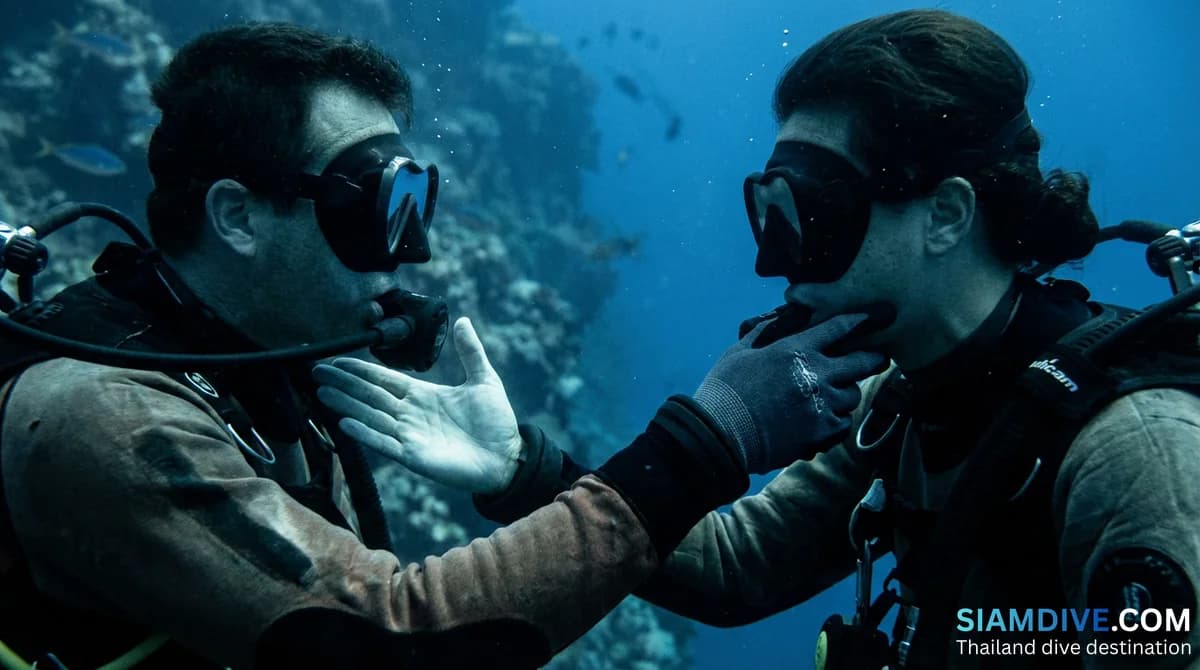
OK (I'm fine / Are you OK?): Form a circle with your thumb and index finger, extend the other three fingers. This is both a question and an answer — your buddy flashes it to ask if you are OK, and you flash it back to confirm. At the surface or at distance, use the overhead OK: both arms forming a large O above your head. Never use thumbs up to mean OK underwater — it means something else entirely.
Thumbs Up (Ascend / End the dive): This is not the casual "all good" gesture from land. Underwater, thumbs up means "go up now." It is a directive, not a status check. When your buddy signals thumbs up, you begin ascending together. Do not ignore it or signal "wait" — if someone wants to go up, you go up.
Thumbs Down (Descend): Point your thumb toward the bottom. Used during descent to indicate you want to go deeper or to signal your buddy to begin descending. Less common than thumbs up but equally clear.
Flat Hand, Palm Down, Rocking Side to Side (Something is wrong): This is the "so-so" signal. It means something is not right but it is not yet an emergency. Follow it with a specific signal pointing to the problem — your ear, your mask, your regulator, or a direction.
Stop / Hold (Open palm facing buddy): Hold up your open hand like a traffic cop. Means stop moving, hold position, wait. Used to get attention before giving another signal, or to pause during descent or navigation.
Turn Around / Go Back: Point your index finger and make a circular motion. Means reverse direction. Often used when you have reached the turnaround point on a dive plan based on air consumption or time.
Low on Air: Make a fist and place it against your chest. This alerts your buddy that your air is getting low and you should begin planning the ascent. Different from "out of air" — low on air means you have time but need to act.
Watch Me / Look: Point two fingers at your eyes, then point toward whatever you want your buddy to see. Used constantly during dives to share marine life sightings, point out hazards, or direct attention to navigation landmarks.
Emergency Signals That Could Save Your Life
Out of Air (Throat slash): Draw your flat hand across your throat in a slashing motion. This is the most urgent signal in diving — it means you have no air and need to share your buddy's alternate air source immediately. When you see this signal, offer your octopus without hesitation. Every second counts.
Help / Distress on Surface: Wave both arms overhead repeatedly. This is the international distress signal visible to boats, shore, and other divers on the surface. Do not use single arm waves — that looks like a greeting. Both arms, repeated motion, obvious distress.
I'm in Trouble (Underwater): Rapid waving of one hand at your side or overhead. Combined with eye contact, this signals that something is seriously wrong. Follow up with specific signals about the problem if possible.
Abort / Emergency Ascent: Repeated, emphatic thumbs up with urgency. When combined with a throat slash or distress signal, it means immediate controlled ascent is necessary. Safety stops may need to be shortened or skipped if the emergency is severe enough.
Air Communication Signals
Your dive guide will ask about your air regularly. Standard responses use hand signals that represent numbers.
200 bar (full tank): Hold up two fingers in a V shape, or use the number signals your dive school taught. Make the signal large and clear — your buddy may be 3 meters away in low visibility.
100 bar: Hold up one finger, or make a fist with index finger extended. At 100 bar, your dive is roughly half over depending on depth and consumption rate. Your buddy should acknowledge this signal.
50 bar (safety reserve): Hold up five spread fingers, then make a zero with thumb and forefinger. At 50 bar, begin ascending regardless of what your buddy's gauge reads. This is your personal reserve and not negotiable.
Some dive operators use tank tapping — rapping your knuckles on your tank — to get your buddy's attention for air checks. Tap twice, then display your current pressure. This works better than waiting for eye contact in current or low visibility.
Marine Life and Direction Signals
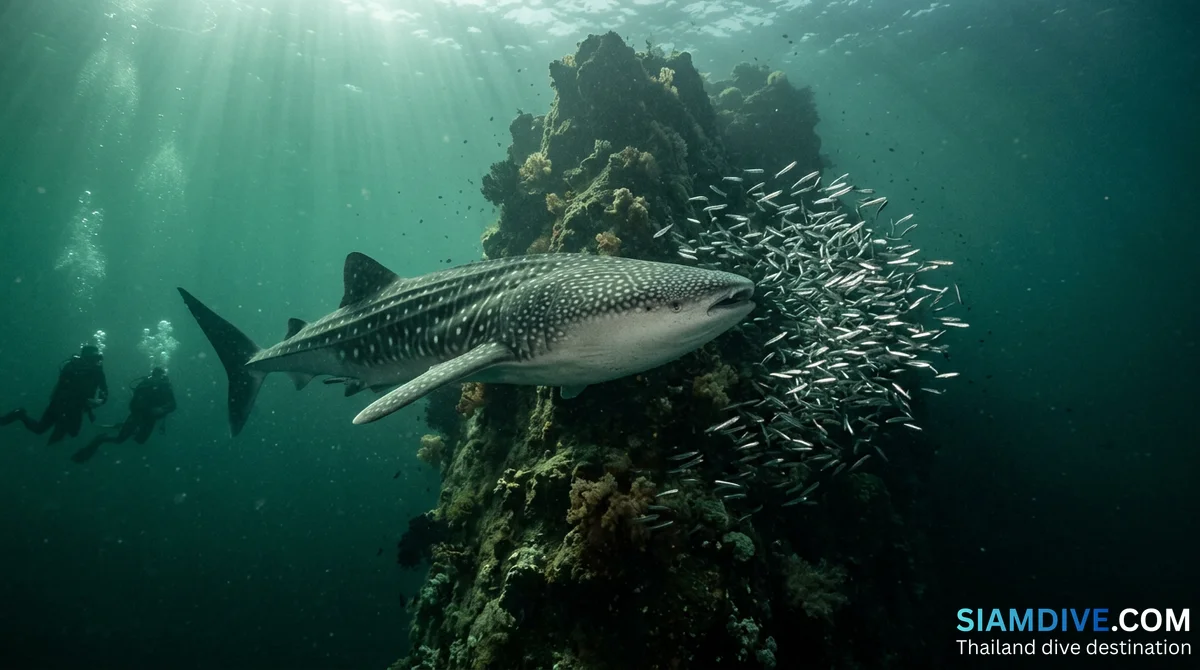
Shark: Place your flat hand vertically on top of your head like a dorsal fin. Universal and immediately understood. Stay calm and signal direction with your other hand.
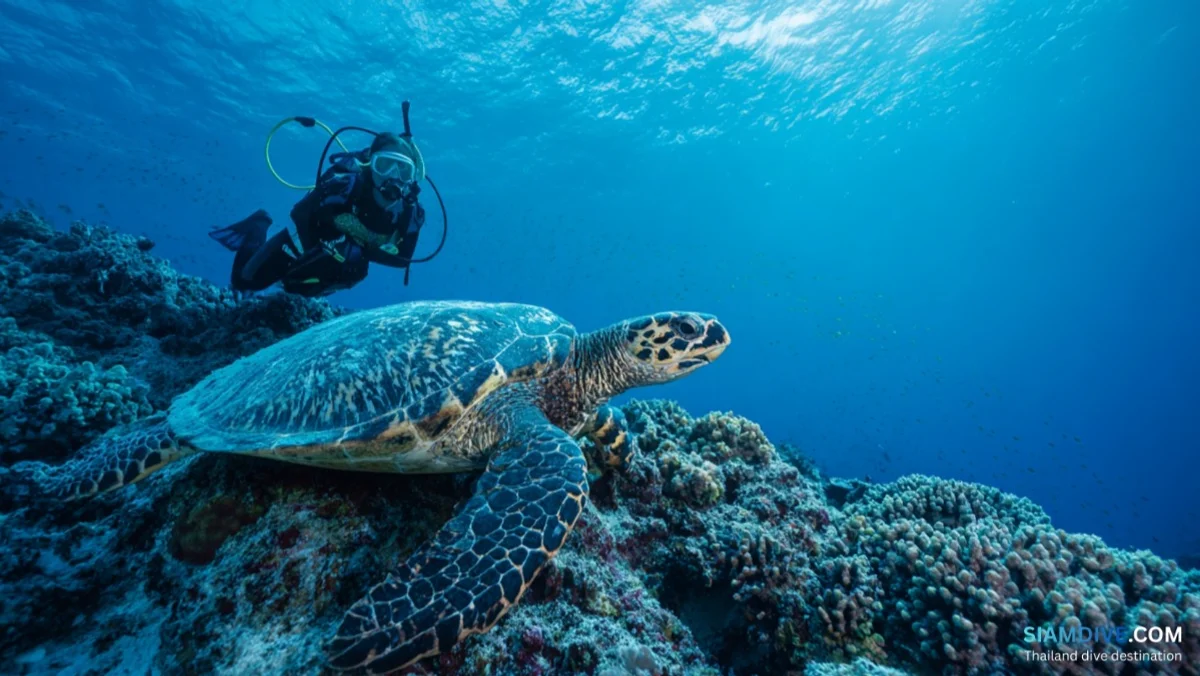
Turtle: Stack both fists and rotate your thumbs around each other, mimicking a turtle swimming. Or simply point and make a slow sweeping hand motion — context usually makes it clear.
Manta Ray / Large Ray: Extend both arms out to your sides and flap gently, mimicking the wingspan. Hard to miss and gets everyone's attention instantly.
Nudibranch / Small creature: Point with your index finger and bring your other hand close with thumb and finger nearly touching, indicating something small. Then point to the exact location — nudibranchs are tiny and your buddy will need precise direction.
Current direction: Extend your arm and wave your hand in the direction the current flows. Useful for communicating to your buddy which way the drift is pulling and which direction to navigate.
Night Diving Communication
Hand signals in the dark require light. Point your dive light at your hand while signaling so your buddy can see the gesture. Never shine your light directly in someone's eyes — it destroys their night vision for several minutes and is genuinely disorienting.
A slow circular motion with your light means OK. A rapid side-to-side motion means attention or something is wrong. Keep light-based signals consistent with whatever your dive operator briefed — variations exist between regions.
Underwater slates become more important at night. Pre-write common messages like "low air," "which way," or specific marine life names. A slate with a small light illuminating it is readable from further away than hand signals in the dark.
Backup lights are not optional for night diving. If your primary light fails and you cannot signal your buddy, the dive is effectively over. Carry at least one backup clipped to your BCD where you can reach it with either hand.
Regional Differences and Dive Team Agreements
While core signals are standardized globally, some regional variations exist. In parts of Europe, BSAC divers may use a V sign (two fingers) to mean "up" instead of thumbs up. Some Asian dive operators add local signals for specific marine life common to their sites — seahorses, whale sharks, or clownfish each get their own gesture depending on where you dive.
Technical diving adds another layer. Signals for gas switches, deco stops, and stage bottle management are not part of recreational training. If you are diving with tech divers, ask about their signals during the briefing.
The most important practice is the pre-dive signal review. Spend two minutes with your buddy before every dive confirming the signals you will use, especially if you trained at different schools or in different countries. Agree on air check signals, turnaround signals, and emergency procedures. Two minutes of surface time prevents underwater confusion.
How to Practice Until Signals Are Automatic
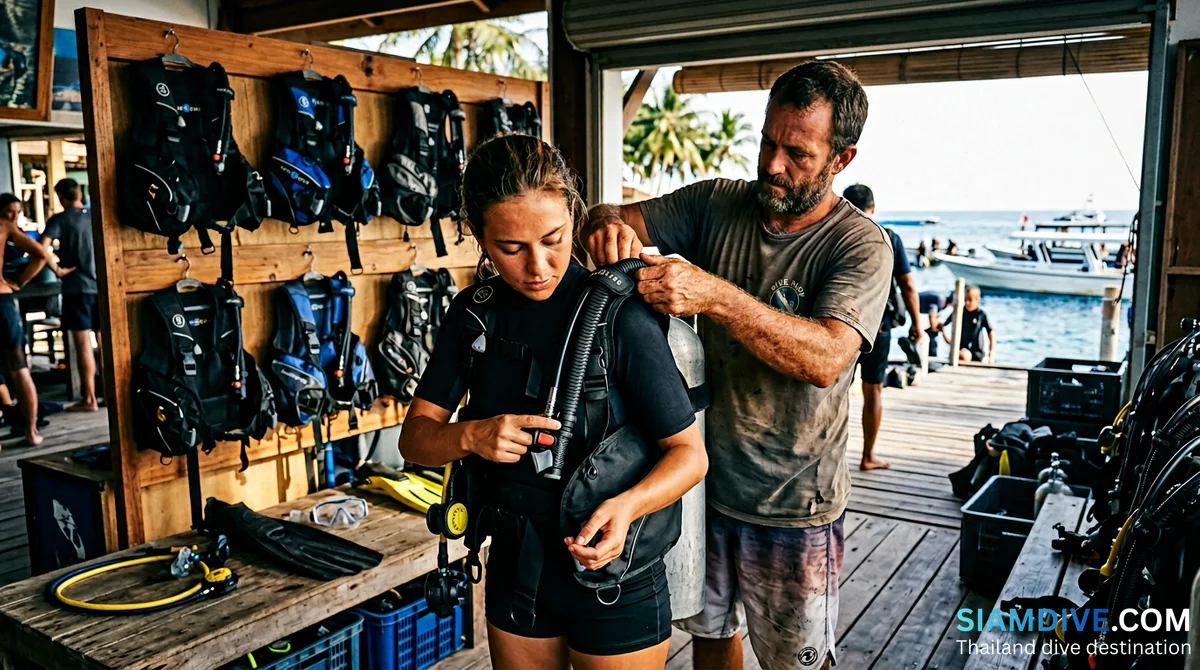
Practice on land first. Run through all signals with your buddy in the gear room or on the boat deck. Make them large, deliberate, and hold each one for two full seconds so they are unmistakable.
In the water, start every dive with a signal check. Your buddy gives OK, you respond OK. Confirm air, confirm direction, confirm depth limit. This takes 15 seconds and ensures both of you are on the same page before the dive begins.
Quiz each other mid-dive. Flash a random signal and confirm your buddy responds correctly. This builds the reflex you need in a real emergency — where hesitation costs time and time costs air.
After the dive, debrief any signal confusion. If your buddy misunderstood a signal, discuss what happened and agree on a clearer version. Every buddy team develops their own shorthand over time — that is normal and expected, as long as the emergency signals remain standard.
Communicate Better on Every Dive
Hand signals are the cheapest, most reliable dive equipment you own. They weigh nothing, never malfunction, and work at any depth. The only investment required is practice — and the payoff is safer, more enjoyable dives where you and your buddy function as a real team instead of two people who happen to be in the same water.
Looking for your next dive adventure? Browse trips and operators at siamdive.com — from beginner-friendly day trips to advanced liveaboards, find the right experience for your level and see how good communication makes every dive better.