At 18 Metres, Sail Rock's Barracuda Cylinder Begins to Spin
3 พฤษภาคม 2569
Three hundred chevron barracuda form a rotating column taller than the pinnacle itself. The physics behind the Gulf's most reliable vortex involves selfishness, wake energy, and one isolated rock.
Three hundred silver bodies hold position against the current, each one angled two degrees off the next, and the whole formation rotates like a slow-motion drill bit descending through blue water. From the sandy bottom at 30 metres the column reaches upward past the chimney exit at 18, past the shallow coral shelf, past the surface glare — a living cylinder six metres wide and taller than the pinnacle itself. This is the barracuda wall at Sail Rock, and it happens most mornings between March and September when the Gulf of Thailand lies flat.
What Exactly Are They Doing?
The species responsible is the chevron barracuda, Sphyraena qenie, identifiable by 18 to 22 dark V-shaped bands running from dorsal to belly. Adults reach 140 cm and carry the elongated jaw geometry that makes barracuda silhouettes unmistakable on a reef. At Sail Rock they gather in groups of 200 to 500 individuals — sometimes more during peak calm season — and arrange themselves into a rotating column that underwater photographers worldwide call a "tornado" or "vortex."
The formation is not random. Each fish maintains roughly one body-length of separation from its neighbours while matching speed and bearing with millisecond precision. The school rotates counter-clockwise (viewed from above) at a rate slow enough that a diver hovering at mid-depth can watch the same marked individual pass again within 40 to 60 seconds. The cylinder's diameter stays remarkably consistent — typically five to seven metres — regardless of whether 200 or 400 fish participate. Add more barracuda and the column grows taller, not wider.
The Selfish Logic of Spinning
In 1971, evolutionary biologist W.D. Hamilton proposed what became known as the selfish herd hypothesis: animals cluster not out of cooperation but because each individual reduces its own predation risk by putting others between itself and potential attackers. Fish at the centre of a school face significantly lower capture probability than those on the edge. The geometry is selfish mathematics — each barracuda is trying to hide behind its neighbour.
A cylinder solves an engineering problem that a flat disc cannot. In a disc-shaped school, edge fish have nowhere to go — the geometry offers only a single layer of protection in two dimensions. A rotating cylinder creates continuous movement of individuals from edge to interior and back again. No single fish remains exposed for long. The rotation distributes predation risk across time rather than freezing unlucky edge-dwellers in permanent danger.
Research published in eLife confirms the mechanism quantitatively: both the position of a prey fish within a school and its relative conspicuousness predict individual survival probability. Central positions carry measurable safety benefits. The cylinder formation, then, is not a coordinated performance but an emergent pattern — hundreds of individually selfish decisions that resolve into geometric order without any conductor.
Hydrodynamics: Why the Shape Holds
Selfish positioning alone does not explain why the column maintains its diameter or why the fish swim in circles rather than simply bunching into a sphere. The answer involves fluid dynamics and the invisible architecture of wakes.
Studies published in Nature Communications demonstrate that fish swimming in formation can achieve thrust improvements of up to 42% and efficiency gains of 13% compared to solitary swimming. The vortices shed by one fish's tail provide energy that trailing fish can harvest — a phenomenon researchers call "vortex phase matching." For this to work, spacing must stay within a narrow range. Too close and the wake turbulence becomes chaotic; too far and the energy dissipates before the trailing fish can capture it.
A rotating cylinder maximises the number of fish that can benefit from wake energy simultaneously. Each barracuda rides in the slipstream of the one ahead and slightly above or below it, creating a helical path within the larger column. The constant-diameter shape is not aesthetic coincidence — it is the formation width at which hydrodynamic coupling remains effective for the greatest number of participants. Wider, and interior fish lose the wake benefit. Narrower, and the turbulence from too many bodies in too little water volume becomes counterproductive.
The result is dual-purpose engineering: the cylinder simultaneously minimises predation risk through the selfish herd effect and minimises energy expenditure through wake harvesting. Evolution has no blueprint — but selection pressure on individuals who save energy and avoid being eaten converges on the same shape every time.
Why Sail Rock and Not Somewhere Else?
Barracuda tornadoes occur at a handful of sites worldwide — Sipadan's Barracuda Point, the Similan Islands' Koh Tachai pinnacle, the Azores seamounts — and they share three structural features that Sail Rock also possesses:
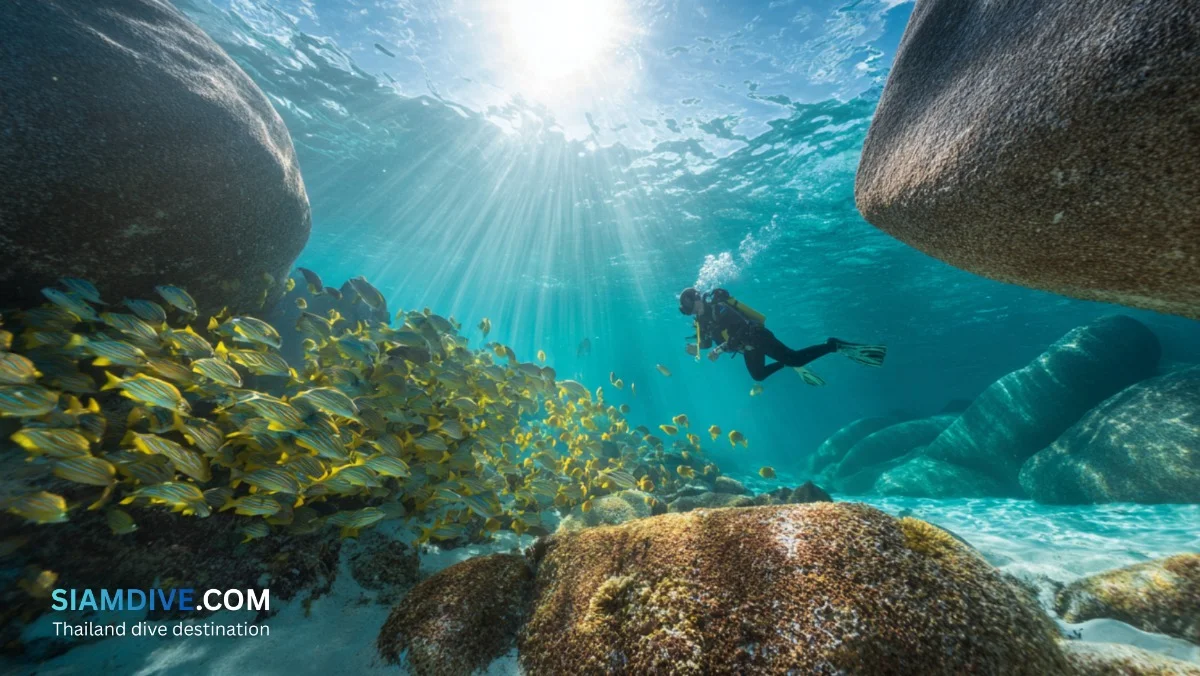
- Isolated vertical structure — Sail Rock is a lone granite pinnacle rising from 40 metres of open sandy bottom with no nearby reef for kilometres in any direction. Isolated pinnacles concentrate pelagic traffic the way a single tree in an open field concentrates birds. There is nowhere else to go.
- Predictable current and upwelling — The pinnacle disrupts tidal flow between Koh Tao and Koh Phangan, creating localised upwelling that draws nutrients from depth. Research published in PNAS confirms that underwater structures trap eddies (termed Taylor columns) that can persist for weeks, boosting local primary productivity. More plankton means more baitfish aggregation. More baitfish means barracuda have reason to remain.
- Adequate vertical range — The cylinder needs space. Sail Rock drops from 4 metres below the surface to beyond 30 metres of recreational diving depth, giving the school a full 25-metre water column to occupy without hitting bottom or breaking through the surface.
The Gulf of Thailand's minimal current during calm season (March–September) is the final ingredient. Strong currents break apart schooling formations by imposing directional flow that overrides the rotational pattern. The sheltered Gulf conditions during these months let the barracuda maintain their cylinder undisturbed for hours at a time — sometimes from first light until early afternoon without dispersal.
The Chimney and the Cylinder
Sail Rock's most famous geological feature — the Chimney, a vertical swim-through that cuts diagonally through the granite from 5 metres down to 18 metres — creates a unique spatial relationship with the barracuda school. The Chimney's lower exit opens directly at the depth where the cylinder is typically densest. Divers who descend through the dark passage and emerge at 18 metres often surface into the rotating wall of silver with almost no transition — one moment enclosed by rock, the next enclosed by fish.
The barracuda tolerate this proximity because the Chimney exit does not produce the sudden pressure changes of a diver approaching from open water. The rock absorbs fin-kick turbulence. Experienced guides from both Koh Phangan and Koh Tao operators use the Chimney approach specifically to deliver close encounters with the school without scattering it.
When and Where on the Rock
Sail Rock is compact — the exposed portion stands roughly 15 metres above sea level, and the submerged perimeter takes about 20 minutes to circumnavigate at a relaxed pace. The barracuda cylinder typically forms on the east or southeast face, positioned in the lee of the prevailing westerly tidal push. Mornings before 10:00 tend to produce the tightest, most geometrically stable formations; by early afternoon the school often loosens into a broader, less defined shoal as feeding instinct pulls individuals toward open water.
- Best months
- March–September (calm Gulf season, visibility 15–30+ metres)
- Water temperature
- 28–30°C, occasionally exceeding 30°C in April–May
- Typical school size
- 200–500 chevron barracuda; peak encounters reported above 300
- Depth of cylinder
- Column spans roughly 8–30 metres, densest between 14–22 metres
- Minimum certification
- Open Water (Advanced recommended for full column depth and the Chimney)
Dive boats depart from Koh Phangan (45 minutes), Koh Tao (90 minutes), and occasionally Koh Samui (2+ hours). Day-trip pricing from Koh Phangan and Koh Tao typically runs 3,000–4,500 THB for two dives including equipment, with Sail Rock as the primary destination on every operator's premium schedule.
Approaching Without Breaking the Spin
A cylinder of 300 barracuda is not easily spooked — S. qenie is among the most diver-tolerant of the barracuda family — but clumsy approaches still scatter formations. Three principles keep the column intact:
- Horizontal entry at mid-column depth (14–18 m) — approaching from below triggers a shadow-predator response; from above, exhaled bubbles rise into the formation and disrupt spacing between individuals.
- Neutral buoyancy, no fin kicks within 3 metres — the school responds to pressure waves more than visual cues. A single hard kick sends a compression wave that ripples outward through the formation faster than sound travels in air.
- Let the cylinder come to you — the rotation means every fish will pass your position within 60 seconds. There is no need to chase. Photographers who hover stationary at 15 metres and shoot upward into the column with natural light report the strongest compositions: silver bodies against blue water, the cylinder receding toward the surface in forced perspective.
The Afternoon Dissolve
Chevron barracuda are crepuscular hunters. Survey data from Thailand's Department of Marine and Coastal Resources documents that S. qenie leaves reef structures in late afternoon to hunt in deeper open water. At Sail Rock this means the tight morning cylinder progressively loosens after midday. By 15:00–16:00 the formation often dissolves entirely as barracuda peel away in small hunting packs of 5–15 individuals, fanning outward into the blue to intercept fusiliers and small trevally returning from their own daytime feeding grounds.
The next morning, they reassemble. The fidelity to Sail Rock is remarkable — the same school occupies the same face of the same pinnacle day after day through the six-month calm season. Whether individual fish return to identical positions within the cylinder remains unstudied, but the school's loyalty to the site has been consistent across years of dive operator logs from both Koh Tao and Koh Phangan fleets.
The Supporting Cast
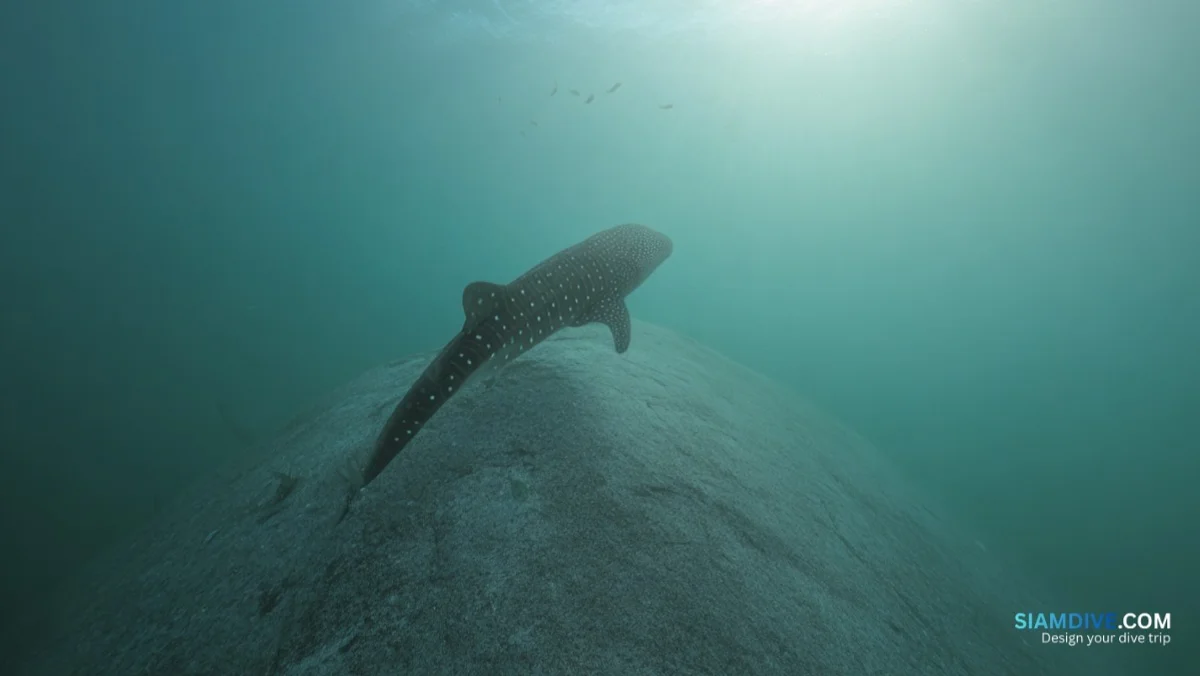
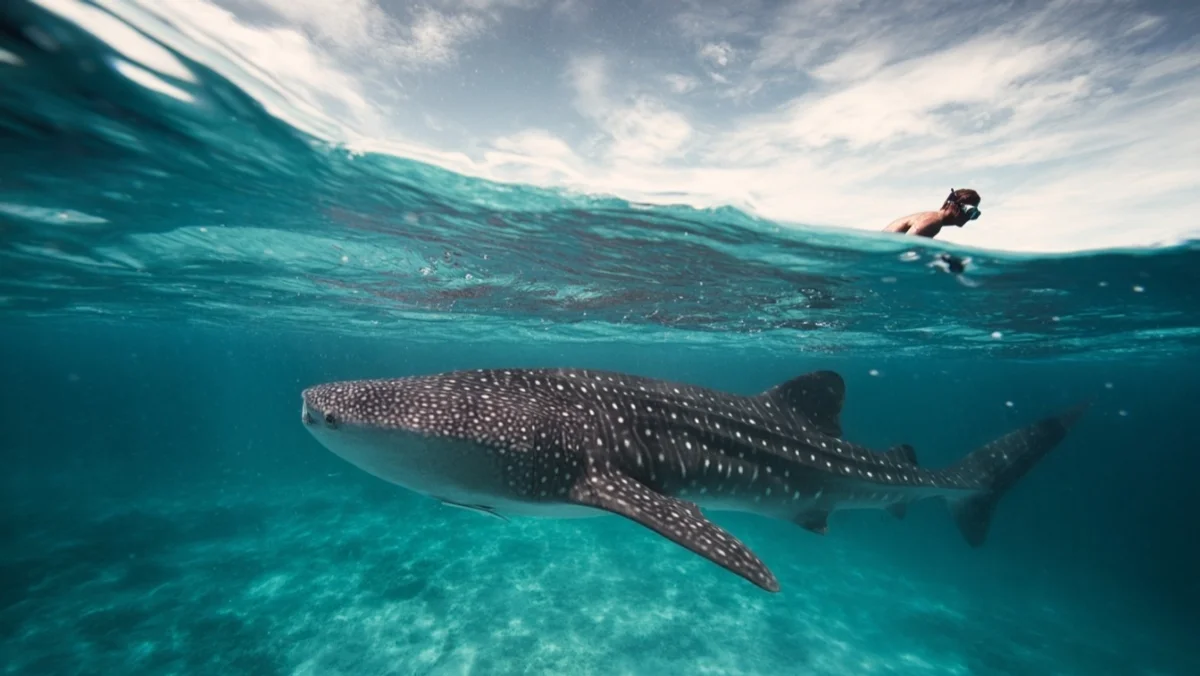
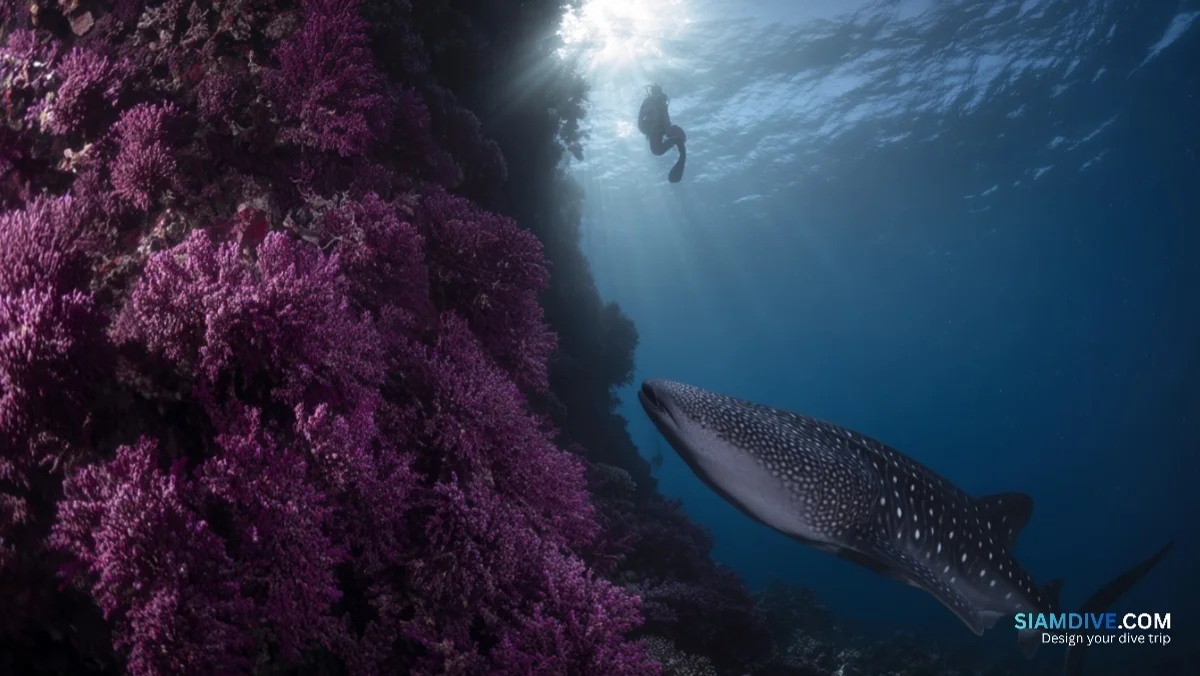
The cylinder is the headline act, but Sail Rock's isolated-pinnacle ecology supports a broader pelagic community that interacts with the barracuda school in visible ways. Giant trevally (Caranx ignobilis) patrol the school's perimeter — not hunting the barracuda themselves but exploiting the baitfish that scatter when the cylinder momentarily pulses outward. Longfin batfish (Platax teira) hover in loose squadrons just below the chimney exit at 18 metres, apparently unbothered by the silver carousel above them. And between March and May, juvenile whale sharks — typically 3–4 metres in Gulf of Thailand waters — occasionally pass through, drawing the barracuda cylinder into a brief, dramatic elongation as the school deforms around the larger animal before snapping back to shape.
Reports from the early 2026 diving season confirm continued strong marine life activity at Sail Rock, with operators noting increased fish biomass compared to previous seasons — dense trevally schools and barracuda formations visible from the surface on calm mornings.
Sources
- PMC — The role of hydrodynamics in collective motions of fish schools
- Nature Communications — Hydrodynamic schooling of flapping swimmers
- eLife — Both prey and predator features predict individual predation risk
- Thailand National Parks — Blackfin barracuda (Sphyraena qenie)
- PADI — Sail Rock dive site reference