One Missing Sugar Is Why Anemones Don't Eat Their Clownfish
1 พฤษภาคม 2569
Clownfish mucus lacks one sugar that triggers anemone stings — a 2025 study cracked the mechanism. Plus sex changes, matchmaking rules, and Thai species.
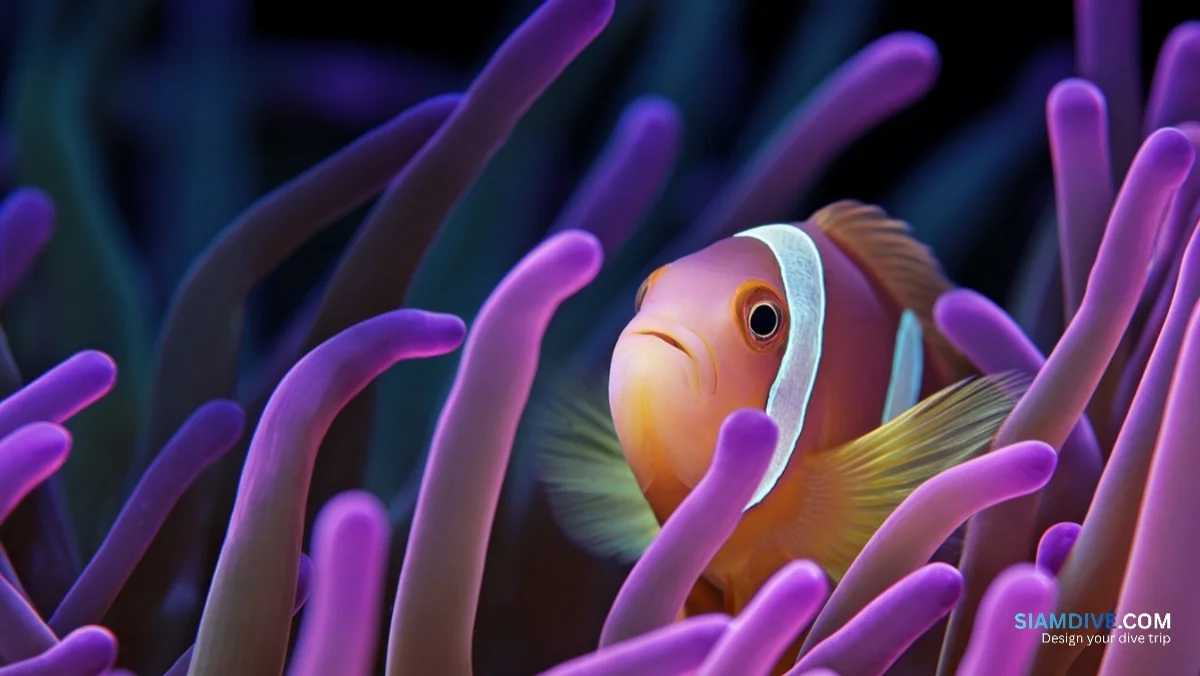
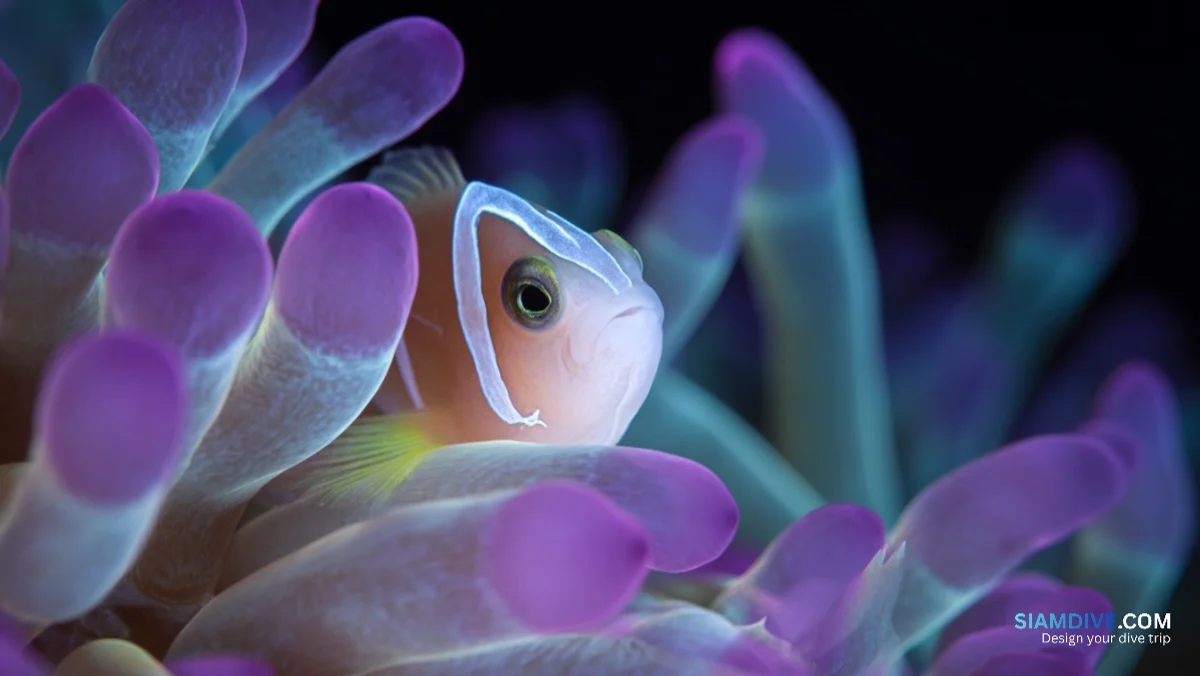
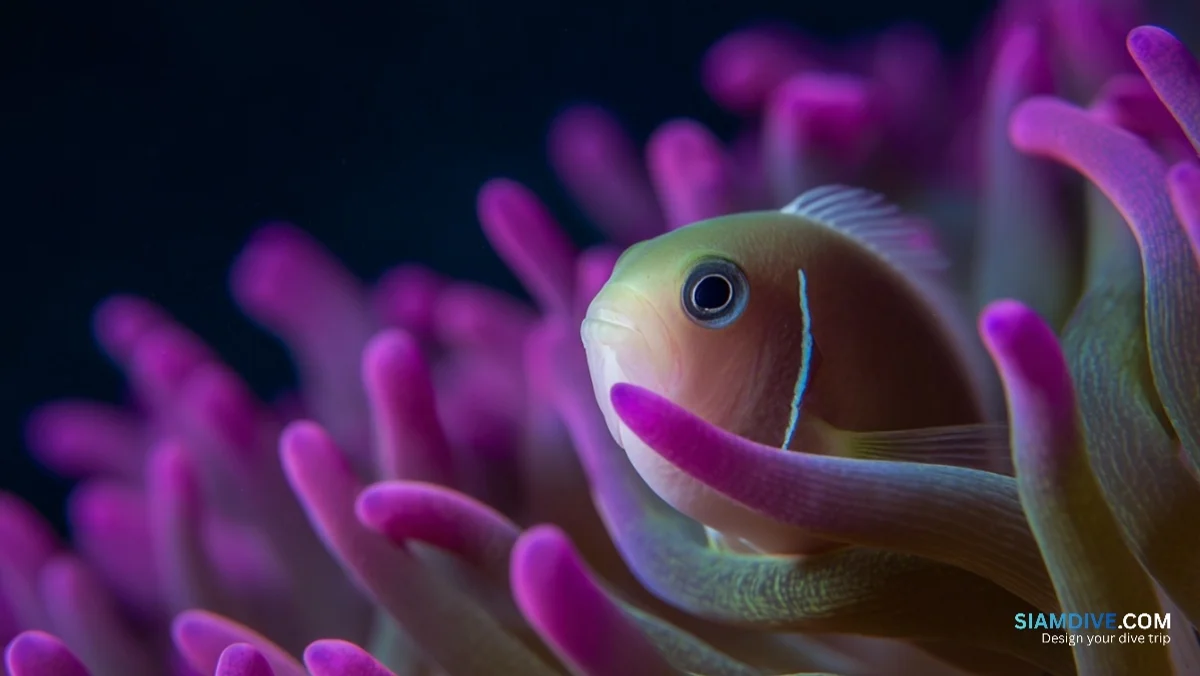
A juvenile clownfish — barely two centimetres long, translucent as a contact lens — drifts toward the tentacles of a magnificent anemone on a Similan reef. It touches one. Gets stung. Pulls back. Drifts forward again, holds contact a fraction longer. Over the next several hours it will repeat this dance dozens of times, each approach lasting a bit longer than the last, until the tentacles fold around it like fingers closing into a fist and nothing happens at all. The difference between the first touch and the last comes down to a single class of sugar molecules in the fish's skin mucus — a chemical negotiation so precise that getting it wrong means death, and getting it right means a home for life.
Thailand hosts at least seven species of clownfish across both coastlines, every one of them running this same negotiation with a host anemone that would eat any other fish on contact. The mechanism was debated for decades. In 2025, researchers finally pinned it down — and the answer turned out to be stranger than the theories it replaced.
The Sugar That Stops the Sting
Sea anemone tentacles are loaded with nematocysts — microscopic harpoons coiled under spring tension, each one primed to fire when a chemical trigger lands on the cell's surface. That trigger is a group of N-acetylated sugars, particularly sialic acid, present in the skin mucus of nearly every reef fish. A damselfish grazes a tentacle, its mucus delivers sialic acid to the nematocyst's chemoreceptor, and the harpoon fires in three milliseconds.
Clownfish mucus is different. A 2025 study published in BMC Biology by a team at the Okinawa Institute of Science and Technology measured sialic acid concentrations across clownfish and damselfish species and found a clear divide: clownfish skin carried significantly lower levels. Remove the sugar, remove the trigger. The nematocysts do not recognise the fish as food or threat — they simply do not fire.
The regulation is active, not passive. Two proteins — versican core protein and O-GlcNAc transferase — bind and mask residual N-acetylated sugars on the fish's skin, preventing them from reaching anemone chemoreceptors. It is not armour. It is a chemical password: the clownfish does not block the sting, it avoids delivering the signal that would launch it. And if the fish leaves the anemone for too long, the password expires. Sialic acid levels in the mucus begin climbing back toward normal within days.
Larvae Get Stung, Adults Do Not
No clownfish hatches stingproof. The eggs incubate for six to ten days inside the anemone, then the larvae enter open water — tiny, transparent, carried by currents for eight to twelve days with no host and no protection. During this phase their mucus carries normal sialic acid levels. A larva that bumps into an anemone tentacle gets stung exactly as a damselfish would.
The shift arrives with metamorphosis. As the juvenile develops its orange pigment and white bars, sialic acid concentrations in the skin drop sharply. The acclimation dance — the repeated touching that divers sometimes witness on shallow reefs — takes anywhere from two hours to two full days depending on the species pair. During that window the fish is recalibrating its mucus chemistry in real time, testing the threshold with each contact.
This developmental lock creates a consequence most divers never consider: adult clownfish almost never switch anemones voluntarily. Leaving a host means starting the chemical negotiation from scratch, with a real risk of lethal stinging during the reset window. A clownfish that has spent three years in one anemone is not merely comfortable there. It is chemically bound.
The Microbiome Starts Talking First
Proximity alone matters before physical contact does. A study published in the journal Microbiome tracked the skin bacteria of settling clownfish and their target anemones and discovered that the microbial communities on both partners begin converging before the fish makes its first touch. Sharing water — being near the anemone in the same current — is enough to trigger a shift in the fish's skin microbiome toward a bacterial profile that resembles the anemone's own surface coating.
This pre-contact alignment may explain speed differences between species. Clark's anemonefish (Amphiprion clarkii), the generalist of the family, associates with more host species than any other clownfish and carries a notably flexible skin microbiome. The saddleback clownfish (A. polymnus), loyal to a single anemone type, adjusts more slowly. Flexibility in bacteria translates to flexibility in partnership.
The takeaway for divers watching a juvenile settle into an anemone at Racha Yai or a pinnacle in the Similans: the negotiation they are seeing started before the fish got within arm's reach. The bacteria were already talking.
Every Clownfish Starts Male
Inside every occupied anemone on every reef sits a hierarchy built on an unusual rule: the largest fish is always female, and she began life as male. All clownfish are protandrous hermaphrodites — born male, with a one-way sex change available only to the dominant individual in each group.
The social structure is rigid. The female holds rank one. The second-largest fish is the breeding male. Every other individual in the anemone — sometimes two, sometimes six — is a non-reproductive male held in a state of hormonal growth suppression by the dominant pair. They do not grow at full rate. They do not breed. They wait in line.
When the female dies, the breeding male begins converting. Cyp19a gene expression shifts, dormant ovarian tissue activates, and within roughly three months the former male is a functioning female laying eggs. The next-ranked male steps up to become the new breeding partner. The entire queue advances by one position.
This means every plot point in a certain animated film is biologically wrong. If a clownfish mother dies, the father becomes female — and the largest juvenile becomes his new mate. The film chose not to mention this.
At Koh Bon or the Twins dive site off Koh Tao, divers can read this hierarchy at a glance: the large female stationed front and centre, the smaller male hovering just behind, and the suppressed juveniles wedged deep between tentacles where they are hardest for predators — and the dominant pair — to reach.
Ten Anemones Out of a Thousand
Over 1,100 species of sea anemone live in the world's oceans. Exactly ten of them host clownfish — less than one per cent. Even within that exclusive group, most clownfish species will only pair with two or three hosts in the wild. Entering the wrong anemone does not end with a polite rejection. It ends with a sting and a meal.
Each host anemone carries a distinct nematocyst chemistry, tentacle architecture, and surface mucus composition. A clownfish adapted to the magnificent anemone (Heteractis magnifica) cannot safely enter a carpet anemone (Stichodactyla haddoni) without running the full acclimation process again — and survival is not guaranteed.
Thailand's reefs host at least seven clownfish species across both coastlines. Their hosting preferences shape where divers are most likely to find each one:
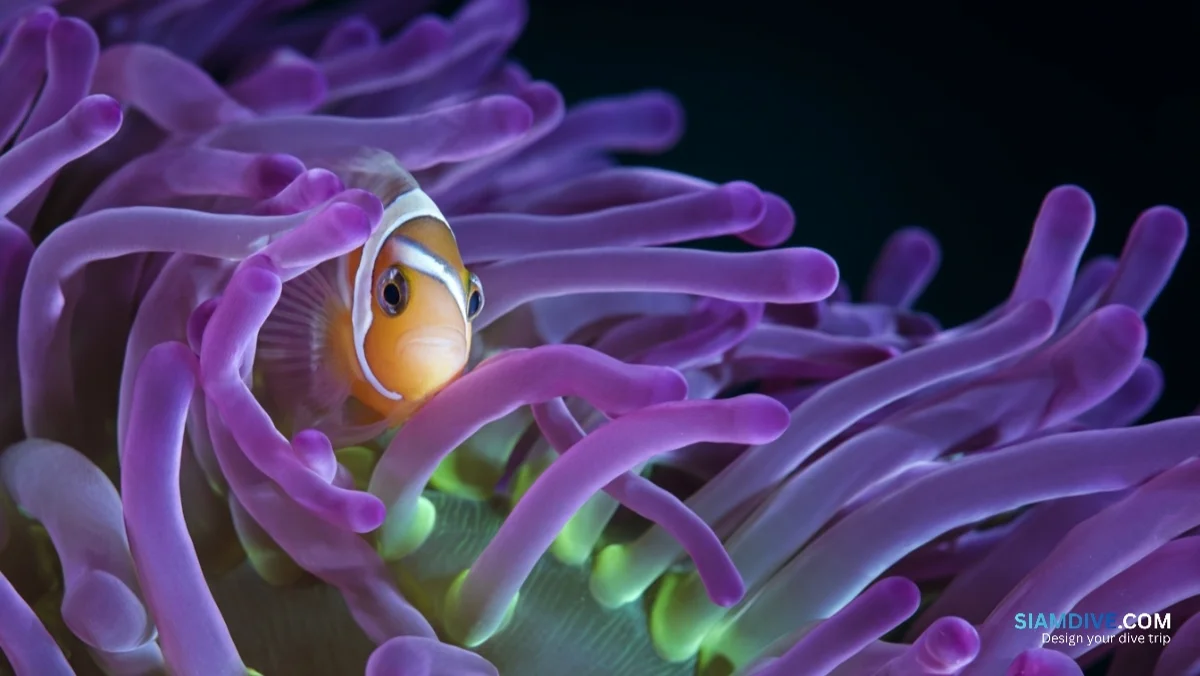
- False clownfish (A. ocellaris) — magnificent anemone, Andaman Sea reefs from Similan to Phi Phi and Koh Haa
- Clark's anemonefish (A. clarkii) — bubble-tip anemone plus at least nine other hosts, found on nearly every Thai reef
- Skunk anemonefish (A. akallopisos) — magnificent and Mertens' carpet anemones, Khao Lak to Koh Lipe
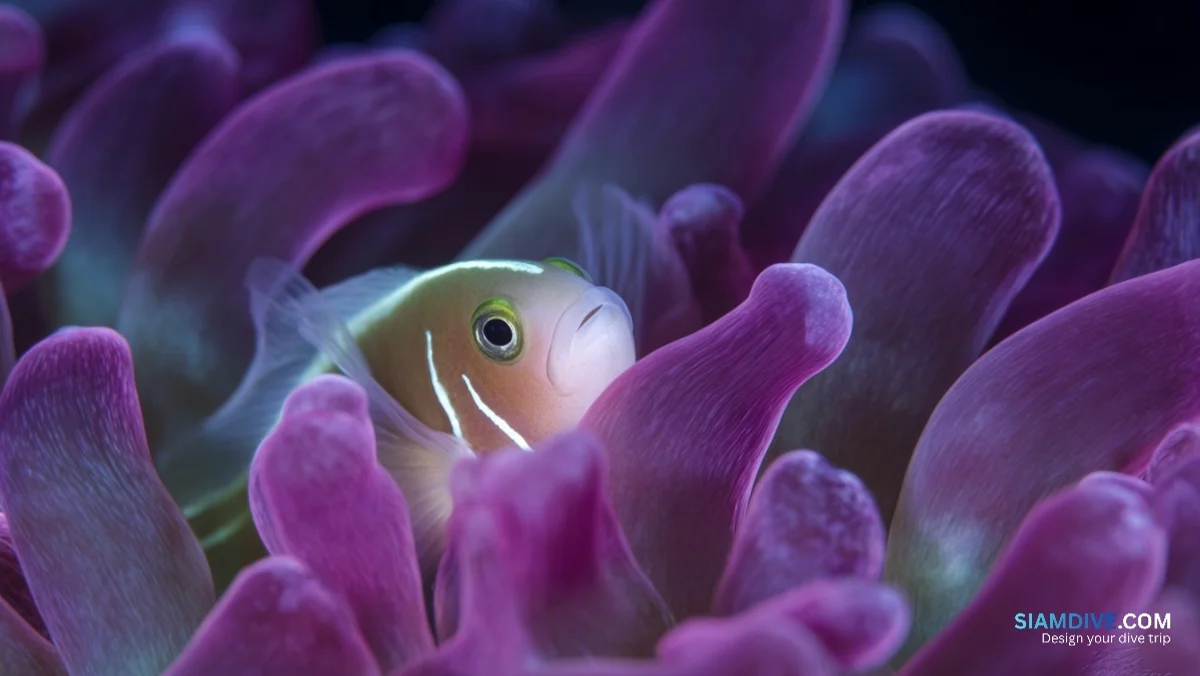
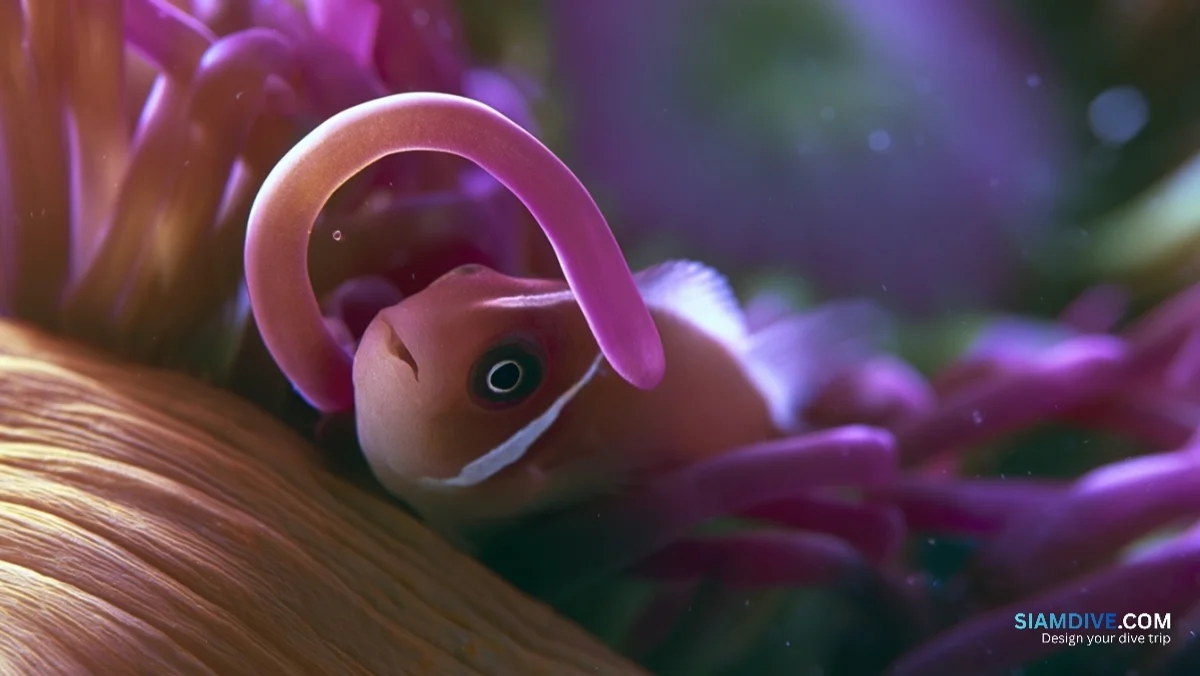
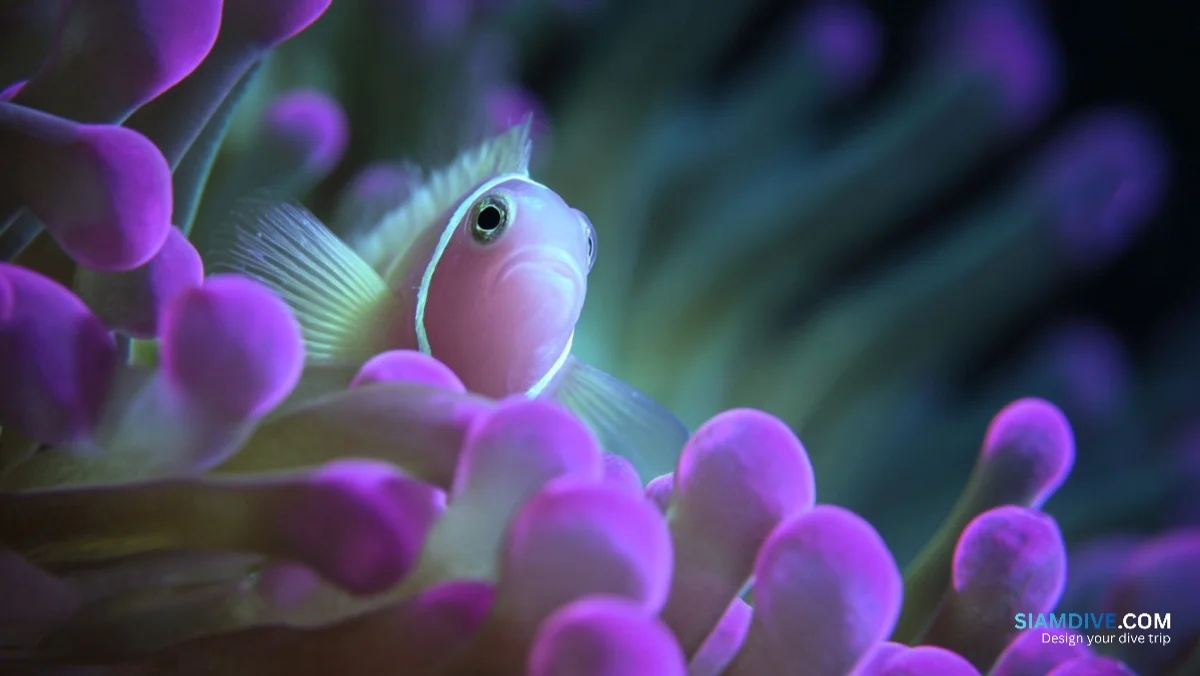
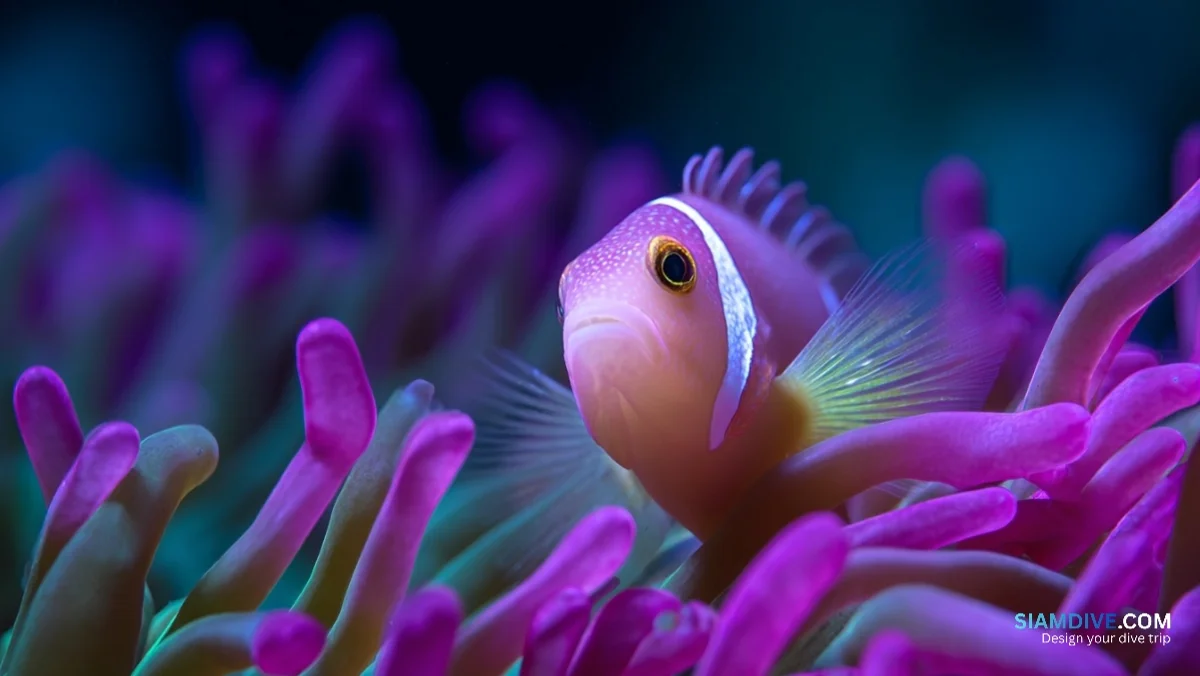
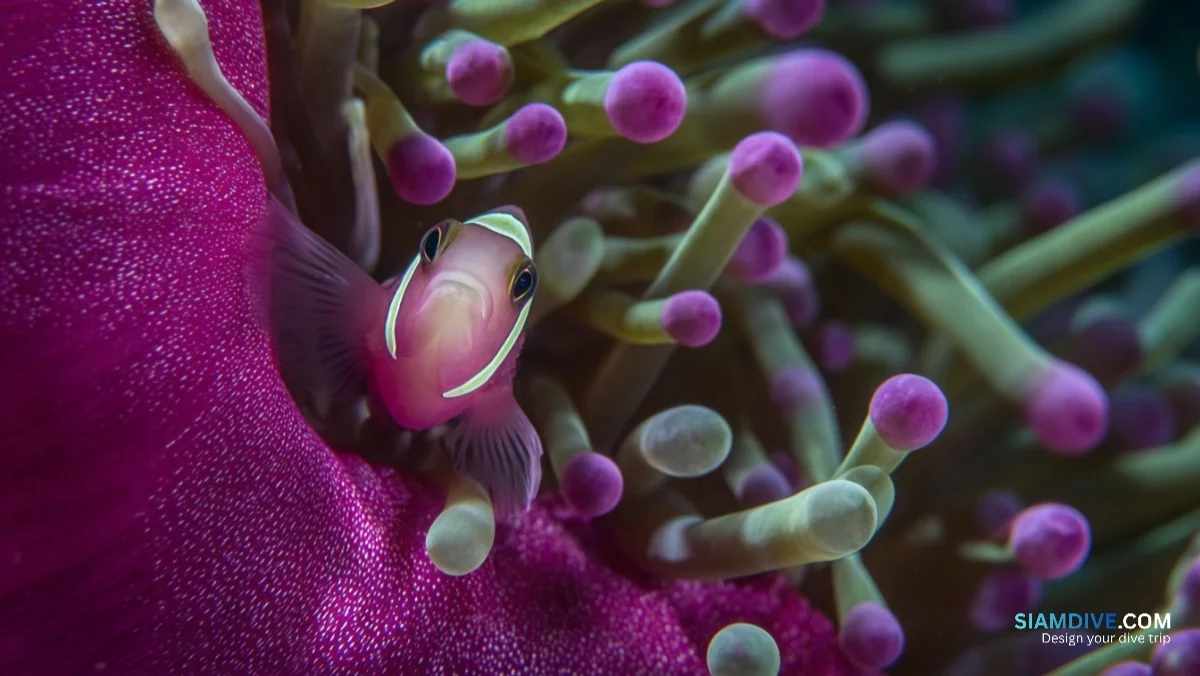
- Pink skunk clownfish (A. perideraion) — magnificent anemone, common at Gulf sites including Koh Tao
- Saddleback clownfish (A. polymnus) — carpet anemone, sandy reef flats at Koh Tao and Gulf sites
- Tomato clownfish (A. frenatus) — bubble-tip anemone, widespread but less frequently spotted than skunk species
- Spine-cheek anemonefish (Premnas biaculeatus) — bubble-tip anemone, Andaman Sea, the only clownfish with cheek spines
The standout generalist is Clark's. Documented in ten different host anemone species — more than any other clownfish worldwide — it shows up on nearly every Thai reef regardless of what anemone is anchored there.
When the Anemone Bleaches, Fertility Crashes
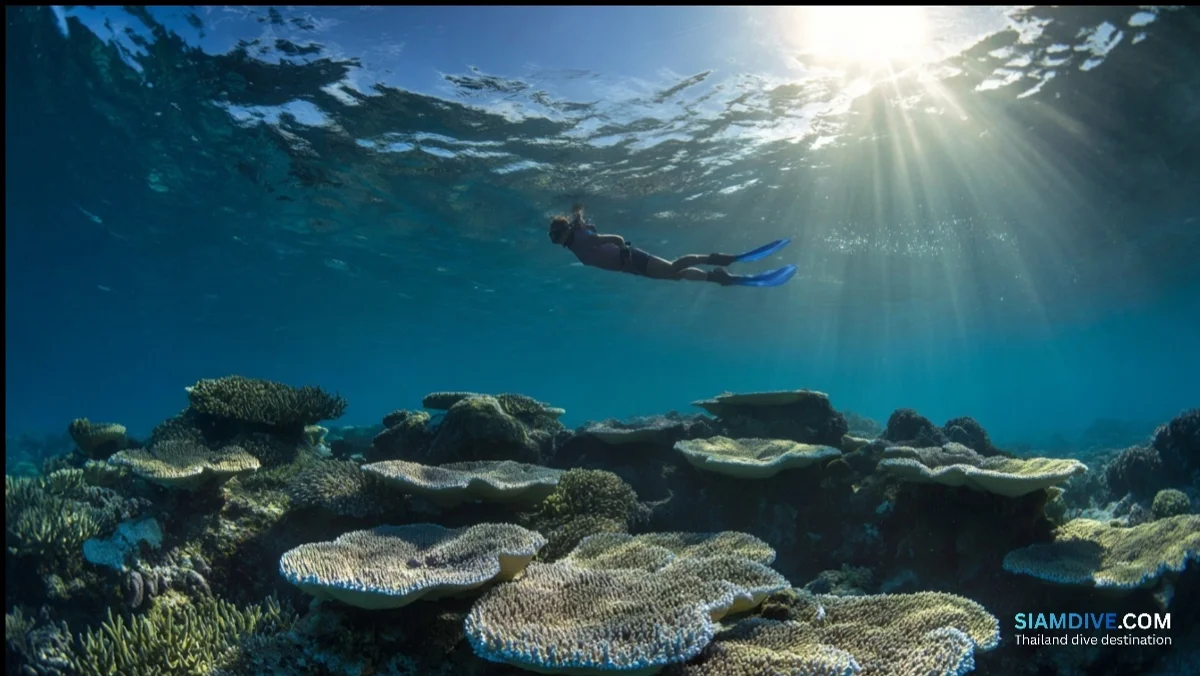
Clownfish do not live on coral. They live in anemones. But anemones harbour the same photosynthetic zooxanthellae as reef-building corals, and they bleach under the same thermal stress — expelling the algae, turning bone-white, and losing the energy source that sustains them.
A long-term CNRS study tracked clownfish in bleached versus healthy anemones and measured a 73 per cent drop in viable eggs among fish whose hosts had bleached. The clownfish did not relocate. They stayed in the weakened host, reproduced less, and waited for recovery — or did not.
Thailand's reefs felt this pressure on both coastlines. In 2024, bleaching was documented across 19 national marine parks spanning the Gulf and Andaman coasts, with some sites at eight to nine metres depth showing 80 per cent coral bleaching. A 2026 study in Coral Reefs confirmed that bleaching events alter anemone microbiota and measurably affect clownfish physiology — connecting rising sea temperatures to microbial disruption to reproductive failure in a single chain.
The link for divers is direct. The same thermal stress that damages reef-building coral at the cellular level also starves the anemones that clownfish depend on. A bleached anemone is not dead — but the fish inside it are producing far fewer offspring, and the population math turns against recovery fast.
What Changes When You Know the Mechanism
Understanding the sialic acid trick changes what a diver sees on the reef. A clownfish fanning its tail inside an anemone at a Koh Tao night dive is not performing for the camera. It is ventilating the host — pushing oxygenated water across the tentacles, which measurably boosts anemone growth. The relationship runs both directions: shelter in exchange for circulation, cleaning, and nutrient-rich waste.
Approach distance matters more than most divers think. A clownfish defending its anemone will charge a mask, nip at a regulator hose, and bite outstretched fingers — not from random aggression but from a survival calculation. The defending fish is one death away from a sex change it cannot reverse, protecting a home it cannot easily leave. Every territorial rush is a cost-benefit analysis running at fish speed.
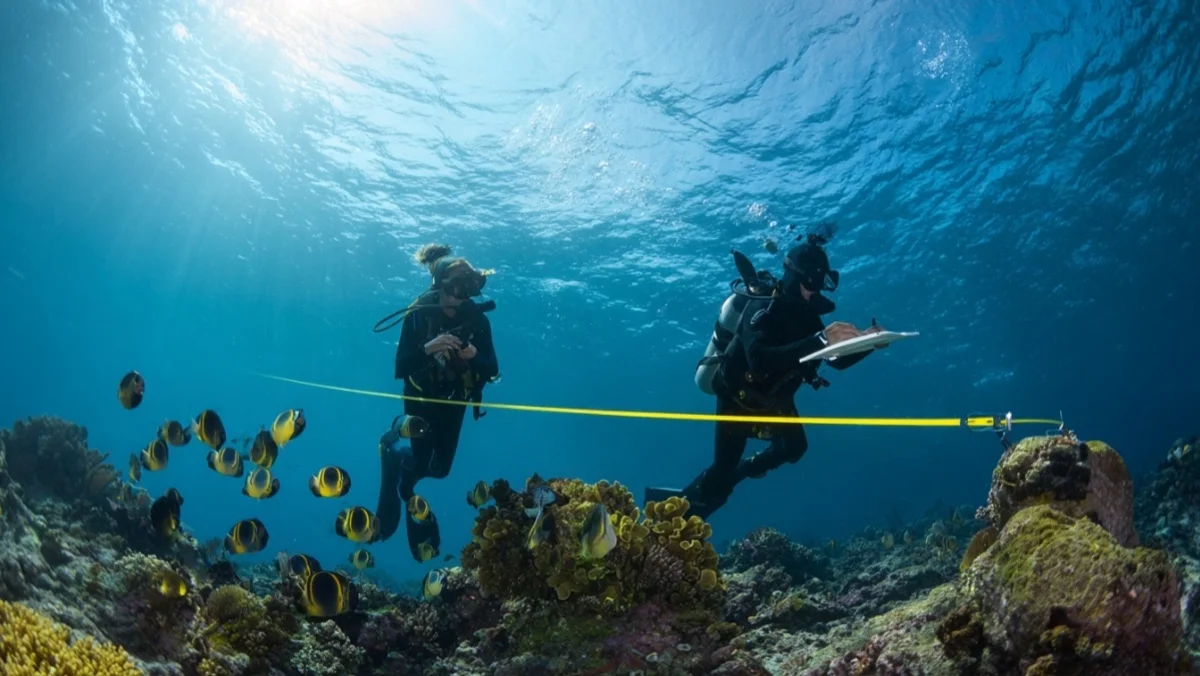
Count the residents next time. A healthy anemone in Thai waters typically holds three to six clownfish in a clear size hierarchy. If that number drops to one or two, something displaced them — a storm, a predator, or a bleaching event that made the host inhospitable. That headcount is data. Reef monitoring efforts increasingly rely on exactly these kinds of diver-reported observations to track population shifts across seasons.
Sources
- BMC Biology — Anemonefish use sialic acid metabolism to avoid giant sea anemone stinging (2025)
- Microbiome — Microbiomes of clownfish and host anemone converge before first physical contact
- CNRS — When anemones bleach, clownfish suffer: fertility impact study
- Thailand National Parks — Ocellaris clownfish species profile
- Coral Reefs — Microbiota of host sea anemones and anemonefish during bleaching events (2026)