Why a Thousand Garden Eels Disappear the Moment You Exhale
16 พฤษภาคม 2569
One careless exhale and a thousand spotted garden eels vanish into white sand at Racha Noi. Their colony runs on rules no individual eel sets.
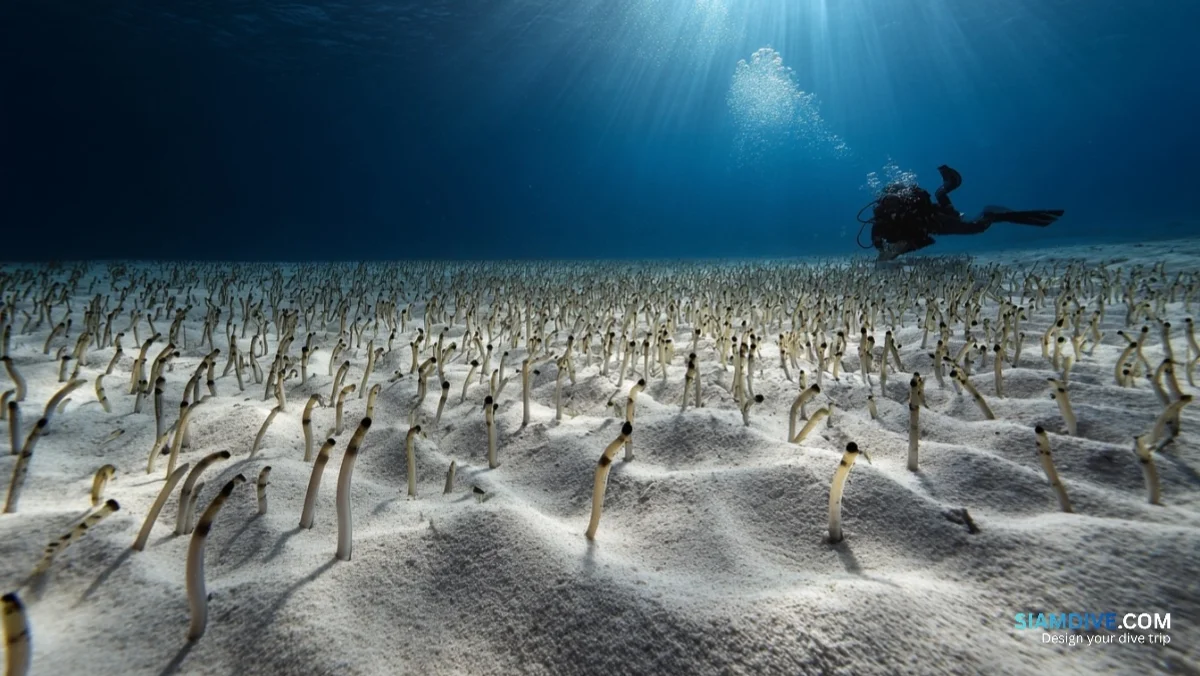
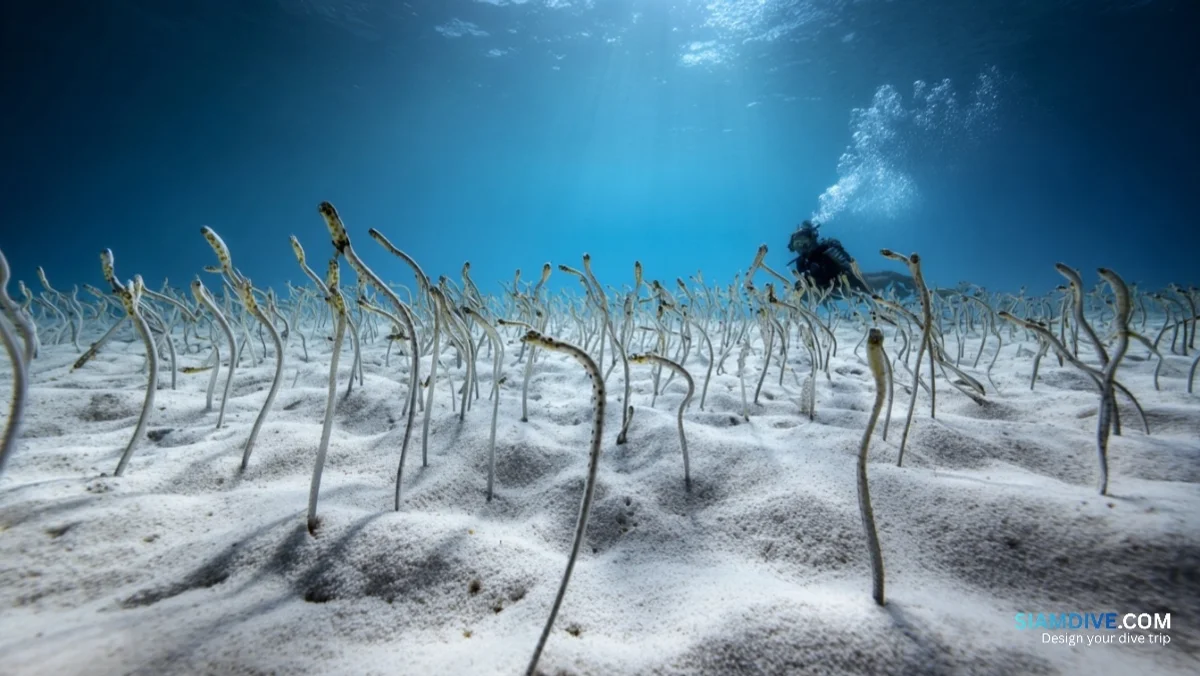
The sand at 18 metres looks empty. White, featureless, sloping away toward deeper blue. A few staghorn coral heads break the monotony, but the flat between them appears bare. Then the first head rises — a thin stalk no thicker than a pencil, dotted black on cream, swaying in a current you can barely feel. Ten more follow. Then a hundred. Within seconds the barren patch has transformed into a meadow of swaying bodies, each rooted in its own burrow, each facing the same direction, each utterly still except for the slow oscillation driven by passing water.
A colony of spotted garden eels (Heteroconger hassi) at Racha Noi's Banana Bay is one of the stranger sights in Thai diving. It is a living field that breathes, feeds, and — the moment you fin too close or exhale too hard — vanishes underground in a single coordinated pulse, leaving nothing but white sand and the unsettling feeling that the bottom was watching you the entire time.
Built for Vanishing
Every spotted garden eel carries its escape route everywhere it goes. The tail tip is hardened and pointed, shaped like a blunt drill bit, and a gland near the tail base secretes a thick mucus that binds sand grains into a reinforced composite tube. The eel digs by driving its tail downward in rapid corkscrewing motions. As it descends, the mucus coats the tunnel walls and the dorsal fin pushes loose sand out of the opening. The result is a permanent vertical burrow — typically 40–70 centimetres deep — that holds its shape even when the surrounding substrate shifts in current or surge.
When relaxed, roughly a third of the eel's 35–40 centimetre body extends above the sand into the water column. The rest stays coiled in the burrow, spring-loaded for instant retraction. When startled, the entire animal disappears tail-first in under a second, pulled down by body musculature bracing against the tube walls.
The engineering goes further than structure. The mucus-sand composite flexes without cracking and survives the vibration of passing fish. If an eel senses a direct threat — a predatory lizardfish gliding over the colony or a moray nosing along the sand — it can seal the burrow entrance with a final plug of mucus, blocking access from above. Predators that attempt to dig through rarely breach the seal before the eel retreats into the deepest section of its tube. Home, armour, escape hatch — all built from sand and slime.
- Scientific name
- Heteroconger hassi (Klausewitz & Eibl-Eibesfeldt, 1959)
- Maximum length
- ~40 cm
- Depth range
- 1–50 m, typically below 15 m on sandy slopes
- Colony size
- Up to several hundred individuals
- Burrow depth
- 40–70 cm, mucus-cemented walls
- IUCN status
- Least Concern (assessed 2016)
The Wave That Has No Leader
Watch a colony long enough and the retraction starts to look choreographed. One eel drops. Its neighbours follow a fraction of a second later. The wave radiates outward like a stone dropped in a still pond, except no eel gave a signal. There is no sentinel posted at the edge, no alarm call, no leader scanning for threats. Each animal simply tracks the height of its nearest neighbours and mirrors their movement.
The spacing between burrows — typically 20–50 centimetres — is maintained with quiet aggression. An eel that drifts too close to a neighbour during feeding gets a brief lateral threat display: jaws wide, body rigid. The intruder retreats within seconds. This territorial spacing serves a double purpose: it keeps feeding zones separate, and it ensures the information network — neighbour watching neighbour — covers the entire colony with no blind spots.
The result is emergent coordination on a scale that looks deliberate but is not. A diver approaching from the south triggers the closest eels first. The wave propagates north through the colony faster than a diver can swim, and the effect is disorienting — the sand appears to swallow its own inhabitants before you have done anything you can identify as wrong.
Research on garden eel behaviour has confirmed that when disturbance levels rise, individual eels reduce feeding height — keeping less of their body above the sand — and lower their feeding rate, trading calories for safety in real time. The colony never votes on this. Each eel runs the same simple algorithm: if neighbours are low, go low. If neighbours are gone, disappear.
A Factory That Runs on Current
Garden eels do not chase their food. They wait for it. Each eel extends into the water column, mouth open, body facing the prevailing current, and picks off zooplankton one piece at a time as it drifts past. The efficiency of this stationary feeding depends almost entirely on two variables: how much plankton is in the water, and how fast that water moves.
Three-dimensional tracking studies have found that feeding rates increase linearly with prey density — more plankton passing means more eating, with no saturation point at natural densities. The relationship with current speed is not linear. At moderate flows around 0.1–0.2 m/s, feeding peaks. Beyond roughly 0.25 m/s, rates drop sharply. Rather than fighting the stronger current, the eels reduce body exposure and drag — pulling lower into the burrow, presenting less surface area to the flow. At high current the colony idles: heads barely visible, mouths closed, hundreds of eels choosing not to eat at the same time.
This flow-dependent shutdown explains a pattern divers notice worldwide. Garden eel colonies occupy sheltered sandy slopes with gentle, consistent current — never high-energy channels or surge zones. Banana Bay at Racha Noi, tucked into the island's lee side with a steady but mild Andaman drift, fits the profile exactly.
Two Sand Flats Worth the Descent
Racha Noi sits roughly 25 kilometres south of Phuket, beyond the closer and busier Racha Yai — far enough from shore for the visibility to open up and the reef traffic to thin out. On a standard day, 25 metres of water clarity is the norm. During peak dry season in February and March, visibility past 35 metres is not unusual. The island is uninhabited, ringed by granite boulders above and below the waterline, and its sandy bays provide the kind of calm, current-swept flats that garden eels colonise.
Two sites are known for reliable colonies:
- Banana Bay (15–25 m) — A gently sloping white-sand bottom fringed with staghorn coral. The main garden eel colony occupies a wide patch of open sand between 15 and 22 metres, often numbering several hundred individuals visible from a single position. Kuhl's stingrays lie half-buried on the same flat, and bluespotted ribbontail rays cruise the fringes. The bay faces west, sheltered during the northeast monsoon season (November–April), making it the default Racha Noi stop on most Phuket day trips.
- Camera Bay (5–8 m) — Shallower sand with a smaller colony, but the reduced depth means significantly longer bottom time and easier natural light for photographers. Scissortail gobies and juvenile reef fish share the sand. Camera Bay sits on the island's east side, making it a reliable option during the green season (May–October) when the western bays take monsoon swell.
Both sites are accessible as day trips from Phuket's Chalong Pier — roughly 90 minutes by boat. A three-dive day trip typically runs 3,500–5,000 THB per person including equipment, depending on operator and season. Garden eel dives are standard itinerary stops at both bays.
For more on species behaviour at Thai sites, see why divers fin past three seahorse species at Koh Tao, or read about the groupers that never leave Southwest Pinnacle — another case of site-faithful animals running on rules divers rarely notice.
Getting Close Without Losing Them
Photographing garden eels is an exercise in anti-diving. Everything a trained diver does by reflex — exhale steadily, kick to maintain position, approach a subject head-on — works against the shot. The colony reacts to pressure waves before it responds to visual stimuli, so a single careless fin kick at 10 metres can flatten a colony sitting at 18.
- Descend early, settle late — Drop to the sand well before the colony's edge and lie flat on an empty patch. Wait 3–5 minutes without moving. The closest eels will begin to re-emerge, starting with the bravest individuals near the colony centre.
- Breathe shallow, breathe slow — Exhale bubbles create the largest single source of pressure disturbance. Rebreather divers close the distance noticeably more than open-circuit divers, but even on a standard regulator, slowing breath rate and reducing exhalation volume makes a measurable difference.
- Crawl, do not fin — Moving along the sand on elbows and belly produces less water displacement than finning above. Straight, predictable lines work far better than course changes — garden eels tolerate steady slow motion but panic at lateral movement.
- Wide-angle or fisheye lens — A fisheye positioned close to the sand captures the colony's scale while keeping individual eels sharp in the foreground. Macro is tempting for portraits, but the mathematics are against you: by the time you are close enough for a frame-filling shot, the subject is underground.
- Extend the camera, not your body — Holding the housing at arm's length while keeping your torso flat gains roughly half a metre of effective proximity without the pressure wave an advancing chest would create. Review images between approaches, not during one.
The patience game applies to other shy Thai subjects too — see the 2-metre fish inside Sail Rock's chimney and how individual mantas are tracked at Koh Bon.
When the Sand Is Worth the Trip
Racha Noi is diveable year-round, though conditions rotate predictably with the monsoon. November through April brings the northeast monsoon, sheltering the western bays — including Banana Bay — and pushing visibility past 30 metres on most days. Water temperature holds at 28–29 °C through the dry season. May through October flips the equation: the southwest monsoon sends swell into the western bays, and dive boats shift to the eastern side. Camera Bay becomes the default. Green-season visibility still averages 20–25 metres but can dip on heavy-swell days.
Early 2026 TripAdvisor reviews from Racha Noi day trips describe visibility holding at 25–30 metres through January and February, with water temperatures steady at 28–29 °C — tracking the recent dry-season average for the Phuket-area Andaman coast.
The spotted garden eel will never headline a dive briefing. It is not rare — FishBase lists its IUCN status as Least Concern. It is not large — maximum length barely reaches 40 centimetres. It does not charge the camera, breach the surface, or do anything that sells liveaboard brochures. But a colony of several hundred, swaying in unison across a white sand flat, executing a synchronised vanishing act that no single individual controls, is a dive encounter that recalibrates what you expect from a Phuket day trip. The trick — as with most things underwater — is lying still long enough to let the sand forget you are there.
For another look at Thailand's underrated marine residents: why Koh Tao keeps giant clams in cages for a year.