How Cuttlefish Rewrite Their Skin in 50 Milliseconds
28 เมษายน 2569
A pharaoh cuttlefish fires 200 chromatophores per square millimetre in under a second. Most divers on Thai reefs swim right past the fastest light show on the reef.
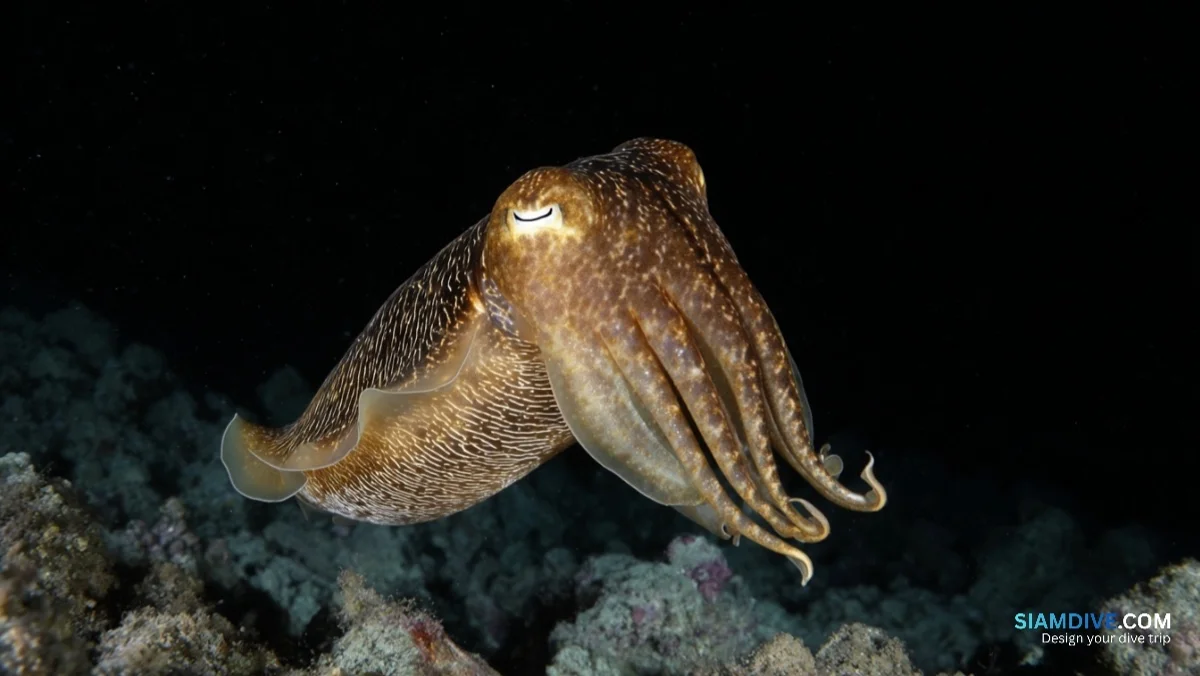
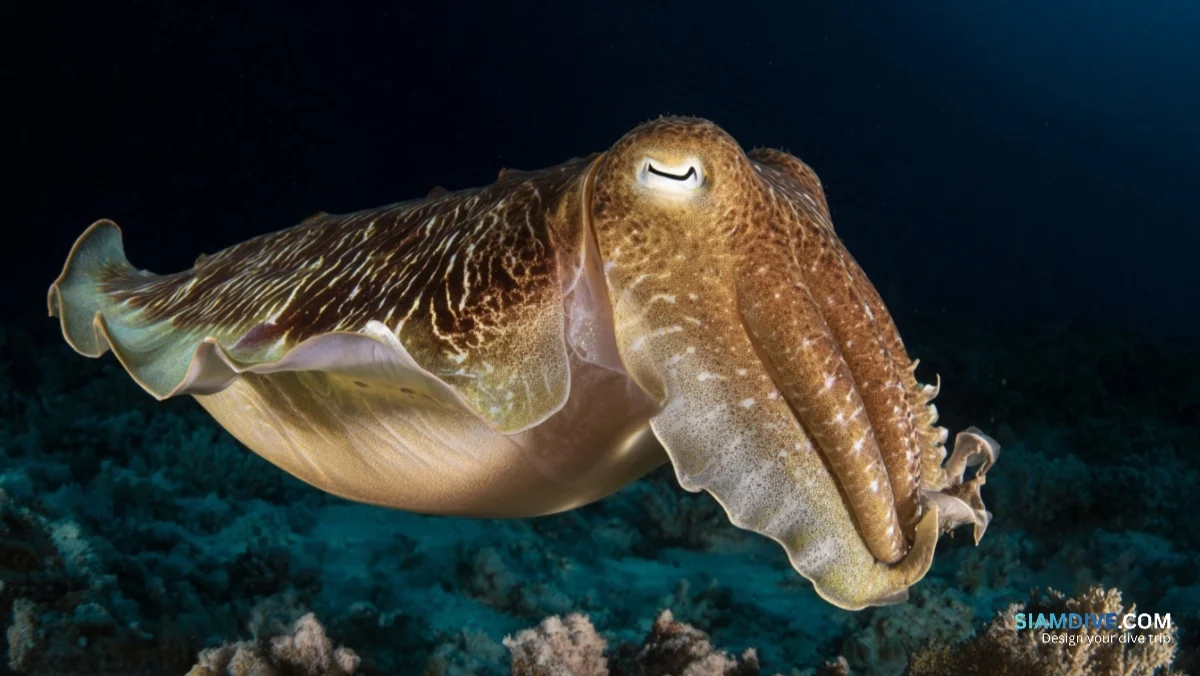
Swing a dive torch across rubble at Twins pinnacle after dark and something moves — not away, but through a spectrum. A pharaoh cuttlefish hovering at arm’s length shifts from mottled brown to pale cream to pulsing electric bars in the time it takes your eyes to refocus. The entire performance runs on roughly 200 chromatophores packed into every square millimetre of skin, each one a muscle-driven sac of pigment that can expand fifteen times its resting size. No LED, no bioluminescence, no chemistry. Just muscle, nerve, and physics.
This is how cuttlefish talk, hunt, argue, and vanish — all at once, all at speeds a camera strobe cannot keep up with.
A Skin Built from Millions of Tiny Engines
A cuttlefish’s mantle is less a body wall and more a high-resolution display. Beneath the epidermis sit three stacked layers of specialised cells:
- Chromatophores — elastic sacs of yellow, red, or dark-brown pigment, each ringed by 15–25 radial muscles wired directly to the brain
- Iridophores — thin-film reflectors that bounce blue and green wavelengths, creating metallic sheen without any pigment at all
- Leucophores — broadband scatterers that produce a base layer of diffuse white, the blank canvas underneath everything else
When a motor neuron fires, the muscles pull the chromatophore sac flat — stretching it from a pinpoint to a visible disc in under 50 milliseconds. Release the signal and the elastic sac snaps shut. Multiply that by the roughly 200 chromatophores per square millimetre documented by Stanford’s Gilly Lab, and you get a screen resolution that makes a smartphone look crude.
The critical difference between this system and a chameleon’s colour shift: cuttlefish chromatophores run on direct muscular control, not hormones. There is no waiting for chemicals to diffuse through blood. The brain sends a signal, a muscle contracts, a pixel changes. The whole loop finishes before you can blink.
Trial, Error, and Sixty Frames per Second
For decades, biologists assumed cuttlefish matched their surroundings in a single calculated step — brain sees background, brain computes pattern, skin executes. A 2023 study in Nature overturned that model. Researchers at the Max Planck Institute for Brain Research tracked tens of thousands of individual chromatophores on live Sepia officinalis at 60 frames per second and found something unexpected: the animals run a search.
Their skin patterns shift through multiple intermediate states — accelerating, decelerating, reversing — before settling on a match. The process looks less like a computer rendering a file and more like a painter mixing colours on a palette until the shade feels right. Each search meanders through skin-pattern space on a slightly different path, which means the same cuttlefish never camouflages the same way twice.
The same imaging system resolved individual chromatophore cells over weeks, revealing that a single cell can join different display patterns depending on context. A chromatophore that forms part of a disruptive camouflage patch at noon might be recruited into a completely different mating signal at dusk.
The Hermit-Crab Trick and Other Hunting Lies
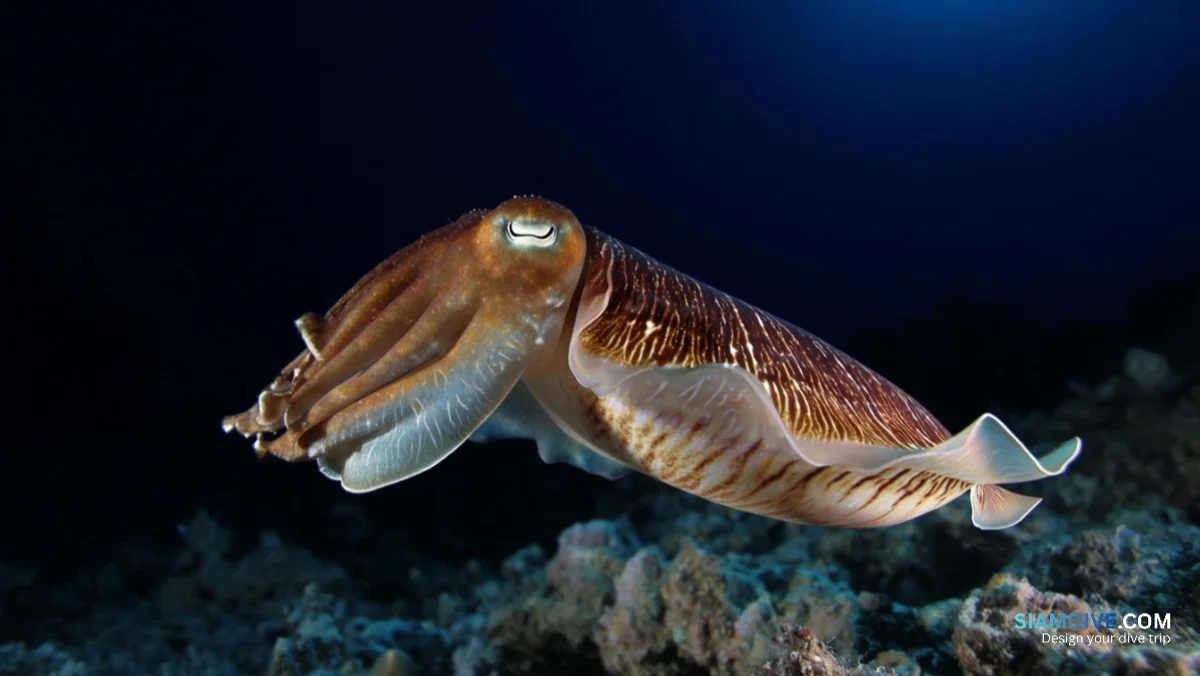
Pharaoh cuttlefish hunt primarily at night. They drift above rubble and sand, arms tucked, two feeding tentacles coiled beneath the mantle like loaded springs. When prey — a shrimp, a goby, a small crab — strays within striking distance, those tentacles fire forward, grab, and retract in a fraction of a second. The alternative is blunter: the cuttlefish lunges and wraps all eight arms around the target like a closing fist.
The strangest tactic was documented in a 2017 paper in the Journal of Ethology. Researchers filmed pharaoh cuttlefish raising and wrinkling their first arm pair while flapping the second and third pairs at the tips — a motion that closely mimics the leg movement of a hermit crab. The working hypothesis: prey fish that feed on hermit crabs approach to investigate, and the cuttlefish strikes before the illusion breaks.
The deception runs deeper than movement. While performing the hermit-crab walk, the cuttlefish simultaneously textures its skin to resemble a mottled shell — blending shape, motion, and colour into a single coordinated lie that plays out across millions of chromatophores at once.
Zebra Stripes Settle the Argument
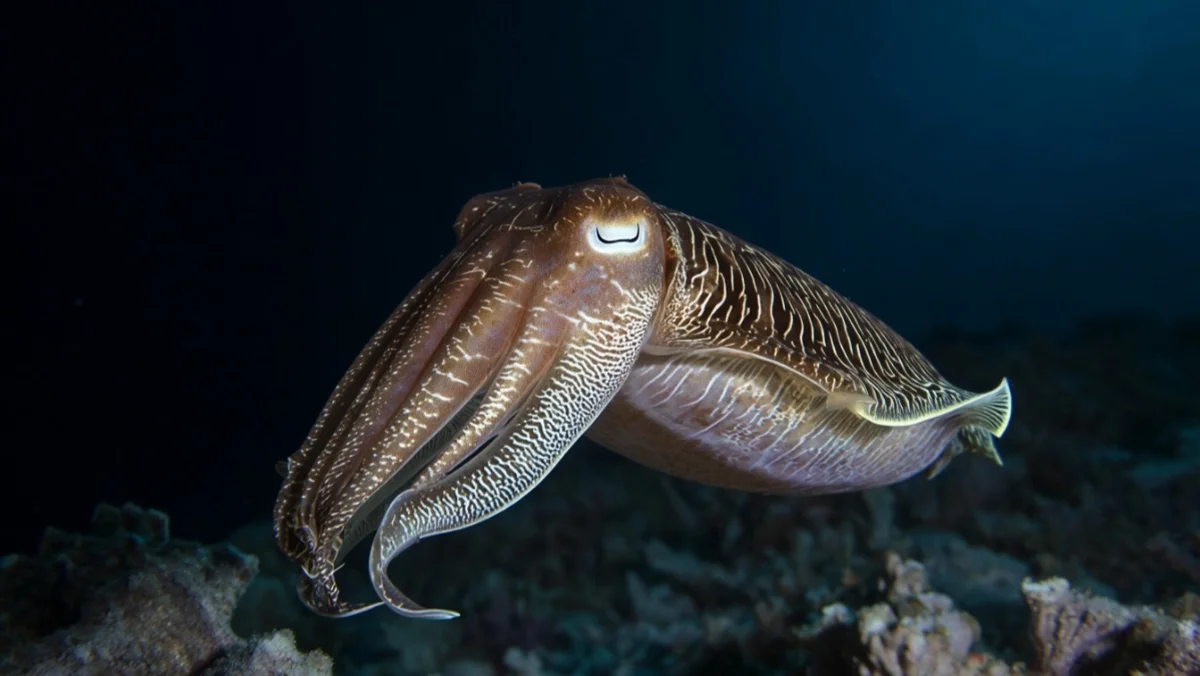
Mating season for pharaoh cuttlefish in the Andaman Sea peaks between February and April. Males arrive first, claim patches of reef or rubble, and start advertising. The display is unmistakable: the animal’s normal mottled camouflage dissolves into bold, high-contrast zebra stripes running the full length of the mantle.
Those stripes serve two audiences at once. Rival males read them as a territorial claim. Females — who keep their mottled pattern throughout courtship — read them as an invitation. When two males meet over the same patch of bottom, they circle each other in escalating chromatic threats. Colour pulses sweep across mantles. Arms spread wide. Most disputes end when one male dims his pattern and retreats. Physical contact is rare.
The winning male approaches the female and strokes her gently between the eyes with a modified arm — a signal that triggers his switch back to mottled pattern, indicating readiness to mate. Sperm packets are placed in a pouch beneath the female’s mantle, and she attaches fertilised eggs to the underside of coral ledges or inside crevices, often in grape-like clusters. Pharaoh cuttlefish are semelparous: they breed once and die. A female that lays eggs in March on a Similan boulder will not see the hatchlings emerge roughly 40–50 days later.
- Maximum mantle length
- 42 cm (males typically smaller in Thai waters)
- Maximum recorded weight
- 5 kg
- Sexual maturity
- 4–5 months after hatching
- Egg incubation
- ~40–50 days at 25–28 °C
- Lifespan
- 1–2 years (one breeding cycle, then death)
Where to Watch the Show in Thailand
Two cuttlefish species dominate Thai dive sites. The pharaoh cuttlefish (Sepia pharaonis) is the larger of the pair, more common on the Andaman side, and the species most likely to stage a full mating display within torchlight range. The broadclub cuttlefish (Sepia latimanus) favours shallow coral gardens in the Gulf and tends to produce more sustained colour-ripple feeding patterns.
Gulf of Thailand — year-round
Koh Tao’s night dives produce the most consistent sightings. Cuttlefish patrol the sand-and-rubble margins of nearly every site, but a few stand out:
- Twins — pharaoh cuttlefish along the sand channel between the two pinnacles, especially after dark
- Japanese Gardens — broadclub cuttlefish feeding above hard coral at 8–14 metres
- Pottery Pinnacle — the rubble slope at 18 metres where pairs stage mating displays January to March
- Aow Leuk — shallow night-dive favourite; cuttlefish hunting over seagrass and sand at 6–10 metres
Andaman Sea — November to April
- Similan Islands (sites 5–9) — pharaoh cuttlefish on sandy patches between granite boulders, mating pairs common February–April
- Richelieu Rock — cuttlefish along the deeper shelves at 20–28 metres, sometimes sharing the rubble with seahorses and harlequin shrimp
- Koh Bon — the same rubble fields where marine life congregates also harbour cuttlefish at dusk
For the best chance of a full colour display, go slow. Cuttlefish tolerate divers who approach from below and hold still; they bolt from overhead movement and fast fin kicks. A red-filtered torch helps — nocturnal marine creatures respond less to red wavelengths, so the animal often continues its display rather than switching to flight camouflage.
What a Solar Cell and a Cuttlefish Have in Common
In March 2025, materials scientist Leila Deravi at Northeastern University published research showing that cephalopod chromatophores do more than display colour — they harvest light. Her lab found that the pigment granules inside chromatophore sacs absorb photons and convert them into chemical energy, functioning as biological solar cells. The chromatophores sense the ambient light field and use that energy to help power the camouflage response itself.
The finding reshapes how biologists understand cuttlefish skin. Rather than a passive display driven entirely by the brain, the skin is partly autonomous — sensing its own light environment and feeding information back into the system. For engineers working on adaptive materials and soft robotics, the discovery opens a path toward self-powered, light-sensing surfaces that need no external cameras or wiring.
For divers, the implication is simpler. When a cuttlefish hovers above a reef and matches the tones of recovering coral in real time, it is not merely following orders from its brain. Its skin is reading the light and co-authoring the pattern. The show is literally powered by the light you shine on it.
How to Stay for the Whole Show
A cuttlefish that goes pale white and jets backward is stressed. One that holds ground but flashes rapid dark–light pulses is warning you off. A calm animal hovers with arms slightly spread, chromatophores cycling slowly through ambient-matching tones. That last state is the one worth waiting for — and the one that produces the strongest photographs.
Keep your torch beam off the animal’s eyes. Approach from a 45-degree angle below. Solid buoyancy control matters here because a single fin kick stirring sand will trigger flight mode. If a mating pair is present, stay at least two metres back. The male may flash aggressive stripe patterns at you — enjoy the display, but do not push closer. Mating windows are short, and every reproductive event counts for a species that breeds once and dies.
Night dives deliver the richest behaviour, but early-morning boat dives — when cuttlefish are still finishing their nocturnal hunts — can catch the transition from hunting camouflage to daytime resting pattern. That shift, a full-body colour reset rolling from head to tail, is one of the most photogenic moments in Thai waters.
Sources
- Nature — The dynamics of pattern matching in camouflaging cuttlefish (2023)
- PMC / NCBI — Decomposing the control and development of skin patterning in cuttlefish
- Animal Diversity Web — Sepia pharaonis species profile
- Journal of Ethology — Unique arm-flapping behavior of pharaoh cuttlefish (2017)
- Nature Scitable — Cephalopod camouflage: cells and organs of the skin