The Net Keeps Fishing After the Fisher Leaves
13 พฤษภาคม 2569
Abandoned fishing nets kill 300 marine animals a year in Thai waters — and they never stop catching. Divers are pulling them off the reefs.
A Net That Never Stops Working
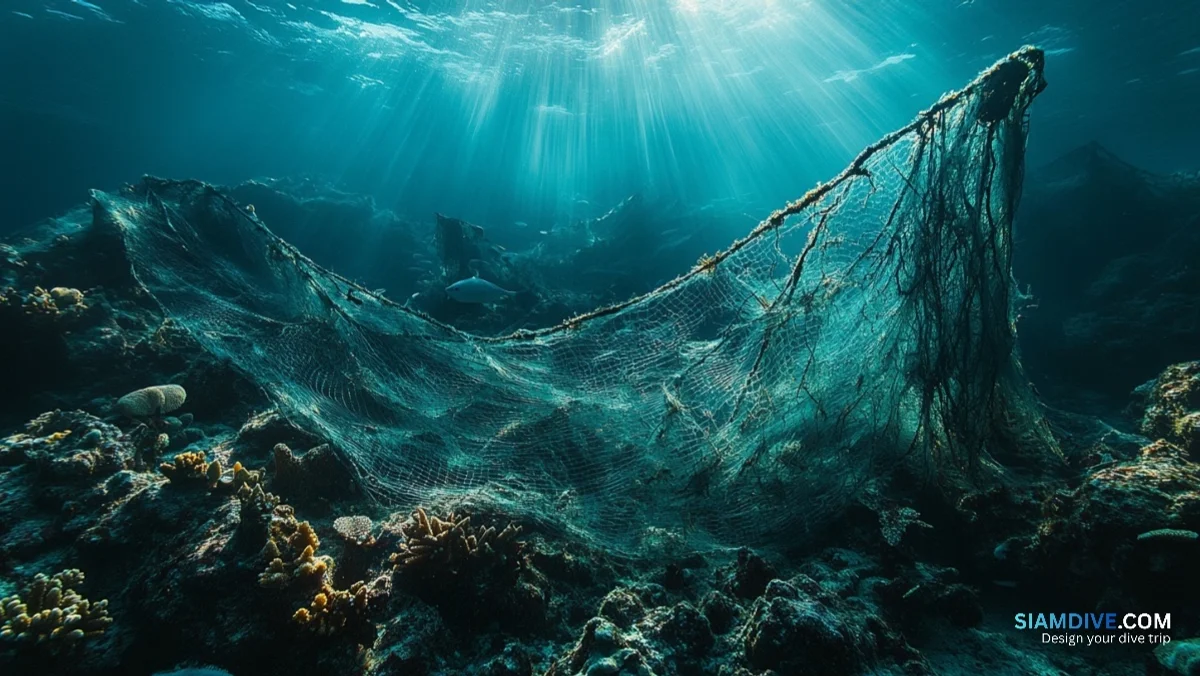
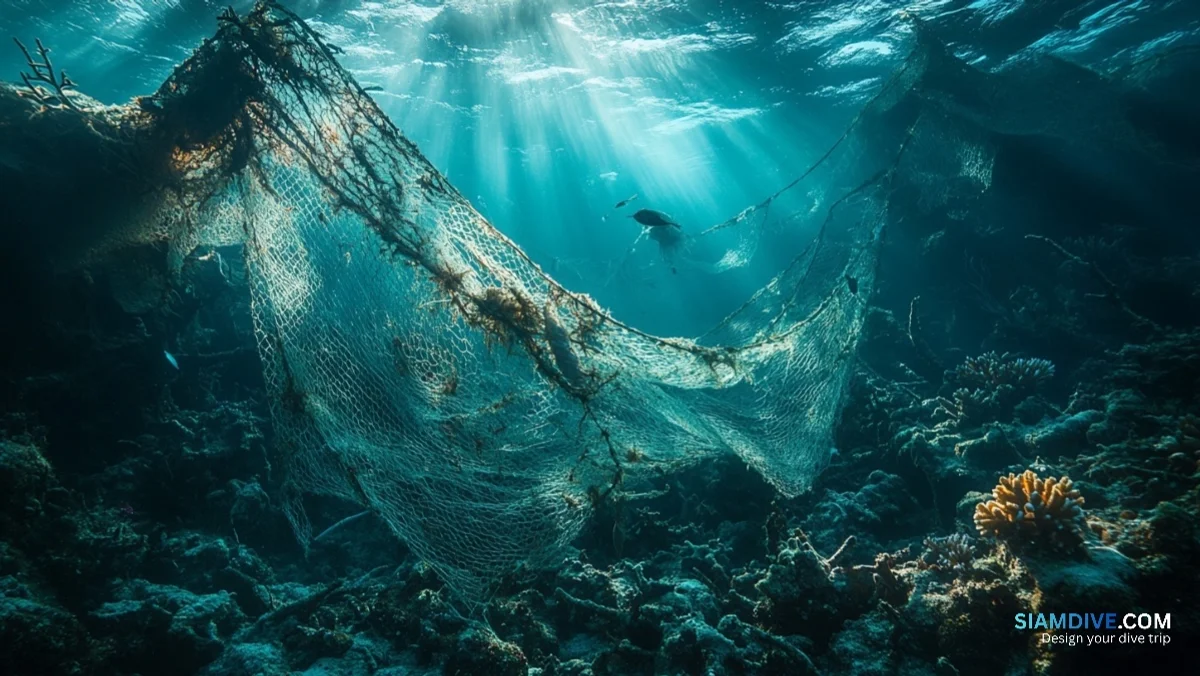
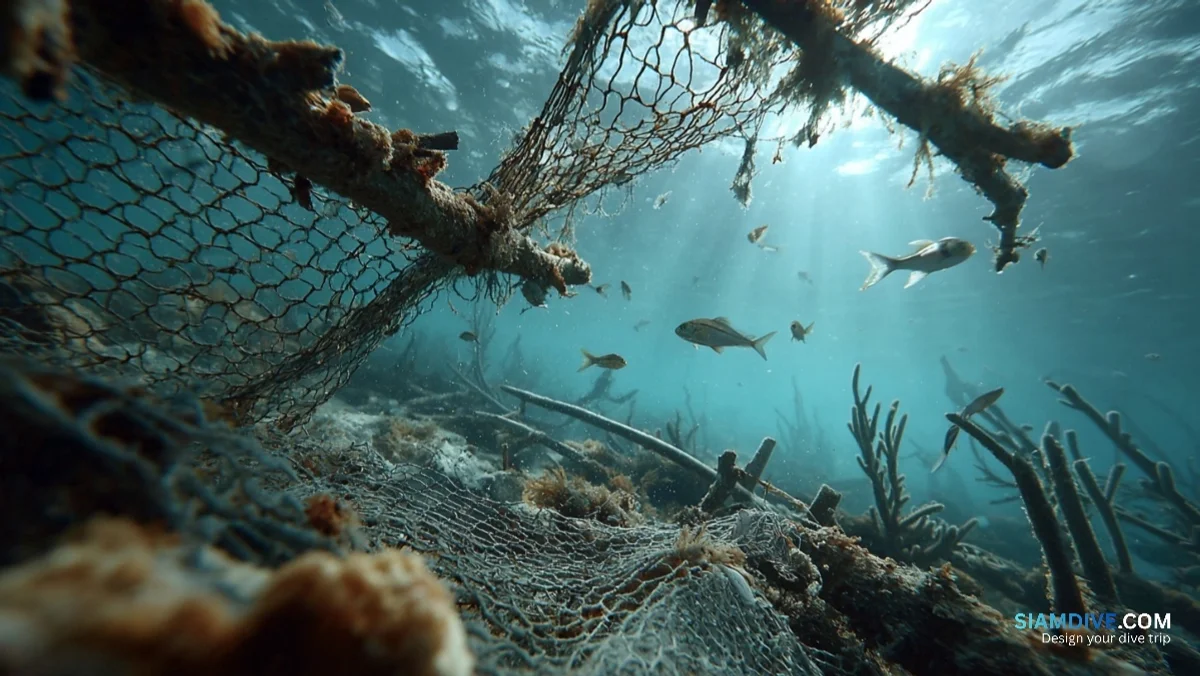
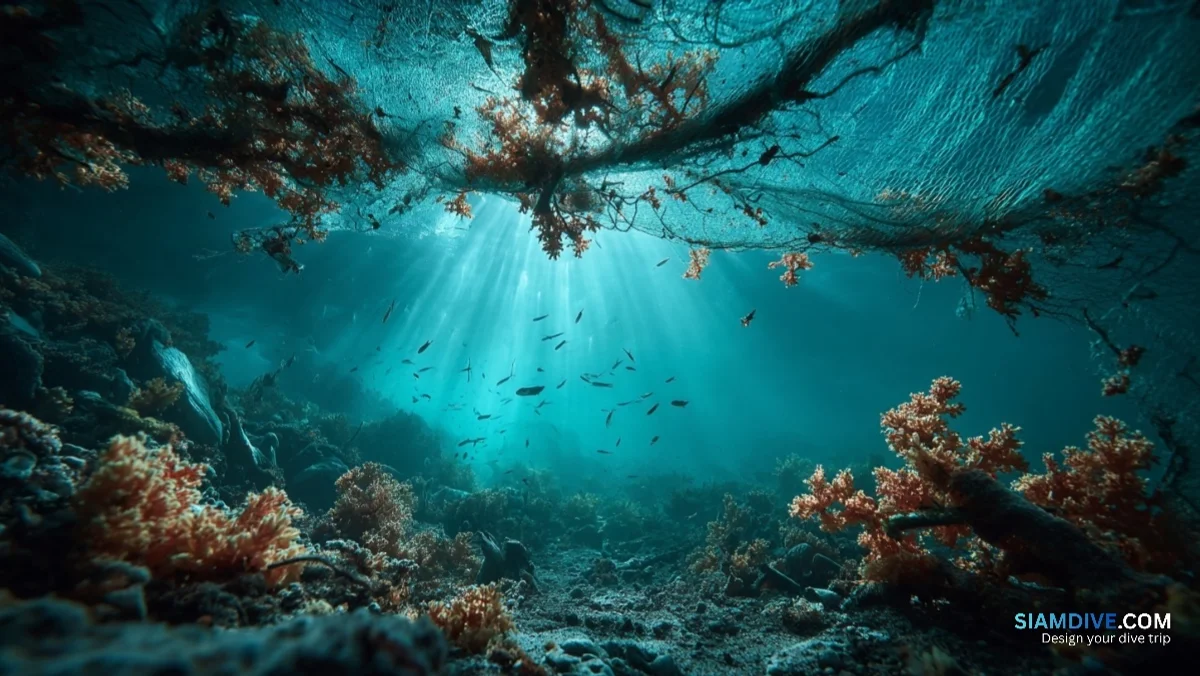
Somewhere off Koh Tao, a monofilament gillnet drifts across a pinnacle. The fisher who set it is long gone — the net snagged on rock, the line snapped, and the gear was abandoned. That was months ago. The net is still catching. A barracuda hangs motionless in the mesh, dead. Behind it, a porcupinefish. Below, branching coral has been smothered flat under a curtain of nylon that will take decades to decompose.
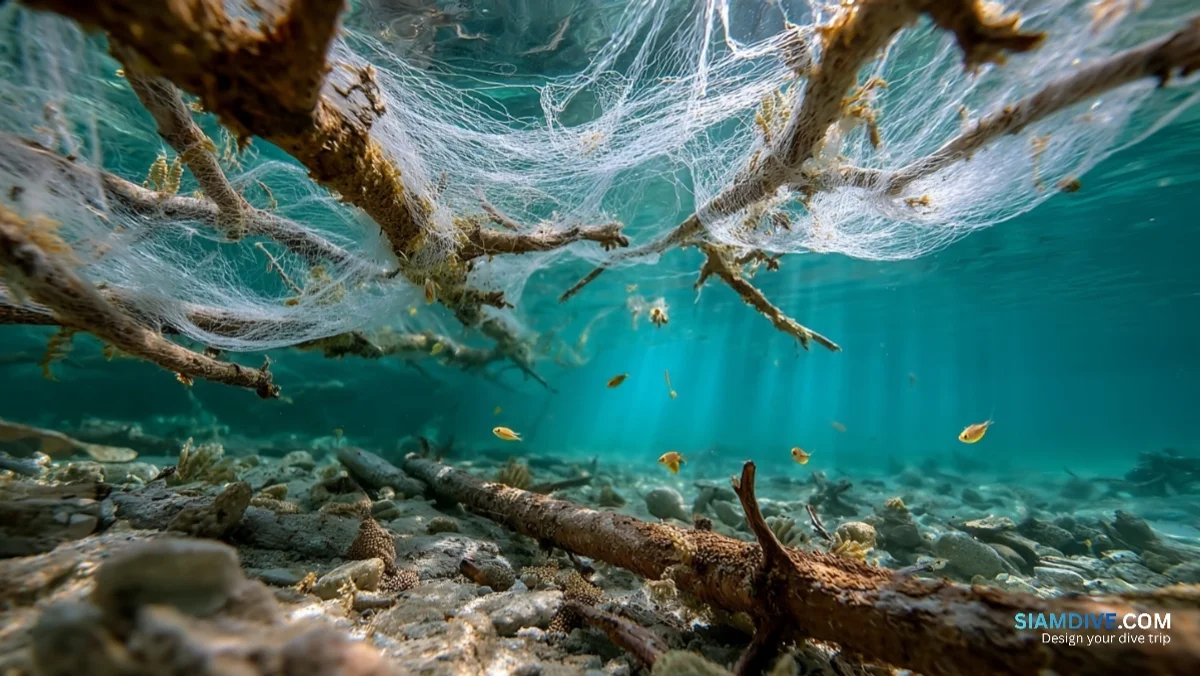
This is ghost fishing — the term for what happens when abandoned, lost, or discarded fishing gear continues to trap and kill marine life with no one on the other end of the line. In Thai waters alone, ghost gear seriously harms or kills up to 300 marine animals every year, according to the Department of Marine and Coastal Resources. Globally, UNEP and FAO estimate that 640,000 tonnes of fishing gear enter the ocean annually. None of it has an off switch.
What a Citizen-Science Survey Found
In January 2025, Mongabay reported on a citizen-science programme that sent trained volunteer divers to survey ghost gear across Thai dive sites. The results were sobering: 606 pieces of abandoned equipment were documented, amounting to more than 1,200 square metres of netting and hundreds of metres of rope and fishing line.
The gear was not empty. A wide range of species — from reef-building hard corals to crabs, marine snails, schooling fish, and apex predators — had been caught. Barracuda, groupers, batfish, and porcupinefish were among the dead. So were branching corals that had taken decades to grow and large predatory sea snails whose ecological role is to keep algae in check.
The study revealed a mechanism that makes ghost nets uniquely destructive: the entanglement cascade. A trapped animal attracts scavengers. The scavengers become entangled. They in turn attract more predators, which are also caught. The net creates a self-perpetuating cycle of death that continues until the mesh degrades — which, for modern synthetic netting, can take 300 to 600 years.
The Numbers Behind the Haunting
- Global gear loss (annual): ~640,000 tonnes — UNEP/FAO estimate
- Percentage of all fishing gear lost: nearly 2% annually
- Gillnets lost per year: enough to cover 2,963 km²
- Pots and traps lost: >25 million per year
- Share of marine plastic pollution: ~10% globally, up to 50% in some regions
- Species affected: 66% of marine mammals, 50% of seabirds, 100% of sea turtle species
Ghost gear is not a fringe problem. It is the single largest category of harmful marine debris by weight, and it is the only form of plastic pollution that is specifically designed to catch and hold living things.
Why Thai Reefs Pay a Higher Price
Thailand's combination of intensive coastal fisheries, dense coral reef systems, and strong currents creates ideal conditions for ghost-gear accumulation. Nets lost or discarded in open water drift onto pinnacles, reef walls, and rocky outcrops — the same structures that make Thai dive sites world-famous.
A 2025 study published in Frontiers in Marine Science examined plastic pollution from lost fishing gear on underwater pinnacles in the Gulf of Thailand. The findings confirmed what divers had reported for years: pinnacles act as ghost-gear magnets, concentrating debris on the very formations that support the highest biodiversity.
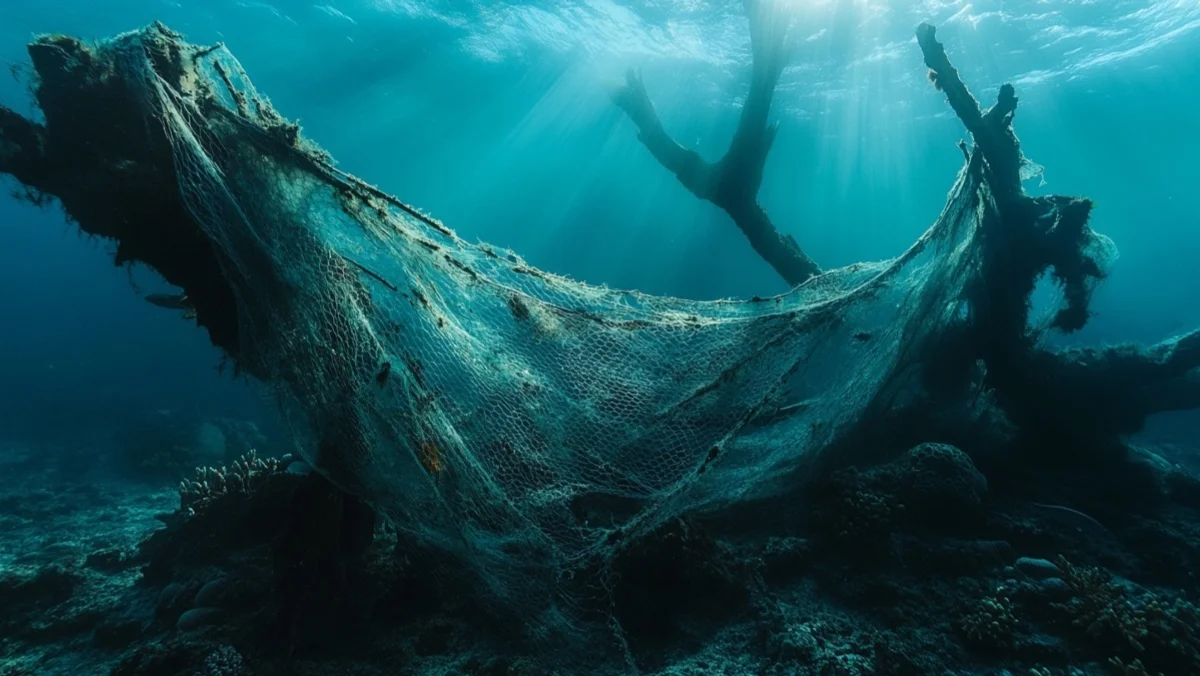
The damage is not limited to entanglement. Nets draped across coral colonies block sunlight, restrict water flow, and create abrasion injuries that open the coral to disease. On a reef already stressed by blast fishing or rising water temperatures, ghost gear can be the factor that tips a colony from stressed to dead.
What Thai Divers Are Doing About It
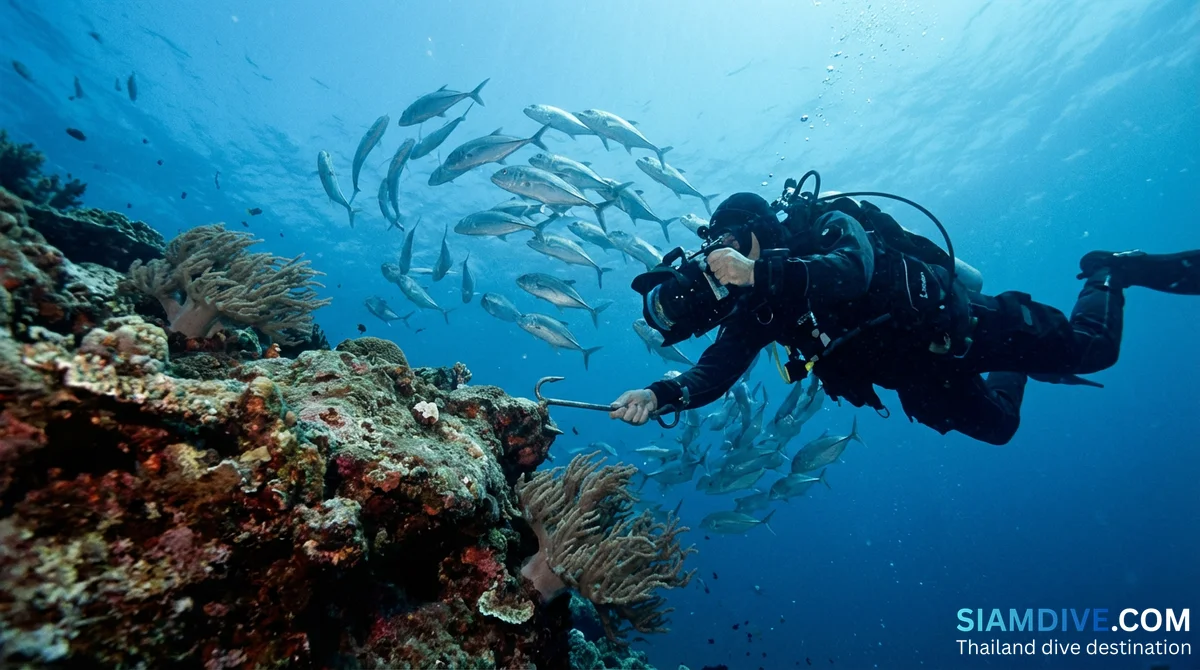
The response from Thailand's dive community has been practical and growing. The Environmental Justice Foundation (EJF) has organised cleanup dives in Chumphon, Rayong, and Chonburi provinces, where volunteer divers freed reefs of more than 300 kilograms of netting. Off Phuket, teams of roughly 20 divers conduct regular removal missions with cutting tools, collection bags, and data notebooks.
On the supply side, EJF has collected 130 tonnes of used fishing equipment from coastal communities along the Thai coastline and channelled it into recycling programmes — turning discarded nets into products like face shields and recycled-nylon textiles. A national net-buyback programme removed 100 tonnes in its first two years.
In the Similan Islands, national park divers recovered ghost nets tangled around deep-sea coral reefs, preventing further harm to dugongs, sea turtles, and dolphins that transit the area.
- EJF cleanup dives: 300+ kg of nets removed across 3 provinces
- Community collection: 130 tonnes of old gear recycled
- Net-buyback programme: 100 tonnes recovered in 2 years
- Citizen-science surveys: 606 ghost-gear items documented in one study
Ghost Gear in April 2026 — A Hidden Threat Resurfaces
In April 2026, Euronews ran a feature investigation calling ghost fishing gear "the hidden threat at the bottom of our seas and oceans," highlighting that despite decades of awareness, the volume of abandoned gear entering the ocean shows no sign of declining. The report underscored that current removal efforts — however heroic — cannot keep pace with the rate of loss.
For divers in Thailand, ghost nets are not an abstraction. They are something you encounter on a reef and either swim past or do something about. Reporting ghost-gear locations to dive operators and national park authorities is the minimum. Joining organised removal dives — with proper training, because cutting a loaded net underwater is genuinely dangerous — is the next step. And pressuring the fishing industry to adopt traceable, retrievable gear is the long-term solution that no amount of volunteer diving can replace.
A net with no owner is still a net. It does not care that nobody meant for it to be there. It catches what it catches, kills what it kills, and waits — on a reef that took a century to build — for someone to cut it free.
Sources
- Mongabay — Underwater citizen science reveals the spectre of ghost fishing in Thailand (January 2025)
- Science Advances — Global estimates of fishing gear lost to the ocean each year (2022)
- FAO — Abandoned, lost or otherwise discarded fishing gear
- EJF — Collecting and recycling ghost gear in Thailand
- Euronews — Ghost fishing gear: the hidden threat (April 2026)