64 Faces in a Database: How Koh Tao Tracks Every Hawksbill
12 พฤษภาคม 2569
Koh Tao's turtle database holds 64 hawksbill faces, each mapped by unique scale patterns. The same turtles return to the same reef ledges year after year.
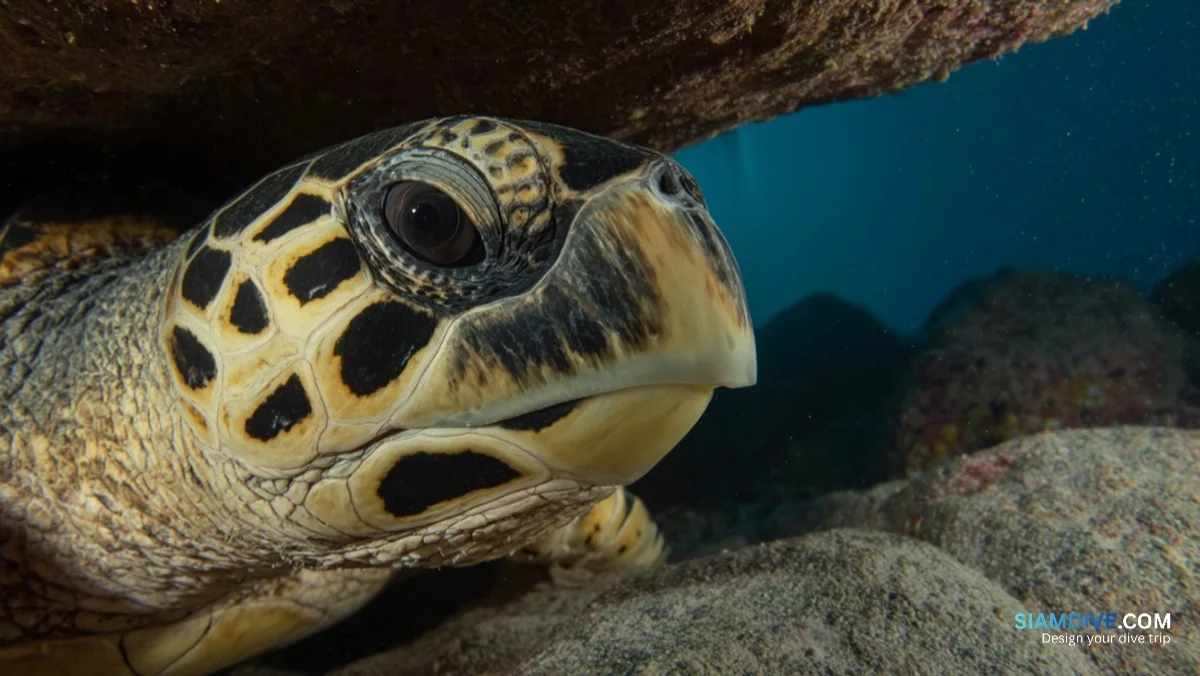
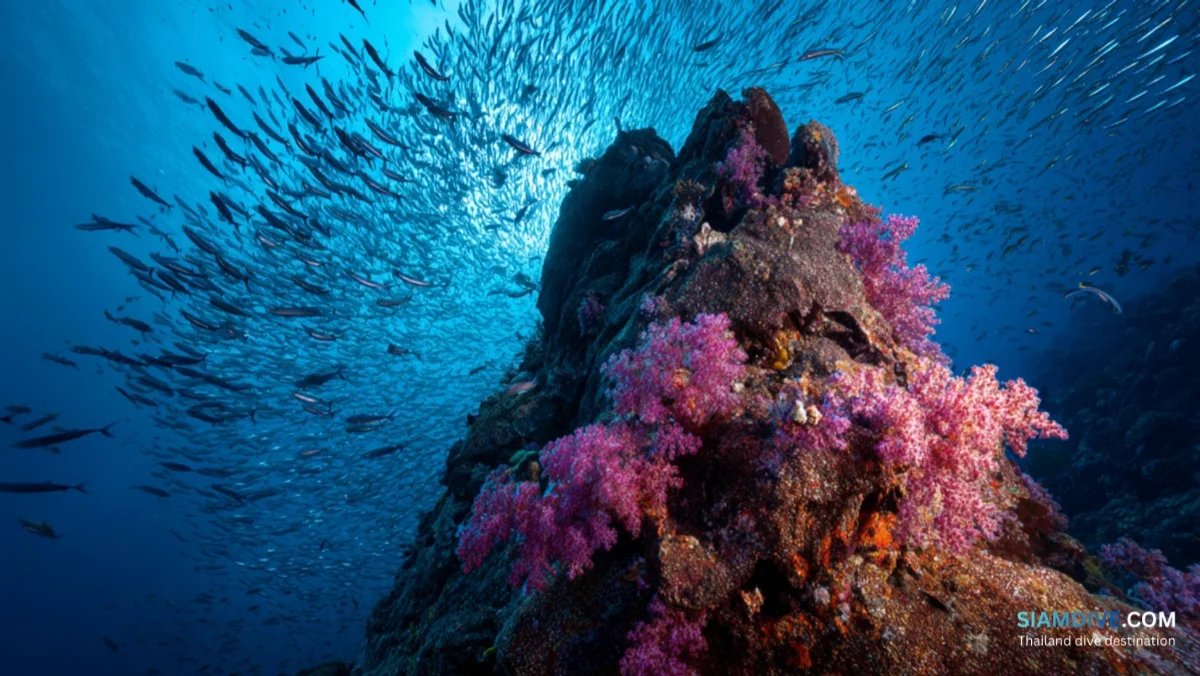
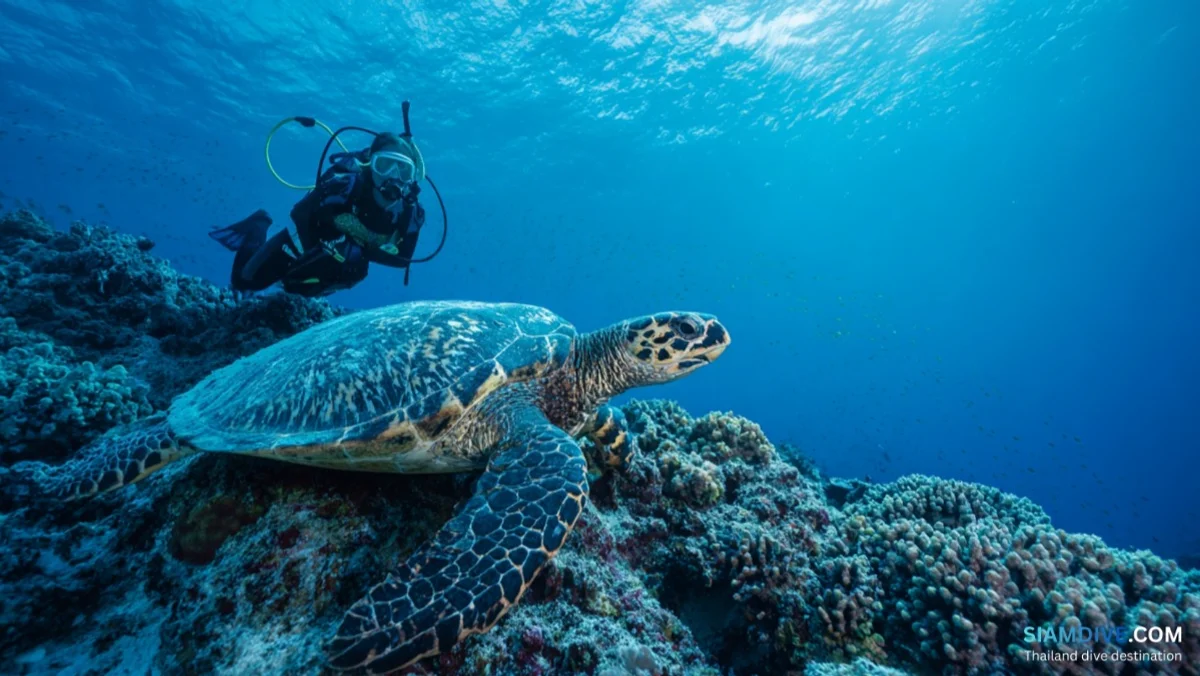
A metre-long hawksbill hangs motionless under a granite overhang at White Rock, her serrated shell flush against the stone. She has been photographed here — same ledge, same angle of approach — in January 2023, again in March 2024, and once more this past February. The conservation team that catalogues her did not need a flipper tag or a satellite transmitter. They needed one clear photograph of her face.
A Face Unlike Any Other
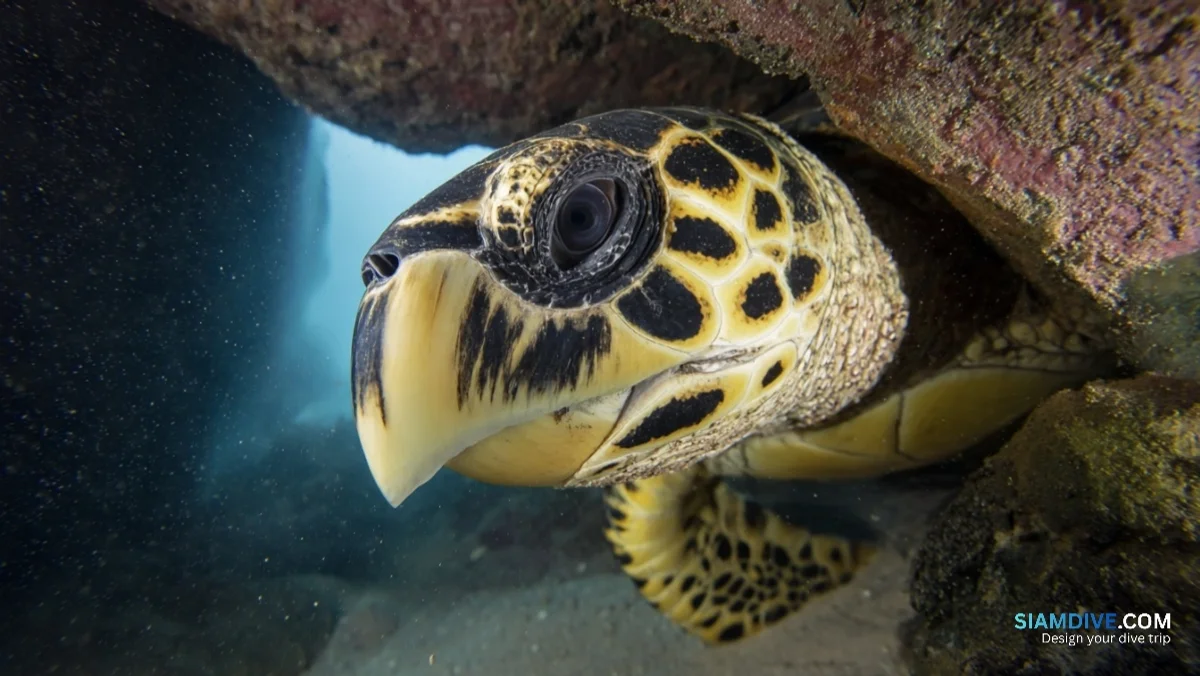
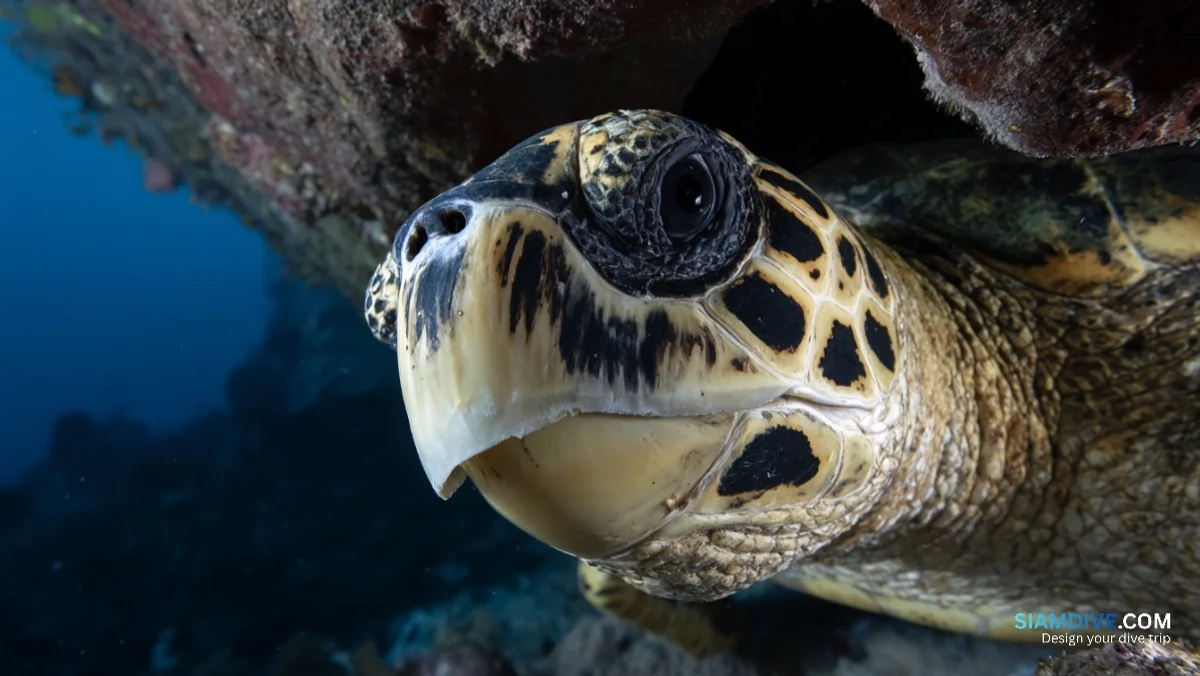
The scales on either side of a sea turtle's head form patterns as singular as a human fingerprint. No two hawksbills carry the same configuration of postocular and temporal scutes — the bony plates framing the eye and covering the temple. These patterns lock in during embryonic development and remain stable for at least four years in adults and at least 1,046 days in juveniles. A turtle photographed at seven kilograms carries the same facial map at seventy.
That permanence turns every well-lit photograph into a lifetime ID card. The computer-vision programme HotSpotter, tested against 2,136 hawksbill images, matched the correct individual on the first attempt 80 percent of the time and climbed to 91 percent within six guesses. A more recent algorithm treats each scale as a node in a spatial graph, mapping the geometric connections between them, and pushes recognition accuracy above 94 percent. The technology is open-source, the camera is already in the diver's hand, and the resulting data lasts as long as the turtle does.
Traditional flipper tags corrode in salt water, shed during growth, and require physical capture to apply. Satellite transmitters cost thousands of dollars per unit and deliver data for a single tracking season. A facial photograph costs nothing extra, causes no stress beyond a brief approach, and remains valid for the animal's entire lifespan — which in hawksbills can exceed fifty years.
64 Hawksbills, One Island
Before anyone thought to photograph a scute, the island already had its name: Koh Tao — Turtle Island — a granite speck in the western Gulf of Thailand. Community-led monitoring running since 2007 has built an identification database of the island's sea turtles: 101 individual greens, 64 individual hawksbills, and two olive ridleys. Each entry holds a file of dated facial photographs, GPS-tagged to the dive site where the encounter occurred.
Sixty-four may sound like a small number until it meets the global arithmetic. The IUCN classifies the hawksbill as Critically Endangered, with roughly 8,000 nesting females estimated worldwide. Thailand's inner Gulf historically supported between 9 and 42 nesting females per season. A handful of reliably returning individuals on a single island reef is not a footnote — it is a data set that conservation policy cannot afford to lose.
- White Rock — granite boulders and soft coral at 8–22 m; consistent hawksbill resting ledges on the western face
- Twins (Nang Yuan) — channel between pinnacles at 10–18 m; feeding and cleaning encounters year-round
- Hin Pee Wee — isolated rock at 12–25 m; hawksbills forage on encrusting sponge colonies along the north wall
- Shark Island — wall and boulder field at 8–28 m; resting ledges on the sheltered north side
- Aow Leuk Bay — shallow sandy reef at 3–14 m; juvenile hawksbills graze in the rubble zone
For a broader look at all five species found in Thai waters, see our sea turtle species guide for divers.
Why the Same Ledge?
The short answer is energy. A hawksbill that already knows where to sleep, what to eat, and how to navigate a reef patch burns fewer calories on exploration and banks the surplus for growth and reproduction. The long answer appeared in a 2025 paper in the journal Ecology, where Maurer and colleagues satellite-tracked 17 adult female hawksbills from three Western Atlantic nesting beaches and then re-tracked the same individuals the following year.
Of 15 turtles with sufficient data, 14 returned to the same foraging home range. The fifteenth shifted less than ten kilometres — roughly the length of Koh Tao's coastline. The mean distance between successive annual foraging centroids was 1.45 kilometres, a figure smaller than the positional error of many satellite fixes. In practical terms, a hawksbill's home address is precise enough to pin to a single reef outcrop.
Home ranges measured across global studies span 0.05 to 17 square kilometres, but core activity zones sit far tighter. Juveniles tagged and recaptured in Honduras strayed a mean distance of just 545 metres from their original capture point. At that scale, a diver returning to the same mooring buoy on consecutive mornings is almost certainly watching the same animal, not a lookalike drifting through. The fidelity is so consistent that researchers now treat a prolonged absence from a known site as evidence of mortality or displacement rather than wandering.
Sponge, Ledge, Repeat
Hawksbills are among the few large vertebrates that treat sponges as a dietary staple. In some Caribbean populations, sponge tissue accounts for more than 95 percent of gut content by volume. The bird-like beak — narrow, curved, hooked at the tip — evolved specifically for reaching into reef crevices and tearing sponge flesh from the substrate. Sponge colonies regenerate slowly, over months or years, which gives a hawksbill that has mapped a productive patch a powerful incentive to stay. Leaving means gambling on a reef where competition, predator corridors, and shelter quality are all unknown.
Shelter matters because hawksbills do not simply hover on the reef at night. They wedge themselves under ledges, inside small caves, or between coral heads, returning to the same resting spot with a consistency that borders on ritual. Field researchers at multiple sites report being able to predict exactly where a particular turtle will be sleeping at midnight — because it has used the same hollow for months or years running. Koh Tao's granite geology, with its blocky overhangs and fissured boulder fields, creates precisely the kind of stable architecture that hawksbills favour.
This double anchor — reliable food and trusted shelter — is what biologists call site fidelity. Green turtles show it too, but comparative tracking data from Aldabra Atoll in the Indian Ocean shows hawksbills maintaining tighter core ranges than greens on the same reef system. The hawksbill is not merely loyal to a reef. It is loyal to a particular corner of a particular rock. Other large marine species show similar attachments — manta rays return to cleaning stations with comparable precision — but few match the hawksbill's granularity.
From Photograph to Policy
Photo-ID does more than satisfy scientific curiosity. When a government agency draws a marine protected area boundary, it needs geographic evidence that the species it wants to protect actually lives inside the lines year-round, not just passing through on a migration corridor. A satellite transmitter delivers that proof for one animal over one season. A photograph delivers it for one animal over a lifetime — and it scales. Dozens of volunteer divers can submit usable images per week at zero marginal cost.
Koh Tao's database gives conservation planners exactly this: geographic proof that critically endangered animals are residents, not visitors, and that they depend on named reefs sitting within — or dangerously close to the edge of — the island's managed zones. Island conservation programmes have also invested in head-starting, raising five to 20 hatchlings per year in nursery conditions and releasing them at roughly 25 centimetres shell length, the threshold where their size gives them a far better chance against open-water predation.
Over nearly two decades, around 50 sea turtles have been released through the island's longest-running programme. The numbers are modest, but the photo-ID database is starting to close the loop: individuals first catalogued as juveniles have reappeared in later survey records as sub-adults, evidence that at least some released animals survive, adopt local reefs, and begin building the same ledge loyalty that defines the species. Healthy reef structure matters as much as the animals themselves — if seagrass beds decline or blast fishing damages the substrate, the ledges hawksbills depend on disappear with them.
What a Diver Needs to Know
The hawksbill resting under a ledge at White Rock barely flickers an eye as a diver passes overhead. Her shell — amber and brown tortoiseshell plates laid in overlapping rows — blends so deeply into the reef that many divers kick right past without noticing. The same beauty that camouflages her now is the reason her species was hunted nearly to extinction: those translucent, layered scutes were the raw material of the tortoiseshell trade for centuries.
Spotting one takes a slow, low approach along the base of a reef wall. Watch for the hooked beak protruding beyond a ledge edge, or the faint scratch marks where shell scutes have scraped the overhang's underside over repeated visits. Mid-May on Koh Tao, water temperatures hover around 28–30 °C and visibility regularly pushes 20–30 metres — conditions that make facial-scale photography feasible even with a compact camera or a phone in an underwater housing. Nesting season in the Gulf runs from roughly May through July, and while the turtles at dive sites are foraging residents rather than transient nesters, reef activity tends to pick up during these warmer months.
The photo that matters is not a full-body glamour shot. It is a clean, well-lit frame of either side of the head, taken from roughly one metre, without flash. That single image gives a monitoring team everything it needs to check the turtle against the existing database. Several citizen-science platforms accept submissions from recreational divers, and Koh Tao regulars who log the same sites month after month have become some of the most productive contributors to the island's growing dataset. The instinct that draws a diver back to a favourite site — familiarity, comfort, the quiet pleasure of recognition — turns out to be the same instinct the turtle follows.
The Ledge Will Outlast Us If We Let It
Sixty-four hawksbills in a database is not a recovery story. It is a headcount — precise enough to track who is here, who has gone, and who keeps coming back, but too thin to absorb many losses without demographic consequences. Every individual removed by boat strike, fishing-line entanglement, or reef degradation is a named gap in a dataset that has no margin for blanks.
The species staked its survival on loyalty: find a good reef, memorise its contours, return season after season, and trust that the rock will still be there. Photo-ID turned that loyalty into a research advantage. Whether the reefs hold up their end of the deal depends on the choices made by the humans who share them.
Sources
- Maurer et al. (2025) — Habitat fidelity in hawksbill sea turtles, Ecology
- NOAA Fisheries — Hawksbill Turtle species profile
- Sea Turtle Facial Recognition Using Map Graphs of Scales — bioRxiv
- Marine Biology — Site fidelity of sea turtles at Aldabra Atoll (2024)
- Olive Ridley Project — Hawksbill Turtle conservation status